“Sveta came back to get money for her mother-in-law’s anniversary celebration and heard through the door: ‘We’ll transfer the apartment tomorrow.’ At the party, she pulled out a single folder.
Sveta opened the apartment door with her key and immediately sensed that something was wrong.
The light was on in the hallway. The air smelled of unfamiliar perfume—cloyingly sweet, like candied drops. On the mat by the door stood a pair of shoes she had never seen before: burgundy, with gold buckles and high heels. Beside them were men’s shoes polished to a shine, the kind no one in their household ever wore.
Sveta stepped inside and quietly closed the door behind her. Her heart was pounding somewhere in her throat, the beat echoing in her temples. She had come home just an hour before her husband so she could change before the anniversary celebration for her mother-in-law, Raisa Petrovna, who had ordered her to show up “properly dressed,” otherwise she would disgrace the family in front of the guests.
There were a little less than two hours left before the celebration. But voices were coming from the kitchen. Two voices. One definitely belonged to her husband, Dima. The other was low and raspy, and Sveta did not recognize it.
She took off her shoes and, walking on tiptoe and trying not to make the floorboards creak, crept closer to the kitchen. The door was open just a crack. Through the gap she could see part of the table, a checkered tablecloth, and Dima’s arm with his sleeve rolled up. Another hand, wearing a massive signet ring on the index finger, pushed a folder toward him.
“The apartment is yours. All you have to do is sign,” the raspy voice said. “The owner is ready to move out in a month. He’ll clear everything out, down to the last nail.”
“And Sveta?” Dima leaned back in his chair. Sveta could not see his face, but from his tone she understood that he was smiling. “She won’t find out anything until the paperwork is finished anyway. Mother will make sure of that.”
“Just don’t drag it out. The buyer is getting nervous—he needed that apartment yesterday. The money, as you understand, is in cash. Your mother gets a share, but tell her to keep her mouth shut. Women talk too much.”
Sveta froze.
A chill ran down her spine, and her fingers gripped the strap of her handbag so tightly that her knuckles turned white.
The apartment.
That very apartment she had inherited from her grandmother five years earlier. The apartment where she and Dima had lived after their wedding, where their son Alyosha had been born, where every scratch on the parquet floor felt familiar and dear to her. And now her husband—her Dima—was sitting calmly in the kitchen discussing the sale of that apartment as though they were talking about a sack of potatoes.
Continued in the comments.”
Sveta pushed open the apartment door with her key and immediately felt that something was wrong.
The light was on in the hallway. The air smelled of someone else’s perfume—cloyingly sweet, like candied drops. On the mat by the door stood a pair of unfamiliar shoes: burgundy, with gold buckles and high heels. Beside them were men’s shoes polished to a shine, the kind no one in their home ever wore.
Sveta stepped inside and quietly closed the door behind her. Her heart was pounding somewhere in her throat, throbbing in her temples. She had come home just an hour earlier than her husband so she could change before the anniversary celebration of her mother-in-law, Raisa Petrovna, who had ordered everyone to arrive “properly dressed,” otherwise they would embarrass the family in front of the guests.
There were a little less than two hours left before the celebration. But voices were coming from the kitchen. Two voices. One definitely belonged to her husband, Dima. The other—low and hoarse—was unfamiliar to Sveta.
She took off her shoes and tiptoed toward the kitchen, trying not to make the floorboards creak. The door was open just a crack. Through the gap she could see part of the table, the checkered tablecloth, and Dima’s arm with his sleeve rolled up. Another hand, wearing a large ring on the index finger, slid a folder toward him.
“The apartment is yours. You just have to sign,” the hoarse voice said. “The owner is ready to move out in a month. He’ll clear everything out, right down to the last nail.”
“And Sveta?” Dima leaned back in his chair. Sveta couldn’t see his face, but from his tone she could tell he was smiling. “She won’t find out anything until the documents are finalized anyway. Mother will take care of that.”
“Just don’t drag it out. The buyer is getting nervous. He needed that apartment yesterday. The money, as you understand, is cash. Your mother gets her share, but tell her to keep her mouth shut. Women talk too much.”
Sveta froze.
A chill ran down her spine, and her fingers gripped the strap of her handbag so tightly that her knuckles turned white.
The apartment.
That very apartment she had inherited from her grandmother five years earlier. The apartment where she and Dima had lived after their wedding, where their son Alyosha had been born, where every scratch on the parquet floor felt familiar and dear to her.
And now her husband—her Dima—was sitting calmly in the kitchen talking about selling that apartment as though they were discussing a sack of potatoes.
“So tomorrow at the notary’s?” Dima asked in a businesslike tone. “You understand, tonight we’ve got this anniversary party. Mother decided it would be the perfect moment: everyone will be there, Sveta will be with her parents, lots of hugging and crying. You come by in about two hours. You’ll get a look at her.”
“Well, good luck to your family,” the guest chuckled. “Fighting with your mother-in-law is the last thing anyone needs.”
“She’s not my mother,” Dima cut him off. “My mother is sacred.”
Sveta stepped backward once, then again. Her back hit the wall.
The voices from the kitchen blurred together. Her ears were ringing. She couldn’t remember how she got to the bedroom, how she opened the wardrobe, or how she pulled out the first blouse she found. Her hands moved automatically while her mind replayed what she had heard over and over.
“The apartment is yours. You just have to sign.”
In ten years of marriage, Dima had not lifted a finger to earn that apartment. Sveta had received it through her grandmother’s will after she passed away. Her mother had paid for the renovation, and the furniture had been bought with Sveta’s savings. Dima only contributed to the utility bills—and even then he forgot half the time.
And now it turned out his family had their own plans for Sveta’s property.
Her phone vibrated inside her handbag.
Sveta pulled it out with trembling hands.
A message from Raisa Petrovna:
“Sveta, where are you and Dima? The guests are already arriving! Have you decided to humiliate me in front of everyone?”
Sveta exhaled and typed back:
“We’re on our way.”
Then she sat on the bed and closed her eyes for a second.
Stop.
No panic.
Sveta had always considered herself a calm person. But now a fury was boiling inside her unlike anything she had ever felt before.
They had decided simply to erase her from her own life.
And they were going to do it under the guise of a celebration—with cake, guests, and toasts.
There was a rustle in the hallway. Apparently, the visitor was leaving.
Sveta sprang to her feet but did not leave the bedroom. Instead, she silently pulled the door almost shut and stood behind it, listening.
“All right, I’m off,” the hoarse voice said. “Tomorrow at eleven. Get the documents ready. Make copies of the passports.”
“Will do,” Dima replied.
The front door slammed.
Then the lock clicked.
Almost immediately, Sveta heard the rustle of Dima handling his phone. She heard him dial a number.
“Mom? Yeah, he’s gone. Get ready, everything will be settled tonight… Sveta? What about Sveta? She’ll come like a good girl. I couldn’t find the main document at home, but it’s only a matter of time… Don’t shout, Mom. It’ll turn up. Women hide all their documents in cupboards when they get upset… I’ll check Alyosha’s drawer. She stuffs everything in there… Yes, I understand! She won’t find out anything…”
Sveta stood pressed against the wall, listening to her husband discuss a plan to strip her of control over her own home.
Goosebumps ran across her skin.
So it wasn’t only her mother-in-law.
Her husband, Dima, had apparently been on his mother’s side all these years.
She remembered Raisa Petrovna smiling at their wedding, hugging her and calling her “my daughter.” She remembered how, only a month after the marriage, her mother-in-law had first suggested that they should “transfer the apartment into the family’s name—it would be safer that way.”
At the time Sveta had brushed it off.
Mothers-in-law and daughters-in-law always had conflicts, she had thought. Ordinary friction. Eventually they would get used to each other.
They never did.
Dima finished the call and headed toward the bedroom.
Sveta rushed to the wardrobe, hugged the blouse to her chest, and pretended to be sorting through clothes.
The door opened.
“Oh, you’re already home!” Dima smiled as if they were meeting after a long separation. “I see you’re not ready yet. Mother keeps calling nonstop. She says the guests are waiting.”
“Dima,” Sveta said, turning toward him.
Her voice was steady, though everything inside her was trembling.
“Who just left our apartment? I heard voices.”
Her husband hesitated.
For a fraction of a second, something sharp flashed in his eyes, but it immediately disappeared behind his usual smile.
“Just a friend. He stopped by for a minute to congratulate me. You don’t know him.”
“Congratulate you about what?” She looked directly into his eyes. “Is something happening? Maybe you decided to surprise me?”
“Mother said she has some important news for us.” Dima had already turned away and was buttoning his shirt. “Maybe she decided to give us a car. Or something else.”
Sveta said nothing.
“Give us” something.
Or force her to sign something.
For the rest of the hour before the anniversary celebration, Sveta got ready as if in a fog. She pinned up her hair, put on makeup, and chose a severe burgundy blouse that matched her thoughts—the color was almost identical to the unfamiliar shoes she had seen in the hallway.
As though it were a sign.
A plan pounded through her mind: go to the party, see what her mother-in-law had prepared, then quietly leave, pick Alyosha up from kindergarten, and go to her mother’s house.
But the more Sveta thought about it, the more clearly she understood that she couldn’t run away.
Running would only confirm that she was weak, that they could fool her and get away with it.
She needed a weapon.
Not a physical one, but something capable of protecting her and her son.
And she had one—the will bearing the notary’s signature.
Sveta knew exactly where it was. But judging by Dima’s phone conversation, he was searching for that document too. If he found it first, he might destroy it, manipulate the paperwork, and turn everything against her.
Sveta looked into Alyosha’s room.
In the bottom drawer of his desk was a plastic envelope containing the documents for the apartment.
She slipped it into her handbag and covered it with a scarf.
Then she quickly went into the hallway.
“What’s taking you so long?” Dima called from the kitchen. “We’re going to be late!”
“I’m coming.”
They arrived at the restaurant where Raisa Petrovna’s anniversary was being celebrated exactly on time.
The tables were overflowing with appetizers, and the air rang with clinking glasses and laughter.
Her mother-in-law sat at the head of the table like a queen—in a scarlet dress, her hair piled high, massive beads sparkling around her neck.
The moment she saw Sveta, she threw up her hands and drew everyone’s attention.
“And here is my daughter-in-law! A daughter-in-law with a heart of gold, by the way!”
Then she leaned toward Sveta and hissed through her teeth without losing her smile:
“You’re late. I was already beginning to think you’d forgotten my special day again.”
“I’m sorry,” Sveta replied just as quietly, looking directly into her eyes. “Traffic.”
Most of the people around the table were strangers to Sveta: distant relatives, family friends, some important-looking elderly guests.
Only Sveta’s mother, Nadezhda Ivanovna, sat modestly to one side, nervously twisting a napkin in her hands.
She was the only person who caught her daughter’s gaze and immediately understood that something was wrong.
The first hour passed relatively peacefully.
The guests ate and gave toasts. Sveta smiled, nodded, and pretended she was enjoying herself.
But inside, everything was winding tighter and tighter like a spring.
Across from her sat her sister-in-law, Dima’s sister, who kept giving Sveta long looks. Once she even smirked into her wineglass.
After the main course, Raisa Petrovna tapped a fork against her glass.
“My dears!” Her voice rang through the hall. “I’m a simple woman, but today is a special day for me. And not only because it’s my anniversary. I want to announce something that will bring great joy to the whole family.”
Sveta tensed.
Under the table, she quietly tightened her grip around the strap of her handbag, where the envelope containing the documents lay.
“My son, my pride,” her mother-in-law continued, pointing toward Dima, “is finally returning to the family what has belonged to it for a long time.”
The room went quiet.
Sveta heard her mother whisper from across the room:
“What? Returning what?”
“Dima and I discussed it,” Raisa Petrovna raised her voice, “and we decided that the apartment where the young family currently lives rightfully ought to belong to him. It is our family hearth. Our nest. And today, on this solemn occasion, Sveta, as a good daughter-in-law, will sign the papers and return the apartment to our family.”
Sveta sat motionless.
It felt as though the air itself had frozen.
Then she turned very slowly toward her husband.
“Dima,” she said. “Is that true? You decided this?”
Her husband cleared his throat, avoiding her eyes.
“Well, what’s wrong with it? It’s logical. The apartment came from your grandmother, and your grandmother was yours, not mine. So, to be fair, it’s sort of…”
“Sort of what?” Sveta interrupted. “I didn’t steal it. I inherited it. Before we were married. And as far as I remember, you had no objection to living there.”
“Well, look at the attitude on our daughter-in-law!” her sister-in-law snorted loudly. “Mom, I told you! See who you welcomed into the family.”
“Be quiet,” Raisa Petrovna snapped without taking her eyes off Sveta. “Svetochka, I don’t want to offend you. But family is family. Respect is sacred. And our family, by the way, has been living in discord ever since you became part of it.”
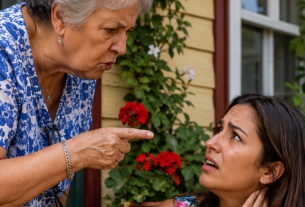
“Are you talking about yourself?” Sveta stood up from her chair. “About how after Alyosha was born you never said one kind word to me, only criticized me: ‘You don’t have enough milk, he’s too thin, you’re holding him wrong’? About how you suggested I transfer the apartment to you because ‘a young daughter-in-law doesn’t understand business matters anyway’?”
“You see, dear guests,” her mother-in-law spread her arms, “I tried to teach her. And this is the result. Toxicity toward the family. She has ‘personal boundaries’!”
Suddenly Sveta laughed.
The laugh came out nervous, but free.
“Personal boundaries,” she repeated. “You don’t even know what those are. Fine. I’ll sign.”
A murmur of surprise swept around the table.
Sveta’s mother, Nadezhda Ivanovna, clutched her chest.
“Sveta, what are you doing?” she gasped.
“I’ll sign,” Sveta repeated firmly, looking around at the guests. “But first I’ll read one little clause.”
She pulled the envelope from her handbag and took out a sheet of paper folded in half.
Her hands were no longer trembling.
She held the will in front of her like a shield.
“‘The apartment located at the address… shall pass into the full ownership of Svetlana Andreevna. In the event of a division of property or attempts to transfer ownership without the voluntary consent of the owner, all rights to the property shall remain with her. This document has been notarized.’ There’s the seal. There’s the signature.”
She turned toward Raisa Petrovna.
“Is this what you were looking for? This piece of paper? Dima searched the entire apartment for it. He told you on the phone that ‘it’ll turn up, it’s only a matter of time.’ Well, here it is. I always kept it in my bag. You just didn’t know where to look.”
The hall became deathly quiet.
One of the distant relatives coughed.
Her sister-in-law lowered her eyes.
Dima turned white, and beads of sweat appeared on his forehead.
“You… you were listening?” he croaked.
“You didn’t want me to know?” Sveta shook her head. “Ten years, Dima. Ten years I washed your shirts, cooked your meals, helped Alyosha with his lessons. I thought we were a family. And behind my back, you were selling my home like some market trader.”
“Sveta, I can explain everything…”
“No,” she cut him off. “There’s nothing to explain.”
Raisa Petrovna jumped to her feet.
Her cheeks were covered in red blotches.
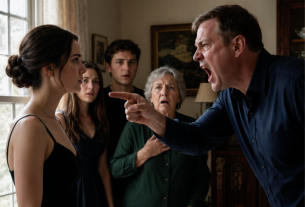
“Don’t you forget yourself, young lady!” she shrieked. “I was the one who welcomed you into my home! I let you sit at my table like a human being!”
“Apparently, you never considered me one,” Sveta replied calmly. “You treated me like a servant all these years. An outsider of a daughter-in-law you could carve up and throw away. But here’s the problem—I’m not an outsider. I’m your son’s wife. And I’m the mother of your grandson. But if those words mean nothing to you, then you never should have called me family.”
At that moment, an elderly woman sitting in the far corner stood up.
Sveta did not immediately recognize her. The guest was modestly dressed in a gray knitted cardigan.
She walked toward the table, raised her glass, and quietly said:
“Forgive me for interfering. My name is Maria Trofimovna. I’m a caregiver at the kindergarten Alyosha attends.”
Sveta looked at her in surprise.
She had seen the woman at kindergarten before but had never spoken to her.
“I’m here by chance, as a friend of a distant relative,” the caregiver continued. “But I heard more than I was supposed to. Three days ago there was a rehearsal in the music room, and Raisa Petrovna was waiting for the director with some man. They were sitting behind the curtain discussing how they were going to force Svetlana Andreevna to sign the apartment papers. The man said, ‘If necessary, she can live with her mother—her mother has a dacha.’ And he also said, ‘We’ll find another kindergarten for the child based on his new place of residence.’”
Maria Trofimovna turned toward Raisa Petrovna.
“So you could say I witnessed the discussion. And as someone who has spent three years teaching Alyosha how to draw snowflakes and make little hedgehogs out of clay, I cannot remain silent.”
Sveta looked at her and felt tears rise in her eyes.
Not from anger.
From relief.
There he was—an unexpected ally.
An ordinary kindergarten caregiver.
A stranger who had turned out to be closer to her than her husband’s own family.
“Thank you,” she whispered.
Raisa Petrovna opened her mouth to respond, but another guest rose from the table—an elderly man with a cane.
Sveta knew him only as some distant relative’s uncle.
“Allow me,” he said. “There appears to be another detail in this story. Raisa Petrovna, wasn’t it you who took out a loan two years ago using your dacha as collateral? And, if I’m not mistaken, you haven’t paid it back. I deal with banks professionally—to put it simply, I’m a lawyer.”
Her mother-in-law went pale.
“That’s none of your business!”
“I think it very much is,” the lawyer replied calmly. “So it turns out you needed your daughter-in-law’s apartment to pay off your debts. That’s the whole motive. So much for ‘family justice.’”
The room erupted with noise.
Guests whispered to one another and shook their heads.
Dima sat with his head lowered toward his chest.
His sister quietly began to cry—it seemed she hadn’t known the whole truth either.
Sveta took a breath.
She could feel solid ground returning beneath her feet.
But the most important confrontation was still ahead.
“Dima,” she called quietly. “Did you know about the dacha?”
Her husband did not answer.
He only squeezed the fork in his hand so tightly that his fingers turned white.
“I see.” Sveta smiled bitterly. “Mama’s boy. You’ve belonged to your mother your whole life. And you wanted to turn me into a convenient wife who would sign whatever paper you put in front of her and then hide quietly in a corner.”
“Sveta, I wanted what was best,” he muttered. “Mother said we’d transfer it temporarily so she wouldn’t lose the dacha. Then we’d transfer everything back.”
“Transfer what back?” she scoffed. “You’d already decided I could live with my mother. You’d already decided Alyosha would change kindergartens. You didn’t want what was best, Dima. You wanted your mother to be happy.”
Nadezhda Ivanovna walked over to her daughter and took her hand.
The elderly woman was pale, but she was smiling.
“Let’s get out of here,” she said quietly. “Enough. You’ve already endured too much.”
Sveta nodded.
Then she looked around at the guests.
“I’m sorry for making a scene. But you deserve to know the truth. Your birthday woman,” she nodded toward Raisa Petrovna, “isn’t a mother-in-law. She’s a corporate raider in a dress. And if you have daughters, sisters, or granddaughters, protect them from families like this.”
She turned toward the exit.
Behind her, her mother-in-law gasped loudly and glasses clinked.
But Sveta did not look back.
In the car, Sveta finally exhaled.
Her phone was exploding with messages. Dima kept writing that he would fix everything, that he had finally seen himself from the outside, that only now did he understand what he had done.
Her mother, sitting beside her, took her hand.
“My daughter, I’m so proud of you,” Nadezhda Ivanovna whispered. “You endured things for so long that even I forgot how brave you are.”
“Mom,” Sveta smiled through her tears, “I forgot too.”
That evening she picked Alyosha up from kindergarten.
The boy ran into the changing room waving a drawing.
“Mom, look! I drew our home!” He pointed at the yellow roof, green trees, and a large window. “And Aunt Maria Trofimovna said I have the brightest home in the whole world.”
Sveta crouched down, hugged her son, and buried her face in his hair.
“She’s right,” she said. “Because we live there.”
That evening, after putting Alyosha to bed, Sveta sat in the kitchen.
The plastic envelope lay on the table in front of her.
She opened it slowly.
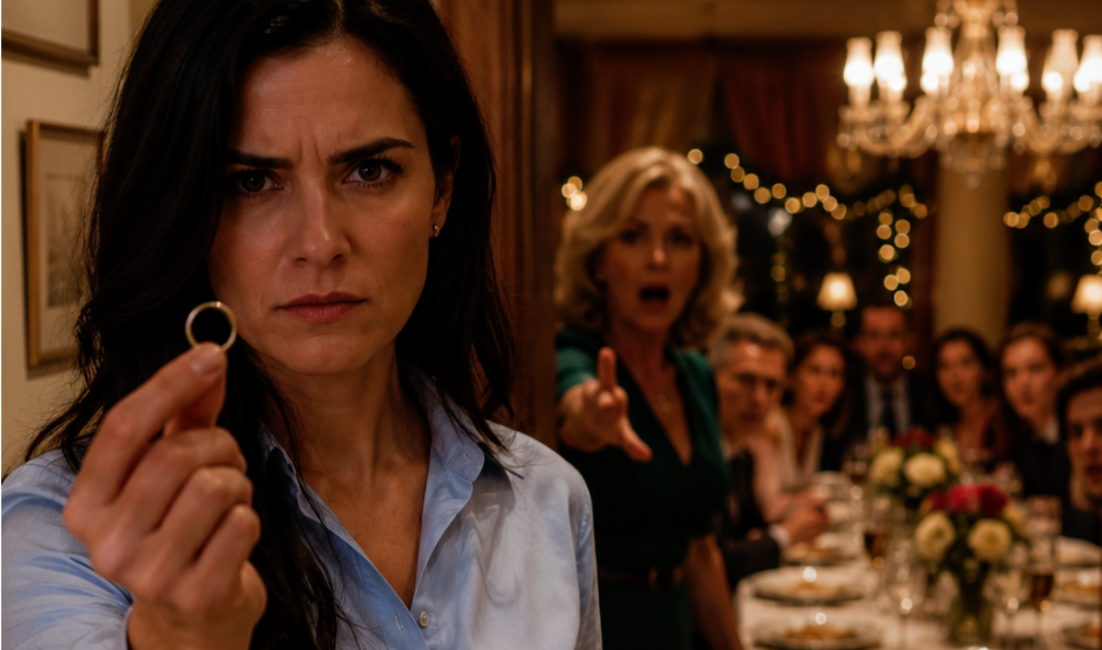
Inside, among the papers, was a wedding ring.
An old one that had belonged to her grandmother, with the engraving slightly worn away.
Sveta slipped it onto her finger.
Before, it had always seemed heavy, like a cast-iron yoke.
Now it felt light—as light as a promise she had made to herself.
She still didn’t know what she would do about Dima.
Forgiving such a betrayal seemed impossible. Divorce was frightening. Living together in the same apartment was unbearable.
But the most important thing had already happened:
She had finally stopped being convenient.
She had stopped being afraid of her mother-in-law and her husband.
She had stopped believing that family meant allowing people to use you.
“Thank you, Grandma,” she whispered, closing her hand around the ring. “You saved me even from there.”
In the next room, Alyosha slept peacefully.
The kettle hummed softly on the stove.
The lights of the evening city glowed outside the window.
Everything was still uncertain, fragile, unresolved.
But for the first time in ten years, Sveta truly felt at home.