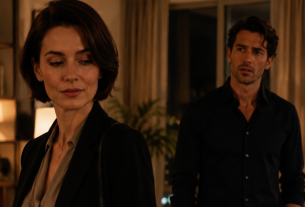
«If you don’t sign these papers at the notary tomorrow, you can forget that you even have a husband.»
Roman was standing in the bedroom doorway, clinging to the frame as if someone had just told him all hope for humanity was lost. He wore the shirt he always picked when he wanted to look important—a light one with rolled-up sleeves. He always rolled them up on purpose, believing it made him look more businesslike.
Olga sat at the edge of the bed, taking off her tights. One leg was free, the other stuck. She glanced up at her husband, then went back to fiddling with her tights.
«Forget about having a husband,» she repeated calmly. «But what about my last name—do I need to change it? Or should I keep it for convenience on the documents?»
Roman’s face turned crimson. This was his trump card in any argument—he could flush red all the way to his hair roots in seconds, and usually, it was intimidating. But Olga had figured out this move in the first year of their marriage and had long since stopped reacting to it.
Of course, it all started with the apartment—or more specifically, with the inheritance.
Olga’s mother-in-law, Tamara Vikentyevna, had always believed the world owed her—attention, respect, priority in lines and in life. Sixty-three years old, with her hair perfectly styled each morning, lipstick a ripe cherry shade, and a voice sharp enough to cut glass whenever she chose.
The four of them lived together in Tamara Vikentyevna’s old apartment—a three-room place in a brick building she’d inherited from her own parents. Olga and Roman took the room at the far end, Tamara claimed the largest one with the balcony, and the third room was the so-called «living room»—although no guests had set foot in it for years.
A year and a half ago, Olga’s grandmother passed away. Olga hated that word and to herself would say, «my grandmother is gone.» Her grandmother left her a one-bedroom apartment on the other side of the city—small, but filled with light, with new windows and a fresh renovation that she’d done herself just a couple of years before she passed.
Olga inherited the apartment as per her grandmother’s will. She handled everything by the book: the notary, the certificate of inheritance, the registry extract. The apartment became her own property. And that’s when something broke in the family.
At first, Tamara Vikentyevna was thrilled. She went around the kitchen, musing aloud about how well everything was turning out.
«Well, that’s great,» she’d say, stirring her soup. «Now the young ones will have something to inherit. Our family has two apartments now. Rich folks!»
Olga kept quiet then. The word «our» grated on her, but she chalked it up to her mother-in-law’s way of speaking. Tamara loved blending everything into a common pot—»our money,» «our family,» «our apartment.» The truth was, she only ever pooled what belonged to others. Her own things Tamara kept separate, literally under lock and key—a vintage wardrobe with a little key stood in her room, and no one knew what she kept inside.
Eight months went by. Olga decided to rent out her one-bedroom apartment. She found a quiet married couple, signed a lease, and the twenty-two thousand rubles per month went straight to their joint account. From there, half was used for utilities on the three-bedroom and groceries for everyone. Olga didn’t hold anything back—she felt it was only fair to contribute equally to their shared home since everyone lived under the same roof.
Roman worked—if you could even call it that. He was technically employed as a manager at a construction materials company, but his salary barely covered his own gas and lunches. Everything else in the household rested on Olga’s shoulders. She’d worked as an accountant at a transport company for twelve years, knew the value of every penny, and could add up columns faster than a calculator.
And then, last Tuesday, everything truly began.
Olga came home from work, took off her shoes in the hallway, and hung up her coat. Voices drifted from the kitchen—her mother-in-law and Roman were whispering about something. The moment Olga walked in, they fell silent a little too abruptly. Tamara Vikentyevna suddenly busied herself at the stove, and Roman buried his face in his phone.
“What’s going on?” Olga asked, placing her bag on the stool.
“Nothing at all,” her mother-in-law chimed in. “Are you hungry? I made cutlets. Your favorites.”
Olga grew suspicious. The ‘your favorite’ cutlets only ever appeared when someone wanted something from her. Twelve years in, she knew that signal by heart.
The real conversation came that evening. Roman came into the room, sat down on the bed next to her, and started talking around the subject.
“Ol, I was thinking… we really should get everything sorted out. Like a real family.”
“Sort out what?”
“Well, the apartments. Mom’s worried. She says, what if something happens to her, and there’s no clear inheritance, it’ll all turn into arguments and court battles. She just wants everything to be fair. Done the right way.”
Olga put her book aside.
“Roma, we don’t have any disputes. The three-bedroom is your mom’s, the one-bedroom is mine. Life itself has divided everything already.”
“Exactly!” Roman perked up. “And Mom wants to make it official. Legally. So there are no questions later on. She wants us to go to the notary tomorrow and re-register the one-bedroom.”
Olga slowly sat up straighter.
“Re-register it to whom?”
Roman hesitated, picking at a seam in the bedspread with his finger.
“Well… to Mom. Temporarily. She says it’s safer that way. She’s the head of the family, she has experience. And later, when necessary, she’ll give it back. Or maybe transfer it to both of us. Whatever we decide.”
An awkward silence filled the bedroom. The TV was murmuring on the other side of the wall—her mother-in-law was watching an evening talk show, but Olga was pretty sure the volume was low and Tamara Vikentyevna was listening in on every word.
“Roma,” Olga said very calmly. “You’re asking me to sign over the apartment my grandma left me to your mom. Do I have that right?”
“There’s no need to say it like that. Not ‘sign over,’ but ‘make it official as a family matter.’ That’s not the same thing.”
“It’s exactly the same thing, Roma. Only one of those phrases doesn’t have a bad smell.”
Roman started turning red again.
“You always make things so complicated! Mom treats you like her own daughter and you…”
“Like her own daughter,” Olga interjected. “That must be why your dear mother wants to take my apartment. Out of her deep love for her daughter, I’m sure.”
The conversation was abruptly cut short. Roman slammed the door and went off to complain to his mother. A minute later, an indignant voice echoed from the kitchen – Tamara Vikentyevna wasn’t just speaking, she was proclaiming, with all the confidence of a newscaster who knows she is always right.
At breakfast the next morning, my mother-in-law launched her attack. She placed a cup of tea in front of Olga, sat down across from her, folded her hands neatly on the table, and gave her a look filled with the sorrow of the universe.
«Olenka,» she began softly, in that tone that always made Olga’s teeth clench. «I didn’t sleep all night. I kept thinking about you and Roma. You’re both so young, so inexperienced. And life is just so unpredictable. I only want one thing – for you both to be okay. For you to be protected.»
«Tamara Vikentyevna, I am protected. I have an apartment, a job, and a good head on my shoulders.»
«Oh, a head!» Her mother-in-law threw up her hands. «A head is wonderful, but paperwork is better. Tell me, what if something happens to me? Where will you two go? But if the apartment is in my name, I can guarantee you a roof over your head. I’m your mother. I’d never abandon you.»
Olga took a sip of tea. The logic of her mother-in-law was perversely flawless: to avoid being left without a home, Olga was being asked to willingly hand over her own. It was like being told to chop off your hand so your fingers don’t get cold.
«Tamara Vikentyevna,» she replied, «what if nothing happens to me, and the apartment is in your name? Where will I go then? Not with my own apartment, but with yours?»
Her mother-in-law was caught off guard for a moment, but quickly regained her composure.
«How can you think that way! I only want the best for you! My dear, you’re crushing me with these suspicions. I care for you like my own daughter, and yet…»
And then began what Olga had come to call the ‘greatest hits performance.’ Tamara Vikentyevna was a master of playing for sympathy. She reminisced about raising Roma alone, denying herself everything, going hungry so her son could have the best. She reminded everyone of her illnesses – heart, blood pressure, joints. Of how she didn’t have long, and wanted to get things sorted decently before she was gone. Roman sat beside her, nodding along in rhythm like a little bobblehead.
Olga listened in silence. She knew: any word could be used against her. Speak up, and she would be accused of disrespecting her elders. Agree, and the apartment would be gone by evening.
«I’ll think about it,» she finally said, just to end the spectacle.
Her mother-in-law beamed with delight.
«That’s my smart girl! I knew you were reasonable. We have an appointment at the notary tomorrow at eleven – I already booked it.»
Already booked. So the decision had been made for Olga before the conversation even started. All that was left was to force her signature.
All day, Olga felt out of sorts. Not because she was undecided – she had no intention of signing anything, no matter what. But because she sensed something was wrong. Her mother-in-law was moving too quickly. Everything was too perfectly arranged. People don’t rush to the notary out of love. You go to the notary when you have a plan.
And that evening, she finally heard what that plan was.
Olga stayed late at work finishing the quarterly report and got home later than usual. She slipped in quietly, opening the door with her own key. The hallway was dark, but light and voices spilled from the kitchen. Her mother-in-law was on the phone, talking loudly enough for the whole apartment to hear — she always acted like the person on the other end was half deaf.
Olga froze in the entryway, still in her shoes.
«…Don’t worry, Lida,» Tamara Vikentyevna was saying. «We’ll get it all sorted tomorrow. As soon as the apartment is in my name, I’ll put it up for sale. My realtor has already found a buyer, just waiting for the papers. I’ll sell it and pay off your Valerka’s debt like I promised. With interest, all fair and square.»
Olga held her breath. Lida was her mother-in-law’s friend, and Valerka, her son, was involved in some shady business that the family only whispered about.
«And my daughter-in-law?» her mother-in-law’s voice grew sharper. «Oh, she’ll have no choice. Roman will talk her into it — he knows how. And if he can’t, I’ll pressure her myself. I’ll say I’m sick, dying, that it’s my last wish. Guilt always works, Lida, it never fails. She’s a soft one, she’ll cry a bit and sign.»
A pause. Her mother-in-law laughed — short and satisfied.
«Come on, like anyone’s going to give it back! Once it’s sold, the money is mine. Whatever’s in writing is what counts — paper can handle anything. I’ll tell Roman I invested it, and when we’re rich, we’ll buy him and his wife a new place, better than before. He’ll believe me, he’s so trusting. And my daughter-in-law… well, she’ll make a fuss, then get over it. She won’t divorce him over a little apartment. She loves her husband, she won’t go anywhere.»
Olga stood in the dark hallway, leaning against the wall. Roman’s jacket hung on a hook nearby, his shoes underneath — he never put them away. Car keys were on the table; the insurance for that car was paid by Olga, since Roman was ‘having money troubles for now.’
She didn’t feel angry. Anger is for when you’re caught off guard. Nothing about this was a surprise. Everything Olga had vaguely suspected these last few days was just spoken aloud now, clearly and without shame. It was as if someone finally read out a message that’s been on the wall forever, which everyone pretended not to notice.
The worst part wasn’t even her mother-in-law — at least she acted openly, if twisted in her own logic. The real horror was knowing: Roman knew everything. He knew about the realtor, Valerka, the debt. He knew and kept quiet. He sat next to Olga on the bed, stroking the blanket, urging her to sign over the apartment, knowing it would be sold that same day.
Quietly, Olga stepped back out onto the landing. She stood there for a minute. Then she opened the door again — loudly this time, letting the lock clang.
«I’m home!» she yelled into the apartment.
Instant silence fell in the kitchen. When Olga walked in, her mother-in-law was putting her phone away into her robe pocket, her face plastered with a sugared smile.
«Olenka! We’ve been waiting for you. You must be hungry. Come, I’ll heat you up some dinner.»
«Thank you, I already grabbed a bite,» Olga replied evenly.
She walked into the room, changed her clothes, and lay down. Roman came home half an hour later, lay down beside her, and tried to hug her. Olga didn’t pull away—she just stared at the ceiling. Let them think she was ‘warming up.’ Let them get ready for tomorrow’s big triumph at the notary. She was more than prepared to face that morning.
Olga didn’t sleep all night—but not because she was hurt. She was counting. Twelve years as an accountant had taught her one golden rule: before making any decision, check all the documents. Emotions lie, but documents don’t.
She got up at six, while everyone else was asleep, quietly got dressed, and left the apartment. By nine, she was at her own notary—not the one her mother-in-law had ‘scheduled,’ but her trusted one, who had handled her inheritance paperwork. An hour later, Olga had a fresh registry statement in hand, confirming the apartment belonged to her, and a note verifying there were no claims or encumbrances against it. Plus—after a brief consultation, Olga finally felt at peace.
She came back around half past ten. Both her mother-in-law and Roman were all dressed up: Tamara Vikentyevna in a stylish blouse and especially bright lipstick, and Roman in that familiar shirt with rolled-up sleeves.
“Well, finally!” her mother-in-law fussed. “Where have you been? The taxi will be here in fifteen minutes, the notary is waiting. Get ready quickly, bring your passport and the apartment documents.”
Olga calmly hung up her coat and set her bag down on the stool.
“I’m not going anywhere,” she said.
The kitchen went silent. Her mother-in-law froze with her purse in hand. Roman frowned.
“What do you mean, you’re not going?” he asked.
“Exactly what I said. I’m not going to sign over my apartment. Not to your mom, not to anyone.”
Tamara Vikentyevna straightened to her full height. The sugary mask fell away in an instant, revealing what had always been hiding underneath.
“How dare you!” her voice turned steely. “I didn’t sleep all night, I did this for you two, and now you’re betraying the family at the last minute! You ungrateful girl! I treated you like a daughter, and you stab me in the back!”
“Tamara Vikentyevna,” Olga said, and something in her tone made her mother-in-law pause. “Last night, I heard your conversation with Lida. All of it. About the realtor waiting for the documents. About Valerka’s debt. About how you’re going to sell my apartment the same day I sign it over. And about how you need to play the sympathy card, because I’m ‘soft’ and ‘won’t go anywhere’.”
The silence was deafening. Tamara Vikentyevna opened her mouth but didn’t know what to say. Roman turned pale and slowly sat down on the stool.
“So you were eavesdropping,” her mother-in-law finally hissed, grasping at the last straw.
“I walked into my own apartment and you were yelling all over the kitchen on speakerphone. That’s not eavesdropping. That’s just loudspeaker, Tamara Vikentyevna.”
Olga turned to her husband. Roman sat there, hunched over, staring at the floor as if he might find all the answers written there.
“Roma. You knew.”
It wasn’t a question. Roman said nothing.
«You knew about the realtor. About the debt. About how the apartment would be sold right away. And still, you sat next to me yesterday, smoothing the bedspread and urging me to sign. You knew I was being tricked, and you helped them trick me. Your own wife.»
«Olga, I…» Roman looked up at her, eyes full of panic. «I didn’t want to… Mom said it was necessary, that it was temporary, that we’d get everything back later…»
«Get what back?» Olga scoffed. «Your mother said to her friend on the phone an hour ago: ‘Who’s going to give it back to her?’ Word for word. And you knew that and stayed silent.»
«I didn’t hear that conversation!»
«But you heard all the previous ones. And you knew all about the realtor. Stop lying at least now, Roman, when there’s no one left to lie to.»
Roman finally gave in completely. Seeing her son falter, his mother jumped in to take over the argument herself.
«And now what?!» she placed her hands on her hips. «So you heard, so what! Yes, I wanted to sell! What else could I do?! I’m in debt, I need to help people, and your apartment just sits there empty—are you really that selfish? You live in my house, eat my bread, and still clutch your little one-bedroom like a dragon hoarding gold!»
«Stop,» Olga raised her hand. «Let’s stick to the facts, since you love fairness so much. The one-bedroom isn’t empty—I rent it out, and the money goes into our joint account. From that account, half of your utilities and groceries for everyone are paid. So that bread I’m supposedly eating is actually half bought with my money. And I pay half the utilities on this place too.»
Her mother-in-law faltered for a moment, but Olga pressed on, pulling a folder out of her bag.
«Now let’s talk about ‘my house’ and ‘your house.’ Tamara Vikentyevna, you love documents. Let’s look at some documents.»
She placed a statement on the table.
«One-bedroom apartment. Received as an inheritance from my grandmother. Officially registered as such. According to Article 36 of the Family Code, property received by inheritance is personal property and is not subject to division in a divorce or otherwise. It’s mine. Completely. And I’m not required to sign it over to anyone under any circumstances.»
Roman stared at the paper like he’d never seen it before.
«And as for your house, Tamara Vikentyevna,» Olga looked her mother-in-law straight in the eye, «Roman and I are both registered residents here. By law, both of us have the right to live here. So even if you wanted to, you can’t throw us out. But let me reassure you: no one will have to be thrown out. We’re leaving on our own.»
«We?» Roman finally spoke up for the first time.
«No, Roman. Me. I’m leaving. To my own apartment, the very one you wanted to sell. The rental lease ends at the end of the month—I won’t be renewing it. I’m moving in and living there. Alone.»
Tamara Vikentyevna turned as red as her son.
«Oh, so that’s how it is! You’re leaving Romka over an apartment! Throwing your husband away for a flat! You never deserved him anyway! I always said you two weren’t a match—he was always too good for you!»
«Tamara Vikentyevna,» Olga said tiredly, «your son just helped you deceive me so that I would lose my home. I’m not leaving him—he left himself yesterday, when he sat next to me and lied, knowing exactly how this would end.»
«Roma, I’m not kicking you out. You’ll stay here with Mom, in her house. Help her with Valerka’s debts, since you two are a team. As for the divorce—yes, I’ll file. No drama, no arguments. We don’t have kids, there’s nothing to fight over—my apartment stays mine, your car stays yours. It’ll be over quickly.»
Roman jumped up, and suddenly a spark of determination lit up inside him.
«Olya, wait! Let’s talk! I get it now! I was a fool, I listened to my mom, but I’ll fix it! We can start over, just the two of us, without Mom! We’ll rent an apartment and live together on our own!»
«With what money, Roma?» Olga asked quietly. «Your salary barely covers gas. Or on my one-bedroom apartment—the one you wanted to sell?»
Roman was at a loss. He didn’t have an answer.
«See?» Olga said. «Even now, when you’re promising a fresh start, you’re counting on my money. Not because you’re mean, just because you don’t know any other way. Your mom made decisions for you your whole life, and someone else always paid the bills. First her, then me. You’re thirty-five, Roma. Isn’t it time you did something on your own?»
She gathered the documents back into the folder.
«Taxi’s probably here already,» she added matter-of-factly. «There’s no need for the notary anymore. Cancel the appointment, no sense wasting their time.»
Her mother-in-law was still yelling after her—about how ungrateful Olga was, about ruining her son’s life, about how Olga would regret this. But the voice already sounded distant, like it was coming from another room or from someone on TV, not about Olga at all.
Olga packed quickly—in just a couple of hours. It turned out that in twelve years, she’d accumulated surprisingly little: a couple of suitcases of clothes, a box of books, her laptop, and her grandmother’s old jewelry box she’d always treasured. Everything else was «communal,» which meant it belonged to someone else.
While Olga was packing her suitcases, Roman hovered in the doorway. He’d start to say something, then fall silent. At one point, he finally said:
«I thought you loved me.»
Olga zipped up her suitcase and straightened up.
«I did love you, Roma. For a long time. But love isn’t about one person putting up with things while the other takes advantage. For twelve years I thought I was building a family. Turns out I was just paying for someone else’s life. Yours, your mom’s, and I almost took on Valerka’s debts too. That’s enough.»
She called a taxi. While she waited, her mother-in-law locked herself in her room, purposefully not coming out. Roman sat in the kitchen, his head in his hands. Olga decided not to say goodbye—there was nothing left to say.
The taxi arrived ten minutes later. The driver helped load the suitcases. Olga got into the back seat, glanced at the brick house she’d lived in for twelve years, and felt no regret. Only relief—as if a heavy weight she’d carried so long she’d forgotten about it was suddenly gone.
Her own apartment greeted her with silence and the faint scent of her grandmother’s wallpaper. Olga set her suitcases down in the middle of the room and opened a window. A breath of spring air drifted in from outside, and children were laughing somewhere in the yard.
A week later, the tenants moved out—Olga honestly returned part of their rent for ending the contract early. She scrubbed the apartment until it sparkled, rearranged the furniture to suit herself, and hung her grandmother’s jewelry box in a special spot in the kitchen.
The divorce was finalized in just a month, without a single argument. Roman showed up to court looking downcast and avoided eye contact. His mother didn’t come at all—apparently, she thought it was beneath her. Olga overheard that they never paid back the money they owed Valerka and now Lida and her mother-in-law aren’t speaking. But that wasn’t Olga’s story anymore.
Sometimes, late at night, Olga would sit in the kitchen with a cup of tea, gazing out at the city lights and reflecting on how strange life can be. For twelve years, her biggest fear was ending up alone. But it turned out that being ‘alone’ and being ‘lonely’ are two completely different things. She was alone. And for the first time in a long while, she felt completely at peace.
Accounting is an exact science. Sometimes, to balance the books, you simply have to remove the expense that’s been dragging you down for years. Even if that expense goes by the lovely name of ‘family.’