The suitcase just wouldn’t close. I sat on top of it, tugged at the zipper, and it moved a little, snagging on the edge of my sweater. My hands were shaking so much that the teeth wouldn’t line up.
Tolik stood in the doorway, wearing his work jacket and carrying a tube under his arm. He had just come back from the factory and hadn’t yet processed why he was being met with packed bags instead of dinner.
«Vera, what are you doing?»
«I’m leaving.»
«Where? Why? What happened?»
I looked up and almost laughed. His face was so confused and genuine, with a smear of paint on his cheek and a look like a child who’s had their favorite toy taken away. How convincingly he plays the part, I thought.
«You know why.»
«I swear, I don’t!»
«Don’t, Tolya. I don’t want to discuss anything. I don’t want to listen, either.»
Behind him, at the end of the hallway, stood Nina Petrovna. Arms crossed over her chest, lips pressed tight, with a mournful expression. Only if you looked closely, you could see something flash in her eyes. Back then, I thought it was sympathy for me. How wrong I was.
I squeezed past my husband, my suitcase banging against the door frame. The door slammed shut. I stood by the elevator for a long time, listening to the silence behind me. Tolik didn’t run after me. He stayed in the apartment with his mother, and that silence convinced me I was right more than any argument could.
To explain how I got to this point, I’ll have to go back a few months.
We got married quickly and happily. Tolik was one of those people who made you want to smile for no reason. Tall, a little stooped from always working at a graphics tablet, with hands that were constantly drawing: on napkins, on foggy windows, even on my palm. He was a designer at the car plant—when he talked about work, his voice changed, becoming deeper and warmer.
«You see, Vera, we’re making a car from scratch,» he would say, waving his fork over the cooling potatoes. «An entirely new one. Everything about it is invented by us: the concept, layout, design, system tuning, driving dynamics. We’ve created about 1,000 original parts and components for it. Can you imagine, about 1,000! And I had a hand in every line inside the cabin.»
«Tell me about the interior,» I would ask, even though I’d heard it many times already.
«Panoramic roof with a sunroof. 360-degree camera. Dual-zone climate control. The trunk opens by itself, with electric drive. Wireless charging for your phone right in the console. There’s never been anything like this in the LADA lineup. This will be the flagship crossover, the Azimut.»
I was so happy and proud of him that my chest felt like it would burst. My husband was building a car that one day would drive all over the country. I would imagine seeing it on the road and saying out loud: look, my Tolya created this.
We lived in his mother’s apartment. Two rooms, a carpet on the wall, and a display cabinet with crystal shot glasses behind the glass that had never been used. We didn’t have a place of our own yet, and the prices seemed like a mountain we’d have to climb for a long time. Nina Petrovna greeted me politely, even cheerfully. For the first few weeks, I thought I was lucky with my mother-in-law.
Then it turned out that the politeness was just a shell.
Nina Petrovna spent her entire life running a spotless home. The floors gleamed, the laundry always smelled of lavender, and there was a warm pot of borscht waiting for her son, even if he came home after midnight. Order was her religion, and as the woman of the house, she was the high priestess. I simply didn’t fit into that religion.
I’m a music tutor—piano, vocals, music theory. My students would come over: serious girls with bows, and wild-haired boys dragged in by their parents. The piano stood in our small room, and during the day, the scales and melodies would fill the whole apartment.
“Oh Lord, not those creaks again,” sighed Nina Petrovna, rattling the pot lids.
“They’re scales, Nina Petrovna. You can’t play music without them.”
“Back in my day, a woman made a proper home first, and only played for her own enjoyment after that.”
“Well, I believe a woman should work and contribute to her family. Just like her husband does.”
“Contribute,” she repeated with a smirk, as if tasting the word and finding it sour. “Contributing to the family means feeding your husband and making sure his shirt is ironed.”
We argued, voices rising, piano lid slamming. Tolik would dash between us like a referee. “Girls, come on, don’t fight,” he’d plead, and we’d both fall silent—only to pick up the fight again a day later.
The pot was the last straw. Or rather, it was the beginning of what happened next.
It was an old enamel pot, heavy, with a chipped rim and faded daisies on the side—once blue, now almost gray. Nina Petrovna had been making compote in that pot for nearly fifty years. That day, she went to the doctor and forgot yesterday’s soup was still on the stove. When I got back from lessons, the kitchen was cloudy with smoke, and at the bottom of the pot was a burnt crust, bubbling up. The enamel was cracked. The smell made my eyes water.
I opened the windows, scraped away what I could, but it was hopeless. I took the pot out to the trash bins. There was no anger or malice—just the feeling I was doing something good, freeing the house from something ruined beyond repair.
Nina Petrovna came back an hour later. She peeked into the kitchen, then the cupboard, and turned pale.
“Where’s my pot?”
“It got burned, Nina Petrovna. The bottom was completely black and bubbling. I threw it out.”
“You threw it out?”
Her voice grew quiet, and that made it even scarier.
“That was a memory,” she said. “My mother gave it to me. And you just decided, in a second, that you could get rid of it.”
“But it was ruined!”
“You’ve hardly been in this house, and already you’re deciding what belongs and what’s fit for the trash. Maybe when I’m old and useless, you’ll toss me out too?”
I couldn’t take it and said things I shouldn’t have. I told her things are just things, that it’s no way to live surrounded by dead clutter. That at her age, she should learn to let go of the past. Each word harsher than the last, and I just couldn’t stop.
Nina Petrovna didn’t say a word. She retreated to her room and shut the door. That evening, Tolik came home from the factory looking completely worn out, but his mother said nothing to him. She just sat at the table, her back very straight, barely touching her food. He didn’t notice anything was wrong either—his thoughts were somewhere else. The factory’s production launch was just around the corner, and he was practically living at work these days.
I thought the conflict was over. I was wrong. It was only just beginning.
The first hint came about two weeks later, during breakfast, after Tolik had already rushed off for the day.
“Verochka, do you know Tolik’s colleague, Marina?”
“I’ve heard of her. They’re working on the interior together. She’s on their design team.”
“She’s a beautiful woman,” sighed Nina Petrovna, stirring her tea. “I happened to see her yesterday in the store. Tall, slim, hair down to her waist. The kind of woman who belongs in movies, not at a factory.”
“You saw her?”
“From a distance. She was with Tolik. He was carrying her shopping bag.”
I froze with my cup halfway to my lips.
“Well, they are colleagues. Probably just heading to work from the store.”
“Probably,” my mother-in-law agreed cheerfully. “Don’t mind me, just making conversation.”
That word landed between us like a pebble you don’t notice at first, but then you keep tripping over it.
Nina Petrovna moved carefully and took her time. Later, I realized she had planned it all. At first, she simply dropped Marina’s name here and there, affectionately, as if talking about a family friend. Then she began sharing little details.
“Tolik came home late yesterday. I heard him hiding his phone in the hallway. Smiling at something.”
“He’s busy with the project. Anyone could be calling him.”
“Of course, anyone. But work calls don’t make you smile like that.”
A few days later, she brought in Tolik’s jacket from the hallway, supposedly to clean it.
“Look what I found in the pocket. A cafe receipt. Coffee, pastries, bill for a group.”
“Tolia always has lunch with his team. They all eat together.”
“Everyone, of course. I just thought it was strange—pastries. He can’t stand sweets.”
I stared at the receipt, at the tiny letters, at the date, trying to convince myself it meant nothing. Tolik really didn’t like sweets. Tolik really did come home late. Tolik really did smile at his phone.
He was smiling because people were sending him drawings and renderings of the finished car. But at the time, I didn’t know any of that.
The worst part was that Nina Petrovna never said anything outright. She never accused her son, never once uttered the word «betrayal.» She would sigh, shake her head, look away, fall silent mid-sentence. My mind filled in the blanks, always in the darkest colors. Every word from my mother-in-law led me to my own conclusions, and because they felt like my own discoveries, I believed them all the more.
“Verochka, don’t worry,” she’d say while I was washing the dishes. “Men get carried away with big projects. Shared work, late shifts, exhaustion. Nearby, there’s a beautiful woman who understands his job even better than his own wife.”
Every word hit home. I understood his work even less than his colleague did. I had no clue what drafting programs did, what layout meant, or why people could argue for months over a headlight’s shape. But Marina knew all that. She’d sit with him late into the night, speaking his language.
I started keeping an eye on Tolik, ashamed of myself. I checked the smell of his shirts, though they only smelled of the factory and his antiperspirant. I’d ask him when he was coming home and listen closely to his tone. He always replied gently, kissed the top of my head, and promised that it would all be over soon.
«Vera, just hang on a little longer. The big launch is almost here. After that, we’ll have a normal life, go somewhere together.»
I would nod and smile, but inside, a coldness was slowly building up.
One Saturday, Nina Petrovna announced:
«I brought Tolya lunch at the factory today. Don’t be upset, he hasn’t had a proper meal in ages. The gate there is open, the guard knows me. So, I’m standing by the entrance, waiting, and then I saw them come out.»
«Who?»
«Tolik and Marina. He was holding her by the arm, leading her to the car, opening the door for her. So caring, so gentle, as if she was made of glass. And she leaned into him.»
I felt a lump form in my throat.
«Maybe she wasn’t feeling well?»
«Maybe she wasn’t,» my mother-in-law agreed thoughtfully. «I didn’t go over to them. Why get in the way? But he never took care of you like that, Veronika. Forgive an old woman for saying so.»
I walked out of the kitchen, sat down at the piano, and tried to play. My fingers wouldn’t cooperate; the scales fell apart. An hour later, my student arrived and timidly asked if I was feeling sick.
That evening, Tolik came home exhausted, hugged me, and mumbled, «I’m sorry I keep disappearing.» I stood in his arms, stiff as wood, thinking: what if he’d just been with someone else? He fell asleep almost immediately, while I lay next to him listening to Nina Petrovna’s satisfied, quiet cough in the other room.
Everything came to a head the day I went to his factory to surprise him. I wanted to leave a jar of jam, a homemade pie and a note at the entrance. I was standing by the gates when I saw her—the same woman. Tall, beautiful, in a light coat. She hugged herself around the waist, paused, and softly smiled at something in the air. A car pulled up, Tolik got out, and helped her in.
That was it. I didn’t need anything else. I turned and walked away, leaving the jam sitting on the bench by the entrance, forgotten.
At home, I packed a suitcase in a matter of minutes. I didn’t bother explaining to Tolik—what was the point? It all seemed obvious. Nina Petrovna stood in the hallway with a mournful face, and I even felt grateful to her for opening my eyes.
I arrived at my parents’ late that evening. Mom opened the door, looked at me, and didn’t ask a single question. She just put the kettle on. My father hugged me in silence.
Tolik kept calling me – at first every hour, then less often. He sent messages: “Vera, please tell me what happened,” “I don’t understand anything,” “Please answer.” I just stared at the screen and put my phone back in the drawer. Every question I wanted to ask, I already knew the answer to. Sometimes he would come and stand under my window. I never went outside. My father would go down, talk to him briefly, and then Tolik would walk away, looking defeated.
Weeks went by. I kept teaching, made dinner for my parents, practiced my scales, and tried not to think about everything. But it didn’t work. At night, I would lie awake staring at the ceiling, hearing his voice in my head: “We’re building a car from scratch.”
The truth came from the most unexpected place. My friend Lena, with whom I had studied at music college, called me one Sunday evening.
«Vera, are you sitting down? I have something to tell you. Do you remember Marina, Tolik’s coworker? My sister works at the factory in the department next door. Well, she told me—Marina was taken to the maternity ward in the middle of the day. She’s been pregnant for a while but kept it quiet at work because she was afraid they’d pull her off the project. And her husband, can you believe it, he ordered dinner from a restaurant for the entire hospital staff! Isn’t that something!»
I stayed silent.
«Vera, are you hearing me? Tolik was just helping her out. You know, carrying her bags to the car. The whole team took turns helping her because she was expecting. But you… you assumed the worst.»
My phone slipped from my hands. As I listened to Lena’s voice, I realized I was sitting on the floor in the hallway, leaning against the wall. In my mind, I saw a gentle figure waiting at the gate, hands on her waist and a soft smile. That’s how women act when they’re expecting a child.
I remembered the bag Tolik was carrying. The café receipt. His hand gently steadying her elbow. I remembered how every little comment Nina Petrovna made during these weeks had fit perfectly into a certain picture, and how carefully that image had been constructed.
I finally saw what I had done.
Tolik showed up the next day. He looked terrible—drawn, red-eyed, with his hands covered in tiny cuts from some kind of work material. My mom poured him some tea and then quietly disappeared into the kitchen.
“The project’s done,” he said quietly, not looking up. “Production started. The first cars are off the assembly line. I wanted you to be the first to know, but you weren’t answering my calls.”
“Tolik, I need to explain everything to you.”
I told him everything. About the breakfasts and the conversations, the receipt in his pocket, the scene at the factory gates, the light-colored coat. How I decided he had fallen in love with someone else. He listened, and his face slowly changed, like a sky darkening before a storm.
“So you thought I was cheating on you,” he said, dragging out each word. “And you left. Without ever asking me. Without giving me a chance to say a word.”
“It felt like everything was already clear to me.”
“Vera, I thought we were a family. Families are supposed to ask questions.”
He stood up, paced around the room, and stopped at the window.
“Wait,” he suddenly said. “You say Mom saw us at the factory gates? Mom was bringing me lunch? She’s never been to the plant. Not once in all these months.”
I looked up.
“She told me the security guard knows her.”
«The guard knows her, that’s true. He worked here back when my father was around. Mom always said the factory isn’t ours anymore, and she’d never set foot in there again. I offered to show her around, to let her see how our cars are built. She refused.»
We glanced at each other, and suddenly everything grew so quiet between us.
«Let’s go,» Tolik said, grabbing his jacket. «Right now.»
Nina Petrovna was sitting in the kitchen, staring at an empty cup as though she’d been waiting for us. Maybe she really had. She looked up at her son, then at me, and in that glance, she seemed to understand everything without words.
«Mom,» Tolik paused in the doorway, his voice steady, which somehow made it even scarier. «Tell me the truth. Did you see me with Marina at the factory entrance?»
The silence seemed to stretch on forever.
«No,» she breathed out.
«Did you go to the factory?»
«No.»
«Did you tell Vera I was cheating on her?»
«I didn’t say it. I only hinted.»
«Only hinted,» Tolik echoed. His shoulders trembled. «Mom, because of your hints my wife left me. Do you understand?»
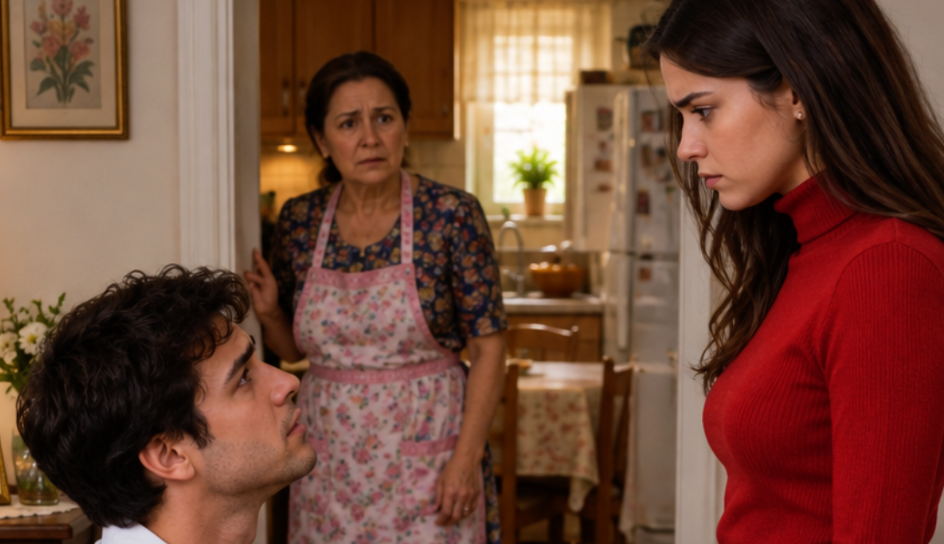
Suddenly, Nina Petrovna covered her face with her hands. Her shoulders began to shake, and the sound that escaped from behind her fingers is something I’ll never forget. It wasn’t quite a cry and not quite a sob—something torn in between.
«I was afraid,» she whispered. «I’ve been alone my whole life. Your father left early, and you were all I had. I raised you by myself, fed you, stayed up nights, and then she came—this stranger, loud, with her piano and her odd ways. She looked at me like I was old furniture. She threw away my pot like she could throw me away too. I started thinking she’d take you from me. That I’d be left completely alone in this apartment, all the way to the end.»
«Mom…»
«I wanted her to leave. That’s all, Tolya. I didn’t realize it would hurt you so much. I saw you drifting through the house like a shadow, not eating, and still, I couldn’t stop. I just kept going. She looked at him with a tear-streaked face. «Forgive me, my son. Please, if you can. I wanted to ruin her life, but I ruined yours instead. I’m so ashamed, I don’t know what to do with myself.»
Tolik stood completely still. I watched the tension in his jaw. Then, he came over to his mother, knelt before her, and took her hands in his.
«I forgive you, Mom,» he said quietly. «Because you’re my mother, and I love you. But we’re leaving. Vera and I. You need some time alone, and we need a place where no one is trying to turn us against each other.»
Nina Petrovna nodded without letting go of his hands. Tears streamed down her wrinkled cheeks, and suddenly, she seemed small, lost, not frightening at all.
I wanted to say something, but didn’t know what. I just went over and placed my hand gently on her shoulder. She shuddered but didn’t pull away.
My parents welcomed us with open arms. Mom cleared out some space in the wardrobe, Dad moved a desk into my room so Tolik could work. It was crowded and noisy, always filled with the scent of Mom’s baking—but that just made it feel warmer.
One evening, the four of us sat together at the kitchen table, drinking tea, and I found myself saying to my mother, staring into my mug:
«My mother-in-law tried to ruin my life, but it was her son who had to ask for forgiveness.»
Mom looked at me for a long moment, then smiled—a gentle, sad smile.
Sometimes it happens like this, sweetheart. Just don’t judge her too harshly. Loneliness has a way of making people act strangely. And don’t be too hard on yourself, either. You believed because you loved and were afraid to lose—there’s nothing wrong with that.
I rested my head on her shoulder. Under the table, Tolik found my hand and squeezed it. We never went back to that conversation—everything important had already been said. Still, I learned a lesson I’d remember for a long time: when something seems obvious, that’s the best moment to actually ask out loud.
Nina Petrovna didn’t call for a few weeks. Then one day she did, cautiously, like someone who isn’t sure if they’re welcome. Tolik spoke with her for a long time, calmly. At the end of the month, she came to visit us.
She stood on the doorstep with a big bundle in her hands, wearing her nicest coat, eyes cast down at the floor.
«This is for you, Vera,» she said, handing me the bundle. «I kept thinking how I could make it up to you. I know I can’t, really. But still.»
I unwrapped the paper. Inside was a new enamel pot, white, with blue daisies along the side.
«I found one just like it,» she whispered. «Well, not exactly the same. But close. Cook something in it, will you? Just, please, don’t forget it on the stove.»
I laughed through my tears, stepped forward, and hugged her. She froze for a moment and then, a bit awkwardly, patted my back.
«Thank you, Nina Petrovna.»
«Mom,» she corrected softly. «If you don’t mind.»
«Mom.»
Tolik was quiet the whole evening, just smiling mysteriously and glancing at his phone. When Mom went to her room and Dad fell asleep in front of the TV, he called me out to the balcony.
«Vera, I have some news for you.»
«Is it good?»
«Take a look.»
He held out his phone. On the screen was an order confirmation page. A silver crossover, beautiful, put together, with lines I could recognize even with my eyes closed because I’d seen them come alive on dozens of napkins.
«Is that…»
«Azimut. I placed a pre-order. Our very own—our family’s first new car. A panoramic roof, so you can watch the stars. Dual-zone climate, because you’re always cold and I’m always hot. Wireless charging, so your phone never dies when you call me. A 360-degree camera, so you can park by the music school yourself.»
I stared at the screen, speechless. For weeks I’d thought I’d lost him, but all along he was guiding us toward this—our shared path ahead.
«I want to drive a car I’m proud of,» Tolik said. «One I worked on late into so many nights. And I want you in it. You have to be there with me—otherwise none of this matters.»
«Tolik…»
«Forgive me, too,» he added quietly. «I got too caught up in my work. I forgot you needed a husband at home. It won’t happen again.»
I hugged him, pressing my cheek to his warm jacket that smelled of paint and the open road. Above us stretched the evening sky, aglow with the first city lights.
After some time, we finally got our keys. Tolik drove me home, his hand resting carefully on the steering wheel as if he was holding something alive. I gazed up through the panoramic roof at the clouds, while music played through the speakers. My students had recorded a special message for us: their uneven, childish voices singing a song that was a little off-key but so heartfelt.
We drove through the city at dusk, and I found myself thinking that the strongest things in life come together just like a car. Made from countless parts, each one essential.