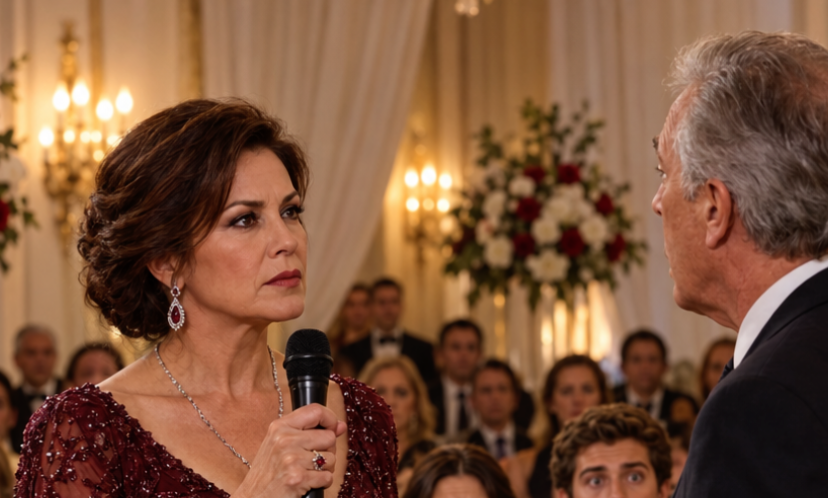
Olha grabbed the microphone herself. The host barely had time to raise his eyebrows in surprise, and there she was—standing in the middle of the hall in a cherry-colored dress with tiny sparkles on her shoulders. All conversation at the tables fell silent. Ihor, who had been laughing the loudest just a minute ago, looked up at his wife—and for the first time in many years, he found himself at a loss for words.
Everyone waited to see what would happen next. Matchmaker Halyna covered her mouth with her hand. Their son Andriy froze, fork still in hand.
Olha looked at her husband calmly, almost gently, and said:
«Ihor, I’ve kept quiet for a long time. Now it’s your turn to listen.»
* * *
Ihor was always the life of the party. Sixty-five years old, silver hair, a suit that fit like he was the groom, and a tongue that never tired. At work, he was invited to every celebration before they even made the guest list: Ihor will tell stories, Ihor will make us laugh, it won’t be boring with Ihor around.
That’s exactly what Olha fell in love with thirty-five years ago. Back then, she worked at the library, and he came in to return an overdue book—and rambled so long about why he was late that everyone in line started laughing. Half a year later, they were married.
He kept joking at home, too. First about his mother-in-law, then about the neighbors, and later about the TV. But as the years passed, his jokes were more and more about her—about Olha. About her figure, her dresses, saying things like «My Olya’s prime days are behind her.» Not mean, not harsh. He’d say it with a smile and a wink, as if there was nothing to take offense at.
«Olya, why do you need a new dress?» he’d ask while she tried on something new in front of the hallway mirror. «You’re not entering a beauty pageant after all.»
She would smile back, then hang the dress back in the closet. And for a long time after, she’d stand by that mirror, while he was already watching the news.
Olha never complained to anyone. Not even to her friend Larysa, whom she’d known since college. Because how can you talk about something like that? «He doesn’t insult me, he’s just joking.» It sounds so trivial. But all these little things, piled up over thirty-five years, end up weighing more than you’d think.
* * *
It all started with an old wedding album. In the spring, Olha was clearing out the upper shelves and found it under a box of Christmas ornaments. She sat right there on the hallway floor and started flipping through the pages.
There they were outside the registry office. There’s Ihor carrying her across a puddle. And there’s their first dance. She remembered that moment so clearly, as if it happened just two weeks ago. The music started, their guests made room, and Ihor leaned in and whispered:
«Olya, I don’t know how. Let’s just stand here.»
So they stood in the middle of the hall, swaying from foot to foot until the band caught on and switched to something more upbeat. Back then, it felt touching. Olha even promised herself that one day, they would finally dance that waltz properly.
But they never did. Not on their tenth anniversary, nor their twentieth, nor their thirtieth.
They were about to hit thirty-five in December. Olha closed the album and, that same week, noticed a sign on the door of the cultural center: «Ballroom dancing for adults. No experience needed. Tuesdays and Thursdays, 6:00 p.m.»
She stood in front of it for about five minutes. Then she snapped a photo with her phone. Then she walked home and didn’t say a word to anyone.
* * *
The trainer’s name was Roman Vitaliyovych. He was lean, fit, and had a voice strong enough to lead a parade. At their first lesson, he looked at Olga and asked what she wanted to learn.
«The waltz,» she said. «By December. For my husband’s anniversary.»
«Does your husband dance?» he asked.
«No. That’s why at least one of us needs to know how to lead.»
Roman Vitaliyovych laughed and signed her up for the group.
At the third class, Olga was surprised to spot a familiar face in the studio. It was Halyna, her co-mother-in-law and the mother of their daughter-in-law Kateryna, changing into soft slippers by the mirrored wall.
«What are you doing here?» Olga exclaimed.
«And you?» Halyna laughed. «My Mykhailo said dancing was silly. So I decided that silly is exactly what I need right now.»
Olga told her about the waltz and the anniversary. Halyna pressed her finger to her lips: she promised not to tell anyone.
At home, Olga only said she’d signed up for dance classes “for her health and mood.” Not a word about the waltz. After all, it’s a surprise.
* * *
Ihor took the news as a gift—a new reason for jokes.
“Our ballerina is off to conquer the stage,” he’d say as Olga wrapped her scarf in the hallway on Tuesdays. «Be careful out there, you probably all have to share one partner.»
She started meeting her friends more often. On Saturdays, she’d stroll through the park with Larysa; after dance class, she and Halyna sometimes grabbed coffee at a tiny café near the bus stop. Olga smiled more. She finally bought that cherry dress she once wanted but never dared to get.
Ihor didn’t seem to notice. What he did notice: she wasn’t home on Tuesdays and Thursdays, dinner was now at seven instead of six, and his wife had started softly humming in the kitchen.
And the jokes kept coming—now not just at home, but in public. To their neighbor Stepan on the bench by the entrance:
«Mine’s gone off to be a ballerina. Pretty soon she’ll go on tour, and I’ll be making borscht on my own!»
To their son over the phone, when he asked how things were going:
«Mom’s a star now. She’s spinning fouettés. Good thing we have high ceilings!»
One day, Olga was practicing in the kitchen with a broom as her partner: one-two-three, one-two-three, turning by the fridge. Ihor came back early from the garage and stood in the doorway.
«Hey, you’re doing pretty well with the broom,» he laughed. «At least it doesn’t step on your feet.»
Olga put the broom in the corner and quietly went to peel potatoes. That night, for the first time, she wondered if she’d made a mistake. Maybe it really was silly. Fifty-seven years old—could she really be a dancer?
But on Thursday, she still went to class. That day, Roman Vitaliyovych said she’d finally stopped looking at her own feet.
* * *
It was Mykhailo’s seventieth birthday. They celebrated at a restaurant with a huge crystal chandelier, white tablecloths, and bouquets of roses and peonies on every table. Around sixty people showed up: relatives, godparents, and Mykhailo’s former colleagues from the depot.
Olga and Ihor sat at the main table. Next to them were Andriy and Kateryna; across from them were Halyna and Mykhailo. Olga wore her cherry dress. Before they left, Ihor looked at her and said «well, well,» and she decided that counted as almost a compliment.
When it was time for the toasts, Ihor was the first to grab the microphone. He spoke beautifully: about friendship, about how he and Mykhailo spent half their lives fishing at the same pond, about their grandchildren. The guests laughed and applauded. And at the end, Ihor winked at the crowd:
— And one more thing, Mykhailo, take good care of your Halyna. My Olya has already dragged her into those dance classes. Soon it’ll just be the two of us having dinner while our ballerinas twirl away. Although I’ve heard my Olya has already gone through three partners in her group—none of them could keep up!
Someone giggled. Someone else burst out laughing. Ihor, looking pleased, handed the microphone back to the host.
But Olga stood up faster.
* * *
— Mykhailo, I’d also like to congratulate you, — she began, her voice barely trembling. — Stay healthy, you’re a wonderful person, and Halya is happy with you. And now, please excuse me while I say a few words to my husband. Because at home, he never listens to me.
The hall grew so quiet you could hear a dish clink in the kitchen.
— Ihor, thirty-five years ago we didn’t dance at our own wedding. You said, ‘Olya, I don’t know how, let’s just stand.’ And we stood. I promised myself back then that one day we’d dance that waltz together.
Ihor slowly straightened up in his chair.
— Our anniversary is in December. For six months now, I’ve been going to those dance classes you make fun of. I’m learning the waltz. So I can invite you. So I can lead this time, if you still don’t know how. Halyna knew. The coach knew. Even Larysa knew. The only one who didn’t know was you, because you were too busy laughing.
She paused for a moment.
— I’m not offended by your jokes, Ihor. I’m just tired of being the punchline.
Olga put the microphone at the edge of the table. Next to her, Halyna nodded quietly, confirming it was all true. Andriy lowered his eyes. Ihor looked at his wife as if he was seeing her for the first time: from below, bewildered, mouth half open.
Mykhailo was the first to come to his senses. He stood up, straightened his tie, and reached out to Olga:
— Olga, will you teach me? Halyna has been trying to get me to dance for thirty years, but I always refuse. Seems like that was a mistake.
The host, an experienced man, immediately turned on a waltz. Mykhailo danced poorly, losing count, but he was trying so hard that the guests started to smile. And Olga was leading. Calmly, smoothly, with the same posture she’d been learning from Roman Vitaliyovych for six months. When the music ended, the hall rose to give them a standing ovation.
Ihor didn’t clap. He sat and stared at his hands.
* * *
He came up to her at the end of the evening, when the guests started leaving. He stood next to her by the window, silent.
— Olya, — he finally said. — Looks like I took the jokes too far. Thirty-five years of making jokes and I never noticed that I’m the only one who finds them funny.
— You would have noticed if you’d ever really looked, — she answered, not angry.
— Please forgive me. I didn’t have the courage to do it in front of everyone. Though maybe I should have.
He rubbed the back of his head, just like he used to do in the library when explaining why he hadn’t returned a book on time.
— And that waltz… Is it still not too late? I still don’t know how to dance.
— I know, — Olga smiled. — That’s why I was learning.
* * *
On Tuesday at six in the evening, Roman Vitaliyovych was surprised to see a tall, gray-haired man in brand-new dance shoes walk through the door—shoes he’d bought at the market without knowing his size. They were a bit tight. Ihor shifted from foot to foot, searching for his wife in the hall.
«Who are you here to see?» the coach asked.
«I’m here for Olga. Actually… I want to sign up too. I need to learn by December.»
He spent all of November stepping on her feet. He’d lose track, count out loud, mix up left and right. Halyna and Mykhailo, who eventually joined in too, giggled quietly from the corner. Ihor laughed along with them—this time, at himself.
For their anniversary, they danced a waltz in a cozy little café, inviting only their closest friends. It wasn’t perfect. On the second lap, Ihor stumbled, but Olga gently guided him forward, just as she had learned. Andriy filmed it on his phone, while Kateryna wiped her eyes with a tissue.
Back at home, a note appeared on the fridge, written in Ihor’s bold handwriting: «Tuesday, Thursday — dance lessons. No jokes. I’m learning to lead.»