You should move back in with your mother after the divorce. This is my apartment,” my husband declared, conveniently forgetting that my parents had bought the place.
Lyubov Ivanovna, a fifty-six-year-old woman of remarkable inner strength, stood by the stove, watching with quiet melancholy as baked pollock with stewed carrots finished cooking in the pan. The pollock had cost two hundred and thirty rubles per kilo, the carrots next to nothing, but the effort required to turn such basic ingredients into something edible was worth far more. Surrounded by the smell of cooking and the steady hiss of oil, Lyubov Ivanovna found herself thinking about the utility bills, which had climbed past eight and a half thousand this month, and about the fact that it was probably time to buy new water filters.
The idyll was shattered by her husband.
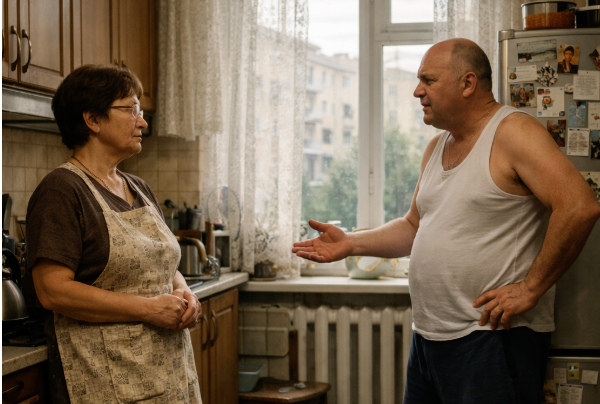
Valery, a fifty-eight-year-old man, walked into the kitchen wearing the expression of someone who had either just discovered a new law of physics or, at the very least, composed a symphony. He was dressed in a pair of sweatpants stretched out at the knees — the very same ones Lyubov had bought on sale five years ago for three hundred rubles — and a faded T-shirt with the slogan “Sport Is the Norm of Life,” though the only sport Valery acknowledged was watching chess on television.
He stopped by the refrigerator, dramatically placed one hand behind his back, let out a sigh so heavy the tulle curtain at the window trembled, and said:
“Lyuba, we need to have a serious talk. I’m leaving you. More precisely, we’re getting divorced.”
Lyubov Ivanovna carefully turned over a piece of pollock with a wooden spatula.
“Really, Valera?” she asked calmly, without taking her eyes off the pan. “Just like that, before dinner? Because I was planning to make navy-style pasta for tomorrow.”
“Don’t cheapen the moment with your domestic routine!” Valery grimaced, as if from a toothache. “My soul demands flight. I’m suffocating in this atmosphere of chlorine, laundry detergent, and endless conversations about supermarket discounts. I’ve met a woman. Her name is Evelina. She weaves willow baskets, plays the harp, and understands my inner essence. We were made for each other.”
“A harp is wonderful,” Lyubov nodded, turning off the burner. “Does it take up much space? Don’t the neighbors bang on the radiators?”
“That’s none of your business,” Valery snapped, drawing in more air for his grand finale. “That’s not the point. The point is this: after the divorce, you, Lyuba, should move in with your mother. Pack up your things without making a scene — be a woman with dignity. This apartment is mine. And I plan to bring Evelina here. She needs space for her creativity and a bright living room for meditation.”
“Continued in the comments.”
Lyubov Ivanovna, a fifty-six-year-old woman of remarkable inner strength, stood at the stove and watched melancholically as baked pollock with stewed carrots finished cooking in the frying pan. The pollock had cost two hundred and thirty rubles per kilogram, the carrots next to nothing, but the effort it took to turn these basic ingredients into something edible was worth a great deal. Amid the kitchen aromas and the steady hiss of oil, Lyubov Ivanovna was thinking about utility bills, which had climbed past eight and a half thousand this month, and about the fact that it was probably time to buy new water filters.
The idyll was broken by her husband. Valery, a fifty-eight-year-old man, entered the kitchen with the expression of someone who had just personally discovered a new law of physics or, at the very least, composed a symphony. He was wearing sweatpants stretched out at the knees—the very ones Lyubov had bought on sale for three hundred rubles five years earlier—and a faded T-shirt with the slogan “Sport Is the Norm of Life,” although the only sport Valery acknowledged was televised chess.
He stopped by the refrigerator, dramatically clasped one hand behind his back, sighed so heavily that the tulle curtain by the window trembled, and said:
“Lyuba, we need to have a serious talk. I’m leaving you. More precisely, we’re getting divorced.”
Lyubov Ivanovna carefully turned over a piece of pollock with a wooden spatula.
“Really, Valera?” she asked calmly, without taking her eyes off the pan. “Just like that, before dinner? I was planning to make navy-style pasta for tomorrow.”
“Don’t cheapen the moment with your domestic trivia!” Valery winced as though from a toothache. “My soul demands flight. I’m suffocating in this atmosphere of bleach, laundry detergent, and endless conversations about supermarket discounts. I’ve met a woman. Her name is Evelina. She weaves baskets from willow branches, plays the harp, and understands my inner essence. We were made for each other.”
“A harp is wonderful,” Lyubov nodded, turning off the burner. “Does it take up much space? Don’t the neighbors bang on the radiators?”
“That’s none of your business,” he snapped, drawing a deeper breath for the main finale. “The point is something else. After the divorce, Lyuba, you’ll have to move in with your mother. Pack your things without making a scene—be a woman with dignity. This apartment is mine. And I plan to bring Evelina here. She needs space for creativity and a bright living room for meditation.”
Lyubov Ivanovna slowly wiped her hands on a towel. Inside her, nothing snapped, lurched, or shattered into pieces. On the contrary, she felt a kind of crystal-clear, almost scientific curiosity.
“My apartment, you say?” she уточнила. -> Need translate. Continue carefully.
“My apartment, you say?” she asked.
“Of course!” Valery puffed out his chest proudly. “I’m the head of this family! I’ve lived here for thirty years! I wallpapered the hallway back in ninety-eight, remember? And who changed the faucet in the bathroom five years ago? I invested my masculine energy, my sweat, and my labor into these walls!”
Lyubov Ivanovna looked at her husband. Then at the leaking faucet (the very same one), the crookedly glued baseboard, and the trash can, into which Valery “invested his energy” about once every six months, and only after three reminders.
Good Lord, what an unclouded fantasist, she thought. You really have to believe in your own exceptional importance to forget such elementary facts completely.
To understand the full depth of Valery’s delusion, one had to rewind more than thirty years, back to the wild nineties.
At that time, Lyubov’s parents—stern people hardened by the North, who had spent their whole lives working at a metallurgical plant—had brought cash in a gym bag. Her father, may he rest in peace, had personally counted out the bills to buy this spacious three-room apartment on a good floor. The times were murky, laws were changing every day, and to avoid any risks, the apartment had been registered not in young Lyubochka’s name, and certainly not in the name of her newly minted graduate-student husband, but in the name of Lyubov’s mother, Zinaida Stepanovna.
Years passed. Valery worked as a junior research fellow at some dusty research institute, earning just enough to cover his own transit pass and a couple packs of tea. Lyubov Ivanovna spun like a squirrel in a wheel: she worked her way up to head of a large logistics warehouse and carried the burden of utilities, groceries, renovations, furniture, winter tires, and even those very metal-ceramic teeth with which Valery was now so confidently stating his rights to the apartment.
Valery, for his part, sincerely considered himself an unrecognized genius. He didn’t drink, didn’t make scenes, but he had a remarkable ability to merge with the sofa for days at a time, reading historical forums and discoursing on geopolitics. And apparently, after sitting in one place for so long, something happened to him that Lyubov Ivanovna mentally called “apartment amnesia.” Over thirty years he had become so accustomed to the idea that this was his home, his armchair, and his television that the paper reality had simply been erased from his memory.
“All right, Valera,” Lyubov said peaceably, hiding a smile. “Since it’s love, flights of the soul, and the harp, I won’t stand in the way. These things happen. Give me until the weekend, and I’ll pack my things.”
“That’s more like it,” her almost ex-husband nodded magnanimously. “Just don’t touch the furniture. Evelina isn’t used to Spartan conditions. Leave the refrigerator, the washing machine, and the sofa in the living room. Your mother will give you some old stuff.”
“Of course, Valerochka. Whatever you say,” Lyubov Ivanovna sang sweetly.
For the next three days, Lyubov Ivanovna busied herself with preparations. But she was packing far more than just her blouses. As a logistics specialist with many years of experience, she approached the process systematically and ruthlessly.
On Thursday, while Valery was at work (where he heroically shifted three pieces of paper from nine to six), a cargo Gazelle truck pulled up to the building. In half an hour, sturdy men in work uniforms carried out of the apartment:
the outrageously expensive orthopedic mattress Lyubov had bought a year earlier so Valery’s back would stop hurting;
the two-compartment No Frost refrigerator (in its place, a rattling Soviet relic borrowed from a neighbor at the summer cottage was ceremoniously installed in the kitchen);
the new washing machine;
the microwave, coffee maker, and vacuum cleaner.
Lyubov Ivanovna packed up her own belongings in boxes. As for dishes, Valery was left with one aluminum pot, a frying pan with scratched Teflon, and two mismatched plates.
That evening, Valery came home. The apartment greeted him with a hollow echo and the forlorn sight of a bare bed frame.
“Lyuba! What kind of vandalism is this?!” he shouted, bursting into the kitchen, where Lyubov Ivanovna was calmly drinking tea from her favorite mug (already wrapped in bubble wrap). “You stripped my nest bare! You’ve left me in ruins!”
“Valera, don’t be so dramatic,” his wife waved him off. “I only took what I bought with my own money. And now you and Evelina have a unique chance to fill this space with your high energies. Why would a muse need a sixty-inch television? It emits low vibrations. And as for washing clothes, Mother Nature intended it to be done by hand, in a basin, with soap root.”
Valery opened his mouth to launch into a tirade about female greed, but at that very moment his phone rang. Evelina. He instantly changed his tone to a cooing murmur and retreated to the bathroom—the only place where the illusion of former comfort still remained, although Lyubov had prudently taken the Zewa toilet paper as well, leaving behind a roll of harsh gray cardboard.
On Friday morning, Lyubov Ivanovna handed the keys to her stunned husband and left for her mother’s house.
Zinaida Stepanovna was seventy-nine. She had a straight back, a thunderous voice, and a character cast from quality pig iron. She lived in a cozy village outside the city, grew elite varieties of tomatoes, and every evening watched political talk shows, arguing with the hosts so fiercely that the cat hid under the sofa.
When Lyubov Ivanovna entered the house and explained the situation, Zinaida Stepanovna even stopped making dumplings.
“So the apartment is his?” the mother repeated, and in her eyes there flashed a dangerous, almost youthful spark. “And he wallpapered it?”
“He did, Mom. Back in ninety-eight. It’s still peeling off in the corner.”
“Well, would you look at that, what a hard worker. And here I thought all he knew how to do was solve crosswords,” Zinaida Stepanovna said, wiping the flour from her hands. “Evelina, you say? With a harp? Good. Let the young people enjoy their honeymoon. Three days will be enough for them. And on Tuesday, Lyubochka, we’re going into the city.”
Zinaida Stepanovna called her nephew, who worked at a real estate agency. She needed the most aggressive, loud, energetic realtor possible. And such a man was found—Eduard, a young man in a cheap but shiny suit who could sell sand in the Sahara.
On Tuesday evening, romance reigned in Lyubov Ivanovna’s former apartment. Valery and Evelina were sitting in the kitchen. Evelina—a woman of indeterminate age, dressed in a linen smock and wearing many wooden beads around her neck—was burning dried wormwood to “cleanse the aura of the ex-wife’s negativity.” The smell was like an old broom being burned alive in the apartment. On the stove, lentils simmered miserably in the only pot.
“Valerik, my love,” Evelina was murmuring languidly, adjusting her beads. “The energy here is bad, of course. But we’ll renovate. We’ll tear down this wall, combine it with the kitchen, and I’ll put my weaving loom here…”
At that moment, the key turned in the lock.
The door flew open. On the threshold stood Zinaida Stepanovna, leaning on a cane that looked in her hands like a scepter. Behind her towered Lyubov Ivanovna with a light, unreadable half-smile. And after them burst in Eduard, accompanied by a noisy family of five—potential buyers.
“Come in, come in, dear people!” Eduard boomed cheerfully, paying no attention to the petrified Valery in the hallway. “Take note of the layout! Three rooms, windows on both sides, separate bathroom and toilet. Yes, of course, the renovation is granny-style, but the price is attractive!”
The buyers, two adults and three children, immediately scattered throughout the apartment, peering into every corner.
Valery turned pale, then blotchy red, and croaked out:
“Lyuba… Zinaida Stepanovna… What are you doing?! This is my apartment! Call the police! This is trespassing on private property!”
Zinaida Stepanovna approached her former son-in-law unhurriedly. From her enormous handbag she took out a plastic folder and pulled out a crisp sheet of paper.
“Trespassing, you say?” the mother-in-law’s voice echoed through the hallway, drowning out the shrieks of children from the bedroom. “Here is an extract from the Unified State Register of Real Estate. Owner: Ivanova Zinaida Stepanovna. That is, me. And you, Valerka, were merely registered here. Out of charity.”
“How… how can that be?” Valery began gulping air like a fish thrown onto the shore. “But we were married… I’m the husband…”
“You were my daughter’s husband,” Zinaida Stepanovna cut him off. “And I bought this apartment with my own money. And registered it in my own name. You fool, in thirty years you didn’t pay a single kopek toward the utilities. Your private property, Valerik, is that collection of rubber boots on the balcony and those bound volumes of Science and Life magazine from 1989.”
Drawn by the commotion, Evelina emerged from the kitchen. She was holding a smoldering bundle of wormwood.
“Valery, what is happening?” she asked nervously. “Who are these people with low vibrations in our nest?”
Zinaida Stepanovna looked the muse up and down with such a gaze that the wormwood in her hand seemed to go out on its own.
“Oh, so this must be the harpist? Hello. Our vibrations are ordinary and legal. I’m selling the apartment. And you, madam, together with your Valerik, have exactly twenty-four hours to vacate my premises. Tomorrow workers are coming to rip up the linoleum.”
Evelina shifted her stunned gaze to Valery.
“Valera… you told me you were the rightful owner! That you had elite real estate! You promised me a studio for weaving! What are you, a pauper?!”
“Evelina, my love, wait, this must be some mistake!” Valery babbled, trying to grab her hand. “It’s some legal nonsense, we’ll go to court…”
But the muse turned out to be a practical woman. Realizing that instead of a bright living room she was facing the prospect of renting a tiny room in a Khrushchyovka on the outskirts with an aging junior research fellow, she instantly lost all her esoteric loftiness.
“I cannot remain in this chaos! Your aura is broken, Valery! You’re a deceiver!” Evelina shrieked. She threw the wormwood into the lentil pot, grabbed her linen bag with the beads, and rushed out the door without even changing clothes, nearly knocking realtor Eduard off his feet.
Valery was left standing alone in the hallway in his stretched-out sweatpants. His world—so reliable, comfortable, and free—had collapsed in an instant.
Lyubov Ivanovna looked at him without gloating. She simply found it a little funny. For thirty years she had carried this suitcase without a handle, listened to his lofty speeches, fed him, washed for him, and all it had taken was one flick of the switch of reality for his whole importance to burst like a soap bubble.
“Tomorrow at six in the evening I’ll come to change the locks, Valera,” she said calmly, looking into his bewildered eyes. “I left boxes for you on the balcony. Hurry up.”
Of course, Zinaida Stepanovna never actually sold the apartment. Eduard received a generous commission for the performance, and the fake buyers—his friends—left very pleased.
A week later, after the smell of wormwood and Valery’s ambitions had aired out of the apartment, Lyubov Ivanovna hired a construction crew. She decided to do a full renovation. A real one—bright, with new floors and modern plumbing. Without crooked baseboards and leaking faucets.
Valery called her a couple of times from unfamiliar numbers. He complained that Evelina had blocked him, that he had been forced to move into a room in a communal apartment with some distant relative, and that “the energies of the moon had been in retrograde,” which was why he had stumbled. He offered to start all over again and promised he would take out the trash himself.
Lyubov Ivanovna stood in the middle of the empty apartment, looking through a tile catalog. Twilight was gathering outside the window. The phone vibrated—an unknown number. She declined the call and suddenly realized: for the first time in thirty years, there was no one she had to wait for at dinner. No one would ask when the meal would be ready. No one would take over the sofa.