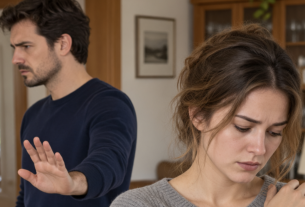
Ekaterina slowly turned toward her husband, trying not to show how those words had made everything inside her clench. Sergey was standing in the doorway, his eyes shining—either from drink or from anger.
“Did you seriously just say that?” she asked quietly, placing the spoon on the table. Her voice did not tremble, though everything inside her was boiling.
“Absolutely seriously, Katya,” he said, taking a step forward and planting his palms on the table. “The apartment is yours, fine. But I’m registered here. Permanently. And by law, you can’t evict me from here. File for divorce if you want, don’t if you don’t. I’m not going anywhere. I’ll live here. Just like before.”
Ekaterina looked at him for a long moment. Five years ago, when they had just gotten married, he had been different. He smiled, carried her in his arms, promised to move mountains for her. And then everything changed. His job “temporarily” ended, then came “one more try,” then “the crisis in the country.” And now, for the third year already, Sergey had not worked at all. He lay on the couch, watched TV series, sometimes took little “jobs through acquaintances,” bringing in pennies that he immediately spent on beer with his friends.
And she got up at six, traveled across the whole city to the office, came home late, cooked, cleaned, did the laundry. The apartment was hers—left to her by her grandmother. Small, but her own, in a good neighborhood. Back then Sergey had said, “Let me register here so the utilities will be cheaper.” She had agreed. She had not thought it through. She loved him, after all.
“So you’re telling me right now that you’re going to live at my expense because you’re registered here?” she asked, trying to speak calmly.
“Why not?” he shrugged, as if it were obvious. “You work. You earn decent money. And I… well, things just aren’t working out for me right now. But it’s temporary. And you’re supposed to help me. We’re family.”
Family. The word sounded like mockery coming from his mouth.
Ekaterina turned toward the window so he would not see the sting of tears in her eyes. Outside, it was already getting dark—November, early dusk, wet snow falling onto the windowsill. She remembered how a year ago he had promised, “Starting in January, I’ll definitely look for a job seriously.” January passed, then February, then spring… And then he stopped pretending altogether.
“I’m tired, Seryozha,” she said quietly, without turning around. “I’m tired of carrying everything alone. I’m tired of coming home and seeing that nothing has been done. I’m tired of paying for everything. For electricity, for the internet, for your cigarettes.”
“Oh, here we go,” he rolled his eyes. “Again with your complaints. It’s not like I’m just sitting around. I’m looking. It’s just that the job market right now… well, you know yourself.”
She knew. She knew he had not sent out a single résumé in six months. She knew his friends had long since found jobs, while every vacancy was still “not for him.” She knew his phone was full of chats with former female classmates and football betting slips.
“I want you to move out,” she said, turning to face him. “Voluntarily. I’ll give you time to pack. One month. Find a place to live—I’ll help with the first payment. But I won’t live like this anymore.”
Sergey laughed. Loudly, mockingly.
“Where am I supposed to go, Katya? I have no money. I have nothing. Except registration in your apartment. And I’m not leaving here. Call the police if you want. They’ll tell you: if I’m registered, I have the right to live here. Everything’s legal.”
He turned and went into the room, slamming the door. Ekaterina remained standing in the middle of the kitchen, looking at the cooling soup. Everything inside her went numb. She understood: he was right. By law—yes, he had the right. Deregistering him without his consent was almost impossible. Especially if he resisted.
She turned off the stove, sat down at the table, and rested her head in her hands. One thought spun in her mind: “How did I let it come to this?”
The next day, everything became even worse. Ekaterina came home from work exhausted—the day had been difficult, her boss had torn into her over a report. All she wanted was to lie down and disappear. But when she opened the door, the apartment smelled of fried potatoes and cigarette smoke. Sergey was sitting on the couch with a friend—the same Vitka who was “always there in difficult times.”
“Oh, Katyusha’s home!” Vitka shouted cheerfully, raising a bottle of beer. “Come sit with us, let’s celebrate!”
“What are we celebrating?” she asked, taking off her coat.
“Serёga said you’re kicking him out,” Vitka chuckled. “And he put you in your place! Well done, brother!”
Ekaterina looked at her husband. He was sitting there with a satisfied smile, as if he had just won the argument of the century.
“Sergey,” she said quietly, “can you come to the kitchen?”
He got up reluctantly and followed her.
“What now?”
“I asked you not to smoke in the apartment,” she began.
“I smoked on the balcony,” he interrupted.
“And not to bring friends over without warning.”
“This is my home too,” he crossed his arms over his chest. “I have the right to invite whoever I want.”
“No, Sergey,” she looked him straight in the eyes. “This is my home. You are merely registered in it. That’s all.”
“So what?” he smirked. “Registration is forever. Until I deregister myself. And I won’t. Ever.”
That night, she slept in the kitchen on a folding chair. Because Vitka stayed “for the night” in the room, and Sergey said, “I can’t just throw a friend out.”
In the morning, she left for work earlier than usual. On the subway, staring into the black window, she suddenly understood: it could not go on like this. She had to do something. Otherwise he would turn her life into hell completely.
During her lunch break, she went online and started searching. First—articles about deregistration without consent. Then forums. Then lawyers’ phone numbers. One phrase caught her attention: “If a person has not paid utilities for more than six months and does not actually live there, it can be done through court.”
She froze. Sergey had never paid anything at all. Ever. All the bills were paid by her. And actually… actually, he did live there. But what if he stopped?
That evening, she came home and saw Sergey with Vitka again. On the table—beer, chips, an ashtray full of cigarette butts.
“Sergey,” she said calmly, “I want to talk.”
“Again?” he rolled his eyes.
“Yes, again. I’m filing for divorce. And I will demand your deregistration through court.”
He laughed.
“Go ahead. Let’s see what the court tells you. I’m not a stranger. I’m your husband.”
“Ex-husband,” she corrected him. “Soon.”
Vitka giggled.
“Katya, are you serious? Serёga will be lost without you.”
“And I’m already losing myself with him,” she answered quietly. “Every day.”
Sergey suddenly grew serious.
“You won’t be able to deregister me. I know the laws. I’ve read them.”
“I’ve read them too,” she said. “And I found something interesting.”
She said nothing more. She simply went into the bathroom, locked the door, and turned on the water so she would not hear their laughter. But inside her, a small, cautious hope had already been born.
A week later, everything changed.
Ekaterina came home and did not recognize the apartment. Someone else’s things were scattered on the couch—a jacket, boots, a backpack. In the room was another of Sergey’s friends, Dimon, whom she had seen a couple of times.
“What is this?” she asked, stopping in the doorway.
“Dimon will stay for a while,” Sergey answered carelessly. “He’s doing renovations, he has nowhere to live.”
“How long is ‘a while’?”
“Well… a month or two.”
She looked at him. Then at Dimon, who smiled awkwardly.
“No,” she said firmly. “Not a month. Not two. Not even one more day.”
Sergey stood up.
“Didn’t you understand? I’m the owner here too. I’m registered.”
“You are not the owner,” she took a paper from her bag and placed it on the table. “Here. A court claim. To recognize that you have lost the right to use this residential property.”
He grabbed the paper and scanned it.
“What kind of nonsense is this?”
“It’s not nonsense,” she looked into his eyes. “You don’t pay for the apartment. Never. You don’t maintain a shared household. You have no income. And in fact… soon you won’t be living here at all.”
“What does that mean?” he frowned.
“Just that,” she smiled for the first time in a long while. “I’ve already found you a room. In a dormitory. Cheap. On the outskirts. You can move tomorrow if you want.”
“Are you insane?” his face turned crimson. “I’m not going anywhere!”
“You will,” she said calmly. “Because if you don’t go voluntarily, you’ll go by court order. And then you won’t have the right to come back. Ever.”
Dimon coughed awkwardly and began gathering his things.
“I think I’ll go…”
“Go,” Ekaterina nodded. “And don’t come back.”
When the door closed behind him, Sergey looked at her with hatred.
“You’ll regret this.”
“Not anymore,” she answered. “And you know what? I spoke to a lawyer. There’s another option too. Easier. Faster. And you’ll want to leave yourself.”
She did not say what it was. Let him think. Let him worry. Let him feel, for the first time in many years, that he was not the one in charge here.
And the next day, something happened that she had not expected at all…
“Sergey, open the door, please,” Ekaterina knocked on the door of her own apartment with her knuckles.
She no longer had keys. She had handed them over herself a week earlier, when she had packed his things and called a taxi to the dormitory on the outskirts. He had shouted then that he would come back, that she would regret it, that “the law is on his side.” And then he had simply left, slamming the door so hard that plaster crumbled.
Now he stood on the threshold with a grocery bag from Pyaterochka and an arrogant smile.
“I told you, Katyusha,” he said, squeezing past her into the hallway. “Registration is forever. And if you don’t give me the keys, I’ll call the district police officer. He’ll open it for me.”
She did not have time to answer—he had already gone into the kitchen, put the bag on the table, and started unpacking the groceries. Beer, dumplings, a loaf of bread. Just like before.
“What are you doing?” she asked, feeling cold inside.
“Living,” he answered simply, opening the refrigerator. “Like I lived before. And like I will keep living. You haven’t deregistered me, have you? No. So I have the right.”
Ekaterina took out her phone. Her fingers trembled slightly.
“I’m calling the police.”
“Call them,” he shrugged and switched on the kettle. “They’ll come, look at my passport, see the registration, and leave. And they might even fine you for making a false call.”
She dialed the number. She spoke calmly, though a storm was raging inside her. They arrived quickly—two young sergeants, indifferent as always.
“Documents,” they asked Sergey.
He readily showed his passport. The stamp was clear: the address of her apartment.
“You see?” he smiled. “I’m registered here. Permanently. My wife just had a fight with me and won’t let me in.”
The sergeant looked at Ekaterina.
“If he’s registered, he has the right to live here. If you’re divorcing, resolve it in court. We can’t do anything here.”
They left. Sergey stayed. He sat down on the couch, turned on the television, and opened a beer.
That evening, she went to a friend’s place. She slept on a folding bed, staring at the ceiling, and for the first time in a long while, she cried. Not from hurt—from helplessness.
But by morning, she already knew what to do.
“Hello, Irina Viktorovna?” she dialed the number of the lawyer she had found two weeks earlier. “This is Ekaterina Morozova. Do you remember, we spoke about deregistering my ex-husband? Yes, he came back. No, the police didn’t help. Yes, I’m ready. Bring the documents—I’ll sign whatever is needed.”
Irina Viktorovna arrived two days later. With a folder of papers and calm confidence in her eyes.
“There are two ways,” she said, laying the documents out on the café table where they met. “The first is long. Recognition that he has lost the right to use the premises through court. We need to prove that he does not actually live there, does not pay utilities, leads an antisocial lifestyle. That takes months. Maybe a year.”
“And the second?” Ekaterina tightened her fingers around her coffee cup.
“The second is faster. And more reliable. We file for divorce and, at the same time, for eviction. But the main thing is documenting the fact that he does not live there. You change the locks. Officially. Through the housing office. You notify him by registered letter that access is closed due to dissolution of the marriage and the absence of family relations. He will file a lawsuit—and we will prove that he moved out voluntarily, took his belongings, and has no keys. Plus certificates showing he never paid a single kopeck for the apartment.”
“And if he comes with the police again?”
“Let him. The police will see the new locks and the notice—and refuse to open the door for him. It will no longer be within their competence.”
Ekaterina nodded. Something inside her thawed.
“How much will it cost?”
“No more than continuing to feed him,” Irina Viktorovna smiled.
That same day, she went to the housing office. She wrote an application. A maintenance worker came an hour later and changed the locks. Two sets of keys. One for her, the second in the lawyer’s safe.
Then came the registered letter. With delivery confirmation.
“Dear Sergey Alexandrovich, in connection with the termination of family relations and your voluntary departure from the apartment at the address… access is closed. Keys will be provided only by court order.”
She sent it. And exhaled.
Three days later, he came again.
She saw him through the intercom—standing there with a bag, furious as hell.
“Open up!” he shouted into the receiver. “I came home!”
“This is no longer your home,” she answered calmly. “Did you receive the letter?”
“What letter?! Open up, or I’ll…”
“Call the police,” she said. “I’ve already called them. They’re on their way.”
He called. The same pair of sergeants arrived. They looked at the new locks. They looked at the notice. They looked at her—the owner of the apartment.
“Everything is legal,” the senior officer said. “Resolve it through court.”
Sergey shouted that he was being thrown onto the street, that he would stay under the door, that she would regret this. But they left. And he… he remained standing in the stairwell. With his bag. Without keys.
Ekaterina closed the small window so she would not hear his shouting. She sat down in the kitchen and made herself coffee for the first time in a long while. Just because she wanted to. Without hurry.
A week later, a summons arrived. He had filed a lawsuit. To restore his right to live there.
Irina Viktorovna only smiled when Ekaterina called her.
“Excellent. That is exactly what we were waiting for.”
“What now?”
“Now we gather evidence. Utility bills—all in your name. A bank statement showing that he never transferred money for the maintenance of the apartment. Witnesses—neighbors who will confirm that he did not actually live there after moving out. Plus your diary. You kept one, didn’t you?”
“I did,” Ekaterina nodded. Since the very day he left the first time. Every date, every detail.
“Wonderful. One more month—and he’ll be deregistered. Forever.”
Ekaterina hung up and went into the room. She opened the wardrobe—she had given his things to charity long ago. The shelves were empty. Her shelves.
She took out a box of photographs. There were almost none of the two of them left. She had thrown them out back in spring. Only hers remained—with friends, with her parents, from that trip to Crimea where he had never gone because “there was no money.”
She smiled. Truly, for the first time.
But the most interesting thing happened two weeks later, when a letter arrived from the court… with a twist she had not even dared to dream of.
The letter from the court came in an ordinary white envelope, but Ekaterina immediately understood—it was the one. Her hands trembled slightly as she opened it at the kitchen table, where his kettle had recently stood and his cigarettes had lain.
“To refuse the claims of Morozov S. A. in full. To recognize Morozov S. A. as having lost the right to use the residential premises at the address… To deregister him from the apartment by compulsory procedure.”
She read it three times. Then she simply sat down and cried—quietly, without sobbing, tears just rolling down her cheeks. Not from grief. From relief.
Irina Viktorovna called an hour later.
“Congratulations, Katya. The judge didn’t even spend long sorting it out—everything was ironclad. The receipts were all in your name, the witnesses confirmed he didn’t live there, he took his belongings himself. Plus his own words in the record: ‘I left voluntarily because my wife kicked me out.’ That was a fatal gift.”
“And he… what now?” Ekaterina asked, though she almost did not care.
“Now he has ten days to appeal. If he doesn’t, then in two weeks the passport office will deregister him ‘to nowhere.’ And that’s it. Never again.”
He appealed, of course. He came to the hearing angry, unshaven, in a wrinkled jacket. He looked at her across the courtroom as if he wanted to burn a hole through her. But his lawyer was state-appointed—young and confused. He even mixed up the legal articles.
The judge reviewed the materials again and upheld the decision.
That day, Ekaterina left the courthouse and, for the first time in a long while, breathed deeply. The November air was cold, smelling of snow, but to her it felt like spring.
A month later, she received a new passport with a clean page in the “registration” section. Only her surname. Only her address.
Sergey called a couple more times—from different numbers. First he shouted, then begged, then threatened. She simply hung up. Then she added him to the blacklist and changed her number.
Her friend Lena, who had been by her side the whole time, brought over a bottle of champagne.
“To a new life!” she said, raising her glass.
“To never again,” Ekaterina smiled.
She rearranged the furniture. Bought a new sofa—light-colored, without the dent from him in the middle. She hung her own photographs on the walls: with her mother, with her friends, from that trip to Georgia she had taken alone the previous summer. She placed flowerpots on the windowsill—the ones he had always called “your weeds.”
Work suddenly became enjoyable. Her boss promoted her—he noticed that she was no longer late, no longer looked exhausted, and smiled. Her colleagues joked, “Katya, have you fallen in love or something?” She only laughed in response.
One evening, coming home, she met her neighbor Aunt Valya in the stairwell—the very same woman who had testified in court.
“Ekaterina,” the old woman said, narrowing her eyes, “you’ve blossomed. Your eyes are glowing. And rightly so. He was not the man for you. Not at all.”
“I know that now,” Ekaterina answered quietly and hugged her.
In spring, she went to visit her mother in the village—just because, for the weekend. She sat on the porch of the old house, drank tea with mint, and suddenly realized: she was free. Truly free. Not only from him—but from the fear that had once settled inside her and made her endure, forgive, and hope.
In summer, she met Anton—at a photography course she had signed up for “just to try.” He was calm, with warm hands and laughter in his eyes. He did not promise anything right away. He simply invited her for coffee. Then for a walk. Then to visit him at his place.
When he first stayed over at her apartment, she woke up in the middle of the night and lay there for a long time, listening. No snoring from the couch. No smell of stale alcohol. No feeling that she was once again alone in her own apartment.
In the morning, Anton made coffee and asked:
“May I stay over sometimes? Not often. Just… when we want to be together.”
She looked at him and smiled.
“Stay as long as you want. This is my home. And now I decide who gets to be happy in it.”
And somewhere out there, in a dormitory on the outskirts, Sergey was probably still telling his friends how he had been “illegally kicked out.”
But that was an entirely different story now.
Not hers.