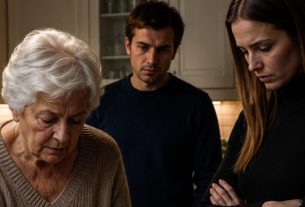
“This coffee is incredible, Gleb. What did you put in it—cardamom?” Denis inhaled the rich aroma rising from his cup with obvious pleasure.
“A little cinnamon and a pinch of nutmeg. I brought the beans back from a festival in Lisbon,” Gleb said with a smile as he arranged small plates of apple strudel on the table. “Veronika, would you like some too?”
“Yes, I suppose,” his wife replied, setting her tablet aside. “Actually, this is a perfect moment to discuss a few plans. Denis, since you’re a mediator, perhaps you could even give us some advice…”
Gleb froze with the cezve still in his hand. Something in his wife’s tone immediately put him on guard. He knew that tone all too well. It was the voice she used when she had already made a decision and was starting a conversation merely for the sake of appearances.
“I’m talking about Dad,” she said, taking a sip of coffee and looking at her husband over the rim of her cup. “He’s moving in with us next week. I hope it won’t be too difficult for you to clear out your studio.”
Gleb’s hand trembled, and the cezve struck the ceramic stand with a sharp clink. He slowly lowered it onto the table, trying to hide the sudden shaking in his fingers. A dark drop landed on the pale tablecloth, leaving a small stain.
“I’m sorry—what?” He stared at his wife, convinced he must have misheard her.
“Dad is moving in. He’ll take your studio. Or he can stay in our bedroom, but then we’ll have to squeeze into the living room,” she said with a shrug, as though they were discussing moving a sofa. “So you’d better find somewhere else for your synthesizers and sheet music.”
Denis awkwardly looked away and pretended to be deeply interested in examining the foam on his coffee.
“But we… we never discussed this,” Gleb said, hiding his hands under the table so she would not see them trembling. “My soundtrack is in its final stages. You know I work from home.”
Veronika grimaced and looked at him with mild irritation.
“Gleb, he can’t exactly live on a park bench. My father no longer has an apartment.”
“What do you mean, he doesn’t have one?” Gleb went still.
“My sister Larisa persuaded him to invest his money in her beauty salon. He sold his apartment, and now that reckless scheme of hers has collapsed,” Veronika said, shaking her head. “He called me last night while you were working on the mix at the studio. The decision has already been made. Or are you suggesting that I abandon my own father?”
Gleb felt something crack inside him.
They had been married for nine years, and never before had she simply presented him with a decision like this. There had always been discussions, compromises, attempts to reach a solution together. Even when they argued, Veronika had at least pretended that her husband’s opinion mattered to her.
“Don’t you think your sister should be held responsible for what she did?” he asked carefully. “Since she was the one who took his money…”
“She’s in Yekaterinburg,” Veronika snapped. “And what exactly are you suggesting? That our father, who had a minor stroke four months ago, travel halfway across the country to stay with her?”
Denis coughed, clearly deciding to soften the atmosphere.
“Perhaps there are other options. There’s no need to make such a drastic decision immediately.”
Veronika gave him a cold, polite smile.
“I’m sorry, Denis, but this is a family matter. Gleb is simply a little confused. He has never liked my father.”
“That isn’t true,” Gleb objected quietly. “I have never had anything against your father. I’m against you making decisions like this without even asking me.”
Denis straightened, and his voice took on a calm, professional tone.
“Veronika, as someone who deals with family disputes every day, I’ll tell you honestly: in a marriage, serious decisions must be made together, especially when they change your entire way of life. It is a matter of basic respect.”
“And forcing my father to search for some corner in a rented apartment is respectful, in your opinion?” Veronika frowned.
“No one is talking about forcing him to do anything,” Denis continued evenly. “We’re talking about finding a solution that takes everyone’s interests into account, including Gleb’s right to work in his own home.”
“So we were supposed to hold a vote?” she scoffed.
For the first time, Gleb heard something unpleasant in that scoff, something that had previously escaped his notice.
“He’s my father, Gleb.”
“And this is my apartment,” Gleb said before he had time to think.
Silence fell over the room.
Veronika slowly set down her cup and stared hard at her husband.
“So that’s how you’re speaking now,” she said with such contempt that Gleb recoiled inwardly. “We’ve lived together for nine years, and you’re still counting square meters.”
“That isn’t what I mean.” He felt his breath catch. “We could have thought everything through together and found a solution.”
“You should have searched for a solution yesterday,” she replied sharply. “Today, we have an obligation to help Dad.”
Denis stood abruptly.
“Veronika, wait. You can’t do this.”
“Yes, I can, Denis,” she said without even looking at him. “I’m saying exactly what I think. If Gleb’s precious pianos are more important to him than his wife’s own father, then I have no reason to remain here.”
Gleb looked at her and no longer recognized the woman with whom he had spent nine years.
He knew that Veronika loved her father. He knew she could be tough and stubborn. But that icy stare and those sharp, alien words—who was she now? And when had she become this person?
“We could help pay for a separate apartment,” he suggested quietly. “We don’t have much space, Veronika. Fifty-eight square meters for three adults…”
“Other people have even less space, and they somehow manage,” she snapped.
“Perhaps you should speak to Larisa,” Denis suggested carefully. “She is also his daughter, and if it was her salon that created this situation…”
“Thank you for the advice,” Veronika answered dryly, “but I will handle my family myself.”
At that moment, Gleb understood that the conversation was over.
Not because they had reached an agreement, but because, in Veronika’s eyes, he had ceased to exist as an equal. He was no longer part of the “family” she spoke about with such passion.
Denis rose awkwardly.
“I think I should go. Call me if you want to talk.”
Gleb nodded, unable to force out a single word.
As soon as the door closed behind his friend, Veronika began speaking again.
“You know, I never thought you were this kind of person,” she said, turning toward the window. “A selfish man.”
“Why did you decide everything without me?” he asked quietly.
“Because I was certain you wouldn’t object,” she said, spreading her hands. “He is my father, after all. I thought you would simply understand and support me.”
Gleb felt something new rising inside him—not hurt, not fear, but a cold, clear anger.
“I am prepared to help,” he said, trying to keep his voice steady. “But why didn’t you even discuss such an important decision with me? We’re supposed to be a family, Veronika. Isn’t that how serious matters should be handled?”
“Because I am your wife,” she replied, steel entering her voice. “And I am asking you for support. Dad raised Larisa and me alone. He gave us everything. Now that he needs help, I expected understanding.”
“I understand that you want to help your father,” Gleb said calmly. “But why must his moving in with us be the only possible solution? Why can’t we consider other options?”
“What other options?” Her eyes narrowed. “Are you suggesting that we put him in a nursing home?”
“Of course not. But we could help him rent an apartment nearby. Or perhaps Larisa could contribute as well. He is her father too. Besides, he lost his home because of her. What does that have to do with us?”
“Larisa lives in another city,” Veronika snapped. “And anyway, he is my father, so the decision is mine. Are you refusing to help your own wife’s father?”
“We are both this family,” Gleb said quietly. “My opinion should be considered equally with yours.”
Veronika leaped to her feet so abruptly that the chair crashed onto the floor.
“Equally?” Her voice trembled, and her face twisted with anger. “My father has been left without a roof over his head, and you’re lecturing me about equality? Do you even hear how that sounds?”
Gleb flinched at her tone but did not back down.
“I only want us to find a solution together. One that works for everyone.”
“I have already found the solution,” she hissed through clenched teeth. “Dad is moving in with us. And your conditions…” She paused, searching for the right words. “Your conditions are nothing but pure selfishness.”
At that moment, Veronika’s phone began to vibrate. She glanced at the screen, brought it to her ear, and turned toward the window.
“Yes, Dad,” she said, her voice instantly becoming soft and almost tender. “Yes, everything is fine. Of course, I’ll prepare everything.”
Gleb remained motionless, watching his wife.
She listened, nodded, and occasionally threw irritated glances in his direction. Finally, without ending the call, she walked into the hallway and firmly closed the door behind her.
Left alone, Gleb lowered himself onto a chair, overcome by a strange numbness.
Fragments of memories flashed through his mind. He and Veronika furnishing his studio three years earlier, choosing acoustic panels and arguing about the color of the walls. The previous winter, when he had worked late into the night mixing a track and she had brought him hot tea, silently stroking his shoulder.
And Arkady Petrovich, who always found something to criticize whenever they met. His music was “not serious,” his hairstyle was “bohemian,” and his voice was “too quiet for a man.”
The memories flowed continuously, mixing with the present and somehow making it even more unbearable.
Fifteen minutes later, Veronika returned. Her expression remained tense, but she seemed calmer.
“Dad said he can wait,” she announced without looking at her husband. “He’ll stay with an old friend for a week or two. But he can’t remain there any longer. Their place is already crowded.”
Gleb opened his mouth to speak, but she raised her hand to stop him.
“I’m giving you time to think. Until the end of the week. After that, I need a definite answer.”
“Veronika,” he said, getting to his feet and struggling to find the right words, “I genuinely want to help. But why does he have to move in? We could rent him an apartment near us. Or a small studio. We would cover the cost.”
She looked at him as though she were seeing him for the first time.
“A studio apartment? You want my father, who has lived his entire life in a three-bedroom apartment, to squeeze himself into a tiny box?”
“But we only have two rooms ourselves,” Gleb protested in confusion.
“At least he’ll be with family,” she snapped.
That evening, they barely exchanged a few words.
Gleb tried to work on his project, but his thoughts kept scattering and the notes blurred before his eyes. Every sound seemed deafening—the rustling of paper, the creaking of his chair.
Veronika sat in the living room, staring at her laptop. Whenever he walked past her, she did not even lift her head.
The night passed in oppressive silence.
Gleb lay on the very edge of the bed, afraid of accidentally touching his wife. He went over the possible solutions in his mind.
Perhaps he should simply give in. He could move his work area into the bedroom. He could work at a friend’s studio on the other side of the city. Could the three of them manage to live together in fifty-eight square meters?
And most importantly, why should he sacrifice his space because of someone else’s mistake?
In the morning, he was awakened by a loud conversation in the kitchen. Veronika was speaking to someone on speakerphone. He recognized the voice of her older sister, Larisa.
“I’m not letting Dad move in with me,” Larisa said irritably through the speaker. “I have two children. You understand that.”
“And I have a husband who has dug in his heels,” Veronika replied with contempt in her voice. “Can you imagine? He actually said that it’s his apartment, as if that even matters.”
“Well, technically, it is…”
“What difference does that make?” Veronika interrupted. “We’ve been living together for nine years. What belongs to him belongs to me, and vice versa. We simply need to help Dad.”
“Listen, perhaps he’s right,” Larisa said cautiously. “It will be crowded in your apartment. Why don’t we split the cost and rent Dad a place? I could pay half.”
“This isn’t about money!” Veronika struck something against the countertop in frustration. “Dad wants to live with his family, not in some rented little hole.”
Gleb put on a house shirt and left the bedroom.
The moment Veronika saw him, she ended the call and turned toward the window.
“Good morning,” he said, trying to keep his voice steady.
She nodded silently without turning around.
Gleb switched on the coffee machine and took out some bread for toast. He tried to behave as usual, but everything inside him was trembling from the tension.
He could not stop thinking about the conversation he had overheard. Even Larisa had suggested a more reasonable solution.
“I spoke to my sister,” Veronika said suddenly, breaking the silence. “She agreed to help financially.”
“That’s good,” Gleb replied cautiously. “Then we can rent an apartment for—”
“No,” she cut him off. “Dad is moving in with us. It is not open for discussion.”
“But Larisa herself suggested—”
“I don’t care what she suggested!” Veronika spun around sharply, her eyes gleaming. “Don’t you understand? He is my father, and I decide what is best for him! And you…” She broke off, as though restraining words that were ready to burst out.
“And me—what?” Gleb asked quietly, feeling his heart pounding somewhere near his throat.
“You have shown your true face,” she said, looking at him with disappointment. “I thought I had a husband. It turns out I have a tenant who happens to own the apartment.”
Every word struck him like a slap.
Gleb stood there, gripping a mug of cooling coffee, feeling something inside him break. It was not merely love. It was respect—the very foundation upon which their marriage had rested for nine years.
“That isn’t fair, Veronika,” he whispered.
“Not fair?” she scoffed. “And leaving my father homeless is fair? He has never done anything bad to you.”
“I don’t want him to become homeless,” Gleb said, feeling himself begin to suffocate again. “I’m suggesting other solutions, and you refuse even to consider them.”
“Because they’re selfish!” she shouted. “My father lost his apartment! Do you understand that at all? And all you care about is your precious studio!”
“What I care about is that you make decisions for me!” he shouted back, finally losing control. “That you simply present me with a finished decision! That my opinion means nothing to you!”
“You’re wrong,” she said, her voice turning icy. “It means something. And right now, I am waiting for you to make the correct decision. Either Dad moves in with us within the next few days, or…”
She fell silent, staring directly into his eyes.
“Or what?” he asked, already knowing the answer.
“Or find yourself another wife,” Veronika declared sharply. “I will not live with a man who refuses to support me during a difficult time.”
The silence that followed seemed deafening.
Gleb looked at his wife and saw a stranger.
Not the woman he had married. Not the woman with whom he had planned the coming decades of his life.
“Is that an ultimatum?” he finally asked.
“It’s a choice,” she said, turning away. “And the choice is yours.”
“That isn’t a choice, Veronika. It’s blackmail,” Gleb said with a calmness that surprised even him.
Something inside him seemed to click into place.
The fear and confusion disappeared, replaced by a strange, cold clarity. He looked at the person standing opposite him—at the face distorted by anger and the lips compressed into a thin line—and no longer recognized the woman he had trusted with nine years of his life.
“Think whatever you want,” Veronika said, heading toward the entrance. “I have to go to work. I expect your answer by this evening.”
The front door slammed shut.
Gleb remained alone in the ringing silence of the apartment.
He looked around the kitchen—bright, comfortable, and furnished with such care. Every cup, every shelf, every small object had been part of their shared life.
Now it all looked like scenery concealing an entirely different reality.
His phone vibrated.
It was Denis.
“How are you?” his friend asked, concern clear in his voice.
“I don’t know,” Gleb answered honestly. “She gave me an ultimatum. Either her father moves in with us, or we separate.”
There was a pause on the other end.
“You know…” Denis finally said slowly, “I’ve wanted to tell you this for a long time. The way Veronika makes decisions for you and treats your opinion as secondary—it is a very unhealthy relationship pattern. I see this every week in my work, and believe me, it almost never ends well unless something changes.”
Gleb remained silent, replaying his friend’s words in his mind.
Deep down, he had always known. He simply had not wanted to admit it.
“What am I supposed to do?” he finally asked.
“Only you can decide,” Denis answered gently. “But think about this. If you give in now, what guarantee do you have that her next demand won’t be even harsher? Today it’s your father-in-law moving in. Tomorrow it will be something else, and your opinion will once again be erased. That’s how boundaries disappear—one at a time, until nothing remains.”
After the call, Gleb sat motionless for a long time.
Then he rose decisively and walked into his studio.
His eyes fell on the photographs pinned to the corkboard—he and Veronika somewhere on the coast, tanned, laughing, and happy.
When had everything changed?
Or had it always been this way, with him habitually closing his eyes to it?
His fingers found an old leather-bound notebook in the bottom drawer of the desk. It was his grandfather’s diary. His grandfather had also been the one who left him the apartment.
Gleb remembered opening it for the first time after the funeral. He remembered one sentence that had seemed strange and almost theatrical at the time:
“It is better to remain alone than to live beside someone who refuses to recognize your boundaries.”
Now those words had acquired a frighteningly specific meaning.
The phone rang again.
It was his father-in-law.
“Hello, dear Gleb,” Arkady Petrovich said in an unexpectedly affectionate voice. “How are you?”
“Hello,” Gleb replied, swallowing the lump rising in his throat. “I’m fine.”
“Veronika told me everything,” his father-in-law continued. “I understand that this is difficult for you. But you know I won’t be a burden to anyone. I’m ready to help around the house and do the cooking. I’m quite a good cook.”
Gleb closed his eyes.
Why did even this conversation feel manipulative? Why did no one ask what he wanted?
“Arkady Petrovich, the issue isn’t that you would be a burden,” he began carefully. “The apartment is simply very small for three adults. And my studio…”
“Ah, the studio,” his father-in-law said, his familiar tone returning. “Of course. Your music is more important. More important than the fate of an old man who has been left without a roof over his head. I understand perfectly.”
“But there are other options,” Gleb said, struggling to remain calm. “We could help you rent an apartment nearby. Larisa is prepared to contribute.”
“Larisa!” his father-in-law snorted. “She is the reason I ended up in this mess. And now you want to dump me in some rented little hole, alone in my old age!”
Gleb sighed.
The conversation was following exactly the same pattern as his argument with Veronika. First came the accusations, then the appeal for pity, and then more accusations.
There was not the slightest desire to listen to his point of view.
“I’ll think about it, Arkady Petrovich,” he said quietly. “Goodbye.”
After ending the call, Gleb felt a strange sense of relief.
It was as though he could finally see the entire picture without distortion. He was no longer torn between different options.
He knew what he had to do.
The rest of the day passed in a focused, almost meditative state.
He organized his archives, answered his clients, mixed a track for a new project, and prepared dinner. They were ordinary tasks, but he performed them with a new, intensified awareness of every minute and every moment he was living.
That evening, Gleb decided to go out for groceries. Remaining within the same four walls had become unbearable. He needed fresh air, movement—anything that would free him from the endless circle of heavy thoughts.
In the entrance hall, he encountered his neighbor Viktor Stepanovich, who was returning from an evening walk with his dog.
“What happened to you?” the elderly man asked sympathetically. “You look terrible.”
Unexpectedly, Gleb told him everything.
He kept it brief and avoided unnecessary details, but he told him about his wife’s ultimatum, his father-in-law, and his studio.
Viktor Stepanovich listened silently, nodding occasionally.
Then he said, “You know, my son went through something similar. First his mother-in-law moved in. Then came demands that he change his job and find something ‘respectable.’ After that, she started controlling every ruble and every step he took. He endured it for six years, until he became nothing more than a shadow. He was afraid to say a word. But when he finally left, it was as though he had been born again.”
“And what… what happened to him afterward?” Gleb asked.
“He lives,” the neighbor answered simply. “He does the work he loves and raises his daughter on weekends. Most importantly, he is the master of his own life. When I look at him now, he’s a different person. There’s light in his eyes again.”
Those words echoed in Gleb’s mind throughout the evening.
“The master of his own life.”
Was that not what he had always dreamed of, even if he had never admitted it to himself?
When Veronika returned, he was already waiting for her.
She entered, slammed the door, tossed aside her bag, and walked into the kitchen without removing her shoes.
“Well, have you made up your mind?” she asked without looking at him.
Gleb stood by the window, upright and calm.
“Yes,” he said confidently. “I’m not giving up my studio.”
Veronika froze and slowly raised her eyes toward him.
“What?”
“I said I am not giving up my studio,” he repeated. “This is my apartment and my personal space. I have every right to protect it.”
Veronika’s face twisted with anger.
“Then you know what that means.”
“I do.” He nodded. “It means you aren’t willing to search for a compromise. It means my opinion has no value to you.”
“So now everything is my fault!” she said with a laugh, though the sound was cold and sharp. “My father has nowhere to live, and all you can think about is your keyboard!”
“No, Veronika.” Gleb shook his head. “I’m thinking about the way you simply presented me with a decision. About how you never even attempted to look for another solution. About how you’re threatening to end our marriage unless I obey you.”
“I’m not threatening you,” she hissed. “I’m putting an end to this. Either Dad moves in with us, or everything between us is over.”
“Then it’s over,” Gleb said quietly.
Veronika went still.
She had clearly not expected that answer.
“What? Are you… are you serious?”
“Completely,” he said, looking directly into her eyes. “I will no longer allow anyone to make decisions for me. Not you and not anyone else.”
Veronika stood speechless.
Then she suddenly rushed toward the wardrobe and began pulling out her clothes.
“Wonderful!” she shouted, throwing blouses, jeans, and sweaters into a travel bag. “Absolutely wonderful! Now I finally see who you really are! You have always been selfish!”
Gleb remained silent, watching his former life collapse.
Strangely, there was no pain. There was only mild sadness and perhaps even relief.
“I’ll collect the rest later,” Veronika said, pulling the zipper closed. “And don’t imagine for a moment that I’ll change my mind!”
“I’m not expecting you to,” he replied calmly.
She froze in the doorway as though expecting him to rush after her, plead with her, and apologize.
But Gleb remained silent, standing upright and calm.
“You’ll regret this,” she hissed before slamming the door behind her.
The silence that followed her departure seemed almost tangible.
Gleb slowly lowered himself onto the sofa and listened to what he was feeling.
There was no despair and no panic inside him. There was only a strange, almost weightless sense of freedom.
The doorbell rang an hour later.
His heart gave a treacherous jolt. Had she returned?
But Denis stood on the other side of the door, holding a bottle of red wine.
“Veronika called my wife,” he explained. “She said everything between you was over. I thought you might appreciate some company.”
They sat in the kitchen, drank wine, and talked.
They did not speak only about Veronika. They discussed work, plans, and the future.
With every passing minute, Gleb understood more clearly that his life had not ended.
It was only beginning.
“You know,” Denis said as he poured the remainder of the wine into their glasses, “this may sound strange, but you look… brighter. As though an enormous weight has been lifted from your shoulders.”
Gleb thought for a moment and then nodded.
“Perhaps it has. For so many years, I adjusted myself, gave in, and accepted compromises that were never really compromises. Today, for the first time, I made a decision for myself. And it feels… right.”
“To your freedom,” Denis said, raising his glass. “And to never giving it away again merely to preserve someone else’s comfort.”
They touched glasses, and the delicate ring of the glass sounded almost ceremonial in the quiet apartment.
A week later, Veronika called.
Her voice sounded unexpectedly soft.
“Gleb, perhaps we could talk. I lost my temper…”
He closed his eyes as he listened to those familiar intonations.
Once, they would have touched his heart. Now he heard only the familiar sound of manipulation.
“No, Veronika. I’ve made my decision.”
“So nine years mean nothing to you?” Accusation crept into her voice.
“They do mean something,” he answered calmly. “That is exactly why I don’t want to return to a place where my opinion has no value.”
“How dare you—” she began, raising her voice, but he interrupted her gently.
“Goodbye, Veronika.”
Then he ended the call.
A month later, the divorce papers arrived.
Gleb signed them without hesitation, his signature smooth and steady.
Two months after that, on a warm Friday evening, he ran into Larisa at the supermarket near his home.
She looked tired and was carrying a basket filled with convenience foods. When she saw him, she froze between the shelves.
“Gleb… hello,” she said, an awkward mixture of surprise and discomfort appearing on her face.
“Larisa? What are you doing here?”
“I came to visit Dad and Veronika for the weekend,” she said with an uncertain smile. “I’m choosing something for my dinner. They have their own plans this evening.”
They both fell silent, unsure how to continue.
Then Larisa seemed to make up her mind.
“Listen, would you like to have some coffee? There’s a nice place nearby. We aren’t complete strangers, after all.”
Something in her eyes—genuine remorse and a desire to explain herself—persuaded Gleb to agree.
Half an hour later, they were sitting beside the window in a small café.
Larisa turned her cup in her hands for a long time, clearly trying to find the right words.
“I wanted to apologize,” she finally said. “For this entire situation. For Dad losing his apartment because of my salon. And for the way Veronika behaved like…” She hesitated, searching for the right word.
“Like Veronika,” Gleb finished calmly.
“He moved in with her after all,” Larisa continued. “They rented a three-bedroom apartment. It’s larger than the one we used to have.”
“So they could afford it,” Gleb observed without bitterness.
“It was never about the money, was it?” Larisa asked quietly. “It was about control.”
He merely shrugged.
“It doesn’t matter anymore.”
They talked a little longer—about her children, her plans to move to another city, and her desire to begin again.
As they said goodbye at the café entrance, Larisa suddenly said, “You know, I’m probably the only person in this family who understands you. You did the right thing.”
Gleb smiled but said nothing.
No words were necessary.
That evening, Gleb returned home—to his apartment with its high ceilings and studio flooded with the light of the setting sun.
He dropped his keys into the ceramic dish beside the entrance and prepared tea in his favorite mug with a familiar movement.
Outside the window, the sun was setting, painting the room in warm golden tones.
He stood by the window, feeling peace spread through him.
An unfinished project was waiting in the studio—a soundtrack in which, at last, he could hear his own voice rather than endless concessions to other people’s tastes.
A postcard from Denis lay on the table, inviting him to a concert.
Life continued.
His own life. A real life, free from compromises that slowly corroded the soul from within.
Gleb smiled at his own thoughts.
Perhaps his grandfather had been right.
It was better to remain alone than to stay beside someone who refused to recognize your boundaries.
Although “alone” was probably not the right word.
“Free” was more accurate.
Free to be himself, make his own decisions, and choose his own path.
He walked over to the piano, raised the lid, and touched the keys.
The first chord rang out, clean and full, filling the room.
For the first time in a very long while, the music came from within him—without hesitation and without fear of disturbing anyone.
And that was worth everything he had lost.