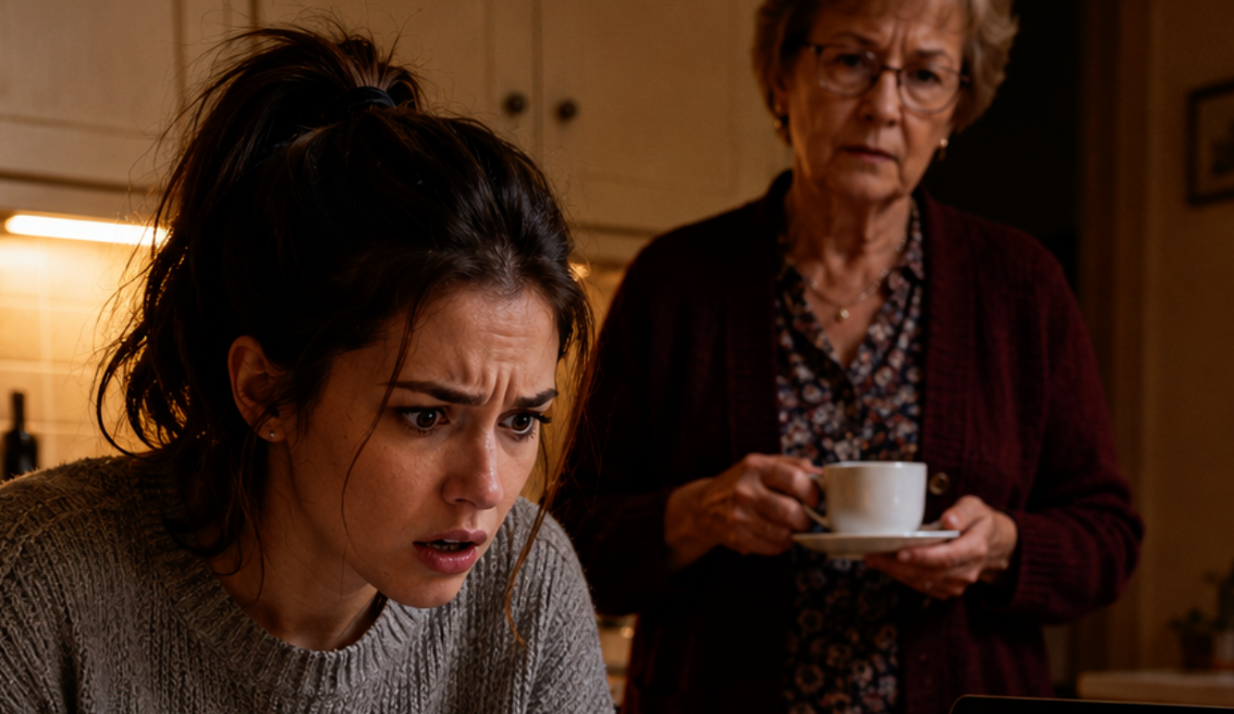
Galina Petrovna asked her daughter-in-law for one small favor—to link her card to the family account. Just for convenience, she said. Vera agreed without giving it much thought. Six months later, she opened the bank statement and felt as though she couldn’t breathe.
Vera found the statement by accident. She had been looking for the electricity bill in a folder on the laptop desktop and opened the wrong file. It was a bank statement covering six months. The family account—the same one to which she herself had linked her mother-in-law’s card back in March.
She scrolled through the first page, then the second, then the third. Her fingers froze on the touchpad.
Eight hundred and forty-two thousand rubles.
Charges she knew absolutely nothing about.
It had all started simply enough.
Galina Petrovna came to stay with them in February, after Kostya slipped on the ice and broke his leg. For two weeks, he lay at home with a cast stretching from his knee to his ankle. Vera was working, their daughter Sonya was four, and someone had to cook soup, take the child to kindergarten, and make sure Kostya didn’t try walking before he was supposed to.
“Mom, come over,” Kostya said on the phone. “Vera can’t handle everything by herself.”
He didn’t ask Vera.
He simply called his mother and told her to come.
Vera only found out when she saw a suitcase in the hallway.
“I won’t be here long,” Galina Petrovna said as she took off her boots. “Just until Kostya is back on his feet.”
She was wearing a burgundy cardigan with stretched sleeves and a skirt that reached halfway down her calves. She was about five foot two, with thin wrists and short, graying hair. She smelled of lily-of-the-valley perfume and train travel.
Vera nodded.
What else could she say?
They really did need the help.
For the first few days, Galina Petrovna behaved perfectly. She cooked borscht, picked Sonya up from kindergarten, and ironed the laundry. Vera would come home from work to find a spotless kitchen, dinner on the table, and her daughter dressed in fresh pajamas.
“Thank you,” Vera said every evening.
“There’s nothing to thank me for, Verochka. We’re family.”
Kostya lay on the sofa scrolling through his phone and occasionally asking for tea. He was thirty-six, but whenever his mother was around, he somehow turned back into a little boy.
Galina Petrovna brought him tea on a tray, complete with a saucer and two cubes of sugar.
Vera never put sugar in his tea.
When she made it, Kostya never asked for any.
The conversation about the bank account happened at the end of February.
Galina Petrovna was standing at the stove, stirring rassolnik soup, when she suddenly turned toward Vera.
“Verochka, there’s something I wanted to ask. You and Kostya have a joint account, don’t you?”
“Yes. A family account. Why?”
“Could you link my card to it too? Just for convenience.”
Vera was holding a plate she had been about to put into the cupboard. Her hand stopped halfway.
“What exactly do you mean by ‘for convenience’?”
Galina Petrovna smiled.
She had a habit of smiling whenever she asked for something awkward. Her lips stretched into a smile, but her eyes remained watchful, like a cat preparing to pounce.
“Well, I buy groceries, I take Sonya places. Sometimes I need money for a taxi or little things. I don’t want to have to ask Kostya every time. It’s uncomfortable.”
“You can just tell me how much you need and I’ll transfer it.”
“Oh, Verochka, why make things complicated? Just link the card. I’ll only spend money on household expenses. My pension is small, you know that.”
Vera did know.
Galina Petrovna received twenty-three thousand rubles a month. She lived in a one-room apartment in Kaluga. Her expenses were utilities, food, and blood pressure medication.
There wasn’t much left over.
Vera placed the plate inside the cupboard and closed the door.
“I’ll talk to Kostya.”
“Kostya doesn’t mind. I already asked him.”
There it was.
She had already asked him.
Vera felt the muscles in her jaw tighten. She consciously unclenched her teeth.
“All right. I’ll do it.”
And she did.
That same evening, while Sonya watched cartoons and Kostya dozed with a tablet resting on his stomach, Vera opened the banking app and linked Galina Petrovna’s card to the family account.
She didn’t set a spending limit.
Kostya said there was no point.
After all, it was his mother.
March passed quietly.
Kostya recovered, started walking with a cane, and then without one.
Galina Petrovna didn’t leave.
“I’ll stay a little longer,” she said. “I’ll help with Sonya while you’re at work.”
Vera worked as an accountant for a construction company. She left home at eight in the morning and returned at seven in the evening. Her commute took an hour each way: subway, transfer, bus.
She woke at six, when it was still dark outside, and drank her coffee standing beside the sink because Galina Petrovna was already sitting at the table watching the morning news.
“Good morning, Verochka.”
“Good morning.”
They exchanged those words every day like a password.
Two words with nothing behind them.
Kostya returned to work three weeks after recovering. He was a sales manager for a company that sold industrial equipment. His salary was good, and he traveled frequently for work.
In April, the company sent him to Yekaterinburg for a week.
“Mom, keep an eye on the girls here,” he said as he put on his jacket.
The girls.
Vera was thirty-four.
She had stopped feeling like a girl around the time she gave birth to Sonya and went three days without sleeping because the baby wouldn’t breastfeed.
But Vera said nothing.
The lock clicked, and Kostya left.
In April, Vera noticed the first strange things.
Not with the money.
With their belongings.
A new tablecloth appeared in the kitchen. It was yellow and green, checkered, made of thick cotton.
Vera knew for certain she hadn’t bought it.
“Where did this come from?” she asked, touching the fabric.
“I bought it,” Galina Petrovna replied. “The old one was completely worn out.”
The old one had been gray linen, and Vera had chosen it herself a year and a half earlier at a store on Taganka.
She liked that tablecloth.
“I see.”
A week later, a new bath mat appeared.
Pink.
Fluffy.
Vera hated fluffy bathroom mats because they never dried properly and eventually started to smell.
“Galina Petrovna, I don’t like mats like this.”
“Oh, Verochka, it’s such a small thing. At least your feet stay warm. Sonya likes it.”
Sonya liked everything pink.
She was four.
That wasn’t an argument.
Vera put the mat in the cupboard.
The next morning, it was back on the bathroom floor.
Wet.
Someone had already taken a shower.
Vera stood there staring at it and counted the tiles on the wall.
Twelve rows horizontally.
Sixteen vertically.
She always counted things when she was angry.
It stopped her from saying something she might regret.
In May, Galina Petrovna rearranged the furniture in the living room.
Vera came home from work and barely recognized the room.
The sofa was against a different wall. The television had been moved near the window.
The coffee table was gone.
“Where’s the table?”
“On the balcony. It was only taking up space.”
That was where Vera spread out her paperwork in the evenings and drank tea.
It was her place.
Thirty minutes of peace before bed.
“Verochka, it’s much more spacious this way. Kostya said he likes it.”
Kostya was sitting on the sofa against its new wall, nodding.
Perhaps he really did like it.
Or perhaps he simply didn’t want to argue with his mother.
Vera walked to the balcony and opened the door.
The coffee table stood between the drying rack and the bicycle.
It was wet from the rain.
She closed the door.
Then she wiped her hands on her jeans, even though they were dry.
“Kostya, can I talk to you for a minute?”
They went into the kitchen.
Galina Petrovna remained in the living room and turned up the television.
“She rearranged the furniture,” Vera said quietly.
“So what? It looks fine.”
“She didn’t ask me.”
“Vera, she was just trying to help. Don’t start.”
Don’t start.
His favorite phrase.
Vera heard it every time she tried to say anything about his mother.
Don’t start.
Don’t make a big deal out of it.
Don’t invent problems.
“When is she leaving?”
“She likes it here. Why should we kick her out? She helps us.”
Vera pressed her lips together and looked out the window.
In the courtyard, an empty swing creaked in the wind.
“All right,” she said.
She always said all right.
And every time, those words seemed to weigh a little more.
In June, Vera decided to check the account.
Not because she was suspicious.
The electricity bill was due, so she opened the banking app.
The joint-account balance seemed unusually low.
Vera earned eighty thousand rubles a month. Kostya earned one hundred and twenty thousand.
Together, that was two hundred thousand.
The mortgage took sixty-eight thousand.
Utilities were twelve thousand.
Then there was kindergarten, food, gas, clothes.
There should normally have been thirty or forty thousand left as a reserve.
But the account held only fourteen thousand.
Vera opened the transaction history.
She scrolled.
Then she closed the laptop.
Her hands rested on the table.
She stared at the closed lid and listened to Galina Petrovna humming an Alla Pugacheva song in the kitchen.
Then Vera opened the laptop again.
Slowly, as though something inside might have changed during those thirty seconds.
Nothing had changed.
The charges began in March.
Neat, small transactions.
Three thousand at a grocery store.
Two and a half thousand at a pharmacy.
Twelve hundred for a taxi.
Taken individually, every transaction seemed reasonable.
Household expenses.
Exactly what Galina Petrovna had said she would use the card for.
But Vera was an accountant.
She knew how to add numbers.
There were grocery purchases every day.
Sometimes twice a day.
The amounts grew.
Three thousand.
Five.
Seven.
In April, purchases from clothing stores appeared.
Four thousand eight hundred.
Then another six thousand.
Then nine and a half.
Vera scrolled forward to May.
Jewelry store: fourteen thousand.
Electronics store: twenty-one thousand.
The tablecloth.
The bath mat.
Something else Vera hadn’t noticed.
Or something that had never appeared in their apartment at all.
She took out a calculator.
Professional habit.
Even when the numbers were simple, she used a calculator instead of doing the arithmetic in her head.
A person’s mind could make mistakes.
A calculator didn’t.
Eight hundred and forty-two thousand rubles in four months.
Two hundred and ten thousand a month.
More than Vera’s entire salary.
She placed the calculator on the table.
Carefully.
Screen facing upward.
Dinner passed in silence.
Sonya chattered about a snail she had found at kindergarten.
Kostya ate his cutlets while looking at his phone.
Galina Petrovna gave her son another helping.
“Kostya, would you like some more salad?”
“Sure.”
Vera ate slowly.
She had to chew each bite longer than usual.
The food seemed tasteless.
Or perhaps taste wasn’t the problem.
Her throat simply didn’t want to swallow.
After dinner, she put Sonya to bed.
She read her a story about a hedgehog who had lost his mushrooms.
Sonya fell asleep on the second page, clutching a stuffed rabbit with one ear torn off.
Vera left the child’s room and closed the door firmly behind her.
Kostya was in the bedroom changing clothes.
She walked in and sat on the edge of the bed.
“I need to talk to you.”
“About what?”
“I looked at the bank statement.”
He didn’t turn around.
He pulled off his T-shirt and tossed it onto a chair.
“And?”
“Your mother spent eight hundred and forty-two thousand rubles in four months.”
Silence.
Kostya stood with his back to her, and Vera saw a muscle twitch between his shoulder blades.
Just once.
A tiny movement.
“It was for the household,” he said.
“Two hundred and ten thousand rubles a month for the household? Jewelry. Electronics. Clothes.”
“She helps us. She needs things.”
“She needs things bought with our money.”
He turned around.
His eyes narrowed.
Vera knew that expression.
It meant he was about to tell her not to start.
She raised a hand.
“Don’t tell me not to start. I’ve started. And I’m going to finish.”
“Vera, she’s my mother.”
“And that is our money. Mine too.”
He sat down on the bed beside her.
Not close.
An arm’s length away.
“How much did you say?”
“Eight hundred and forty-two thousand.”
He rubbed the bridge of his nose.
Then his forehead.
Then the bridge of his nose again.
It was a habit he had whenever he didn’t know what to do.
“Maybe she didn’t understand.”
“She understood.”
“How do you know?”
“Because she bought things for herself and never brought them into this apartment. A jewelry store, Kostya. Fourteen thousand. Have you seen her wearing any new jewelry?”
He said nothing.
“Neither have I.”
Vera scheduled the conversation with Galina Petrovna for the next morning.
She deliberately woke up an hour earlier than usual.
At five, when the world outside was gray and quiet and even the birds were still silent.
She was sitting in the kitchen with a cup of coffee when her mother-in-law came into the hallway.
Her footsteps were soft in felt-soled slippers.
“Verochka? Why are you up so early?”
“Sit down, Galina Petrovna.”
Something in Vera’s voice made her mother-in-law obey without asking questions.
She lowered herself into the chair opposite Vera and placed her hands on the table.
They were dry hands, dotted with brown age spots.
“I looked at the statement,” Vera said.
Galina Petrovna’s expression didn’t change.
That was strange.
Someone who didn’t know what you were talking about would normally ask for clarification.
She didn’t.
“Eight hundred and forty-two thousand,” Vera continued. “In four months. Groceries, clothes, jewelry, electronics.”
“I bought things for the household.”
“A tablecloth for twelve hundred rubles is for the household. What was a fourteen-thousand-ruble necklace for?”
Galina Petrovna tightened her fingers.
Her knuckles turned white.
“Verochka, I’m Kostya’s mother. He’s my son. I have a right…”
“To what?”
A pause.
The refrigerator hummed in the kitchen.
Outside, an early car drove past.
“I’m not accusing you,” Vera said, even though she was. “I want to understand. Why?”
Galina Petrovna looked up.
There was no shame in her eyes.
There was hurt.
Real, living, familiar hurt.
“You wouldn’t understand.”
“Try me.”
Her mother-in-law remained silent for a long time.
Vera didn’t rush her.
She drank her coffee and looked out the window.
The courtyard was empty.
The swings stood still.
“My pension is twenty-three thousand,” Galina Petrovna began. “Seven thousand goes to utilities. Five to medicine. The rest goes to food. And that’s it. Every month is the same. Twenty years of the same thing.”
She stopped, then continued more quietly.
“I came here to help. And I did help. But then I saw how you live. An apartment, a car, cafés on weekends. An eight-thousand-ruble jacket for Sonya. Twelve-thousand-ruble sneakers for Kostya. And I’m wearing the same boots for the fourth winter in a row.”
Vera put down her cup.
The coffee had gone cold.
“So you decided to take the money yourself.”
“I didn’t steal it. Kostya gave me access.”
“I gave you access. For groceries.”
“What difference does it make? The money belongs to both of you. Kostya is my son. I raised him alone, by the way. No husband. No help. I sewed clothes for people at night so he could go to school looking clean and decent. And now what? I’m not even entitled to a tablecloth?”
Galina Petrovna’s voice rose.
Not to the point of shouting.
Just to that point where words begin to tremble.
Vera remained motionless.
She heard every word.
She understood every word.
And none of it made her feel any better.
“You’re right,” she said. “You raised him. But that doesn’t give you the right to spend someone else’s money without asking.”
“Someone else’s? I’m a stranger now?”
“The money isn’t yours. You are not a stranger. Those are two different things.”
Galina Petrovna stood.
The chair scraped across the floor.
She walked to the window and stood with her back to Vera.
Her shoulders were straight.
Her chin was raised.
“So that’s how it is.”
“Galina Petrovna…”
“I understand. I’m not wanted here.”
“I didn’t say that.”
“Then what are you saying? That I’m not allowed to spend a kopeck? That I’m a freeloader?”
“I’m saying eight hundred thousand rubles is not a kopeck.”
Her mother-in-law turned around.
Her face was dry, without a single tear, but her lower lip trembled.
“I’ll leave.”
“I’m not asking you to leave. I’m asking you to return the money.”
Kostya came into the kitchen half an hour later.
His mother had already locked herself in her room.
Vera was washing a cup.
“What happened?”
“I talked to your mother.”
“Without me?”
“You would have said, ‘Don’t start.’”
He opened his mouth and then closed it again.
Because she was right.
They both knew it.
“What did she say?”
“That she raised you alone and believes she deserves it.”
“And what did you say?”
“That eight hundred thousand rubles is a lot of money.”
Kostya sat at the table.
He placed both hands flat on the tabletop.
Vera could see his fingers tapping rapidly against the surface.
Nervously.
“She won’t return the money,” he said.
“Why?”
“Because she doesn’t have it. She spent it.”
“On what? Where are the things?”
“I don’t know.”
He knew.
Or at least suspected.
Vera could tell by the way he glanced away.
Quickly.
Down and to the left.
He did that when he lied or when he didn’t want to tell the truth.
“Kostya.”
“She was sending money to her sister,” he said quietly. “Aunt Raya. Her husband is sick. Cancer. Treatment. Medication.”
Vera leaned against the sink.
The faucet was dripping softly.
She watched a drop swell, fall, and begin forming again.
“How do you know?”
“Mom told me yesterday. After you fell asleep.”
“Yesterday. You knew yesterday and didn’t tell me.”
“I didn’t know how.”
The drop fell.
It hit the sink with a short sound that seemed loud in the silence of the kitchen.
“Couldn’t Aunt Raya ask us herself? Doesn’t she have children?”
“She has a daughter in Novosibirsk. She’s unemployed. Her husband left her.”
“Couldn’t Aunt Raya get treatment through the government quota system?”
“Mom says there is a quota, but it doesn’t cover all the medication. The imported drugs are expensive.”
Vera turned off the tap.
The dripping stopped.
“So your mother took our money and sent it to her sister to pay for her husband’s cancer treatment. Without asking us. Eight hundred thousand rubles.”
“Not all eight hundred thousand. She really did spend some of it on herself.”
“How much?”
“I don’t know. Maybe a hundred thousand.”
“Maybe.”
She dropped that word between them like a stone.
Heavy.
Dull.
For three days, the apartment was quiet.
Not the kind of quiet that means everything is fine.
The kind of quiet that happens when everyone is afraid to speak first.
Galina Petrovna came out of her room only for breakfast and dinner.
She ate silently, washed her own plate, and went back inside.
Sonya sensed something was wrong and became irritable.
She refused to put on her tights.
She spilled her soup.
She bit Vera’s finger.
“Ow! Sonya!”
“I don’t want to! Grandma Galya won’t read to me! Why is Grandma Galya sad?”
Vera crouched in front of her daughter and took her hands.
The little fingers were sticky from an apple.
“Grandma Galya is tired. She’ll be all right soon.”
“Promise?”
“I promise.”
Vera wasn’t sure she had the right to make that promise.
Kostya avoided conversations.
He came home from work, ate dinner, played with Sonya, and went to bed.
Between him and Vera stood a word neither of them said aloud.
Betrayal.
Or perhaps not betrayal.
Vera couldn’t decide.
On the fourth day, she went to Galina Petrovna herself.
She knocked.
Her mother-in-law was sitting on the bed in the room that had once been Vera’s study.
A book lay upside down across her lap.
“May I come in?”
Galina Petrovna nodded.
Vera sat in the chair beside the desk.
There was a glass of water on the desk, a pair of glasses in a red case, and a blister pack of blood pressure pills.
“Tell me about Aunt Raya,” Vera said. “Everything.”
Her mother-in-law was silent for a long time.
Then she began.
Raya was four years younger than Galina Petrovna.
They had grown up in Kaluga, in the same courtyard. Technically, they were cousins rather than sisters, but they had always been closer than sisters.
Raya helped Galina Petrovna when she found herself alone with a young Kostya.
She brought food.
She watched the child.
She lent Galina Petrovna money and never asked to be repaid.
“She saved me,” Galina Petrovna said. “More than once.”
Raya’s husband, Viktor, had become ill a year earlier.
Lung cancer.
His surgery had been covered by a government quota, but for chemotherapy he had been prescribed an imported medication that wasn’t included on the approved list.
A course cost one hundred and twenty thousand rubles a month.
“Raya’s pension is eighteen thousand. Viktor gets twenty-one. Their daughter is unemployed. Who is supposed to help them?”
“You could have asked Kostya.”
“I did.”
“And?”
“He said, ‘Mom, we have a mortgage.’”
Vera closed her eyes.
Then opened them again.
The glass of water was still in the same place.
The world had not changed.
“He knew?”
“He knew Viktor was sick. He didn’t know I was sending them money.”
“Then how did he find out yesterday?”
“I told him myself. I got scared that you would discover it.”
Vera rubbed her temples.
Her head was beginning to ache.
A dull, steady pain behind her eyes.
“Why didn’t you talk to me? Directly?”
“Would you have agreed?”
“I don’t know. But it would have been honest.”
Galina Petrovna lifted the book from her knees and put it on the bedside table.
Vera saw the cover: Dina Rubina, On the Sunny Side of the Street.
The spine was worn.
The corners were bent.
“I knew I was being dishonest,” her mother-in-law said. “And I did it anyway. Because Raya will die if Viktor dies. Not physically. She’ll simply stop living.”
Vera knew what that looked like.
Her grandmother had survived her grandfather by eight months.
For eight months she had sat beside the window, barely eating and barely speaking.
Then she died quietly in her sleep.
As if she had simply decided not to wake up anymore.
“I’m not making excuses,” Galina Petrovna said. “Do whatever you think is right.”
That evening, Vera sat in the bathtub.
The door was locked.
The pink bath mat lay under her feet, wet and warm.
She stared at the tiles.
Twelve rows horizontally.
Sixteen vertically.
She counted them and couldn’t stop.
Eight hundred thousand rubles.
Four months.
A sick couple in Kaluga.
A mother-in-law who had sewn clothes at night thirty years ago so her son could go to school in clean clothes.
A husband who had said, “We have a mortgage.”
A mortgage they still had nine years left to pay.
Vera picked up her phone.
She opened the banking app.
The balance was fourteen thousand.
Twelve days until payday.
She closed the app.
Opened her contacts.
Found “Kostya.”
She didn’t call him.
The bathwater had gone cold a long time ago.
Vera sat in the cold water and thought.
Not about the money.
About Raya, whom she had never met.
About Viktor and his lung cancer.
About her grandmother sitting by the window.
About Sonya asking why Grandma Galya was sad.
About herself.
About the fact that truth could be uncomfortable from both sides.
She got out of the bathtub, dried herself, put on a robe, and walked into the kitchen.
Kostya was sitting at the table.
An empty cup stood in front of him.
“I don’t know what to do,” he said.
For the first time in four days, there was no defensiveness in his voice.
Only exhaustion.
Vera sat opposite him.
She placed her hands on the table.
His hands rested nearby, but they didn’t touch.
“How much does Viktor’s treatment cost?”
“One hundred and twenty thousand a month. He has three courses left.”
“Three hundred and sixty thousand.”
“Yes.”
“We don’t have that kind of money.”
“I know.”
“But together, we can find it.”
He looked up.
“What do you mean?”
“I can take on extra work. Evening work. Remote bookkeeping. Outsourced accounts. Thirty or forty thousand a month. If you give up on buying a new car.”
“Vera…”
“I’m not forgiving what happened. I’m not saying it was okay. But if someone is dying and we can help and choose not to, then what kind of people does that make us?”
He said nothing.
Then he reached across the table and covered her hand with his.
His palm was warm and slightly damp.
“Thank you.”
“Don’t thank me. You can thank me after I disconnect your mother’s card from our account.”
He nodded.
The next morning, Vera set a spending limit.
Five thousand rubles a month.
Groceries and small household expenses.
Not a kopeck more.
She didn’t disconnect Galina Petrovna’s card immediately.
First, she called Aunt Raya.
Her mother-in-law gave her the number silently, writing it on a slip of paper in crooked handwriting.
Raya answered after the fifth ring.
Her voice was quiet and hoarse.
“Hello?”
“Hello. This is Vera, Kostya’s wife.”
“Oh… hello, Verochka. Galya has told me about you.”
Vera was standing on the balcony.
Below, children played in a sandbox.
The coffee table was still there, between the drying rack and the bicycle.
“How is Viktor?”
“He’s undergoing treatment. The doctors say there’s a chance. But the treatment is expensive.”
“I know. Galina Petrovna was helping.”
“Yes. I didn’t ask her to. She did it herself.”
Vera was silent for a moment.
“We’ll continue helping. But differently. Through direct transfers. With my knowledge.”
“Verochka…”
“You don’t need to say anything. Just send me the invoices from the clinic.”
She ended the call and remained on the balcony for another minute.
The wind touched her hair.
The air smelled of linden trees from the neighboring courtyard and something bitter from the road.
Then she picked up the coffee table, carried it back into the living room, and placed it exactly where it had been before.
Galina Petrovna left a week later.
She packed the same suitcase she had arrived with in February.
Vera stood in the hallway watching her mother-in-law close the zipper.
“I’ll leave the tablecloth,” Galina Petrovna said. “You can throw it away.”
“Leave it. It can stay.”
Her mother-in-law straightened.
She looked at Vera.
Between them were two meters of hallway and four months that neither of them could rewind.
“I was wrong. I’m guilty before you.”
“Yes.”
“You haven’t forgiven me.”
“I don’t know.”
“When you know, tell me.”
She hugged Sonya, who wrapped herself around her grandmother’s legs and refused to let go.
Then she kissed Kostya on the forehead.
Then she nodded to Vera.
Not coldly.
Not warmly.
She simply nodded.
The door closed.
Vera stood in the hallway listening to the elevator descend.
The mechanism hummed.
The cables vibrated.
She counted the floors by the sound.
Fifth.
Fourth.
Third.
Sonya tugged at her hand.
“Mom, will Grandma Galya come back?”
“I don’t know, Sonya.”
“Will the tablecloth stay?”
“It’ll stay.”
Sonya ran back into the room.
Vera walked to the kitchen window.
Galina Petrovna emerged from the building, dragging her suitcase over the asphalt.
Burgundy cardigan.
Mid-calf skirt.
Straight back.
At the courtyard gate, she stopped and looked upward.
Vera stepped away from the window.
She didn’t know whether her mother-in-law had seen her.
Viktor began improving after his second course of treatment.
Raya called Vera herself in August and said the doctors were cautiously beginning to talk about remission.
Her voice sounded different.
No longer hoarse.
Alive.
“Thank you, Verochka.”
“Don’t thank me.”
“I’m grateful to Galya too. And to you. You could have refused to help.”
Vera said nothing.
She could have.
She had every right to.
And still, she had helped.
The extra work consumed her evenings.
Vera sat at her laptop from nine at night until midnight, sorting through other people’s invoices and reconciliation statements.
Her eyes hurt.
Her neck grew stiff.
Kostya brought her tea without sugar and placed it on the coffee table.
That same coffee table.
One evening near the end of August, he sat beside her.
“Vera.”
“Hmm?”
“I gave up on the car.”
“I know. You told me.”
“No, I mean I really gave it up. I sold the old one for more than I expected and sent the difference to Raya. Seventy thousand.”
She removed her glasses.
Rubbed the bridge of her nose.
Looked at him.
“Why couldn’t you do that before?”
“I don’t know. Maybe I didn’t understand.”
“And now you do?”
“Not completely. But I’m trying.”
She put her glasses back on and returned to the screen.
He didn’t leave.
He simply sat beside her in silence while she worked.
It felt closer than any words could have.
In September, Vera received a message from Galina Petrovna.
Not a phone call.
A message.
Three lines.
“Verochka, Viktor has finished his treatment. Raya says he’s doing better. Thank you. I won’t forget what you did.”
Vera read it.
Then read it again.
She put the phone on the table.
The yellow-and-green checkered tablecloth was still in the kitchen.
Thick cotton.
Vera had never bought another one.
Perhaps she had gotten used to it.
Or perhaps she had decided that some things should remain as reminders.
She picked up her cup, poured herself some coffee, and sat at the table.
She ran a finger over the fabric.
Thick.
Rough.
Covered in a small checkered pattern.
The morning sunlight lay across it in a slanted rectangle.
She didn’t reply immediately.
She waited two days.
“Galina Petrovna. I’m glad Viktor is doing better. Come to Sonya’s birthday. In October.”
She sent the message and put her phone aside.
The hallway was quiet.
But it was a different kind of quiet.
Not the silence from the summer, when everyone had been afraid of words.
This silence felt like an inhale before a conversation that had not yet begun but was no longer frightening.
Vera finished her coffee.
She washed the cup.
Placed it on the drying rack.
The tablecloth remained on the table.
Yellow and green.
Checkered.
Once foreign, now familiar.
Like everything you grow accustomed to not because you like it, but because it contains a piece of someone else’s truth that you can’t simply throw away.