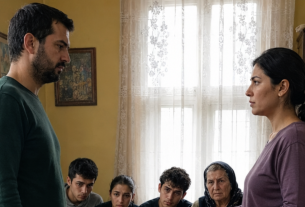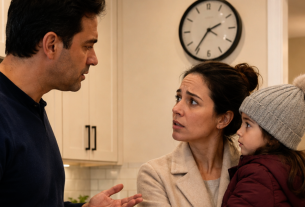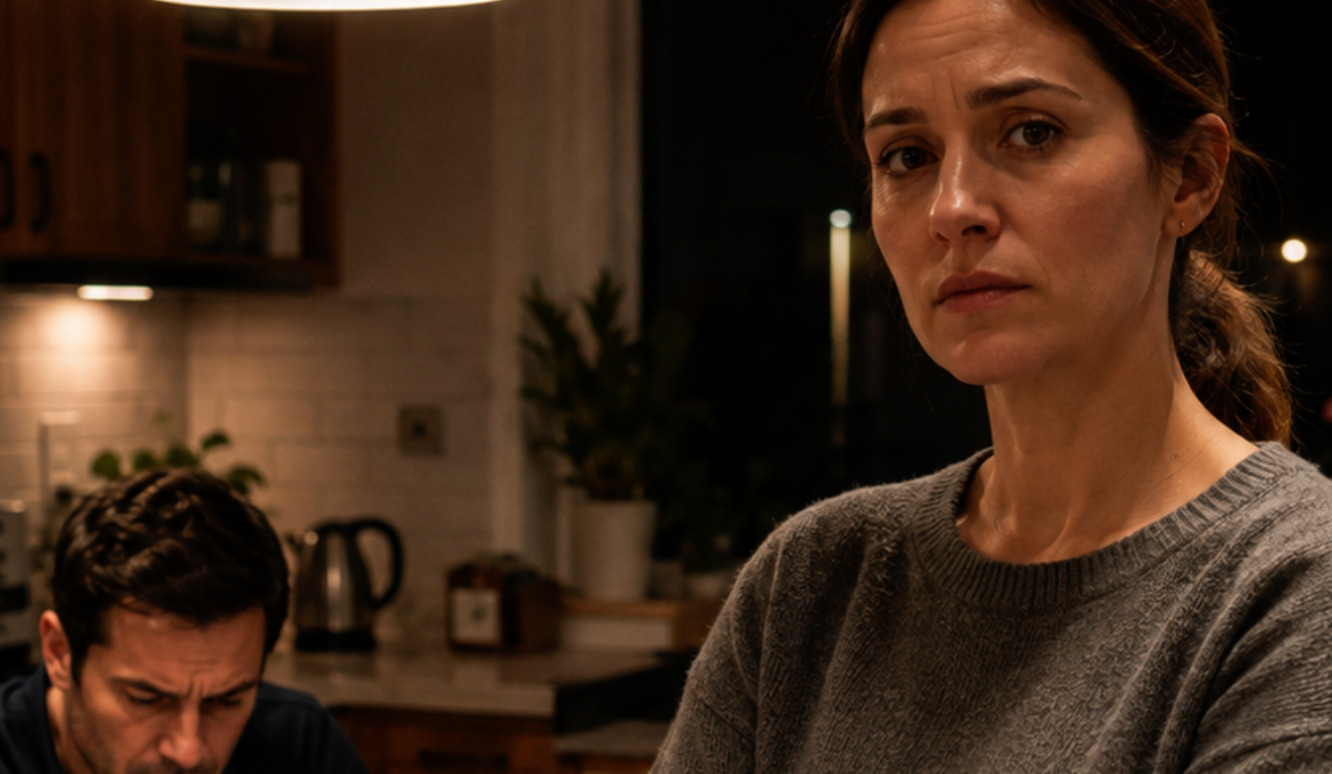
Galina thought she knew her husband. Twenty years together, two children, a shared life. But one sentence spoken at the kitchen table changed everything she thought she knew about him.
Galina put the kettle on the stove and heard the front door lock click. Oleg had come home earlier than usual. That in itself meant nothing, yet for some reason she wiped her hands on the towel twice before turning around.
He was standing in the kitchen doorway without taking off his coat. In his hand was a transparent folder filled with documents.
“Sit down. We need to talk.”
She didn’t sit. She leaned against the counter and folded her arms. It was a habit she had inherited from her mother: when you sense something is wrong, keep your hands occupied so they don’t give you away.
“Go ahead.”
He placed the folder on the table, unzipped his coat, and sat down. The chair creaked. Oleg rubbed the bridge of his nose between his thumb and forefinger, and Galina noticed that the skin on his hands had grown drier over the past year. A tiny detail, but she noticed things like that.
“I’ve calculated everything. We don’t have enough for the down payment. We’re seriously short.”
He was talking about an apartment in a new development. They had been discussing moving since autumn. Their two-room apartment on Biryulyovskaya Street had become cramped: at sixteen, Lyosha took up the entire bedroom, while Nastya slept in the walk-through room behind a wardrobe. Galina wanted to move too. But there was something else on Oleg’s face. Something beyond numbers.
“How much are we short?”
“Two and a half million.”
She nodded. The amount was about what she had expected. They had been saving for three years, and every time something got in the way: repairs to the car, Nastya’s dental treatment, Oleg being laid off from his previous job.
“We talked about this. We’ll take out a loan.”
“I found a better option.”
He opened the folder. Inside was a printout from a real-estate website. Galina saw a familiar address and, for a moment, couldn’t understand why it looked familiar.
Then she realized.
It was her mother’s apartment.
A one-room apartment on Tashkentskaya Street, third floor, forty-one square meters. Green wallpaper her mother had put up herself in 1998. A balcony overlooking the poplar trees.
Her mother had died a year and a half earlier. Galina still went there once a week: she dusted, watered the ficus, checked the pipes. The keys were kept separately in a small pocket of her handbag, attached to the same keychain with a plastic ladybug that her mother had bought at a market about fifteen years ago.
“Are you serious?”
“Listen to me. The apartment is just sitting there unused. No one lives there. We sell it, add the money to what we already have, and we’ll have enough not only for the down payment but for renovations too. Clean and simple. No loan.”
He spoke calmly. Businesslike, as though he were at a meeting. Galina knew that tone. Oleg used it whenever he considered his position indisputable. Facts, numbers, logic. She often lost against that tone because she thought differently.
Not in numbers.
“It’s my mother’s apartment, Oleg.”
“I know whose apartment it is. I went to your mother’s birthday every year for seventeen years. I know.”
“Then you should understand.”
“I do understand. That’s exactly why I’m suggesting it. Anna Petrovna was a practical woman. She would have approved.”
Galina clenched her jaw.
He shouldn’t have said that.
He shouldn’t have brought her mother’s name into an argument about money.
The kettle whistled. She took it off the stove but didn’t pour the water anywhere. She simply held the kettle and watched the steam.
Anna Petrovna Rybakova had lived in that apartment for thirty-four years. She had moved there with five-year-old Galya after her first husband left.
She hadn’t thrown him out.
She hadn’t caused a scene.
She had simply come home from work one day, found his wardrobe empty, and discovered a note on the refrigerator:
“Sorry. I can’t do this anymore.”
Three words.
No explanation. No address.
Her mother had taken down the note, folded it into quarters, put it in the pocket of her apron, and never spoke about him again.
Not once in all those years.
Galina learned the details only when she was twenty-three and already dating Oleg.
“Mom, what about Dad? Is he even alive?”
“He’s alive. In Saratov.”
“Didn’t you ever want to find him?”
“Why?”
And that was it.
The conversation was over.
Her mother placed a plate of vareniki in front of her and turned on the television.
The apartment on Tashkentskaya became everything: a fortress, a workshop, an infirmary.
Her mother worked as an accountant at a garment factory and took extra jobs in the evenings, sewing curtains for neighbors and altering old coats. Galina grew up to the sound of a sewing machine.
That steady, rapid sound was still associated with safety in her mind.
In the corner of the room stood her mother’s chair: wooden, with a worn burgundy velvet cushion. Her mother’s cardigan always hung over the back.
Gray, knitted, with one button that had been sewn back on.
When her mother became ill, Galina brought her to live with them. But every evening Anna Petrovna asked the same thing.
“Did you water the ficus?”
“I did, Mom.”
“And did you close the little window? There’s a draft. The pipes could freeze.”
“I closed it.”
Then her mother would relax.
As though the apartment weren’t a home but a living creature that needed someone to look after it.
She died in March.
Quietly, at night, in her sleep.
Galina found her the next morning when she came in carrying tea. The mug of chamomile infusion remained on the bedside table. Galina didn’t move it.
For three days she couldn’t bring herself to enter the room. When she finally did, the tea had dried up, leaving a dark ring at the bottom of the mug.
Oleg was waiting for an answer.
He sat at the table with his printouts spread before him: the apartment’s estimated market value, mortgage calculations if they kept it, calculations without a mortgage if they sold it.
Two columns of numbers.
The savings in the second column came to more than a million.
“Just look at it calmly, without emotions. Just look at the numbers.”
Galina put the kettle on its stand.
“Without emotions?”
“I didn’t mean to hurt you. I want our children to live properly. Lyosha will be going into the army or university in two years. He needs his own room. Nastya’s growing up. She’s thirteen. She can’t keep sleeping behind a wardrobe.”
All of that was true.
Galina knew it.
Every evening she herself felt guilty when her daughter went behind her partition and put on headphones so she wouldn’t hear the television through the thin wall.
But the apartment.
Her mother’s apartment.
“I go there.”
“I know. Every Saturday. You dust.”
“Not just dust.”
He was silent for a moment and rubbed the back of his neck.
“Gal, I’m not forcing you. I’m suggesting it.”
“You brought printouts. Prices. You’ve already checked how much it’s worth.”
He didn’t deny it.
“Yes. I called an agency. Just to ask.”
“Just to ask.”
“Well, what’s wrong with that? Am I not allowed? I’m the head of the family. I have to think ahead.”
Galina turned toward the window.
It was February outside. A streetlamp glowed yellow, and the snow on the windowsill had begun to melt, a transparent drop hanging from its edge.
She watched the drop and thought about how her mother used to seal the windows with strips of paper in winter. She would mix flour into paste, cut newspapers into strips, and seal every crack.
The drafts disappeared.
The apartment became warm.
Cloudy streaks crawled across the glass.
“I need to think,” Galina said.
“Of course. Think about it.”
He put away the folder, stood up, and poured himself some tea.
They drank in silence.
The clock on the wall ticked.
It had belonged to her mother. A round cuckoo clock whose cuckoo had stopped calling about ten years ago. Galina had brought it home after the funeral.
Oleg hadn’t said anything then.
The next morning, Galina drove Nastya to school and went to Tashkentskaya Street.
It wasn’t part of her routine. Saturday was still three days away, but she needed to be there.
Right now.
The stairwell smelled of bleach and something vaguely feline.
On the third floor, Galina stopped in front of the brown door marked number 17.
She took out the keys.
The ladybug on the keychain had lost most of its paint, and one eye had rubbed away, but throwing it out was impossible.
It was cold inside.
She kept the radiators at the minimum setting to keep the bills down.
The ficus stood on the windowsill, green and stubborn, just like her mother.
Galina walked over and touched the soil.
Dry.
She poured water from a bottle she kept there specifically for that purpose.
The apartment was silent.
But it wasn’t an empty silence.
It smelled of her mother: old wood, a hot iron, and the faint trace of lavender from a sachet Galina had hung in the wardrobe a year earlier.
Her mother’s real scent was already gone.
Galina was trying to hold on to it anyway.
She sat down in the same chair.
The burgundy cushion sagged under her, and a spring inside gave a quiet squeak.
The cardigan was still hanging over the back.
Galina pressed the sleeve to her face.
Nothing.
Only wool and time.
Her phone rang.
Oleg.
“Where are you?”
“At Mom’s apartment.”
“Oh. All right. I told Lyosha he could go to Dimka’s after school. Okay?”
“Okay.”
“Gal.”
“What?”
“I’m not the enemy.”
“I know.”
She ended the call and sat in silence for another half hour.
A photograph hung on the wall: her mother, young, holding Galina in her arms.
Black and white, with one corner bent.
Her mother was twenty-seven in the picture.
The same age Galina had been when Nastya was born.
That evening Oleg brought up the subject again.
Not directly.
He circled around it.
“I talked to Seryoga. He sold his two-room apartment on Bratislavskaya for seven point eight million. Bought it four years ago for five point three.”
“Mm-hmm.”
“The market’s going up. If we wait, the new development will get more expensive. One-room apartments on the secondary market are staying more or less the same.”
Galina was chopping cabbage for shchi.
The knife struck the cutting board in steady beats.
“What are you getting at?”
“Nothing. Just information.”
“What are you getting at, Oleg?”
He fell silent.
Then said:
“I want to live normally. I want our children to live normally. I’m forty-five years old, and I sleep on a fold-out sofa in the living room. Every morning I put the bedding away so Nastya can get to the bathroom. That’s not a life.”
She stopped cutting.
“I sleep beside you on that same sofa.”
“Exactly. And you deserve better too.”
“Don’t sell me my own dream in exchange for my mother’s apartment.”
He raised both hands.
“Fine. Fine, Gal. Then what? A mortgage? For twenty years? I’ll be sixty-five by the time I pay it off.”
“Then you’ll be sixty-five.”
“Do you understand how insane that is?”
“I understand. Do you understand that it’s my mother’s home?”
“It’s an apartment. Forty-one square meters. Concrete, wallpaper, and pipes. Your mother isn’t there.”
The knife slipped from her fingers and struck the sink with a metallic sound.
Not because Galina had dropped it.
She had placed it there.
Carefully, blade down.
But her hands were shaking.
“Don’t tell me where my mother is.”
He stopped short.
For the first time that evening, he truly looked at her.
Not as an opponent in an argument.
As a person in pain.
“I’m sorry. That’s not what I meant.”
“That’s exactly what you meant.”
She dried her hands, left the kitchen, closed the bathroom door, turned on the water, and stood over the sink for four minutes staring at the stream.
Then she turned it off and went back.
The cabbage was waiting.
For a week they barely spoke.
They didn’t argue.
No.
There was simply nothing to talk about.
Or rather, there was only one thing to talk about, and they couldn’t touch it.
Around that one subject grew a silence that slowly spread into everything else.
Lyosha didn’t notice anything. He was sixteen and had his own world.
But Nastya noticed.
At dinner, she looked from her mother to her father and back again like a spectator at a tennis match in which nobody was serving.
“Is everything okay with you two?”
“Yes, sweetheart. Everything’s fine.”
“Dad?”
“Everything’s fine, Nast.”
Their daughter shrugged and disappeared behind her wardrobe.
A minute later, the voice of some blogger drifted from her headphones, muffled but still audible.
Galina washed the dishes and thought.
She always thought while washing dishes.
Her mother had done the same.
Hands in water.
Mind working.
Oleg wasn’t a bad husband.
That was what made it difficult for her simply to become angry and say no.
He worked. He didn’t drink. He genuinely loved their children.
When Nastya had pneumonia at seven, he barely slept for three days, changed compresses, and counted her breaths.
When Lyosha got into a fight at school and someone broke his finger, Oleg took him to the emergency clinic, waited for three hours, and never once raised his voice.
He wasn’t bad.
He was rational.
And inside that rationality there was no place for things that couldn’t be calculated.
Her mother’s cardigan.
Her mother’s ficus.
Her mother’s chair with its sagging cushion.
How much were those things worth?
Zero.
There was no row for them in Oleg’s calculations.
On Saturday, Galina went to Tashkentskaya Street as usual.
She dusted the shelves, washed the floor, watered the ficus.
She opened the small window for fifteen minutes to let the room breathe.
It had grown warmer outside, and melting snow tapped against the windowsill like tiny drumbeats.
She took her mother’s box out of the wardrobe.
A metal cookie tin with “Yubileynoye” printed on it and a scratch across the lid.
Inside were Galina’s birth certificate, her mother’s employment records, photographs, apartment receipts, and one piece of paper folded into quarters.
The note.
The same note her father had left.
“Sorry. I can’t do this anymore.”
Her mother had kept it for thirty-seven years.
Not out of love.
Not out of resentment.
She had simply kept it.
The way people keep a movie ticket from a film they saw once and will never see again.
Galina unfolded the note.
The handwriting was small and uneven, the letters jumping across the page.
The handwriting of someone in a hurry to leave.
She folded it again, closed the box, and returned it to the wardrobe.
On her mother’s refrigerator there was a magnet shaped like a white cat with the words “Patience and hard work.”
Galina had never removed it.
Every time she opened the refrigerator—empty and unplugged—she saw that cat and smiled.
Her mother had loved silly refrigerator magnets.
There were eleven of them.
On Monday, Rita called.
Rita had been her mother’s friend. She was seventy-two, had a bright voice, and spoke quickly, as though she were afraid she might not have enough time to finish.
“Galochka, I heard from Zina that you’re planning to sell Anya’s apartment?”
Galina nearly dropped the phone.
“Who said that?”
“Zina. Your neighbor Pyotr Ivanovich told her. He says some man came by and was taking pictures of the building entrance.”
Oleg.
He had photographed the entrance.
For the agency.
Galina closed her eyes.
Her fingers tightened around the phone until her knuckles turned white.
“Rita, we are not selling anything.”
“Oh, thank goodness. I was thinking Anya would have been so upset. She built that apartment practically brick by brick with her own hands.”
“Yes.”
“You should come over for tea, Galochka. I baked a pie. Apple, the way Anya liked it.”
“I’ll come.”
She ended the call and stood in the middle of the room for a while, staring at the wall.
Then she called Oleg.
“You went to Tashkentskaya Street.”
“What?”
“You went there and photographed the entrance. The neighbors saw you.”
The silence on the other end lasted about five seconds.
“I wanted to evaluate the condition of the building for…”
“For the agency.”
“Gal…”
“We’ll talk at home.”
At home, she waited for him in the kitchen.
Dinner was ready: shchi, cutlets, buckwheat.
Nastya was doing her homework. Lyosha had gone to Dimka’s.
When Oleg came in, Galina was sitting at the table with her hands folded in front of her.
No cabbage.
No knife.
Just her hands.
He hung up his coat, walked into the kitchen, saw her expression, and sat opposite her.
“I know what you’re going to say.”
“No. You don’t.”
She spoke quietly.
Not in a whisper.
Quietly.
Her voice was steady, without trembling, without tears.
That was how her mother spoke when she was truly serious.
She didn’t shout.
She lowered her voice to the level at which every word weighed twice as much.
“You went there without me. You photographed my mother’s building for strangers. You evaluated her apartment as merchandise.”
“I…”
“Wait. I’m not finished.”
He closed his mouth.
“I understand that you’re tired of living in a cramped apartment. So am I. I understand that the children are growing up. Every evening I hear Nastya turning over behind that wardrobe, and it hurts me too. But you did one thing you should never have done.”
“What?”
“You decided for me.”
He lowered his eyes.
On the table stood a white salt shaker with a crack down one side.
Her mother’s.
It came from the set her mother had given them as a housewarming gift twenty years earlier.
The pepper shaker had broken.
The salt shaker remained.
“You didn’t ask me. You came with printouts, prices, calculations. You called an agency. You photographed the entrance. And only after all of that did you sit down in front of me and say, ‘We need to talk.’ That wasn’t a conversation, Oleg. It was a presentation.”
He rubbed his face with both hands.
“I thought it would be easier that way. If I came with numbers.”
“Easier for whom?”
“For both of us. I knew it would be difficult for you, and I wanted to show you that objectively, financially, it made sense.”
“Objectively.”
“Yes.”
“My mother isn’t an object, Oleg. Her apartment isn’t an object. Her ficus, her wallpaper, her chair with the burgundy cushion where she sat for thirty-four years sewing curtains for people so that I could eat and go to school—none of that is a row in a spreadsheet.”
He said nothing.
Behind the wall, Nastya was listening to something through her headphones.
A quiet rhythm seeped through the drywall.
“I’m not selling it. And not because I’m sentimental, or stupid, or incapable of doing the math. I’m not selling it because it is the only place on Earth where my mother still exists. As long as that place exists, I can go there, sit in her chair, touch her cardigan, and sit in silence. I need that. I do.”
She looked directly at him.
“Do you hear me?”
“I hear you.”
“No. You hear the words. I’m asking you: do you hear me?”
He took off his glasses and wiped them with the edge of his shirt.
Without his glasses, his face looked softer.
Or perhaps more vulnerable.
He squinted, the wrinkles on his forehead smoothing out, and for a moment he resembled the young man who, twenty-two years earlier, had brought her daisies and forgotten to remove the price tag.
“I hear you,” he said in a different voice.
For three days they didn’t return to the subject.
But something changed.
Oleg stopped mentioning the new apartment development. He stopped doing calculations aloud and put away the folder with the printouts.
Galina didn’t know where he had put it.
She didn’t ask.
On Wednesday evening, he came home from work and silently placed a sheet of paper on the table.
She looked at it.
It was a mortgage calculation.
Twenty-two years.
A monthly payment of thirty-one thousand rubles.
At the bottom, in his handwriting, he had added:
“Without selling. We can handle it.”
Galina read it twice.
The third time, her eyes began to sting, and she blinked while staring at the ceiling.
“Thirty-one thousand a month.”
“Yes. We’ll have to tighten our belts. But Lyosha will start working in two years. And I’m looking for some weekend work.”
“Oleg.”
“What?”
“Thank you.”
He shrugged.
He poured himself some tea, sat down, and opened his phone.
As though nothing had happened.
But Galina had seen him glance at the cracked salt shaker before he sat down.
His eyes had lingered on it a second longer than usual.
And she understood.
He had finally seen what he hadn’t seen before.
Not the salt shaker.
What stood behind it.
On Saturday, she went to Tashkentskaya Street.
As usual.
She opened the door and stepped inside.
It smelled of lavender and a little dust.
The ficus was green on the windowsill.
The chair stood in the corner.
The cardigan hung over it.
Galina turned on the radio.
Her mother had always listened to Mayak in the mornings.
She found the station and sat in the chair.
They gave the weather forecast.
Then an old Soviet song came on.
Her mother had loved that song.
The phone rang.
Oleg.
“Gal, I picked Nastya up from school. She wants to go to her friend’s house. Is that okay?”
“Yes.”
“Are you at your mother’s?”
“Yes.”
He was silent for a moment.
“Say hello to her for me.”
Galina smiled.
It was silly, of course.
Sending greetings to an empty apartment.
But she nodded.
“I will.”
A month later, they submitted a mortgage application.
The bank approved it.
The payment turned out to be thirty-two thousand rubles, one thousand more than Oleg had calculated because the interest rate had risen slightly.
Oleg said nothing about it.
They began looking for an apartment.
A three-room apartment so everyone could have a room of their own.
Nastya went with them to viewings and filmed everything on her phone.
Lyosha pretended he didn’t care, but twice asked whether there would be an electrical outlet beside his bed.
One evening after viewing an apartment near Domodedovskaya, they were driving home.
Nastya was dozing in the back seat.
Lyosha sat with his headphones on.
Oleg was driving.
Galina looked out the window.
“Oleg.”
“Hmm?”
“You said back then that Mom would have approved.”
“I remember. I shouldn’t have said that.”
“No. You were right. She would have approved. Just not of selling the apartment. She would have approved of what we did afterward. Of you coming home and putting that mortgage calculation on the table. Without selling.”
He nodded.
He didn’t smile.
Just nodded.
And that was enough for Galina.
Six months later, Galina rented out the apartment on Tashkentskaya Street.
She didn’t sell it.
She rented it out.
To a young woman with a four-year-old daughter.
The woman’s name was Regina. She had moved from Kazan after a divorce, worked as a designer, and needed a place to live without dealing with an agency.
Galina showed her the apartment herself.
Regina stepped inside, looked around, and stopped by the window.
“It’s quiet here.”
“Yes. It’s always quiet here.”
The little girl, Alisa, walked over to the ficus and touched one of its leaves.
“Is this a tree?”
“A ficus,” Galina said. “His name is Fedya.”
Regina looked at her.
“Did you name him that?”
“My mother did.”
They reached an agreement quickly.
Galina left the furniture in the apartment.
She took the chair with the burgundy cushion home with her.
The cardigan too.
And the Yubileynoye cookie tin containing her mother’s archive.
The ficus stayed behind.
It stood on the windowsill and seemed perfectly content with its new owner.
Oleg helped carry the chair.
He carried it down the staircase, holding the cushion in place so it wouldn’t fall off.
At the second-floor landing, he stopped and adjusted his grip.
“It’s heavy.”
“It’s oak. My mother’s grandfather made it.”
“Lyosha and Nastya’s great-great-grandfather.”
“Yes.”
He nodded.
Then carried it downstairs.
At home, the chair was placed in the corner of their bedroom beside the nightstand.
Galina hung the cardigan over the back.
Gray.
Knitted.
With the repaired button.
Nastya peeked inside.
“Is that Grandma’s?”
“Yes.”
“Can I sit in it sometimes?”
“Of course, sweetheart.”
Nastya sat down and rocked slightly.
The spring squeaked.
The girl smiled.
“It’s cozy.”
They moved into their new apartment in November.
Three rooms.
Ninth floor.
A view of the park.
Lyosha immediately claimed the room farthest away.
Nastya chose the middle one, where the evening sunset cast a pink glow through the window.
Galina and Oleg stood in the empty living room.
Boxes were stacked along the walls.
The apartment smelled of plaster and new linoleum.
“Well,” Oleg said.
“Well.”
He hugged her.
Not tenderly.
Not demonstratively.
He simply hugged her, and she rested her forehead against his shoulder.
His jacket smelled of frost and cigarette smoke.
He had quit smoking three years earlier, but sometimes, when it was freezing outside, he slipped.
“We’ll pay it off in twenty-two years,” she said.
“Twenty-two years.”
“You’ll be sixty-seven.”
“And you’ll be sixty-four.”
“Like Mom.”
He held her tighter.
He didn’t say anything.
He didn’t need to.
The next day, Galina hung her mother’s cuckoo clock in the living room.
The cuckoo remained silent, as it had for the previous ten years.
But the clock worked.
The hands moved, and the ticking filled the room.
She placed the chair in the corner.
Hung the cardigan over it.
Put the Yubileynoye cookie tin on the shelf beside it.
Oleg walked past, stopped, and looked at the corner.
The chair.
The cardigan.
The box.
The clock.
“Your mother’s corner?”
“My mother’s corner.”
He nodded.
Then he went to assemble the wardrobe in the children’s room, and Galina could hear the hammer striking, Lyosha asking where to put the books, Nastya shouting from her room that one of her outlets didn’t work.
Home.
New.
Unfamiliar.
Empty.
But her mother’s chair stood in the corner.
And the cardigan was hanging there.
And the clock was ticking.
Galina walked to the window.
The view overlooked the park.
The trees were bare, November trees, but soon snow would cover them, and it would be beautiful.
She returned to the chair and sat down.
The spring squeaked.
A familiar sound.
A necessary sound.
The box rested on the shelf.
Inside it, among receipts and photographs, was a piece of paper folded into quarters with three words written on it.
Galina didn’t take it out.
There was no need.
She knew the note was there.
That was enough.
Behind the wall, Oleg was assembling the wardrobe.
The hammer struck in a steady rhythm.
One, two.
One, two.
Galina closed her eyes.
Everything was where it belonged.