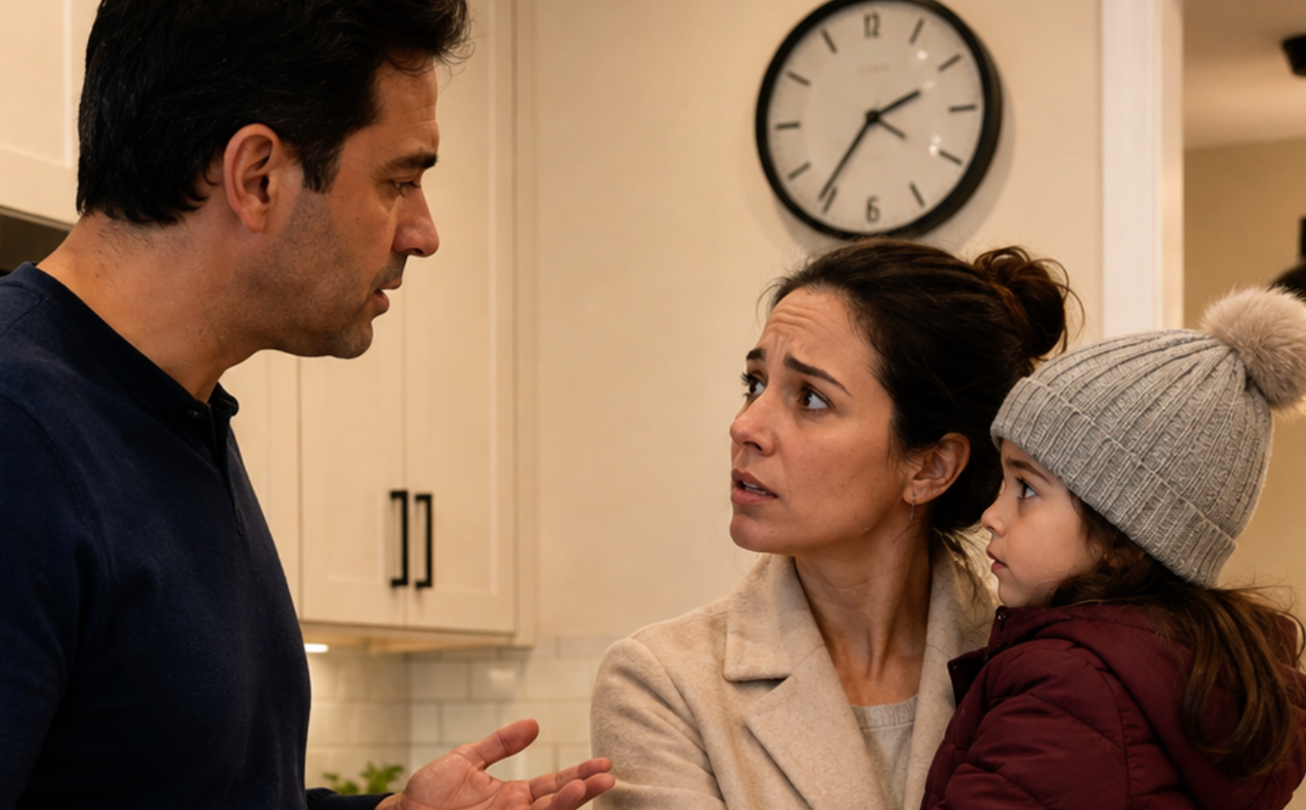
The water was running so loudly that Larisa didn’t immediately understand whether he had answered her or not. She was finishing washing a frying pan, scrubbing at a dried-on edge, and speaking to his back without turning around because that made it easier.
“My company is sending me to a training course, Lyonya. For three days. Everything is paid for—I won’t have to spend a single kopeck of my own.”
Leonid sat sideways to her at the table, scrolling through something on his phone. The glow from the screen fell across his cheek and the glasses he now wore even at home. He didn’t look up.
“And who’s going to cook dinner?” he asked, still looking at his phone. “Is Dasha supposed to live on instant noodles or what?”
Larisa turned off the water.
“Dasha is sixteen.”
“Exactly my point.” He smirked, as though she had just confirmed that he was right. “She’s practically grown up, and her mother is running off somewhere.”
She wiped her hands on the towel hanging from the oven door. Then Larisa picked up the frying pan again and started washing what was already clean. More slowly than necessary. Round and round across the smooth bottom, even though there had been nothing left to scrub for a long time.
Outside, someone in the courtyard was starting a car. Leonid placed his phone faceup on the table and reached for the remote.
“These courses of yours.” He found the channel he wanted and turned the volume up. “You’re not twenty anymore, running around to seminars!”
“I’m forty-one.”
“Well, there you go.” He seemed almost pleased by the number. “That’s exactly what I’m talking about.”
Larisa placed the frying pan on the drying rack. It struck the edge with a clang and tilted awkwardly, so she adjusted it to keep it from falling.
She remained by the sink for a moment, watching droplets fall from the rack into the tray below. Then she finally sat down across from her husband.
“After the course,” she said, “they might promote me to a senior position. Put me in charge of a team. The salary would be different.”
“You?” He didn’t exactly laugh, but the way he blew air through his nose made his meaning perfectly clear. “In charge of a team?”
“Rita says it’s completely possible.”
“Rita.” He nodded as if that explained everything about Rita. “I see.”
He picked up his phone, looked at it, then placed it back on the table, this time facedown. Larisa knew that gesture. He put his phone facedown when he was about to say something he considered important and wanted her to understand that he was doing her a favor by giving her his attention.
“Lar.” He said her name evenly, without irritation, the way someone might remind another person of a date they had forgotten. “You should be grateful I married you at all. With that diploma of yours and a mother living in a village.”
The clock ticked in the room.
It was a round wall clock. It had hung there for fifteen years, and for fifteen years Larisa had never heard it.
Now she did.
The door to Dasha’s room creaked softly in the hallway. It opened halfway and stopped, as though someone behind it were holding it so it wouldn’t open any farther.
Larisa didn’t shout.
She didn’t even feel what she thought she was supposed to feel.
Inside, everything was calm, dry, and empty…
She stood up. She picked up his cup from the table, still half full of tea that had already gone cold, carried it to the sink, poured the tea out, rinsed the cup, and placed it upside down.
“I hadn’t finished that!” he said to her back.
“I’ll make you another one if you want.”
He didn’t answer.
The next morning, everything in the hallway was as usual. Her husband was getting ready for work, searching for his keys and patting the pockets of his jacket, making his usual racket.
“So,” he said as he buttoned up, glancing sideways at her almost cheerfully, “are we going to sulk for three days now?”
Larisa could see what he was waiting for: her pursed lips, a cold “Do whatever you want,” a door slammed shut.
This was his territory. He always won here because he knew every move she would make before she made it.
She took his other jacket from the hook, the warmer one he constantly forgot even though the mornings had already turned cold, and handed it to him.
“Take this one. And don’t forget your keys. They’re on the cabinet.”
He took the jacket and stood there holding it, looking at his wife and finding nothing to latch onto.
There was no resentment. No tears. No pursed lips. Nothing he knew how to interpret.
For the first time in many years, he had no idea what she was feeling, and it seemed to throw him off slightly. He even opened his mouth as though he were going to say something, then changed his mind.
“Well. I’m off.”
The door closed.
She listened as he called the elevator and heard the hum of the car rising through the building.
Larisa went downstairs ten minutes later so they wouldn’t have to ride together.
In the elevator, she took out her phone. Usually, during moments like these, she read articles about how to stop feeling hurt, how to save a marriage, how to talk to a man so that he would actually listen.
This time, she opened an empty search bar and typed:
division of property gift deed.
Links appeared. Headlines. Advertisements for lawyers with phone numbers.
Larisa stared at them for exactly a second or two.
Then she closed the page as if it had burned her, shoved the phone into her pocket, and stepped out when the elevator doors opened.
She didn’t delete the tab.
At work, the day passed as usual. Phone calls, spreadsheets, someone’s birthday, a cake in the conference room that she didn’t touch.
At lunch, Rita sat down beside her and pushed her plate of salad closer, almost against Larisa’s elbow.
“Eat something. You’ve been walking around like you’re made of glass for a week. What did he do this time?”
Larisa picked up a lettuce leaf with her fork but didn’t eat it.
“The opposite,” she said. “I stopped…”
“Stopped what?”
“Answering. Reacting. I can’t do it anymore.”
Rita looked at her more carefully and set down her fork.
“What are you planning?” It wasn’t really a question. “Larisa. You’re not talking about divorce, are you? You have an apartment, Dasha, you’ve been together for fifteen years… Over what? He doesn’t drink, he doesn’t hit you, he brings money home. People hang on to men like that for dear life!”
Larisa took a small spiral notebook from her handbag, the one where she usually wrote shopping lists.
She opened her phone, found the page she needed, and began copying an address and office hours into the notebook.
Her handwriting was steady, number after number, without once looking at Rita.
“Are you even listening to me?” Rita asked.
Larisa finished writing the hours, added a period, and put the notebook back into her bag.
“The salad really is good,” she said. “What dressing is this?”
On Saturday, she went to the village to see her mother without calling ahead.
First the bus, then a walk from the stop across a field where the mud had been seized by the first thin layer of ice and cracked beneath her feet.
Nina Fyodorovna opened the door, saw her daughter standing there, and immediately began fussing. Her hands started trembling, the way they always did when something unexpected happened.
“Larisa? Why didn’t you call? Has something happened? Come in, come in, I’ll put the kettle on.”
Larisa hugged her.
She held her a little longer than usual, feeling the thin, sharp shoulder blades beneath her hands. Her mother noticed and stiffened warily in the embrace.
They sat down at the table.
“Mom.” Larisa warmed her palms around her cup. “Where’s Grandma’s gift deed? The one for half the house. Is it still safe?”
Her mother froze with the kettle in her hand. It tilted, and a drop fell from the spout onto the plastic tablecloth.
“It’s safe. In the dresser, in the yellow folder.” She set down the kettle but kept her hands on the table, gripping the edge. “Are you leaving him?”
“I asked about the document, Mom.”
“But how can you…” Nina Fyodorovna spoke quietly, looking not at her daughter but at the plastic tablecloth and the little wet spot. “He took you out of that dormitory, you foolish girl. You were living there without anything secure, without a home or a thing to your name. And he had an apartment, a salary. Where are you going to go?”
Larisa listened.
She had heard those words a hundred times, but always from Leonid, sitting across the table from her.
Now she heard them from her own mother, in almost the same words and the same tone, and she understood that her mother wasn’t saying it to hurt her.
She genuinely believed it.
For fifteen years, her mother had been convinced that her daughter owed him.
Larisa said nothing.
She finished her tea, got up, walked over to the dresser, pulled open the bottom drawer, and took out the yellow folder. She opened it, checked that the document was inside, and put the folder into her bag.
“Put it back,” her mother said. “Don’t bring sin upon yourself.”
“I’ll bring it back, Mom. I’ll make a copy and return it.”
Nina Fyodorovna remained sitting at the table, looking small, staring at the bag in her daughter’s hands as though something shameful were sticking out of it.
That night, the apartment was dark except for the faint night-light glowing near the ceiling in the hallway, which Dasha still refused to let them turn off.
During the day, Leonid had tried to behave as usual, as though he had said nothing the night before.
At lunch, he had even invited Larisa to watch some movie with him where people were shooting each other and betraying one another. She sat beside him on the sofa and laughed in the places where she was supposed to laugh because that was quieter and easier than explaining why she wasn’t laughing.
Now he was asleep.
He slept heavily on his back, mouth slightly open, one arm hanging over the edge of the sofa.
Larisa got up and went into the room where the cabinet containing their documents stood.
She held the cabinet door as she opened it so it wouldn’t creak.
She took out the bottom folder—the one containing the apartment documents, the contract, and his income statements from when they had taken out a loan for the kitchen.
She spread the papers out on the floor so the light from her phone fell evenly across them and began taking photographs.
A page. Turn it. Photograph.
Check that the number was visible. Make sure the stamp wasn’t blurred.
She didn’t rush, and her hands didn’t shake.
They simply did their job, the way they did at work when she scanned someone else’s invoices.
She returned every sheet exactly as she had found it.
She ran her palm across a crease in the contract and smoothed a bent corner.
She didn’t rummage around or scatter anything.
The kitchen light came on.
Larisa raised her head.
Dasha stood in the doorway, barefoot and wearing an oversized T-shirt, staring at her mother sitting on the floor among the documents with a phone in her hand.
Neither of them spoke.
The kitchen light formed a strip across the hallway, and in that strip of light Larisa could see that Dasha understood everything.
Not the documents.
Everything that was happening.
Larisa didn’t explain, and her daughter didn’t ask.
Dasha stood there for a moment, shifting her bare feet on the cold floor, then returned to her room.
The door closed quietly behind her.
A minute later the kitchen light went out.
Dasha had switched it off herself, as if to say:
I won’t disturb you.
The training course was on the other side of the city, held for three days in a conference room at a hotel.
Larisa took notes as the instructor spoke, raised her hand, answered questions when asked, and during breaks drank instant coffee from the vending machine with the other participants.
One woman named Olya, whom she got talking to beside the coffee machine, happened to be renting out a room. Her daughter had moved away, leaving the apartment too empty and too expensive for her alone.
“Just temporarily, if you ever need it,” Olya said, stirring sugar with a plastic stick. “I wouldn’t charge much. I’d just rather not be alone…”
“Could I move in on Monday?” Larisa asked.
Olya looked at her a little more closely but didn’t pry.
“You can move in Monday if you like.”
Larisa returned home not rested but collected, as if she had spent three days hauling sacks instead of sitting in a chair.
The hallway smelled of fried potatoes, which Dasha had cooked herself.
On the refrigerator, beneath a strawberry-shaped magnet, hung a note torn from a squared notebook page, written in Dasha’s looping handwriting:
“Dinner was good (I made it myself). I’m with you.”
Larisa took the note down and read it.
Then she read it again.
She stood holding that little squared piece of paper longer than she had held any document that entire week.
Longer than the gift deed.
Longer than the contract.
Her daughter had made her decision before anyone had even asked her to.
Larisa folded the note into quarters and slipped it into the inner pocket of her bag, where the documents were.
The lawyer’s office was on the third floor of a business center, between a notary’s office and a company that sold windows.
The lawyer was a middle-aged woman with glasses on a chain and the weary expression of someone who had already heard every possible story.
Larisa placed the folder on the desk.
The lawyer flipped through the papers, putting her glasses on and taking them off, making notes here and there.
“All right. What grounds shall we put down?” She looked up. “This doesn’t qualify as abuse, you understand. There are no beatings, no medical reports. Alcoholism would also have to be proven, and your husband works. His income statements look perfectly respectable.”
“Write that we’re incompatible.”
“Well, incompatible it is.” The lawyer made a note. “Does your husband know?”
“He’ll find out on the right day.”
The lawyer looked at her briefly over the top of her glasses, assessing her, but said nothing.
She slid a form toward Larisa and showed her where to sign and where to write the date.
Larisa took the pen.
And then, when all that remained was to write the date, her fingers trembled.
She pressed her hand against the desk so the numbers wouldn’t come out crooked.
Her fingers were trembling because after this there would be no changing her mind.
She had deliberately arranged everything so that changing her mind would no longer be possible.
She wrote the date, pressing the pen harder than necessary, and her signature came out thick and dark.
“They’ll accept the application and send the summons. In about…” The lawyer glanced at the calendar on the wall. “About a week, they should schedule the hearing. Will you give him his copy yourself, or shall we send it by mail?”
“Myself.”
That evening, everything looked exactly as it had one week earlier.
Larisa stood at the sink washing dishes.
Leonid sat at the table with his phone.
Only now he was relaxed and good-natured, glancing at her over the top of the screen almost affectionately.
“So, how were the courses?” he asked. “Did they teach you anything?”
“They did.”
“If they give you a raise, we’ll go somewhere in the summer, huh?” He put down his phone and leaned back in his chair. “You always wanted to go to the sea. We’ll head south, yeah? Leave Dasha with your mother and go, just the two of us…”
He offered it to her the way you offer candy to a child who has finally stopped crying.
Summer.
The sea.
Just the two of them.
Everything as usual.
First crush her down, then dangle something pleasant in front of her.
Larisa turned off the water.
She dried her hands and took a single sheet of paper from the bag standing on the stool.
She walked over to the table and placed it in front of him, directly on top of his phone.
Leonid picked up the paper, still smiling, and moved it slightly farther away so he could read it without his glasses.
“What is this…” He began reading.
The smile remained on his face because he still didn’t believe what he was seeing.
“What is this, Larisa?”
“You wanted me to thank you.” Her voice remained even. She didn’t raise it. “Here. Thank you. For everything.”
He read it again.
Then he turned the sheet over as though the other side might say that it was a joke.
The back was blank.
He placed the paper on the table, smoothed it out, then picked it up again.
“Because of one sentence?” He smirked, but the smile came out crooked. “Are you serious?! Because of something I said to you? Come on… people say all kinds of stupid things over fifteen years.”
“It isn’t because of one sentence.”
“Then what is it because of?” He raised his voice, and something appeared in it that hadn’t been there before—not exactly anger, but bewilderment. “You had everything. An apartment, money. I don’t cheat on you. I come home every night. You even went to those courses, and I didn’t say a word!”
“You did.”
He fell silent.
Then he found something to grab onto.
The thing that had always worked before.
“You wouldn’t last a month without me!” He stood up and pushed his chair back. “Where are you going to go? Back to your mother in the village to heat the ice cellar? You don’t have anything of your own. All of this”—he swept his hand around the kitchen and the walls—“is mine. You’re only registered in this apartment because I was kind enough to let you.”
He was striking the one place that had hurt for fifteen years.
And he waited for her to collapse.
To cry.
To start explaining herself.
Dasha appeared in the kitchen doorway.
A stuffed backpack was on her shoulders, and she was holding her jacket.
She didn’t stand off to the side.
She walked directly over to her mother and stood so close that their shoulders touched.
Leonid looked from his wife to his daughter and back again.
Something in his face changed.
Suddenly he was on the opposite side of the table, alone, while the two of them stood together facing him.
It wasn’t the arrangement he had grown accustomed to over the past fifteen years.
“Darya.” He tried a different tone now, stern and fatherly. “Where do you think you’re going at this hour? Go back to your room.”
Dasha looked at him.
Not defiantly.
More like the way you look at someone you feel a little sorry for.
“I’m going with Mom, Dad.”
Larisa took the hat from her daughter’s hands—a gray knitted hat she had made herself two winters earlier.
She pulled it onto Dasha’s head and adjusted it so it covered her ears, then pulled up the collar of her jacket.
It was a familiar domestic gesture, something she had done a thousand times before school, before the cold, before a journey.
Only this time, the gesture meant they were leaving.
“Lara! Wait. Come on, let’s talk. You really don’t have anything. No place to live, no money to get started, nothing. Where are you going?”
Larisa pulled Dasha’s zipper all the way up.
She opened the front door and let her daughter step out onto the landing first.
Dasha went outside and waited by the elevator.
Larisa picked up her bag from the stool and slung it over her shoulder.
Already standing in the doorway, without turning around, she spoke not directly to him but somewhere toward the coat rack.
“I do have something. Half of Grandma’s house. A room starting Monday. The court hearing is in a week. They’ll send you the summons. Sign for it when it comes.”
She stepped across the threshold.
She held the door so it wouldn’t slam.
“The cutlets are in the freezer. Defrost them on medium, or you’ll burn them again.”
The lock clicked shut.
On the table lay the sheet of paper with her neat, heavy signature and the date pressed deeply into the page.
Beside it stood his cup of unfinished tea, already cold.
And this time, he never reached for it.