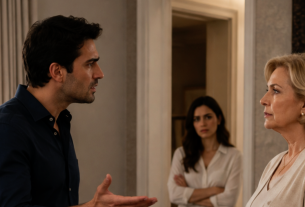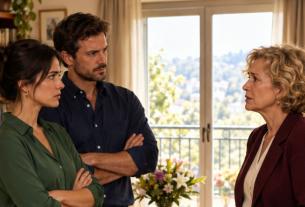
A quiet Friday evening was supposed to be a time to relax, but their apartment was filled with the usual, thick tension. Elena was in the kitchen washing dishes, straining to catch the voices from the living room. Over the sound of running water, she could make out the measured, lecturing tone of her mother-in-law, Lyudmila Stepanovna, and the rare, submissive replies from her husband, Andrey.
She dried her hands, took a deep breath, and stepped into the living room as if crossing an invisible line. Lyudmila Stepanovna was seated right in the middle of the couch, her leather satchel sitting beside her, a clear sign she planned to stay awhile. Andrey was half-reclined in an armchair, his attention buried in his phone.
“Lena, come here,” her mother-in-law said without looking at her, adjusting the pleats of her strict blouse. “Andrey and I have been discussing something.”
Elena silently leaned against the doorframe. “We’ve been discussing it with Andrey” always meant bad news.
“We’ve been talking about your life. Or rather, your lack of one,” Lyudmila Stepanovna continued. “It’s been six years already, and what do I see? No career advancement for Andrey, no children for you both. Just endless get-togethers in this apartment. You couldn’t even update the décor in six years—still the same curtains your late mother picked out.”
Elena felt heat rush through her body. She glanced at Andrey. He didn’t look up from his screen; only a quick flicker of his eyelid gave him away.
“Mom, it’s just… not the right time,” he mumbled quietly into his phone.
“What do you mean, not the right time?” her mother-in-law’s voice twanged like a taut string. “Time is slipping away, Andrey! And you two are living in some kind of vacuum. Just look at her!” she snapped, gesturing briskly at Elena. “No ambition, no spark. She’s just drifting along. She’s dragging you down, son. I can feel it in my bones.”
“Lyudmila Stepanovna,” Elena started, struggling to keep her voice steady, “Andrey and I will decide for ourselves when to have children and how to live our lives.”
“Decide for yourselves?” her mother-in-law scoffed with a fake laugh. “You can’t make any decisions on your own! Who helped you choose a car and paid half of it? Your father and me! Who always brings you groceries because you ‘don’t earn enough’? I do! You’ve even let your country house fall into disrepair. I called the neighbor yesterday, she said the roof’s leaking. Shameful!”
The country house. The word struck a quiet, familiar chord of pain in Elena. The country house her Aunt Olya had gifted her—a slice of childhood, peace and quiet. It was just a month ago that Lyudmila Stepanovna had visited for the first time and immediately declared that the old shed had to be turned into a sauna and the apple trees cut down—they threw too much shade.
“We’ll handle the country house ourselves,” Elena said, looking her mother-in-law straight in the eye.
“Actually, you won’t,” her mother-in-law shot back. “Because you clearly can’t handle it. Andrey is exhausted from work, he doesn’t have time. And you… you simply don’t know how to run a household. That’s why I’ve made a decision.”
She paused dramatically, pulling a folder out of her satchel.
“I’ve made arrangements with some builders. They’ll come to the country house on Monday to assess what needs to be done. Andrey’s father will pay for the materials. We’re going to turn it into a proper home. And you… you can spend summers there once it’s all finished. And don’t worry about the money,” she tossed a look at Elena filled with false generosity, “we’ve taken care of everything. This is our investment in your future.”
Andrei finally tore himself away from his phone.
«Mom, this is great! Thank you! I was just thinking about the roof…»
Elena interrupted him, and her voice sounded unusually firm, even for her.
«No one is going anywhere on Monday. And nothing is going to be done at my summer house.»
Silence filled the room. Lyudmila Stepanovna slowly raised her eyebrows.
«Yours? Your summer house, dear?»
«Yes. Mine. It was given to me. All the documents are in my name.»
«What does it matter whose name it’s registered under?» her mother-in-law waved her hand. «You’re married! What’s yours is ours, Andrei’s. And what’s Andrei’s is mine in the end, because I’m his mother and I invest in him! Or do you not know how property is divided in a divorce?»
The word «divorce» hung in the air, heavy and poisonous.
«Mom, that’s enough,» Andrei whispered voicelessly.
«No, it’s not enough! I’m tired of tiptoeing around!» Lyudmila Stepanovna stood up, her figure suddenly towering. «You, Elena, are not a partner for my son. You’re a burden. For six years I’ve watched you drain the life out of him. It’s time to end this circus. It’s time for a divorce.»
Elena looked at her husband. He stared at the floor, his fingers clenching his phone in a vice-like grip. He didn’t look at her. In that moment, something inside Elena switched off. Everything she had carried for years—small humiliations, unsolicited advice, his silent agreement, her own forced submission—compressed into one hard, cold point inside her.
Lyudmila Stepanovna, seeing her silence and pale face, decided she had won. Her tone softened, becoming almost businesslike.
«Of course, I understand this will be hard for you. That’s why we won’t leave you with nothing. You’ll take your old bedroom furniture and probably the car. It’s old, but it should suffice for you. Andrei and I will take care of the apartment and the summer house. Of course, they’ll be divided after the divorce. But we’re not greedy. We’ll offer you some small compensation. Enough for a rental place.»
Elena slowly shifted her gaze from her husband to his mother. There were no tears or panic in her eyes. Only icy emptiness.
«Alright,» she said quietly.
Lyudmila Stepanovna nodded in satisfaction.
«Finally, you’ve shown some common sense.»
«Alright,» Elena repeated, louder now, enunciating each word clearly. «Let’s get divorced, Andrei. Just as your mother wants.»
Andrei jerked his head up, confusion and fear flashing in his eyes. He had expected a tantrum, begging, tears—anything that would give him the right to feel sorry for himself and blame her. But not this calm agreement.
«Lena… what’s wrong? Mom, maybe you really are being a little…»
«No, son, not too much,» his mother interrupted, beaming in victory. «She understands now. See how reasonable she is? She sees for herself she can’t handle it.»
Elena wasn’t listening anymore. She turned and left the living room, walking into the bedroom. She closed the door behind her, resting her forehead against the cool wood. From the living room came the muffled, excited whisper of Lyudmila Stepanovna: «That’s it, son, the decision is made. We’ll start preparing the paperwork tomorrow… See, she’s already accepted it, you can tell?»
Elena took a deep breath and walked to the closet. She moved aside a stack of bed linens and felt for a small metal door set into the back wall—a built-in safe. Her fingers automatically entered the code: her mother’s birthday.
The safe door opened silently. Inside, there were no jewels and no money—just two folders. The first contained the title certificate for the three-bedroom apartment in the prestigious neighborhood. The owner’s line had only one name: hers. Her parents had wisely and timely transferred the ownership to her when they moved abroad.
The second folder held the deed of gift for the dacha, signed by her aunt Olya. And again, her name was the only one listed as owner.
She didn’t take out the documents. She simply rested her hand on the smooth surfaces of the folders, feeling the roughness of the stamps beneath her fingers. The whispers from the living room no longer reached her ears. Inside that cold spot, a new fire began to burn—not anger, but a complete and unshakeable confidence.
«So you want a divorce, Lyudmila Stepanovna? You want to split up the property?» she thought, staring into the dark window, where her own pale, determined face was reflected. «Fine. Let’s split it. My inheritance. My dacha. My life—the one you’ve always wanted to control. Let’s see how that turns out for you.»
She quietly closed the safe and straightened the linens. Tomorrow, she would need a lawyer. But tonight… tonight she just needed to survive in the same house with people who already considered her defeated. Yet the main battle—the one they had no idea was coming—was still ahead.
Dim dawn light slipped through the gap in the curtains, outlining the shapes of the familiar bedroom. Elena hadn’t slept. She’d spent the entire night lying with her eyes open, listening to the silence outside her door and the frantic pounding of her own heart. The space next to her was empty. Andrey had stayed in the living room, under his mother’s wing. That spoke volumes.
When the clock showed seven, she got up. Her movements were mechanical, without the usual morning drowsiness. She took a long, very hot shower, as if trying to wash away the feeling of yesterday’s humiliation. She dressed in simple jeans and a sweater—nothing that Andrey had ever chosen or complimented.
The kitchen was filled with a heavy silence. She put the kettle on, and its loud hiss seemed like the only living sound in the whole apartment. She heard cautious footsteps from the hallway. Andrey entered. He looked rumpled and out of sorts, still wearing the same wrinkled sweater from yesterday.
«Lena…» he started, hesitating to come any closer.
She didn’t turn around as she took a cup out of the cupboard. Just one cup.
«Mom left early this morning. To Dad. She says she needs to think everything over and start working on the papers…» He trailed off, waiting for a reaction. None came. «I… I didn’t think things would turn out this way. She was just talking, and then you suddenly agreed…»
Elena poured boiling water into the cup and dropped in an herbal teabag. The fragrance of chamomile softly filled the kitchen.
«So you’re just going to be silent now?» There was a hint of his usual irritation in his voice. «Stop sulking! We’re adults here, we can talk about this.»
«Discuss?» she finally turned around, her voice quiet but completely steady. «What exactly, Andrey? The schedule for when I have to move out? Or the amount of that ‘small compensation’ your mother so graciously offered? Is that what you call a discussion?»
He looked away and rubbed his neck with his palm.
«Well, you know, Mom just wants what’s best. She’s worried about me. And about you, too, actually! She said she’d help you find a decent place to live at first. Not everyone is that lucky with their ex-mother-in-law.»
Elena let out a short laugh. It sounded dry and joyless.
«Really? I’m lucky, you say. So the only thing up for discussion is this—where I’ll move and how much your parents are willing to spend on it. And what about the apartment, the dacha—is that already decided? That’s already ‘ours,’ yours and your mother’s, is it?»
«Well, what is there to decide?» Andrey spread his hands, with that same unshakable confidence in his own rightness that he had picked up from Lyudmila Stepanovna. «We got all this while we were married. Actually, not even ‘got,’ your parents and your aunt just gave it to you. But by law, it’s all marital property! So it gets split in half. That’s fair, isn’t it?»
«By law.» Those words were the last straw. Inside, everything finally settled, turned cold, and aligned itself.
«All right,» Elena said, taking a sip of tea. «If it’s by law, we’ll do everything by the law. All the paperwork and all the procedures.»
«That’s my girl,» Andrey visibly relaxed, taking her words as surrender. He walked over to the fridge and grabbed a pack of cottage cheese. «I think I’ll stay at work late today. Need to consult with my lawyer colleague to see where we should start. Just want to get this done quickly, and without you, without any extra drama.»
«Don’t worry,» she replied as she rinsed out her now-empty cup. «I’ve got things to do today too. For the whole day.»
She left the kitchen, leaving him alone. In the bedroom, making sure the door was closed, she opened the safe. She didn’t just place her hand on the folders—she took them out. She put them in a plain but roomy sturdy fabric bag, along with her wallet and keys. She moved with focus and no fuss.
Half an hour later, already wearing her coat, she stepped into the hallway. Andrey was finishing up his cottage cheese, sitting on a stool.
«I’m going,» she said simply, putting on her boots.
«Good luck,» he tossed out without looking up, his attention glued to his phone screen. He was probably scrolling through something real estate-related. He was completely calm. He was sure of himself. He thought the storm had passed, and now all that was left was to gather the fruit his mother had so carefully prepared for him.
Elena slammed the apartment door behind her. The sound was final. The elevator descended to the first floor. The cold autumn air bit her face, but it felt good. It woke her up. It cleared her thoughts.
She got into her own—not exactly new—car, the one Lyudmila Stepanovna «allowed» her to keep, according to the plan. She started the engine. Her first impulse was to go to her friend’s house, cry, let it all out. But she suppressed it. Tears and complaints were a luxury she couldn’t afford right now. She didn’t need a shoulder—she needed a sword. And a shield.
Instead of typing in ‘family psychologist’ or ‘help with divorce,’ she went straight for ‘family law attorney, property division, inheritance’ in her phone’s search bar. She browsed several websites, jotting down names. One lawyer had even been recommended to her in a parents’ chat a while ago—a woman who had helped someone keep their apartment in a similar situation. Her name was Irina Vitalievna Kovalyova.
Elena dialed the number for Kovalyova’s office. The secretary, hearing the urgent words ‘property division’ and ‘inheritance,’ scheduled her in at eleven in the morning. She had two hours until the appointment.
She spent those hours driving around the city, not stopping anywhere. Just driving, listening to the silence in the car, getting used to the new weight in her bag on the passenger seat. The weight of those very folders.
Exactly at eleven, she walked into the office in an old but impressive business center. Lawyer Kovalyova turned out to be a woman in her fifties, with a short greying haircut and sharp, instantly assessing eyes. She didn’t offer tea or try to comfort her.
“So, Elena, tell me the situation,” she said, opening her notebook. “Just facts, dates, and documents.”
And Elena did just that. Without emotion, as if she were writing up a report. Six years of marriage. Constant pressure from her mother-in-law. An apartment given by her parents three years ago. A dacha gifted by her aunt a year ago. Yesterday’s ultimatum about divorce, and her mother-in-law’s plans for a “fair” division. She laid the documents out on the table.
Irina Vitalievna silently studied the documents for a few minutes. Then she took off her glasses.
«Your mother-in-law, excuse me, is either completely ignorant of the Family Code, or a major optimist,» a hint of a smirk appeared at the corner of her mouth. «Article 36. Any property owned by either spouse before the marriage, as well as that received by one spouse as a gift, inheritance, or through other gratuitous transactions during the marriage, is their property. This applies to your apartment and your dacha.»
«But they claim they invested money… On repairs, the car…»
«That only matters in one case,» the lawyer raised her finger. «If they can prove the investments were so significant that the value of the property increased substantially. Do you have a separate account where they transferred money specifically for this apartment’s repairs? Receipts? A contract stating they were the client and payer?»
«No,» Elena shook her head. «They gave cash, just ‘for living.’ And the renovations… I did them gradually, using my bonuses.»
«Perfect. Do you still have the bank statements showing your bonuses coming in?»
«Yes, I save everything.»
«Excellent. Now, most importantly,» Irina Vitalievna leaned back in her chair. «What do you want? Just to fend off their claims and keep what’s yours? Or do you have other demands for your husband? Alimony, for example?»
Elena paused for a second. The image of Andrey, helplessly chewing cottage cheese on the kitchen stool, flashed in her mind.
«No. No alimony. I want just one thing: for them—him and his mother—to leave alone what belongs to me. Legally and without dispute. I want them to finally understand that.»
«Hmm,» the lawyer jotted something down. «So, our strategy is simple. We don’t attack. We take a defensive stance supported by irrefutable documents. If they file a claim to divide the assets—we respond with a counter-objection and attach these papers. That’s it. But be prepared, Elena,» she said, her expression growing serious. «When people who expect an easy win suddenly hit the impenetrable wall of the law, they don’t become more reasonable. They lash out. They get nastier. More irrational. And I don’t think your mother-in-law will be an exception.»
«I’m ready,» Elena said quietly, but with a clarity that surprised even herself. For the first time in years, she truly meant it.
«Then let’s get started. We’ll draft the power of attorney now and prepare a response to their upcoming lawsuit. Right this minute. Let’s make sure they get a surprise at the very first hearing.»
Two hours later, Elena stepped out of the office. In her bag were not just her documents, but also a signed power of attorney for the case and a draft of her future counterclaim. The autumn wind no longer felt cold—it was invigorating. She took out her phone. On the screen were two missed calls from Andrey and a message: «Where are you? Mom called, she wants to meet tomorrow to discuss the details. Call me back.»
She stared at the message, and a hint of a smile crossed her face—one that held no joy at all.
«Discuss the details,» she thought, starting her car. «Oh, we’ll discuss them—all the details of your defeat.»
The meeting was set for Saturday, 2 p.m., in their own apartment. When Elena returned from the store in the morning, she found Andrey engaged in a strange activity: he was rearranging chairs in the living room, moving the coffee table closer to the sofa, setting up what looked like a «negotiation area.» On the kitchen table sat an unusually expensive cake in a pastry shop box and a bottle of mineral water. No tea, no coffee—nothing homemade or warm. Everything was arranged like in a cold office for strangers.
«Mom likes everything to be proper,» Andrey explained, catching her look. «And she asked that you be… well, ready for a constructive dialogue.»
Elena didn’t reply. She walked into the bedroom and stood for a few minutes in front of the closed safe. Inside was her bag with the documents and the power of attorney. She didn’t take them out—today was not the time for that.
Exactly at 2:00 p.m. the doorbell rang. Andrey rushed to open it. Standing at the door was Lyudmila Stepanovna, but she wasn’t alone. With her was a lean, trim man of about sixty holding a briefcase—Viktor Sergeevich, Andrey’s father. His face was marked by the distant look of someone who’s been dragged to an unpleasant yet necessary meeting.
«Come in, please, come in,» Andrey fussed.
Lyudmila Stepanovna, still in her coat and without greeting Elena, went straight to the living room. She glanced around the room and nodded approvingly, clearly noticing the arrangement of the furniture. She sat down in the armchair like it was a throne. Viktor Sergeevich quietly followed, sitting next to her on a chair, his briefcase resting on his lap.
“Well then,” my mother-in-law began, slowly peeling off her gloves. “Since all the adults here are sensible people, let’s keep emotions in check. Let’s just discuss the technical aspects.”
Elena stood by the entrance to the living room, leaning against the doorway—the same spot she’d occupied on Friday. But now, there was no heat or trembling inside her. Just a focused, watchful silence.
“I’ve consulted someone who knows the law,” continued Lyudmila Stepanovna, holding herself proudly straight. “He’s a good friend of ours, a lawyer—corporate, yes, but he understands the basics. He explained everything. In a divorce, if there’s no prenup, everything acquired together is split equally. Right?”
She looked at Elena, expecting her to confirm. Elena stayed silent.
“That’s right,” answered Andrey on her behalf, nervously shifting along the edge of the sofa.
“So, this means both the apartment and the dacha will be divided. But we’re not heartless people,” my mother-in-law paused for emphasis. “We understand Elena might be left without a roof over her head. So, we’re proposing a compromise.”
She glanced at her husband. Viktor Sergeevich silently opened his briefcase and took out a sheet of paper.
“We’re prepared to buy out your share,” he said, his voice even and accountant-like. “The apartment, by our rough estimate, is worth about eighteen million. So your half is nine. Subtract… uh… our investments in the renovations, help with your car, and other financial inputs over the years, which we’re valuing at about two million, that makes seven. The dacha…” He checked the paper. “We’ve valued it at one and a half million as is. Your half—seven hundred fifty thousand. That totals seven million seven hundred fifty thousand rubles. We’re ready to offer you three million. Cash. Up front. To avoid a long court process.”
A heavy, awkward silence filled the air. Andrey looked at his parents with a strange, pained admiration. Viktor Sergeevich was waiting businesslike for a response. Lyudmila Stepanovna fixed Elena with a victorious, condescending gaze, as if granting an extraordinary favor.
Elena slowly shifted her gaze from father to mother, then to Andrey.
“Is this… a joke?” she asked so quietly they all leaned in to hear.
“What joke?” Lyudmila Stepanovna frowned. “This is a serious, market-rate offer! Three million is enough for you to rent a great one-bedroom for three years! You’ll have time to recover, maybe find a better job…”
“A market-rate offer,” Elena repeated, her voice stronger. “Based on what? Your assessment? Where’s the independent evaluation report? Where’s the documentation for these so-called ‘financial inputs’ of two million? Receipts? Bank statements? Or are those just numbers you made up on the spot?”
Lyudmila Stepanovna blushed.
“How dare you speak to us like that! We’re trying to help you! We aren’t even obligated to offer anything! We could take it all through court!”
— Take what? — Elena stepped forward. — What exactly are you trying to take, Lyudmila Stepanovna? My apartment that my parents gave me? My dacha that my aunt gifted to me? I have all the paperwork for these, signed well before you decided I was just a ‘burden.’
The room fell silent. Viktor Sergeyevich, for the first time, looked up from his papers, peering at his daughter-in-law with mild surprise. Andrey’s mouth fell open.
— Lena, what are you even saying? Of course this is all shared…
— It’s not shared, Andrey, — she interrupted, her gaze fixed squarely on him. — It’s mine. Personal property. Article 36 of the Family Code. Anything inherited or gifted is not subject to division during a divorce. Your ‘good lawyer friend’ is either totally clueless or was just trying to calm you down. I’ve consulted another lawyer. A specialist in family law.
Lyudmila Stepanovna leapt out of her chair.
— Liar! Everybody knows it’s all split fifty-fifty! You’re just greedy! You want everything for yourself! We invested so much in you!
— Invested in what? — Elena shot back coldly. — In me? Or in your illusions that everything around you will become yours? The money you gave me was ‘for living’ — that’s a gift. Gifts aren’t returned. The renovations in this apartment? All done with my own bonuses. I have all the receipts. Want to check them?
— That’s not true! — his mother screamed, completely losing control. — Andrey, tell her! You know how it really was!
Andrey’s gaze darted helplessly between his mother and wife. His face twisted in confusion and fear — the kind of deep-seated fear only a lifetime of a mother’s rage could instill.
— Mom… maybe… maybe she’s right… I never really looked into the laws… — he muttered.
— Be quiet! — Lyudmila Stepanovna barked at him. Then she snapped back toward Elena. — You think the court will take your side? We’ll find witnesses! We’ll prove this property is joint! You’ll be left with nothing! I will destroy you!
Elena listened to the barrage of threats without moving an inch. Her eyes held no fear, just a tired resilience and a new, steely clarity.
— Go ahead and prove it, — she replied simply. — Take it to court. Bring your witnesses. I’ll file my own countersuit, with every document proving my ownership. Let’s see who gets ‘destroyed’ in court. And now, please leave. From my apartment.
She pronounced the last three words with a special, unmistakable emphasis.
Lyudmila Stepanovna, breathless with rage, grabbed her purse.
— Fine! You want war? You’ll get it! Andrey, come on! Get your coat! Let her sit here alone in her pathetic little apartment! We’ll see how hard she cries when the court papers arrive!
Andrey, shoulders slumped, shuffled out to the hallway after his parents. At the threshold, he turned around. His face was a painful mix of shame, confusion, and silent reproach.
— Lena… why are you doing all this… — he whispered.
She didn’t answer. She simply watched as he left and shut the door. The lock clicked shut with an unusually loud, final sound.
The silence that followed their departure was absolutely deafening. Elena slowly walked around the living room, straightening the chair that Lyudmila Stepanovna had moved. She walked over to the table and looked at the unfamiliar cake in its pretty box. Without a second thought, she picked up the box along with the bottle of water, carried them both to the kitchen trash bin, and threw them away—no regrets.
She went back to the bedroom and took her bag out of the safe, hugging it tightly to herself. The battle was only beginning. Open war had just been declared. But for the first time in six years, she stood on her own ground, behind her own shield. And she finally knew the name of the law that was now her sword.
She glanced at her phone. Not a single call or message. The world outside seemed to be holding its breath, waiting. She walked over to the window and saw them all three below by the entrance: Lyudmila Stepanovna was gesturing wildly, arguing about something with passion. Andrey stood there with his head down, while Viktor Sergeevich smoked a cigarette, looking off into the distance.
Elena turned away from the window. She had things to do. She needed to call her lawyer and update them on how the ‘negotiations’ went. After that… it was time for a trip to the dacha. She had to check if any of the ‘helpful’ builders her mother-in-law cared so much about had already shown up without her knowing. And maybe, just in case, she should change the locks.
She grabbed the keys to the dacha. They had been on her keyring for as long as she could remember, since childhood. They were a piece of her world—a world she now had to defend.
The drive to the dacha took about two hours. Elena drove slowly, as if trying to put off the moment she’d have to face whatever intrusion might be waiting. Bare autumn fields and dark forest strips flickered by outside the window. This road had always calmed her, but today every bump and rut in the dirt road sent tension shooting up her back.
The country community ‘Birch Grove’ greeted her with its usual sleepy calm. Most of the houses were already boarded up for winter, the shutters nailed shut. Her own plot was at the very end of the street, right next to the forest. As her old car turned onto the familiar, bumpy lane, her heart dropped for a split second: by the gate stood a muddy, unfamiliar GAZelle van, and beyond the fence she could hear men’s voices and the buzzing of a chainsaw.
She slammed on the brakes and jumped out of the car. The gate was wide open. On her property, right in the middle of the unpruned apple orchard, two workers in greasy overalls were busily measuring out spaces on the ground with a tape measure, marking spots with stakes. Nearby, there were freshly cut branches from an old pear tree.
«Hey! What are you doing here?» Elena shouted as she stepped over the threshold. Her voice was sharp and commanding, which caught even her by surprise.
The men turned around. One of them, sweaty and balding, wiped his forehead with his sleeve.
«And who are you? The owner? The boss hired us, told us to stake out the area for a bathhouse foundation,» he said, pointing toward the old shed.
«What boss?» Elena’s hands went cold, but she could feel anger boiling inside her.
«Some guy. Andrey, I think. His mom made the deal, gave us a down payment. Said everything’s approved, just get started.»
Elena walked closer, positioning herself firmly between the worker and the staked-out spots on the ground.
«Nothing has been agreed to. I am the owner of this land and this house. I did not hire you. You are on private property without my permission. Take your tools and leave immediately.»
The workers exchanged glances. The younger one, with a crafty spark in his eyes, started to object:
«Hold on, sister, don’t get worked up. We’ve been paid, there’s a job waiting for us. If there’s a problem, sort it out with that man and woman, while we’re just doing our work.»
«Your so-called ‘work’ is the destruction of my property,» Elena pointed at the cut branches. «And illegal entry. Either you leave now, nicely, or I call the police and we resolve this with the local officer. And discuss damages.»
The word “police” did the trick. The ‘sister’s’ face darkened. The bald worker spat on the ground.
«No way. I don’t need your family drama…» he grumbled as he started winding up his measuring tape. «The old lady was spry, had everything mapped out for the remodel… Guess we’ll have to go after her for the deposit…»
Ten minutes later, the «Gazelle» truck rattled out through the gate. Elena watched it go, then sank heavily onto the steps of her small, time-worn house. Her hands shook, but not from fear—she was shaking with anger. They hadn’t just threatened, they’d already started acting, as if everything had been decided.
She walked around the property. There were no signs of other ‘improvements,’ but the brazen intrusion was disgusting. Back inside, she took a new, heavy padlock from the pantry—one she’d bought in the summer ‘just in case.’ She changed it on the gate. The clink of the new lock sounded like the closing chord of the whole incident.
She didn’t want to sit alone in the cold, empty house. Pouring herself some water from the bottle she’d brought, she stepped outside to the fence separating her yard from her neighbor’s. From the neighbor’s chimney, Aunt Vara’s, smoke was still rising. It looked like she stayed here until late autumn.
As if sensing someone nearby, the door of the neighboring house opened, and an older, plump woman in a downy scarf stepped onto the porch.
«Lenochka? Is that you?» she called out. «I thought no one would come anymore. You had some visitors here this morning.»
«Hello, Varvara Petrovna. Yes, I did. But I sent them away.»
«You did the right thing,» the neighbor snorted, stepping off the porch and coming up to the fence. «Some grand lady showed up, acting all important… Your mother-in-law, I suppose? She kept asking me how long you’ve lived here, if you’re alone, what kind of house this is, what year the land was registered. She said, ‘Now I’m in charge, I’ll be bringing the grandkids.’»
Elena clenched her teeth.
«What did you tell her?»
«I told her the house is yours, Lenok, from your Aunt Olga—rest her soul. She just snorted, ‘It’s ours now!’ And off she went. Then those workers showed up. I wanted to call you, but silly me, I didn’t have your number saved in my phone.»
«Thank you, Aunt Vara, for trying to warn me. Now I know exactly what their plans are.»
«They have some grand plans,» the neighbor shook her head. «Tell me, are your papers for the land all in order?»
«Completely,» Elena nodded. «Gift deed, certificate—everything’s with me.»
«That’s right, that’s right. Take care of those things,» Varvara Petrovna said with a knowing tone. «People these days are greedy. Sometimes relatives are worse than strangers! My own niece too… well, never mind. Hang in there. And if it comes to it, I can testify in court that she was planning to take over here. I may be old, but I heard everything and I remember it all.»
This simple offer of help touched Elena more deeply than all the previous threats had hurt her. For a moment, tears welled up in her eyes, but she brushed them away with the back of her hand.
«Thank you so much.»
«Don’t mention it, dear. Stop by for tea if you’re around. No need to be alone.»
«I definitely will, sometime,» Elena promised.
She went back to her place and wandered through the empty rooms. This house was her sanctuary. Here were her parents’ photos, childhood books, the embroidered napkins from Aunt Olya—all the things that meant nothing to Lyudmila Stepanovna, but were priceless to her.
Suddenly, the phone rang. An unknown number. She answered cautiously.
«Hello?»
«Elena Borisovna?» said an official-sounding male voice. «This is the Express Delivery courier service. We have some documents for you. Will you be at…» he listed her city address.
«I’m not in the city. Can you leave them at the office?»
«These are documents from the magistrate’s court. A personal signature is required upon receipt. When would it be convenient for you?»
A chill ran down her spine. They hadn’t waited. They’d filed the case.
«Tomorrow,» she said firmly. «Ten in the morning.»
She hung up and leaned against the doorframe. The first official signal. Now it was all about to begin for real. She called Irina Vitalievna.
«I’m getting court papers delivered tomorrow,» she said as soon as her lawyer answered.
«That was expected,» came the calm voice on the line. «Don’t worry, and don’t open the envelope. Bring it straight to me when you get it. We’ll read it together and prepare a response. Remember, this is just a formality to start the process. Nothing more than that.»
«They’ve already been at my dacha. Brought in construction workers.»
There was a brief pause on the other end.
«Document everything,» Irina Vitalievna said more sternly. «If there are any traces left, take photos. Broken branches, stakes. Talk to the neighbors, get the contacts of those workers. This could serve as evidence of their unauthorized actions and attempts to take possession of your property before the court’s decision. Stay calm, Elena. They’re in a rush, and rushed opponents make mistakes. We just have to be prepared.»
Elena hung up the phone. She looked out the window at her garden, at the old pear tree with a fresh cut. Yes, she would photograph everything. And she’d talk to Aunt Varya again. The battle had moved from petty quarrels to the legal field. Now she had to play by these rules even better than they did.
She locked the house and checked the new lock on the gate. Before leaving, she turned to look back. Her dacha, quiet and a little neglected, stood in the autumn sun. They wanted to tear down the shed and build a bathhouse. Cut down the apple trees. Redesign this place for themselves, erasing traces of her past.
«Not going to happen,» she thought, getting into her car. «It’s not going to work for you.»
continued in the comments
She started the engine and headed back. Ahead awaited the city, an empty apartment, a letter from the court, and a long, methodical battle. But now she had more than just her own truth. She had a clear stance, a lawyer as her ally, and a simple, straightforward goal: to protect what was hers. Until the end.
The hearing was set for ten in the morning. The district court was in a plain brick building on the edge of the neighborhood. Elena arrived half an hour early alongside Irina Vitalievna. Her lawyer wore a sharp dark blue suit and had her gray hair pulled back in a flawless, sleek bun. She carried a large folder of documents, while Elena gripped only her purse with copies of those same papers.
«The main thing is to stay calm and show respect for the court,» Irina Vitalievna quietly advised as they walked up the creaky stairs to the second floor. «Don’t interrupt, answer only what’s asked, address the judge as ‘Your Honor.’ Leave emotions at the door. Our position is rock solid.»
In the hallway by the judge’s office, the others had already gathered. Lyudmila Stepanovna seemed to radiate confidence, dressed in a new coat and hat as if she were headed to the theater instead of court. Next to her stood Andrey, pale and rumpled in an old jacket that had clearly become too big for him lately. With them was a man of about forty-five in an inexpensive suit—their lawyer, or as it would soon become clear, just “a friend who knows about these things.”
When Lyudmila Stepanovna saw Elena, she looked away with disdain and then, spotting Elena’s companion, whispered something sharp to her son. Andrey didn’t look up.
At exactly ten, they were called into the office. A small room—judge’s desk, two tables for the parties. The air smelled of dust, old papers, and seriousness. The judge, a woman around fifty with a tired but attentive face, opened the session, introduced herself, and announced the matter at hand: “Regarding the dissolution of marriage and the division of jointly acquired property.”
Andrey’s side spoke first. Their lawyer, noticeably nervous, began to read the claims. His voice was unsure. He talked about the many years of marriage, the shared households, how the property—the apartment and the dacha—had been purchased and improved by the efforts of both parties and, significantly, with financial support from the plaintiff’s parents.
«Therefore,» he concluded, stumbling over his words, «we ask to recognize these properties as jointly owned and to divide them equally, with financial compensation to the plaintiff… I mean, the defendant, or…» He got mixed up in the terms and blushed.
The judge, without changing her expression, made a note.
«Please present evidence proving that the disputed property is jointly acquired. Documents showing purchase, certificates of ownership with both spouses listed.»
The plaintiff’s lawyer shifted uncomfortably. Lyudmila Stepanovna nudged him firmly with her elbow. He took a few papers from his folder and handed them to the judge, who quickly looked through them.
«These are receipts for utility payments over the past three years and a contract for installing a plastic window at the dacha,» she said in an even voice. «Where are the documents proving the actual purchase of the apartment and the land plot? Sale agreements, deeds of gift, certificates of ownership?»
Lyudmila Stepanovna couldn’t hold back any longer and jumped up from her seat, forgetting all the rules.
«They live there! That’s a fact! They are husband and wife! Everything should be shared! And those papers… she probably has them! She’s hiding them!»
«Please maintain order,» the judge replied coldly. «Defendant, what can you say regarding the merits of the claim?»
Irina Vitalyevna stood up. Her movements were calm and confident. She placed two tidy folders in front of the judge.
«Your honor, the defendant’s position is as follows. The divorce is being initiated by the plaintiff and the defendant does not contest it. As for the division of property, the plaintiff’s demands are unfounded and should not be satisfied. The properties presented are not jointly acquired marital assets.»
She opened the first folder.
«The apartment at the following address… was received by the defendant as a gift from her parents. The date of the gift was three years ago, which is confirmed by a notarial deed of gift and a certificate of state registration of rights, listing my client as the sole owner. Copies are attached.»
She placed the certified copies before the judge, who examined them carefully.
«The dacha land plot with the house was gifted to the defendant by her aunt a year ago. There is also a notarized deed of gift and a certificate. Copies are attached.»
The second set of documents was laid on the table. The courtroom was absolutely silent. Andrey stared at the papers in front of the judge, his face becoming completely expressionless, as if he didn’t understand a thing.
«Article 36 of the Family Code,» Irina Vitalyevna continued in a calm, teacher-like tone, «clearly states that property obtained by one spouse during marriage through gratuitous transactions is their personal property and is not subject to division. Therefore, neither the apartment nor the dacha can be divided.»
«That’s a lie!» Lyudmila Stepanovna cried out, but this time her voice was more a wail of despair than an angry shout. «They forged everything! We invested money! We helped them! We have witnesses!»
«Your honor,» Irina Vitalyevna calmly addressed the judge, ignoring the outburst. «The opposing side may claim there were ‘investments’, but they haven’t provided any evidence: no specific contracts, no notes, no account statements confirming transfers specifically for improvements to these properties. Paying utilities and installing a window are maintenance and current repairs, not acquisition of ownership.»
The judge made another note, then looked over at the plaintiff’s attorney.
«Do you have any objections to the documents presented? Can your side provide proof that the property was bought using the couple’s joint funds, or that the claimant’s or their relatives’ investments significantly increased the market value of these assets?»
The claimant’s lawyer stayed silent, frantically shuffling through papers in his folder. It was obvious there was nothing there except the same old receipts and a couple of internet printouts showing example motions.
«We… we have witnesses who can confirm that we gave money,» Lyudmila Stepanovna finally let out, but her voice had lost all confidence.
«Witnesses may be presented and questioned in future hearings if the court deems their statements relevant,» the judge said. «But at this point, I see no grounds to grant the claim regarding the apartment and the dacha, since there are indisputable documents confirming the defendant’s sole ownership. Does the claimant have any other demands? Division of other property: a car, furniture, household appliances, or financial accounts?»
Andrey was silent. He stared out the window, his shoulders slumped. He seemed to have physically shrunk in size.
Their lawyer, head lowered, mumbled:
«No… I mean, yes… but we haven’t prepared a detailed inventory…»
The judge closed the folder.
«Based on what’s been said, the decision on the preliminary issues will be made in the deliberation room. As for the divorce—your claim is granted. Regarding the division of property: given the documents presented by the defendant, the court is inclined to reject the claims about the apartment and the dacha. Both sides must, within ten days, submit a clear list and valuation of any other assets they consider jointly acquired so these can be reviewed further. This hearing is adjourned.»
She struck the gavel. The sound wasn’t loud, but in the silence of the office, it rang out like a gunshot.
Lyudmila Stepanovna froze, her face twisted in a mix of rage, confusion, and panic. She glanced at Elena, her eyes blazing.
«You… you set all this up! You destroyed my son!» she spat, but it was clear that this was no longer a threat—just a last, pitiful outburst.
Elena didn’t respond. She quietly gathered her papers, following Irina Vitalievna, who briskly packed the documents into her briefcase.
Once in the hallway, Elena took a deep breath. The air was the same, but it felt much easier to breathe.
«This isn’t a final victory yet,» the lawyer said quietly, walking down the stairs beside her. «But it’s a strategic one. The judge understood everything. Now, the most they can hope for is your old car and maybe a share of joint savings, if any exist. The main things have been defended.»
Behind them, the rest of the group left the judge’s office. Andrey walked while staring at his feet. Lyudmila Stepanovna was furiously and rapidly talking to their lawyer, stabbing her finger into his chest. All he could do was helplessly throw his hands up.
Elena stopped to let them pass. Her eyes met Andrey’s for just a second. There was no hatred in his look—just emptiness, shame, and a childlike, helpless question. He still didn’t understand how things ended up this way. And he probably never would.
He turned away and trudged after his mother, who continued to throw blame everywhere except at herself.
Elena and her lawyer stepped outside. The day was gray and chilly.
«So what happens now?» Elena asked.
«Now we wait for the official court decision, prepare an inventory of what truly belongs to both parties. Just routine work. The worst is over,» Irina Vitalyevna smiled, pride shining in her professional demeanor. «You handled yourself well. Remember this day. Today, they didn’t just lose the hearing. Today, for the first time, they saw the wall—and realized they couldn’t get past it.»
They said goodbye. Elena got into her car. She felt no triumph, just a deep, overwhelming exhaustion and an odd emptiness where fear and resentment had once built up for years.
She glanced in the rearview mirror at the gloomy courthouse. No one was coming out. They were probably still inside, in the hallway, trying to find someone to blame for their downfall.
She started the engine and pulled away. She needed to go home. To her apartment, which now, after the judge’s words, felt not just like her home but like a legally recognized fortress. A fortress she had finally defended.
A week passed since the court date. Elena received the official decision the next day—a short document where the judge confirmed there was no basis for dividing the apartment and the dacha. It wasn’t a final victory, but it was a powerful foothold. Only the formal division of the car and their meager joint bank account remained, but those were just minor details.
The silence from Andrey and his mother was eerie. Elena expected new attacks and outbursts, but her phone stayed silent. The quiet was more oppressive than shouting. She knew—Lyudmila Stepanovna would never give up. The tactics had simply changed.
She visited the dacha again, this time taking a box of the most valuable family relics—photo albums, letters, and Aunt Olya’s embroidery. She loaded everything into her car, locked up the house tight, and as she drove back to the city, she felt less like a runaway and more like a commander, strategically securing her rear guard.
That evening, as she reheated dinner, the doorbell rang. Not sharply and insistently, like her mother-in-law used to, but gently, just once. Elena looked through the peephole. Viktor Sergeevich was standing in the hallway, alone. No coat, still wearing the same suit as in court, his face looking even more tired and aged.
She hesitated for a second, then opened the door without removing the chain.
«Hello, Viktor Sergeevich.»
«Hello, Lena. Sorry for disturbing you. Can I come in for a minute?» His voice was quiet, without its usual businesslike tone.
She closed the door, unchained it, and let him in. He didn’t go further inside—he stayed in the entryway, as if sensing he was an uninvited guest.
«I won’t stay long. And… I’m alone.»
She nodded and leaned against the doorway. It was an old posture, but now out of habit, not insecurity.
“My mom doesn’t know I’m here,” he started, looking past her. “Andrei doesn’t either. I came… to tell you a couple of things. Not as a family representative, just from myself.”
Elena waited in silence.
“In court… I understood everything,” he said with a heavy sigh. “Those documents. They’re real. You’re not guilty of anything. And us… we just looked like complete fools. Greedy fools.”
He paused, gathering his thoughts.
“Lyuda… she was always like that. Pushy. Always sure she knew best. First for me, then for Andrei. I brushed her off, buried myself in work. It was easier just to go along, so I wouldn’t have to listen to the fights. I thought—well, at least she’s keeping the family together, taking care of us. But in the end… she wasn’t saving the family. She was building an empire—her own. Where everyone had to march in line.”
For the first time, he looked Elena straight in the eye. His gaze was tired, helpless, and completely honest.
“I’m sorry. To you. For not stopping this sooner. Not just that fateful Saturday, but years ago. For letting her think she had the right to decide other people’s lives and property.”
Elena listened, stunned. She had expected threats or another attempt to strike a deal—not this weary, bitter remorse.
“Thank you for telling me,” she replied quietly. “But those apologies… they can’t change anything now.”
“I know,” he nodded. “That’s not why I came. I came to warn you. Lyuda doesn’t give up. The court—to her—it’s not a sentence, just an annoying obstacle. She’s angrier than I’ve ever seen her. She’s looking for new ways. What exactly—I don’t know. But she’s been calling her friends, asking about ‘getting deals declared invalid,’ about how you could be declared ‘incompetent’ if necessary… Nonsense, of course, but she lives in that nonsense.”
A chill crept down Elena’s spine. “Incompetent.” That was something out of pure dark magic.
“She won’t stop, Lena. To her, you’re not just the daughter-in-law who dared to disobey. You’re the symbol of her defeat. And she never forgives that. Anyone. Take care of yourself. And the documents. Especially the documents.”
“They’re in a safe place,” Elena replied automatically.
“Good,” he turned to leave, then hesitated. “And about Andrei. He… he isn’t a bad person. He’s weak. Broken. And now, he’s completely crushed. He doesn’t even go to work anymore, just lays at our place, in a daze. His mother’s nagging that he ruined everything, that he should’ve done things differently… He sees no way out. I… I’ll try to talk to him. Make him finally sign the divorce papers and leave you alone. That’s probably the only thing I can still do.”
He reached for the door handle.
“Viktor Sergeevich,” Elena stopped him. “Why are you telling me all this?”
He turned back. His eyes held the same emptiness his son had recently shown, but it was seasoned with bitter experience.
“Because I, too, could have changed things once, but didn’t. Because when I look at you, I see what our family could have been, if we’d respected each other instead of trying to control everything. And because… because I’m ashamed.”
He left, quietly closing the door behind him.
Elena stood frozen in the hallway. His words lingered in the air, heavy and awkward. Instead of comfort, he brought a new, subtler sense of danger. Now she understood—the war wasn’t over. It had simply shifted, from an open assault to an exhausting siege, using forbidden tactics.
The next day, Irina Vitalievna called.
“Elena, I’ve received information from the court. The plaintiff’s side has filed a motion to appoint a forensic psychiatric assessment for you.”
There was a long pause on the phone. Elena couldn’t believe what she was hearing.
“What?… A psychiatric evaluation? Why?”
“The official reason is ‘to determine your ability to understand the significance of your actions at the moment you accepted the property as a gift.’ In short, they’re trying to challenge the deeds by claiming you weren’t in your right mind when signing them, or that you were coerced. It’s a desperate move—almost always pointless—but it drags out the process. The judge will most likely reject it, but they want a delay, more time to look for loopholes or just to wear you down.”
So that’s what all those probes about ‘incompetency’ had meant. They had moved on to the dirtiest, lowest tactic.
“What should I do?” Elena asked, her voice trembling for the first time in a long while.
“Don’t be afraid. This is a standard maneuver in desperate situations. We’ll file an objection and attach your diplomas, work record, a character reference from your job, and if needed—statements from your aunt and your neighbors at the dacha. We’ll prove you’re absolutely healthy and competent. This is their last counterattack, Elena. They’re hitting below the belt because they’ve got nothing left. Stay strong.”
After the call, Elena sat in the kitchen for a long time, staring at the wall. A cold, bottomless fury rose up inside her. They weren’t just after her property. They were coming for her mind, her very right to be considered human. They were trying to declare her insane.
She got up and went to the mirror in the hallway. She studied her reflection: tired eyes, tense lips. But deep in her pupils, a new fire was burning. It wasn’t just resolve to defend herself anymore. Now, there was readiness to go on the offensive.
She realized she couldn’t just fend off attacks anymore. Viktor Sergeevich had warned her. Now, she needed to take the initiative. It was time to not just protect the dacha, but make it impregnable. Not just safeguard her documents, but create conditions where not a single crazy idea from her ex-mother-in-law would stand a chance.
She picked up her phone and dialed the local police officer at the summer community—whose number Aunt Varya had given her. Elena explained the situation: there was a threat of intrusion, possible vandalism, and pressure from her former relatives. The officer listened and advised her to install cameras. He also promised to increase patrols in the area.
Next, she called a trusted security company and ordered the installation of a surveillance system with motion detectors at the dacha, plus an outdoor camera at the gate—all with cloud storage for the recordings.
I called my boss, a sharp and intelligent woman, to give her a heads-up: during the court proceedings, there might be provocations from my ex-husband, including fake calls to my workplace. My boss just snorted, «Send your lawyers to me, I’ll deal with them myself.»
Now, every move she made wasn’t a reaction, but a deliberate action. She built walls, dug moats, and set tripwires all around her life. This wasn’t paranoia, it was strategy.
Before going to bed, she opened the safe once more. She took out the folders with documents, made photocopies, scanned every page. She sent the scans to her secure cloud storage, handed a flash drive to her lawyer, and placed another one in a bank safe deposit box she opened the very next day. The originals stayed in the safe.
She went to sleep with a clear understanding: the enemy had been pushed back, but not destroyed. He was licking his wounds and seeking new venom. So she needed to be ready not just to defend, but to completely shut down any fresh attacks. The silence from the other side was no longer ominous. It was just temporary. And Elena made the most of that time.
Lyudmila Stepanovna’s empire had shown its cracks. And like any regime falling apart, it grew especially dangerous in its downfall. But Elena was no longer the woman trembling by the doorframe. She had become a fortress. And fortresses do not flee sieges. They endure them.
The final court hearing was scheduled for the end of November. Over the past weeks, the motion for a psychiatric evaluation—just as Irina Vitalyevna predicted—was denied. The judge called it ‘groundless and aimed at dragging out the process.’ That was the last, desperate move—and it failed.
On the day of the hearing, Elena saw only two people in the courthouse hallway: Andrey, and their new, truly professional lawyer—a stern, older woman with an expressionless face, apparently brought in by Viktor Sergeyevich. Lyudmila Stepanovna was noticeably absent. Her silence said more than any shouting ever could.
Andrey sat hunched over, never raising his eyes. He looked like a ghost of himself. In the courtroom, he took a seat next to his attorney, never glancing at Elena.
The judge—the same weary woman—opened the session with a brief summary. All preliminary issues were resolved, and each party presented a list of jointly acquired property. The list was painfully short: Elena’s ten-year-old car, a joint bank account with seventy thousand rubles, living room furniture, and a set of tools kept in a closet.
Andrey’s lawyer filed one last motion—to recognize her client’s right to half that amount and compensation for half the value of the car. Her voice was steady, emotionless. It was pure formality, a ritual acknowledgment of defeat.
Irina Vitalyevna, for her part, did not argue. She clarified that the car had been bought by Elena before the marriage with her own money, but in the interest of resolving things quickly, her client would not insist on removing it from the division. This was not an act of mercy, but of strategic prudence—to settle the matter once and for all.
The judge retreated to the deliberation room. The silence in the courtroom was thick and awkward. Andrey sat staring at his hands folded on the table. His new lawyer was jotting something down in her notepad. Elena didn’t feel triumphant—just deeply, overwhelmingly exhausted.
Twenty minutes later, the judge returned and announced the decision.
“Based on articles 34, 38, and 39 of the Family Code, the court rules: the marriage between the parties is dissolved. The plaintiff, Andrey Sergeevich, is granted the right to half the funds in the joint account, that is, thirty-five thousand rubles. The defendant, Elena Borisovna, is granted ownership of the 2012 Hyundai Solaris vehicle, with monetary compensation of seventy-five thousand rubles to the plaintiff based on the appraised value of the car. All other claims are denied.”
The judge paused and turned the page.
«As a separate issue. Based on the submitted documents, the apartment at… and the country plot with a house at… are recognized as the personal property of the defendant, Elena Borisovna; they are not subject to division and remain solely in her possession. This decision can be appealed within ten days.»
She struck the gavel. That was it. A process that lasted a month and a half was over.
When they stepped into the hallway, Andrey’s lawyer immediately approached Irina Vitalievna and they moved aside to discuss the technicalities of the payments. Elena stood alone, watching the back of her ex-husband. He turned to her slowly. His face was gray, his eyes empty.
«Congratulations,» he said hoarsely. «You got everything you wanted.»
«I wasn’t fighting for anything, Andrey,» she replied quietly. «I just didn’t give away what was mine. That’s the difference.»
He nodded, whether in agreement or just to end the conversation.
«Mom… her blood pressure spiked yesterday. She was taken to the hospital. It’s not critical, but… she couldn’t make it. She just couldn’t come.» He said it with no emotion, as if just stating a fact.
Elena didn’t say anything. She felt neither triumph nor pity. Only emptiness.
«I… I’m leaving,» he blurted suddenly, looking past her. «To a friend’s place in another city. I’ll be working at a construction site. Dad will help me with the tickets. There’s… there’s nothing left for me here.»
«Good luck,» Elena said, and it was the most sincere thing she could wish for him at that moment.
He nodded again, turned away, and walked down the hallway, not waiting for his lawyer. His figure faded into the dimness by the stairs, as if he was being erased from reality. From her reality.
Irina Vitalievna approached her after finishing her conversation.
«That’s it, Elena. Legally, you are now free and protected. Once you register the decision at the registry office, the marriage will be officially dissolved. The money from the account will be transferred within five days, as agreed. You have the keys to the apartment, and the documents for the country house as well. Now all that’s left is to live.»
«Thank you,» Elena said, squeezing her lawyer’s hand. «Thank you so much for everything.»
«You did everything yourself. I was just a tool. Now enjoy the silence. It’s worth it.»
As Elena walked down the courthouse stairs for the last time, she realized she didn’t feel happy. Instead, she felt an incredible weight—almost a physical heaviness—lift off her shoulders. And an emptiness, like after a long, exhausting illness when your body has fought and won, but you still need strength and time to recover.
She got into her car—the very one she now had to finish paying off to Andrey. It was almost funny. The car was worth much more, but those seventy-five thousand were just a symbolic price for complete freedom. The best deal of her life.
She didn’t go home right away. Instead, she stopped at a big supermarket on the edge of town and wandered the aisles, buying nothing. She just watched people as they picked out yogurts, scolded their kids, argued about what kind of cheese to buy. That simple, everyday life felt so distant and precious to her now.
Then she bought herself a little piece of expensive cheese—her favorite, the one she never let herself have because Andrey would always say, “Why pay extra?”—and a bottle of good red wine. Just one. Just for one glass.
Later that evening, she was back in her apartment. The silence was absolute. No heavy footsteps, no loud voice coming from a phone, no authoritative echo of Lyudmila Stepanovna’s nagging in her head. She turned on some soft music, put the cheese on a plate, poured herself some wine.
She sat by the window. Outside, the city lights were glowing, flickering in the evening. This apartment, these walls—they’d been witnesses to her humiliation, her fear, her silent consent. Now, they were witnesses to her victory. Her loneliness. Her freedom.
She raised her glass. Not to victory. Not to a new life. She raised it for the silence. The hard-won, precious silence that she could now savor for as long as she wanted.
Her phone rang. She jumped, but when she looked at the screen, she saw Aunt Olya’s name and answered the call.
«Lenochka, I just talked to Varvara Petrovna! She told me everything! Congratulations, my dear! I’m so happy everything turned out well!» came the excited, joyful voice on the other end.
«Thank you, Aunt Olya,» Elena smiled—and for the first time in weeks, her smile felt soft, not strained. «Yes, it’s all over.»
«Come out to the dacha as soon as you can! We’ll celebrate! I’ll bring my famous homemade jam!»
«I’ll definitely come,» Elena promised.
She hung up, took a sip of wine. The bitter, rich taste spread in her mouth. She looked at the city lights, but she wasn’t thinking about the past or the pain she’d been through. She thought about how tomorrow, she wouldn’t have to prove anything to anyone. No more preparing for battle. No more fear when the doorbell rings.
Tomorrow, she could wake up whenever she wanted. Have that cheese for breakfast. Go to her dacha. Or not go anywhere at all. The choice would be hers—and hers alone.
She finished her wine, washed her glass, and put away the plate. Each movement was slow and intentional—a ritual of closure.
Before bed, she walked around the apartment, checking the locks. She stopped at the door to the room that used to be Andrei’s study—a place she hadn’t looked into for some time. She opened the door. The room was empty. He had taken his computer and books a week ago. All that remained was dust on the shelves and the impression of a chair pressed into the carpet.
She closed the door. Not now. Tomorrow, or maybe the day after, she’d start thinking about what to do with that room. Maybe turn it into a library. Or an art studio. Or maybe just leave it as it is, until inspiration struck.
She lay down in bed. There was no one on the other side—just a cool, clean sheet. She turned out the light.
In the darkness, she listened. The silence sang her a lullaby—precious, hard-won, her own silence. It was the sweetest, most complete feeling of victory she had ever experienced. Not triumph. Not celebration. Peace.
Everything was over. Everything was just beginning.
The early June sunrise at the dacha was the quietest and most beautiful time of the day. Elena sat on the porch of her newly renovated cottage, wrapped in a soft blanket, sipping coffee and breathing in the air scented with fresh-cut grass and lilacs. Last year, these very apple trees, the ones Lyudmila Stepanovna had wanted to cut down, stood covered in delicate blossoms. She had saved them.
A lot had changed in a year. The empty room in her apartment had become a bright studio with an easel—it turned out there was a passion for watercolor inside her, buried by years of routine and disapproval. She had signed up for art classes. The job she used to tolerate was replaced by another—not as well paid, but infinitely more interesting. Life had found a different, truly her own rhythm.
She had come to the dacha for a week, to finish a few studies and just be alone. Or rather, not completely alone—two days ago Aunt Olya had come by with pies and news, and last night she and her neighbor, Varvara Petrovna, drank tea out in the fresh air and reminisced about that same ‘lady in the hat.’
A soft knock sounded at the gate. Elena frowned—who could it be at seven in the morning? She threw a shawl over her shoulders and stepped into the garden. Behind the new, sturdy fence with the camera she had finally installed stood Viktor Sergeyevich. He looked even older than before, but there was no longer that distant look in his posture. He held a small paper bag in his hands.
«Hello, Lena. Sorry for coming so early. I’m leaving on the midday bus and wanted… to give you something. If you don’t mind, of course.»
She slowed her pace, but walked up to the gate. Without opening it.
«Hello. What happened?»
«Nothing serious. I was just… packing Andrei’s things before leaving. He’s in Siberia now, working a rotation. I found something that I think should be with you.»
Instead of handing her the bag, he passed a worn cardboard folder through a gap in the fence. Elena took it.
«Open it,» he said simply.
A box of memories unwrapped
She closed the notebook. A lump formed in her throat.
“Why did you bring this?” she asked quietly.
“Because it’s yours,” he replied in the same soft tone. “Andrey couldn’t throw it away. But he couldn’t keep it, either. He asked me to get rid of it. I thought—well, there are different ways to let go. It’s up to you what to do with it. Burn it, keep it, or give it back to me.”
She silently sorted through the postcards. That smiling, carefree girl in the photos seemed like a total stranger now.
«Thank you,» she said finally. «I’ll think about it.»
Viktor Sergeevich nodded—apparently, that was just what he expected.
«And there’s something else I wanted to say. Lyuda… she’s out of the hospital now. But she’s not the same. Not health-wise, but… in spirit. Broken, maybe. She just stays home, barely goes out. She doesn’t boss people around, doesn’t give advice. It’s like all her energy is gone. Sometimes she just sits there, staring off into space… just like that.»
He fell silent, gazing past her at the blooming apple trees.
«Coming up to your house, I saw the new fence, the freshly painted roof, the daisies you planted… It’s beautiful. Cozy. You did a great job. You know, sometimes I wonder… what if, back then, on that Saturday, we’d just sat down and had an honest conversation… but no. History doesn’t deal in what-ifs. It’s a shame.»
«Yes, it is,» Elena agreed. Not out of politeness, but because it was true. It was a pity for the years, energy, and nerves lost. For the feeling it all started with—that had been trampled by someone’s greed and thirst for power.
«Well, I should get going,» he sighed, adjusting the empty paper bag. «I won’t trouble you again. Be happy, Lena. You deserve it.»
He turned and walked down the dirt road toward the bus stop. She watched him go, holding a folder full of fragments from her past life. Then she went back inside, placed the folder on the living room shelf. She’d sort things out later. Maybe she’d burn it. Maybe she’d keep it—as a reminder, not of him, but of the naive girl she once was, who also deserved respect.
A couple hours later, Varvara Petrovna showed up with a cup of fresh strawberries.
«Saw you had a visitor?» she asked, settling onto the step.
«Yes. My ex’s father. He brought back some of my old things.»
«Ah, returning trophies, is he?» the neighbor remarked with a knowing chuckle. «That’s right. And the other one… I heard from a friend, she works at the same clinic. Says your ex-mother-in-law’s gone all quiet, like a mouse now. Sits at appointments, doesn’t talk back to anyone—doesn’t even snap at rude nurses. I guess life taught her a lesson.»
«It didn’t just teach her,» Elena said as she sorted through the strawberries.
That’s exactly it. Well, let God be her judge. But just look at the beauty you have now! Your garden is blooming, the house is shining. And you look like a new person—pardon my honesty. It’s as if a huge weight has been lifted off your shoulders.
Elena smiled. To say the weight was lifted wasn’t quite true. It had dissolved, grain by grain, with every peaceful morning, every painting that turned out well, every evening she no longer waited for trouble. It was gone, but she could still remember how heavy it used to be. And that was okay.
That same evening, she called Irina Vitalyevna to congratulate her on her professional holiday—something she’d learned about from social media. The lawyer, as always, didn’t say much, but thanked her warmly.
«And how are you, Elena? No regrets about anything?» Irina asked at the end of the call.
Elena gazed at the sunset over her garden.
«No. I have no regrets. Sometimes I get a little sad. But I have no regrets.»
«Then you’ve done the right thing. Take care.»
She hung up the phone and stepped out onto the porch. The air flowed in warm, summery waves. Somewhere far off, rooks were calling. Her life was here and now—not perfect, not a fairytale, but real. Her own.
She remembered the question she had asked herself a year ago: «What would our family have been like if we had respected each other?» The answer was simple: that family wouldn’t have existed. There would have been another family. Maybe better, maybe worse. But the one they had had been built on the unstable sand of someone else’s control and her own silence. And it collapsed. Not from the weight of problems, but from the weight of truth—which, sooner or later, always comes out.
She went inside, passed the shelf with that old folder. Without opening it, she reached for a thick, brand new sketchbook on the top shelf. She turned to the first page, picked up a pencil, and lightly sketched an apple blossom branch outside the window.
The past was shut away behind a firmly closed gate, guarded only by memories and a new, sturdy lock. But the future was here—in the tip of her pencil, in the scent of the earth, and in the deep, peaceful silence that, she realized, was her greatest achievement of all. She began to draw.