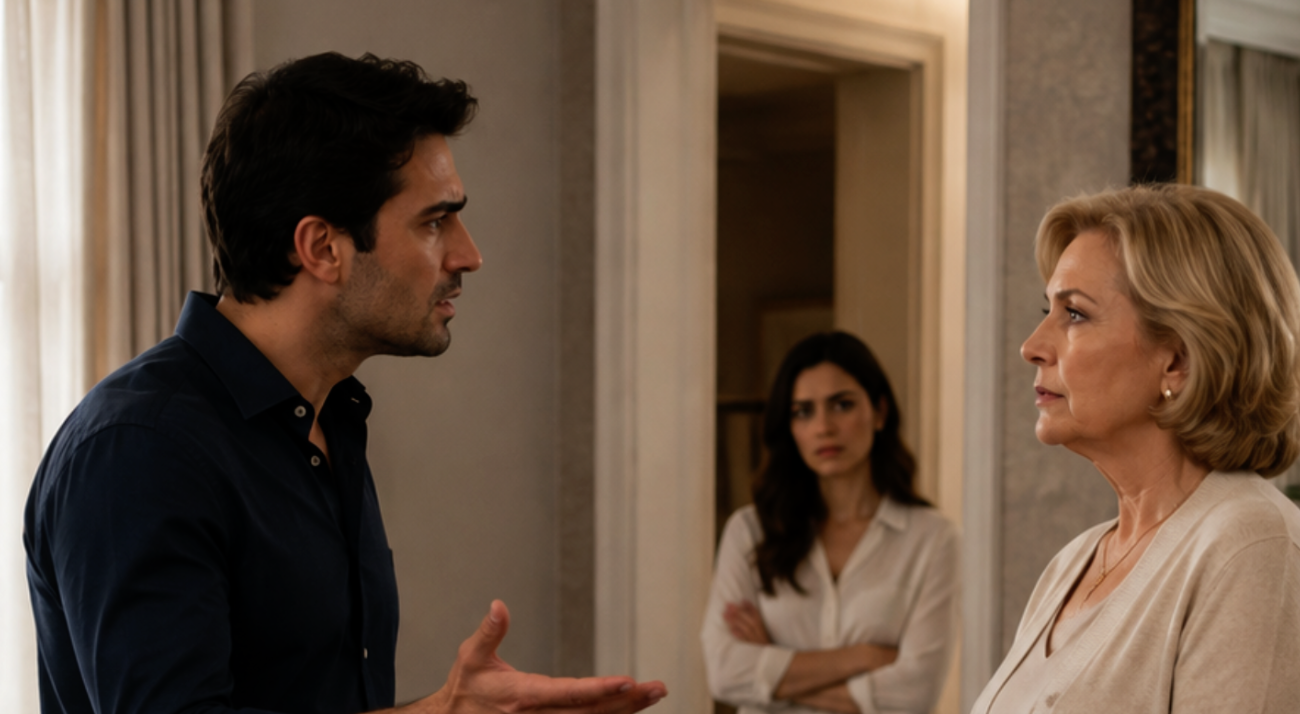
“This apartment is mine now. You don’t even need to take off your shoes—you won’t be staying here long,” her mother-in-law, Antonina Petrovna, said calmly as she opened the door with her own key.
Elena froze on the threshold, holding a cardboard box in her hands. For a moment, she couldn’t think of anything to say. She simply stood there staring at the woman in the colorful housecoat who was blocking the entrance with such confidence, as though she had always lived there.
Just a week earlier, Elena and Slava had been sitting in the kitchen, calmly and almost businesslike, discussing their divorce. He had spoken evenly, suggested that they not drag things out, and promised that everything would be divided fairly. Elena had even felt a certain sense of relief then—at least they would be able to separate without a scandal.
But now her mother-in-law was standing in the doorway of the apartment Elena and her husband had shared, looking at her with barely concealed triumph.
“Antonina Petrovna, I need to collect my things,” Elena said quietly.
“You don’t need anything from here,” the older woman snapped, leaning against the doorframe.
When they had first met, Slava had seemed dependable to Elena: quiet, serious, and someone who had plans for his future. A year and a half later, they had a modest wedding, and what they both called their real life began.
Nine years.
They never had children. At first they postponed it, and later they simply stopped talking about it out loud. But they did have a common goal that held them together more strongly than many other things: owning an apartment.
They both worked hard, denied themselves almost everything, and saved money from every paycheck.
“Three more years and we’ll have enough for the down payment,” Slava used to say while studying a spreadsheet on his phone.
“I could sell my room,” Elena suggested one day. “The one I inherited from my grandmother. That would make things go faster.”
And that was exactly what they did.
The room in the communal apartment that Elena had inherited was sold, and the money went into their joint savings. The mortgage was registered solely in Vyacheslav’s name because his official salary was higher and the bank offered him better terms.
Elena didn’t object. She had always made many important decisions based on trust.
They furnished the apartment together and enjoyed doing it. They visited building-supply stores, argued over tile samples, and assembled flat-pack furniture themselves.
Every month, the mortgage payment came out of their shared household budget, and to Elena that seemed completely natural.
During the last year, however, everything changed.
Vyacheslav began staying late at work. He returned home withdrawn and increasingly spent his weekends visiting his mother.
Elena tried to talk to him.
“Did something happen?” she would ask.
“Everything’s fine. I’m just tired,” he would reply without looking away from his phone.
In the spring, they finally sat down and talked properly.
Slava said things couldn’t continue like this.
Elena agreed.
They decided to separate without arguments or accusations: they would sell the apartment and split the money equally.
“I don’t want courts or ugliness,” he told her. “We’ll handle it like decent people.”
Elena temporarily moved in with her friend Marina, leaving behind her winter clothes, documents, and some household electronics. She intended to return in a week or two, collect the rest of her belongings, and begin looking for a place of her own.
She believed him.
She still believed him.
Elena arrived in the morning, expecting the apartment to be empty.
She rang the bell. No one answered.
She called Slava. He didn’t pick up.
She took out her key, but the door opened before she could even insert it into the lock.
Antonina Petrovna stood there wearing a housecoat covered in large roses and soft fur-lined slippers.
She stood as though she were opening the door to her own home.
“Come in, since you’re already here,” she said without greeting her. “But don’t stay long.”
Elena stepped into the hallway and stopped.
The smell was different—foreign and unfamiliar.
Her mother-in-law’s coat hung on the rack. Her shoes were sitting on the shelf.
When Elena looked into the kitchen, she saw enamel pots with blue lids on the stove—things that had never been there before.
In the bathroom, faded striped towels hung from the rail instead of the ones Elena and Slava had bought the previous year.
“Antonina Petrovna, I came for my belongings. My winter jackets, my documents, and some of the appliances.”
“The things here are mine,” her mother-in-law replied calmly as she sat down on a stool. “And the apartment is mine now too. So you can consider yourself a guest here.”
Elena was about to object when the front door slammed.
Slava entered.
He looked at Elena without surprise or embarrassment—the way someone looks at a person whose arrival they had expected and for whom they had already prepared an answer.
“Lena, I was going to call you,” he began.
“What’s going on?” she asked quietly.
He hesitated for a second before answering in a calm, almost casual voice.
“I transferred the apartment to Mom as a gift. A few days ago. The apartment is registered in my name, so I have the right to decide what to do with it.”
Elena felt as though the floor had shifted beneath her feet.
Not because she didn’t understand what he was saying.
But because suddenly everything made sense: his calmness when they discussed the divorce, his promises, his insistence that they would settle everything “like decent people.”
The next day, Elena called a lawyer.
Marina had given her the number with only a brief explanation:
“Svetlana Viktorovna. She’ll know what to do.”
The lawyer’s office was in an unremarkable building downtown.
Svetlana Viktorovna turned out to be a quiet, attentive woman of about forty-five. She listened to Elena without interrupting and made several notes in a notebook.
“When exactly was the deed of gift executed?” she asked.
“Slava said a few days ago.”
“And when did you file for divorce?”
“Last week.”
Svetlana Viktorovna looked up.
“So at the time the deed of gift was signed, you were still legally married?”
“Yes.”
“Now that is interesting,” the lawyer said, making another note. “Marital property cannot simply be gifted away without the other spouse’s consent, even if the apartment is officially registered in only one spouse’s name. We need to prove that you participated financially in acquiring it.”
Elena began gathering documents.
Bank statements showed transfers from her account toward the initial down payment.
The contract for the sale of the room she had inherited proved where that money had come from.
Receipts from building-supply stores, invoices for the kitchen, and purchase receipts for household appliances had all been kept in a folder that Elena had prudently taken with her during her first visit to the apartment.
But the most unexpected discovery was a series of messages.
While sorting through her belongings, Elena found an old tablet.
She and Slava had used it together during the early years of their marriage, but eventually it had fallen behind a cabinet and been forgotten.
Almost without thinking, she charged it.
The messenger application opened automatically. Slava had never logged out of his account.
Among his conversations with his mother, Elena found a message dated several weeks earlier.
Antonina Petrovna had written:
“First transfer everything to me, and then you can get divorced peacefully.”
Another message said:
“There’s no reason to give the apartment to some woman who is practically a stranger now.”
During one of the court hearings, another detail emerged.
Even after the deed of gift had been completed, Vyacheslav had continued paying all the apartment’s utility bills.
Antonina Petrovna had not paid a single one.
The judge silently examined the documents before looking at the defendant’s representative.
“Explain to the court how the recipient of the property exercised ownership while bearing none of the expenses associated with it.”
There was no answer.
At the fourth hearing, Svetlana Viktorovna submitted the correspondence.
Printed screenshots were placed in a neat stack on the judge’s desk.
The courtroom was small and institutional, smelling of paper and old wood.
Vyacheslav sat upright, looking off to the side.
Antonina Petrovna sat beside his lawyer, her hands folded on her lap.
“I ask that the correspondence between the defendant and the third party be admitted into evidence,” Svetlana Viktorovna said. “The messages indicate that Antonina Petrovna herself initiated the transfer of the apartment. I quote: ‘First transfer everything to me, and then divorce peacefully. There’s no reason to give the apartment to a strange woman.’”
The room fell silent.
Vyacheslav finally lowered his eyes toward the table in front of him.
His lawyer attempted to object, arguing that the messages had been obtained improperly and that they were being taken out of context.
But the judge was already studying the documents and comparing the dates.
“The deed of gift was executed while the parties were still married,” he said without looking up. “The spouse’s consent to dispose of jointly acquired marital property was not obtained.”
Svetlana Viktorovna spoke calmly, without any note of triumph in her voice.
She simply laid out the facts: their joint savings, the money from the sale of Elena’s inherited room, and nine years of shared mortgage payments.
The court invalidated the gift transaction as a sham arrangement.
Antonina Petrovna lost her ownership rights.
Slava listened to the decision with a stone-faced expression, but Elena noticed how tightly his fingers clenched around the folder of documents in front of him.
For the first time in several months, she felt as though the ground beneath her feet was solid again.
The apartment was returned to the pool of jointly owned marital property.
The court determined that Elena and Vyacheslav each owned an equal share.
Vyacheslav was given a choice: either buy Elena’s share at market value or agree to sell the apartment.
He remained silent during the consultation with his lawyer.
He remained silent at the next hearing too.
It quickly became clear that he did not have enough money to buy Elena out.
The apartment was put up for sale.
Antonina Petrovna called Elena herself.
When her number unexpectedly appeared on the screen, Elena hesitated but eventually answered.
“Do you realize that you’ve left my son without a roof over his head?” her mother-in-law demanded. Her voice sounded the same as always—firm and deeply offended.
“Antonina Petrovna,” Elena replied, “I only took back what I had earned.”
The woman hung up.
A buyer was found a month and a half later.
The transaction went smoothly, without any surprises.
As the notary read out the figures, Elena signed the documents and thought about the last time she had entered that apartment carrying a cardboard box.
She had stood in the doorway while her mother-in-law explained that there was no longer any place for her there.
Now the apartment was going to strangers, and somehow that felt right.
In truth, it had never completely felt like hers anyway.
It had been registered in her husband’s name, furnished through their shared efforts, and ultimately used against her.
The money arrived in her bank account on Friday morning.
Elena stared at the amount for a long time.
Then she sent Svetlana Viktorovna a short message:
“I received it. Thank you.”
The reply came quickly:
“Good luck. You did the right thing.”
The mortgage story was finally over.
Nine years of investment, trust, and quiet endurance had finally reached a fair conclusion.
The one-bedroom apartment in the new residential complex was small and smelled of fresh plaster.
Elena registered it solely in her own name.
She checked every line of the contract carefully and placed all the documents in a separate folder, neatly organized with dividers.
That evening, she arranged books on a shelf she had just assembled.
She worked slowly, without rushing—moving them around, straightening their spines, sometimes pausing to look at a familiar cover.
Then she put the kettle on.
Later, mutual acquaintances told her that Slava was renting a room somewhere on the outskirts of the city.
They also said that he and his mother had fallen out.
She believed he had failed to defend her interests properly in court.
He believed she had dragged him into a scheme that had ultimately cost both of them dearly.
Elena listened to these stories without feeling either satisfaction or pity.
She simply accepted the information and moved on.
The tea was ready.
She sat by the window, wrapping both hands around her mug.
Beyond the glass, lights glowed in the windows of other people’s apartments.
For the first time in a very long while, she didn’t have to explain herself to anyone, negotiate with anyone, or entrust anyone else with something that should have belonged only to her.
This home was hers.
Completely.
Without conditions.
And no key except her own could open its door.