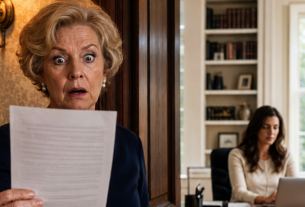
«What’s this?» she asked, though she already had a pretty good idea.
Her husband was closing the container with sandwiches, rushing to get to work.
«Your half. Yesterday came out to three thousand six hundred ninety-four.»
Just the night before, they’d actually had a disagreement at the checkout. Svetlana put coffee, expensive cottage cheese, and food for the stray cat she fed by their building into the cart. Vladislav added dumplings, spicy sauce, and two packs of sweets. He paid that time. They used to take turns, and after seven years of marriage, no one was keeping track of who got the most cheese.
«So I’m paying half for your dumplings too?»
«That’s why I think it’s easier this way. Everything from the store, split evenly. No more discussions about who needed what.»
It was that «no more discussions» line that hit Svetlana harder than the amount itself. But it was only 7:30 in the morning and she wasn’t about to argue. She sent over 1,847 rubles and figured her husband would get tired of photographing receipts in a week.
continued in the comments
He never did get tired of it.
By Friday, they even had a special chat. Vladislav would send photos of bread, milk, apples, dish soap. Svetlana replied with her own receipts. One day, he asked her to subtract two packets of cottage cheese from her purchase, since he didn’t eat them—though later that day he bought ham and automatically sent her half the cost.
«Hold on.» Svetlana pushed her plate away. «The ham is yours.»
«Then just subtract it.»
«Am I supposed to remember your whole receipt?»
«Svet, don’t start keeping books on me.»
She even laughed.
«I’m the one starting?»
Vladislav didn’t reply and changed the subject to his job. He repaired home appliances, and that day he’d spent almost an hour arguing with a customer who insisted their washing machine «just stopped spinning on its own,» though they’d found a child’s sock in the filter. Svetlana listened, nodded, and every so often her phone flashed with new notifications from their receipt-tracking chat.
By the end of the second week, the whole thing wasn’t funny anymore. They didn’t fight every night, but the little calculations started creeping into everything. Who bought the oil. Who finished off the cheese. Why apples were shared but suddenly nuts weren’t. Once, Svetlana actually caught herself counting the slices of salami on her husband’s plate—and instantly got angry at herself.
Svetlana and Vladislav knew ahead of time about Boris Stepanovich and Lidia Semyonovna’s upcoming visit. Vladislav’s parents were planning to stay for four weeks before heading to a health resort. In the past, they’d only come for three or four days, a week at most. Svetlana was fine with them: her mother-in-law never messed with her cupboards, and her father-in-law always offered to fix something—and usually actually fixed it.
On Friday, Vladislav met them at the train station. After work, Svetlana changed the bedding in the small room and cleared two shelves in the closet, while her husband stopped by the supermarket with his parents on the way home. Earlier that day, he checked with Svetlana on whether to get chicken, vegetables, and grains for dinner; they also added his father’s kefir, his mother’s plain cheese, ham, fruit, and cookies.
At the checkout, Vladislav paid—5,172 rubles.
At home, Lidiya Semyonovna headed straight to the kitchen to help out, while Boris Stepanovich left two travel bags in the hallway and handed a jar of honey from the dacha to his daughter-in-law. Over dinner, they chatted about the train ride, neighbors at the dacha, and how hot it was in their son’s apartment. There wasn’t even the smallest hint of conflict.
He came home later, after the guests had already gone to bed.
Svetlana’s phone chimed. In their shopping receipt chat, a photo of today’s receipt appeared along with a message from Vladislav: “2586 is your share.”
Svetlana stared at her screen for several seconds.
“Are you serious?”
Her husband walked out of the bathroom, drying his hair with a towel.
“What?”
“This purchase includes your father, your mother, and the shopping list you sent me.”
“But we agreed to split everything 50/50.”
“Back when it was just the two of us.”
Vladislav sat on the edge of the bed. He spoke quietly so his parents wouldn’t hear.
“They’re guests. I’m not going to ask them to pay for food.”
“Neither am I. But I’m asking why the bill was sent to me.”
“Four weeks won’t ruin us.”
“Then you should pay for it yourself.”
He grimaced, thinking Svetlana was making a big deal out of nothing. She reminded him about the 96 rubles she transferred him for her half of a pack of butter. Vladislav brushed it off: butter is a normal purchase, parents are a different story.
But that “different story” turned out to be the hardest part. The rule was solid as long as it was just about the two of them. As soon as his parents moved in, suddenly these rules started to bend.
That night, Svetlana ended up transferring the 2586 rubles. She stayed mad at herself for a long time for sending the money, even though the amount itself wasn’t a disaster for them.
On Sunday, Vladislav and his father went to the market. They came back with meat, cheese, nuts, fruit, mineral water, and expensive tea that Boris Stepanovich loved. Out of the whole shopping list, Svetlana had only asked for tomatoes.
About twenty minutes later, a receipt for 4,310 rubles showed up in the chat.
“2,155,” wrote Vladislav.
This time, she didn’t transfer the money.
After clearing the table, Svetlana opened the fridge and called her husband into the kitchen. On the top shelf sat eggs, milk, butter, and a container of soup. Just below were her father-in-law’s kefir, two types of cheese, ham, yogurts, mineral water, and containers of ready-made food that Lidiya Semyonovna separated into small portions.
“Look. This top shelf is our usual stuff,” Svetlana pointed out. “Bread, milk, eggs, veggies—the things both of us eat, we split like we agreed. Everything we bought because we have guests for a month—you or your parents can pay for that, however you want.”
“Are you planning to split the fridge now?”
“No, anyone can eat whatever they want. I’m only dividing up the money. That’s what you wanted.”
Vladislav gave a joyless smirk.
“Nice timing—exactly when Mom and Dad arrive.”
“Vlad, the rule was here before them. I just stopped pretending it only worked one way.”
She closed the fridge.
“Now half of it is your responsibility. Not in terms of shelves—in terms of expenses.”
Her husband picked up his phone from the table.
“What about the tomatoes?”
“I’ll transfer half for the tomatoes. Send me the amount separately if you want.”
It sounded petty, even to her. Svetlana realized it, but she didn’t take the words back. In two weeks, she had learned to speak the very way she used to hate.
The next day, she bought bread, eggs, vegetables, and her usual cottage cheese. In the group chat, she wrote just one line: “Total for two people — 620. Your half is 310.” The money transfer came through a minute later.
By evening, Boris Stepanovich’s kefir was finished. Lidia Semyonovna asked for apples. Vladislav silently put on his jacket and headed to the store. He came back with two bags, put the groceries in the fridge, and for the first time in many days, didn’t send his wife the receipt.
The system held up for several days. Svetlana didn’t create special shelves or refuse to cook for everyone. When she made porridge for breakfast, she put out four bowls on the table. But she no longer closed her parents’ lists automatically. Vladislav took it upon himself to buy more kefir, then cheese, then fruit, and suddenly started noticing the prices much more often.
«One decent cheese now costs almost five hundred,» he muttered as he unpacked the grocery bag.
Svetlana kept silent.
On Wednesday at dinner, Lidia Semyonovna asked why the butter wasn’t written on the communal list on the fridge door. Vladislav answered a bit too quickly:
«I’m buying yours separately now.»
Boris Stepanovich raised his head.
«Why separately?»
«It’s just more convenient,» Vladislav replied.
«Convenient for who?»
Vladislav reached for a napkin.
«Dad, it’s all fine.»
His father put down his fork.
«We brought money with us. I told you back home — we’re not going to stay at your place for a month at your expense.»
Lidia Semyonovna nodded.
«Yesterday I wanted to go to the store myself, and you said, ‘No need, I’ll get everything.’»
It was the first time Svetlana heard this. Until now, she thought Vladislav just didn’t want to talk about money with his parents. It turned out, they offered to pitch in themselves, but he refused — all while continuing to split extra expenses with his wife.
Vladislav blushed.
«You’re guests here. It feels wrong to take money from you.»
«But it’s fine to take it from Sveta?» his father asked.
«What does Sveta have to do with it?»
«Just that groceries don’t magically appear in the cupboard.»
Lidia Semyonovna cut the conversation short. She asked to be shown the nearest market the next day and switched the topic to the sanatorium. No one turned the dinner into a family trial, and Svetlana was grateful for that.
Later, Vladislav closed the door to the kitchen.
«Happy now?»
«Happy with what?»
«Now Dad thinks I’m counting every last ruble with my own parents.»
«He thinks exactly what he heard from you.»
«You could have avoided doing this right in front of them.»
«I didn’t say anything in front of them at all.»
«But you led everything to this.»
Svetlana wanted to snap back, her mouth already open, but she stopped herself. Her husband was right about one thing: she didn’t warn him that his first transfer would be the last for the guest groceries. She made a decision and just told him after the fact—almost the same way he stopped sending her receipts after that first Monday.
«Fine. I should’ve warned you. But I still won’t split costs in half for your decision that ‘the parents owe nothing.’»
Vladislav sat at the table, opened his banking app, and started scrolling through expenses. In five days, they’d spent over seven thousand on extra groceries. Not half his salary, and not a tragedy—but a sum that used to be easy to ignore when his wife would send him half back with a transfer.
«They’re staying here through the end of the month either way.»
«I know.»
«And I’m going to keep feeding them.»
«Go ahead.»
He shot her an unhappy look.
— Sometimes you really know how to be supportive.
— And sometimes you make up a rule and then get upset when I remember it.
During the third week, Lidiya Semyonovna suggested inviting her sister and her husband over for Sunday lunch. Vladislav was the first to agree. On Saturday, the four of them went to the hypermarket together. Their cart was soon filled with food for the big meal, the usual groceries for Svetlana and Vladislav, and a few items the parents wanted to take with them to the sanatorium.
At the checkout, the total came to almost nine thousand.
Vladislav unrolled the receipt.
— Should we split it in half?
Svetlana didn’t even have time to answer.
— Split what? — Boris Stepanovich was already pulling out his card. — We came up with the idea for this lunch. We’ll pay.
— Dad, put it away.
— I won’t.
— I invited you to live with us, not to stay in a hotel.
His father frowned.
— And I came to visit my son, not to be a freeloader. Those are two very different things.
People in line started moving their carts forward. Lidiya Semyonovna quickly separated out the bread, milk, eggs, and veggies that Svetlana usually bought for their home.
— This is yours. The rest is ours, and for lunch. Enough arguing at the checkout.
Vladislav had to step aside with the cart. Svetlana paid for the couple’s usual groceries, and her husband transferred her half. Boris Stepanovich paid for the family meal and his own things. Svetlana didn’t feel any sort of satisfying victory. She just felt awkward, standing between her father-in-law and her husband because of a block of cheese and two packs of meat.
But after the guests left, something happened that Svetlana never expected from Vladislav.
He opened up their receipt chat and spent a while scrolling through the photos. Butter. Apples. Her coffee. His dumplings. That first big shopping trip when his parents arrived. The market.
— Hey. — Vladislav paused, finger hovering on the screen. — How much were we actually spending on groceries each month before this?
— I don’t know. It’s not like we tracked every single pack.
— How about we keep track for a week, properly this time. No more splitting transfers back and forth. Just what we spend in general.
Svetlana looked up.
— And personal stuff?
— Each person covers their own. And for this week, my parents aren’t part of the calculation. I’ll sort things out with them myself.
Vladislav didn’t apologize. Svetlana didn’t ask him to. They stopped using their chat as a cash register.
After a week, it turned out that most of their usual food was actually shared, and arguing over every item made no sense. Vladislav’s pricey sweets remained his, while Svetlana’s coffee and cottage cheese were hers. When Boris Stepanovich went out for kefir, he’d bring back bread too. Lidiya Semyonovna once came from the market and handed Svetlana a pack of her favorite cottage cheese.
— This one’s yours. Vlad told me which one you get.
— How much should I transfer you?
Her mother-in-law waved it off.
— Nothing! I bought you a treat, not bringing you an expense report.
Vladislav peeked out of the room, overheard those last words, and rolled his eyes.
Before they left, Boris Stepanovich handed his son money for the last big grocery run anyway. Vladislav argued for a minute but accepted the cash.
After the parents left, the fridge was suddenly empty. On the middle shelf, there were eggs, veggies, a piece of cheese, and half a pot of soup left. There was no more ‘his’ and ‘her’ sides.
On the third day, Vladislav put a slip of paper with a single amount on the table.
— I’ve been thinking about our week. Let’s both transfer the same amount at the start of each month for groceries and household items. Anything personal, we each buy on our own. If anyone’s parents come to stay for a while, the extra expenses should go to whoever invited them—unless we make a different arrangement ahead of time.
— And let’s have no new financial reforms early Monday morning.
— Now that’s a bit much.
— No, that’s actually the main thing.
He wanted to argue, but decided not to.
They agreed to settle up once a month: whoever paid more for shared purchases gets the difference back from the other. Vladislav didn’t delete their old receipt chat—he just renamed it to ‘Archive.’
The next evening, Svetlana came home later than him. The groceries were already in the fridge. But there was no receipt on the fridge door.
A magnet with a tram held their usual list: bread, milk, apples, laundry detergent.