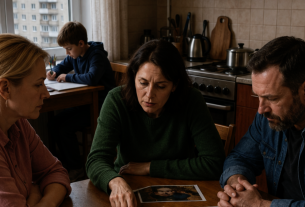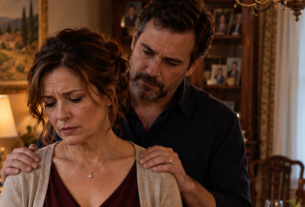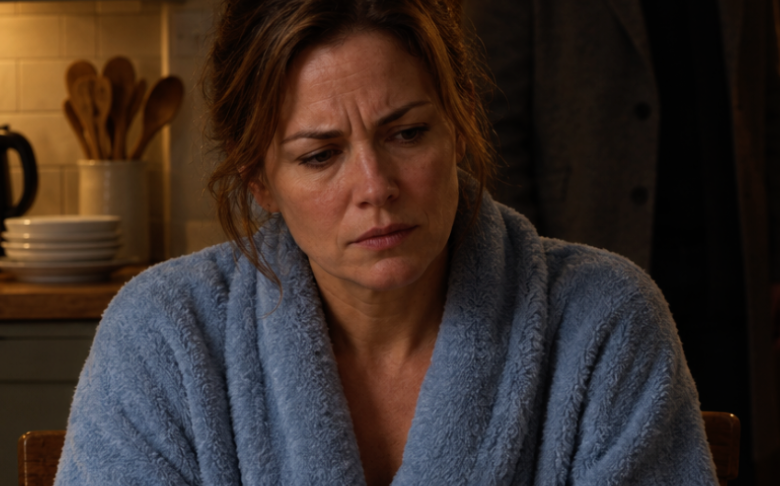
He tossed the keys onto the table so hard that the mug jumped. Tea splashed onto the tablecloth—the very one my mother-in-law embroidered for our silver wedding—and spread out in a dark stain, right over the stitches.
«Are you even listening to me, Vera? That summer house belongs to my mother. To me. And you’re not going there anymore.»
I heard him. I had been hearing him for three hours straight. Ever since he came home from work with that new expression on his face—one I’d never seen in all twenty-six years together.
«Andryush, sit down. I warmed up some soup.»
«Soup? I’m talking about ending our marriage and you’re talking about soup.»
He stood by the doorframe in his coat and work boots—the ones he never took off in the hallway because ‘my feet get tired.’ A snowflake clung to his shoulder, refusing to melt. The kitchen was cold.
«I heard you. About the divorce. I asked if you’d have dinner.»
He looked at me as if I’d just said something obscene. Then he sat down, took off his hat, and smoothed what little hair he had left.
«I won’t. I need to go.»
«To her?»
He didn’t answer. He didn’t need to. I had already known for half a year. I found out about her the night he came back from ‘the work party’ and spent ages washing his hands, then stared at himself in the mirror even longer, as if checking his face for traces.
«Alright,» I said. «I understand about the divorce. What did you want to say about the summer house?»
He perked up. His shoulders even straightened.
«That’s how it is, apparently. We’ll split the apartment equal—by law. I keep the car, it’s in my name. And the summer house is my mother’s, my father bought it, our family’s been going there since ’93, it’s her property, so you’re not setting foot there again.»
«Her property.»
«Vera, don’t nitpick my words.»
I poured myself some tea. My hands weren’t shaking. That surprised me—I thought they would. But they poured the boiling water perfectly, steady and clean, not a drop spilled.
«Andryush, the summer house is in Malinovka.»
«Yes, in Malinovka. So what?»
«The one we bought in 2013.»
«Yes. Why are you giving me a lecture now?»
«Nothing. Just clarifying.»
He stood up and put on his hat. At the door, he turned back.
«I’ll get the documents from my mother this weekend. And make sure your things are gone by spring. No jars, no seedlings, nothing. Tamara Petrovna is tired of all that.»
He left. The door slammed so hard the glasses rattled in the cabinet.
I stayed sitting. Outside, a thin, hesitant snow fell—as if it didn’t know if it was really time. The kitchen clock ticked louder than usual. I stared at the tea stain and wondered: is the embroidery ruined now, or will it wash out?
Strange, isn’t it. He said «divorce,» and all I could think about was the embroidery.
Lyuda arrived forty minutes later. I didn’t even call—she called me, asking for a recipe, and just by my voice, she knew everything. That’s Lyuda for you. She’s been a school vice principal for twenty years and can hear nuances in your voice like a piano tuner hears notes.
«Tell me everything.»
She sat down next to me, in Andrey’s spot, and took off her scarf. The scarf was bright orange—almost ginger—and in our gray kitchen, it looked like a flame in a fireplace.
«He’s leaving. For another woman.»
«Have you known long?»
«Half a year.»
«And you kept quiet?»
«What is there to say? Until he admits it himself, it might as well not exist.»
Lyuda shook her head. She always does that when she disagrees but doesn’t want to argue.
«Vera, what about the dacha?»
«He says it’s his mother’s. Told me to move our things out by spring.»
Lyuda froze. She knows everything about that dacha. She’s been there with us at least fifteen times, maybe more. We planted currants along the fence together, painted the terrace in 2017 together, when Andrey went fishing and said, ‘You’ll manage on your own.’
«And the documents?»
«His mom has the documents.»
«She only has a copy, Vera. Where’s the original?»
I paused to think. I really had to think, because in twelve years I had never actually held the purchase agreement in my hands. We bought it in a rush—the owner was moving to Germany, needed to sell quickly. I’d just finished dealing with paperwork for my mother’s apartment, after she passed away in December 2012, so I was up to my ears in legal documents. Andrey said, ‘You’re our chief accountant, you’ll figure it out.’ And so I did.
«I don’t remember,» I admitted. «I think I must have them somewhere.»
«Look for them.»
«Why?»
Lyuda looked at me for a long moment. She has that way of looking, without saying a word, but you get her meaning.
«Vera. You lived with this man for twenty-six years, and today he threw the keys on the table. Just check.»
I nodded. Then I stood up, went to the room, and reached for a shoe box I kept up on the closet shelf—my storage for everything important. The box smelled of dust and old receipts. Inside were birth certificates, medical cards, some slips, my work record, and at the very bottom— a blue folder stamped ‘FILES’ that I’d bought in 2013 just for the dacha documents.
The folder was thick. The contract, the act, payment receipts, even a handwritten note from the previous owner acknowledging the deposit—all neatly organized. I’d arranged these papers myself twelve years ago, and seeing them now, I suddenly remembered the smell in their office: dust, coffee from a vending machine, and someone’s strong masculine cologne.
I opened the contract and found the ‘buyer’ line.
There was my name.
Vera Nikolaevna Prokopenko. Passport, registration. Mine. All mine.
I flipped through it again. Double-checked. Read it out loud to Lyuda, whispering, as if someone might overhear.
«See?» Lyuda said. «I told you.»
«Lyuda, I don’t even remember us making it out specially in my name. I just remember us doing the paperwork, signing so many things. I didn’t even look at who it was for.»
«So why do you think it turned out that way?»
I thought about it. Thought for a long time. Then I remembered: back in the summer of 2013, we went to see Andrey at the clinic, and they told him his blood sugar was on the edge. He panicked, we argued because of it, and he grumbled, ‘Sort it out yourself, I can’t be bothered with paperwork.’ So I did. I put everything in my name. Because it was just easier at the government office counter than dragging him across town.
And then we forgot. Both of us forgot. I did because my job makes me put all important things in folders and stash them away. He did because he never cared where papers were, as long as they were somewhere.
«Lyuda, he really does think it’s his mother’s dacha.»
«Why?»
— Because twelve years ago we told my mother-in-law we were buying it with her money. She gave us three hundred thousand to add to what we had. And ever since, she’s kept saying, “This is my dacha, I gave you everything I had left.” And we never argued with her. What’s the point of arguing.
Lyuda smirked. Her smile was anything but pleasant.
— Maybe now you’ll argue.
I closed the folder. My heart was pounding somewhere in my throat. Not because I was happy—no, I wasn’t—but for the first time in six months, I felt like I had something to hold on to. It was small, blue, and had embossed lettering.
I didn’t sleep that night. I lay in the dark, recalculating: two hundred and fifty—that was our savings, mine and Andrey’s, split in half. Three hundred came from Tamara Petrovna. One hundred and fifty we borrowed from my brother Oleg, and it took us two years to pay him back—I did, from my own salary, because Andrey had switched jobs and spent six months getting a trainee’s paycheck.
So altogether, it was seven hundred. The owner had asked for six hundred eighty, fifteen went on paperwork, and we had five left over for the first sack of cement.
If we’re being honest, the dacha is more mine than anyone else’s. But who in a family keeps things honest? In families, it’s always done the family way.
By morning I finally drifted off. I dreamed I was standing on that very terrace that Lyuda and I had painted, watching the water rise. The water was muddy and yellow, and it was climbing fast, but I wasn’t afraid. I just stood there and watched.
I woke up to a phone call. It was my mother-in-law.
— Verochka, — her voice was syrupy sweet, the very same tone she uses with the tax inspector and the district police officer. — How are you, my dear?
— Good morning, Tamara Petrovna.
— Andrey told me everything. I can’t even tell you how hard this is for me. You’re like a daughter to me.
— You’re like a daughter to me. I’ve heard that from her at least thirty times in twenty-six years. Always whenever she needed something from me. Help in the garden, a ride to the clinic, looking after her sister from Ryazan, a loan before her pension came through.
— I understand.
— Verochka, you’re a smart woman. Let’s not make this a scandal. Andrey is a wreck, he’s not himself. Just let go of the dacha and we’ll part on good terms. I’ll even give you some jewelry—I have a gold brooch that belonged to Andrey’s grandfather.
I stayed silent.
— Verochka? Hello?
— Tamara Petrovna, whose name is the dacha under?
There was a pause on the line. I could hear her TV murmuring in the background—some morning gardening show.
— Well, Andrey’s, of course. Or mine. Honestly, I don’t remember, dear, it was so long ago.
— Have you seen the copy?
— The copy is in my china cabinet. Why do you ask?
— Oh, no reason. Take a look at it when you get a chance.
She started to say something else, but I’d already hung up. My hands still weren’t shaking. I noticed that for the second time in a day—my hands weren’t shaking. Something inside me had already made up its mind, on its own, without me.
At work, I asked for an hour off. I told Irina Vladimirovna I needed to go to the MFC. Irina Vladimirovna didn’t even look up from her report as she nodded. She’s known me for ten years and knows what’s going on in my life—not all the details, but the gist.
At the MFC, I took a ticket and waited twenty minutes for my turn. I ordered an extract from the Unified State Register of Real Estate. The woman at the counter didn’t even look at me—she typed it up, handed it over, and called out ‘next.’ I walked outside holding the sheet of paper.
The paper said:
Owner: Prokopenko Vera Nikolaevna.
Registration date: 14.08.2013.
Basis: purchase and sale agreement.
No encumbrances.
Standing on the steps of the MFC, I couldn’t help but feel like I’d just gotten back something of mine I thought was lost for good. Not just the dacha—something even bigger. A sense of belonging. A right.
I called Lyuda and said:
«I’ve got the extract.»
«And?»
«It’s mine.»
«Let’s go to the lawyer.»
«Now?»
«Now, Vera. Before you start feeling bad for everyone again.»
We headed to her acquaintance, a lawyer named Sergey Alexandrovich. His office was small, in an old house on Sovetskaya, with a staircase that smelled of cats and bleach. He looked about fifty, with tired eyes and a cheap pen he kept spinning between his fingers.
I laid out my whole folder right in front of him—the contract, the act, receipts, extract. Everything.
He read for a long time. Then looked up at me.
«Vera Nikolaevna, you have full ownership. It’s marital property, yes, so normally it’s split fifty-fifty. But…»
He paused.
«If you can prove that part of the funds were your own—earned before marriage or from selling your personal property—you could have a larger share. Did you have anything like that?»
I remembered. Instantly.
«My mom passed away in 2012. I sold her apartment in March 2013. That’s how we bought the dacha—part of the money came from there.»
«Do you still have the documents?»
«Yes. The inheritance certificate, the apartment sale contract, and the bank statement.»
Sergey Alexandrovich glanced at Lyuda. Lyuda looked at me. The office went quiet, except for a radiator clicking in the corner.
«Vera Nikolaevna,» he said carefully, «do you realize what your situation is?»
«I’m starting to.»
«Don’t just start—understand it right away. You’re not splitting your husband’s dacha. This is your dacha. Completely. Both on paper and by the source of funds. If we’re being blunt, at most he’s entitled to a quarter, maybe a third. And even that’s if the court is generous.»
I nodded. I didn’t smile, didn’t cry. Just nodded.
«And he thinks it’s all his.»
«That’s his problem, not yours.»
That evening, Andrey came to pick up his things. Not everything—just what he said was «for now»: a suitcase, a bag, a box with shoes. He walked around the apartment like it was someone else’s museum, packing up. I sat in the kitchen, drinking tea.
«Vera,» he said as he came in, «have you thought about the dacha?»
«I have.»
«And?»
«Let’s go this weekend and look at the documents. I’ll get them from Tamara Petrovna.»
«Go ahead.»
He exhaled. It was obvious he expected a fight, but since there wasn’t one, he seemed relieved. He even sat down next to me.
«Vera, you have to understand. I’m not your enemy. I just want to live.»
«I understand.»
«My mom poured her whole soul into this dacha.»
«I remember.»
«She’ll never forgive me if I lose it.»
«Then don’t tell her you lost it.»
He didn’t get it. He laughed, thinking I was joking.
«Vera, you’ve always been the smart one.»
He left. I put away my cup. Then I called my son.
Nikita is studying in another city, in his fifth year at university. He’s our only child, born late, long-awaited. I rarely call him myself so I don’t bother him. But this time, I did.
«Mom?»
«Nikita, things are rough between me and your dad. He’s leaving.»
Silence on the other end.
«I know, Mom.»
«How?»
– He told me himself a month ago. Asked me not to say anything to you until he was ready.
I leaned against the doorframe. Now that was a real blow, not the thing with Andrey. This was it. Hurting because of my own son.
– And you stayed silent.
– Mom, I didn’t know how. He asked me not to. I thought maybe he’d change his mind.
– He didn’t.
– No. Mom, I’m sorry.
– God will forgive you, – I said. For some reason my mother’s phrase slipped out. That’s what she’d say when she didn’t really want to forgive, but didn’t want to argue either.
We talked for another ten minutes. He asked about the dacha. I said, «We’ll figure the dacha out, don’t worry.» He said, «Mom, just don’t be too mad at dad.» I didn’t say anything back.
I hung up. Sat down on the hallway floor, right next to the coat rack, and then I started crying. Not because of Andrey. Not about the dacha. It was for the son who’d known for a month and kept it from me. For how, in my own family, I seemed to always come last.
Weekend. Malinovka. The dacha.
Everyone came: me, Andrey, Tamara Petrovna. Andrey was driving, Tamara Petrovna was up front, and I sat in the back with a bag holding my blue folder and the property statement from the registry office.
Tamara Petrovna talked the whole way. About the neighbors, the weather, about how last year the rowan berries were unusually red—meaning a cold winter was coming. She never once mentioned the divorce. As if it never happened. As if we were just off to open the new season.
The plot greeted us with silence. Snow covered the apple trees, the old greenhouse, and the bench Andrey made in 2015 from leftover paneling. There was a small snowdrift right on the front porch.
– I’ll go put the kettle on, – Tamara Petrovna said as she took out the key. – You two stay here for now.
She went into the house. Andrey and I stayed on the porch.
– Vera, – he said, not looking at me, – mom is about to say something to you. Please don’t interrupt her, okay?
– Okay.
We went inside. The house smelled of damp, the old stove, mice, and just a hint of that old dresser of my mother’s we had brought here from my apartment once. I walked into the kitchen. The cups were already on the table. Tamara Petrovna sat up straight, hands in front of her, like at a meeting.
– Verochka, – she said, – sit down. And you too, Andryush.
We sat down.
– I want to say something important. This dacha is mine. Ivan and I bought it in 2013, I put in three hundred thousand of my own money, closed out my savings account for it. You, Verochka, lived here, came here often, and I’m grateful for that. But now, with how things have turned out between you and Andrey, I have to say: the dacha stays with our family. You can take your jars, your tools, your plants—whatever you’re able to dig out. I have nothing against you as a person. But the dacha is mine.
She fell silent. Looked at me with the same expression you’d see in old Soviet movies, when the collective farm chairperson looked at a wayward tractor driver.
I stayed quiet. Andrey stared down at the table.
Tamara Petrovna, not waiting for a response, continued:
– I keep the documents at home, in the cabinet, I’ll give them to Andrey and he’ll put everything in his name through a donation. So don’t worry, everything will be done legally.
I opened my bag. Took out the folder. Put it in front of her.
– What’s this? – she asked.
– Documents.
– What kind of documents?
– For the dacha.
She opened it. Slowly. At first, she stared, confused, then realization dawned. Her face froze, as if someone had hit pause in the middle of an expression.
«Is this a copy?» she asked. Her voice had become thin.
«It’s the original. And the extract from the property register from Thursday. Today is Friday.»
Andrey reached out and took the contract. I watched his eyes move across the lines, from top to bottom, then back to the top, down again, and then he stopped on the line that read «buyer» and froze.
«Vera,» he said. «What is this?»
«It’s the sale and purchase agreement for our dacha. Registered in August 2013, in my name. At your request, by the way. You told me then: ‘You handle it yourself, I can’t deal with paperwork.'»
«I never said that.»
«You did.»
«I don’t remember.»
«But I remember.»
Tamara Petrovna suddenly perked up.
«That doesn’t mean anything. We gave money. Three hundred thousand—mine. And so the dacha is mine.»
«Tamara Petrovna,» I said very calmly, «you gave three hundred thousand in 2013, in cash. No receipt. No loan contract. No bank transfer. Legally, that money doesn’t exist. It’s not there.»
«What do you mean, it doesn’t exist? I gave it to Andryusha, right in his hand!»
«I believe you. But legally—it doesn’t exist.»
«So you mean, I can’t prove anything now?»
«You can’t.»
She looked at Andrey. He sat there, ashen, holding the contract and staying silent.
«Andryush, say something to her.»
He remained silent.
«Andryush!»
«Mom,» he said quietly. «My name isn’t on it.»
«What do you mean, it isn’t?»
«It’s not.»
The kitchen got very quiet. The kettle hadn’t boiled yet, but it was starting to whistle, high-pitched, almost painfully. Outside in the garden, a crow cawed.
Tamara Petrovna suddenly sobbed. Just once, briefly, as if she herself was startled by the sound.
«Verochka,» she said, «you’re like a daughter to me.»
I looked at her. At her hands with age spots. At the sweater she knitted about ten years ago. At her eyes, which now looked at me truly—for the first time, without sweet words, without ‘dear,’ without ‘the brooch from Andrey’s grandfather.’ Just her eyes. An old, frightened woman’s eyes.
And I felt sorry for her. Honestly. Sorry. For just a second.
And then I remembered. How for twenty-six years, she always said in front of everyone, ‘Vera, you’re not our own, but we love you.’ How when Nikita turned three she gave him a toy car, and to her granddaughter from her daughter—gold earrings. How in 2018, when I was bedridden with pneumonia, she showed up and asked, ‘Vera, did you defrost the fridge before you left?’ How in all those twenty-six years, she never once said thank you to me. Not once.
The pity faded. Not suddenly. Slowly. Like water draining from a sink.
«Tamara Petrovna,» I said, «I’m not your daughter. And I never was. I’m your son’s wife. Ex-wife, as it turns out now.»
She started to cry. Not for show. For real. She covered her face with her hands, her shoulders shaking. Andrey immediately rushed to her, began stroking her back.
«Mom, mom, please, mom.»
I stood up. Poured myself a glass of water. Drank it. Put the glass down.
«I’m going to step out now,» I said. «I’ll walk around the yard. You two should talk.»
I stepped outside. Pulled on my boots, zipped up my jacket, and walked over to the apple trees. The snow crunched loudly under my feet, like I was walking across someone else’s yard. I stopped in front of the oldest apple tree—the one we planted together back in ‘13, just a fragile little twig back then—and now it stood tall, its branches wide and covered in big caps of snow.
I placed my hand on its trunk. The bark was cold, rough, and alive.
«Well,» I said out loud to it, «you’re mine.»
And I laughed. Out loud. By myself. For all of Malinovka to hear.
The court date was in four months. Sergey Alexandrovich had prepared everything perfectly. I sat in the courtroom, wearing the gray suit I’d bought just for this day, watching Andrey across the aisle. He was sitting with his mother. Both sides, as he liked to say, were «presenting together.»
Their lawyer talked about family money, his mother-in-law’s investments, moral obligations. The judge listened without interrupting and took notes.
Then Sergey Alexandrovich spoke. He was brief. Account statement. Contract. My mother’s inheritance documents. The sale agreement for her apartment in March ‘13. Bank statement showing the proceeds from that sale and the withdrawal on the day we bought the dacha. That was it.
The judge left the room. She came back twenty minutes later.
«The court has decided. The house in Malinovka is recognized as the plaintiff’s personal property. The remaining property acquired during the marriage is to be divided equally.»
That was all.
I walked out of the courtroom. Lyuda was waiting for me in the hallway. She hugged me silently.
«Vera,» she said when she let go, «do you even realize what you’ve won?»
«I do,» I replied.
«No, you don’t. You didn’t win the dacha. You won yourself.»
I nodded. Honestly, I didn’t really understand it yet. That took time.
Summer. Malinovka.
I’m standing on that very terrace. Tea in my cup, steam rising up, sunlight streaming through the leaves. Currant bushes along the fence that Lyuda and I planted back in ’17, now heavy with berries. There’s a book lying on the bench, the one I started back in May but still haven’t finished—not out of laziness, just because I don’t want to rush it.
Nikita came to stay for a week. He’s out in the yard, hammering at something—helping me fix the gate that got crooked over the winter. We’ve talked a lot, these last few months. No hurt feelings. No digging up the past. Just talking.
«Mom!» he called from the garden. «We’re out of nails!»
«They’re in the shed, in the coffee tin.»
«The blue one?»
«Green.»
He headed off to the shed. I watched him walk away and thought: he really is a good kid, even if he got mixed up back then.
Andrey is living with that woman now. I actually saw her once, at the store. She seemed normal, tired—no better or worse than me. We looked at each other, parted ways at the checkout. I didn’t feel anything. Nothing at all. That was probably the strangest part.
Tamara Petrovna hasn’t spoken to me since. Not one call. At first, I waited—jumping at every ring. But then I stopped. Now I can’t even remember her number.
Sometimes, on the quietest evenings, I wander out into the garden and settle onto the bench beneath the old apple tree. The very same one from thirteen years ago. Now it’s grown so much you can hide from the rain under its branches. Last year it gave us a bucket and a half of apples—small, crooked, but so sweet they bring tears to your eyes.
I sit there and think: for twelve years, I believed this summer home was his. His mother’s. His family’s. I poured my holidays, my hands, my back into this place. And I never even thought to check the contract. Why would I? We were family. And in a family, you don’t check.
But you should check.
Not because people around you are bad. But because you need to know what’s yours. Just know that it’s yours. Not to take anything away. But so that if the day comes and someone throws keys on the table and shouts in a voice you barely recognize, ‘this house belongs to my mother,’ you can calmly pour yourself some tea. Pull the blue folder from the top shelf. And say in a steady voice:
‘Alright. Let’s go take a look at the documents.’
In the fall, Lyuda came to spend the weekend with me. We made jam from those black currants. The kitchen smelled like berries and sugar, the windows steamed up, and the radio played some old song in the background.
‘Vera,’ Lyuda said as she stirred the pot with a wooden spoon, ‘do you ever regret it?’
‘Regret what?’
‘You know, the twenty-six years.’
I thought about it. Really thought about it.
‘No. Twenty-six years is twenty-six years. Nikita was there. There was work. There was life. To regret would mean to cross it all out. And I’m not crossing anything out.’
‘And about him?’
‘Andrei?’
‘Yes.’
I took the pot off the stove. Set it down on the stand. The berries bubbled softly, settling down.
‘You know, Lyuda, I realized something. He didn’t betray me in December, when he left. He betrayed me earlier. Thirteen years ago. When he said, «just handle it yourself, I don’t care about paperwork.» I didn’t notice then. But even back then, he’d already decided—not to care about me. It just took twelve years for it to become clear.’
Lyuda was silent for a long time. Then she nodded.
‘Vera, so what about the house? Are you keeping it?’
‘I am.’
‘Will you sign it over to Nikita?’
‘I will. But not yet. I want it to be mine a little longer.’
We poured the jam into jars. Sealed the lids. Set them on the windowsill to cool—twelve jars in a row, dark red and shiny. Outside, it was already getting dark. The old apple tree stood in the garden, its branches swaying gently in the breeze.
I looked at the jars. Counted them again. Twelve. One jar for every year I didn’t know the summer house was mine.
Now I’ll know.