The bouquet of fresh wildflowers was the first thing Yana placed in her new room. The spring cornflowers and daisies, hastily picked by the roadside just before the move, smelled of sunshine and wind. They seemed like a tiny piece of freedom in this enormous, beautiful house that, for some reason, seemed to breathe coldness.
Pyotr’s family mansion looked impressive. Two stories, flawless brickwork, a perfectly maintained lawn where even the blades of grass seemed to grow in straight lines. When Yana had visited as a bride-to-be, she had genuinely admired its solidity and grandeur.
But now, stepping across the threshold with a suitcase in her hand, she suddenly felt a strange, inexplicable anxiety tighten into a knot inside her.
“Make yourself at home,” Pyotr said, struggling to carry her last bag into the room before wiping his forehead. “This is your home now too.”
Yana nodded, trying to smile as sincerely as possible. Only a week had passed since their modest wedding. Moving in with her husband’s parents had seemed like the right decision. Petya worked in the family business alongside his domineering father, and his parents had insisted that the young couple should begin their married life under their protection.
Yana had not objected. Having grown up within the institutional walls of an orphanage and later in a noisy college dormitory, she longed for warmth with all her heart. She desperately wanted to know what it was like to have a large, real family where everyone gathered around the same table in the evenings, drank tea, and shared news about their day.
“Petya! Come here!” Galina Arkadyevna’s commanding voice shattered the silence from downstairs. “Show your father yesterday’s invoices. Now!”
Pyotr flinched. The habit of obeying his mother was rooted too deeply inside him.
“Coming, Mom!” he shouted back.
Giving his young wife an apologetic wink, Pyotr hurried out the door, leaving Yana alone.
She looked around. The spacious bedroom, with sturdy furniture, a wide bed, and massive wardrobes, looked more like a room in an expensive but impersonal hotel. There was not a single personal belonging of her husband’s in sight, not one warm, intimate detail.
Yana opened her suitcase and carefully took out a small picture frame. Inside was a photograph from her graduation ceremony at the orphanage. In the picture, Yana stood in a simple little dress surrounded by children just like her—children who had no one waiting to take them home.
She carefully placed the frame on the bedside table. At least there would be something familiar in this cold room.
At that moment, the door flew open without a knock.
Galina Arkadyevna stood in the doorway.
“Settling in?” her mother-in-law asked.
Her sharp, assessing gaze immediately swept over the contents of Yana’s open suitcase.
“I hope there’s enough room in our wardrobes for your things.”
“More than enough,” Yana replied quietly, instinctively closing the suitcase.
Suddenly, she felt embarrassed about her simple cotton T-shirts and ordinary jeans under that X-ray-like scrutiny.
Her mother-in-law stepped closer and picked up the picture frame from the bedside table with two fingers, as though it were something unpleasant.
“And what’s this supposed to be? Your orphanage friends?”
“Yes,” Yana replied, her breath catching and her throat instantly going dry. “They’re my friends.”
“Of course, of course,” Galina Arkadyevna drawled dismissively as she put the picture back. “Well, never mind. Now you finally have a normal family. Come downstairs in half an hour. Don’t be late for dinner.”
The door closed.
Yana remained standing in the middle of the room, feeling her cheeks burn with a strange sense of shame about a past she had never been ashamed of before.
“No Dowry, No Connections, No Prospects”
The next few days became a quiet, exhausting ordeal for Yana. Galina Arkadyevna seemed to scrutinize her every breath.
Yana could physically feel the woman’s heavy gaze on her whenever she poured tea, hesitantly opened the enormous refrigerator, or simply sat in the living room reading a book.
Her belongings became a favorite target of ridicule.
One morning, Yana dabbed a drop of her favorite perfume onto her wrist before going to the store. Her mother-in-law, passing by, stopped theatrically.
“What brand is that?” she asked, narrowing her eyes.
“Nothing special. I bought it at a nearby shop,” Yana answered pleasantly. “I really like the light fragrance.”
“Ugh, what an awful smell,” Galina Arkadyevna said, wrinkling her nose and waving her hand as though brushing away smoke. “Cheap and sickly sweet. And here I thought you might at least have some taste.”
A couple of days later, without asking permission, her mother-in-law opened the half of the wardrobe assigned to Yana, supposedly looking for empty hangers. She took her time examining Yana’s modest wardrobe with obvious enjoyment.
“And these are all your shoes?” she asked with exaggerated surprise, pointing at three pairs. “What a poor little life you’ve lived. I suppose it’s a habit from childhood—making do with almost nothing.”
Yana remained silent.
How could she explain to this pampered woman that, to her, possessions were simply possessions?
When Yana had begun living independently and earning good money, she had developed the habit of investing in courses, education, and investments rather than buying dozens of boxes of shoes.
But the worst was yet to come.
One afternoon, while walking down the long wooden staircase, Yana heard voices coming from the study.
Galina Arkadyevna was speaking to her son.
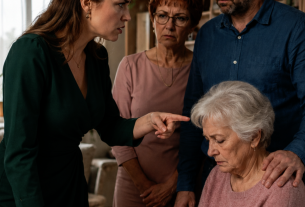
“Son, are you sure you didn’t rush into this?” her mother-in-law asked, venom dripping from every word. “The girl is pretty enough, of course. But think about it. No dowry, no connections, no prospects. An orphanage girl! Do you understand what kind of genes those people have? We’ve never had anyone like that in our family.”
“Mom, stop it,” Pyotr replied weakly and defenselessly. “I love Yana.”
“Love is a fairy tale for poor people, Petenka. You live in the real world. You need to think about your future before she settles comfortably on your neck for good.”
Yana froze on the step.
Her heart was beating so loudly that it seemed impossible they couldn’t hear it from the study.
Should she walk in and make a scene? Should she cry?
Instead, she quietly tiptoed back to the bedroom.
That night, she lay staring at the ceiling for a long time, listening to her husband’s steady breathing beside her.
He had never found the courage to truly defend her.
The Price of a Bowl of Soup
With each passing day, the circle of alienation tightened around Yana.
In the mornings, she often overheard her mother-in-law complaining on the phone or gossiping with neighbors over tea.
“Can you imagine, Anya?” Galina Arkadyevna declared loudly in the kitchen. “The girl has certainly landed on her feet. My Petenka works himself to exhaustion at the company while she just eats our yogurt, buys herself face masks, contributes not a penny to the household, sits around with her laptop, and sleeps!”
Standing outside the kitchen door, Yana could see Pyotr sitting at the table.
He simply stared at his smartphone, pretending to be deaf.
Not once did he interrupt his mother.
Not once did he explain that his wife worked remotely and paid for absolutely all of her own needs.
The situation reached its peak a week later, when her mother-in-law gathered the family in the living room for a household discussion.
Glossy catalogs filled with expensive furniture were spread across the table.
“It’s time to renovate the first floor,” Galina Arkadyevna announced categorically. “The sofa is worn out, and the dining set needs to go too.”
She suddenly turned to Yana, a sickly sweet smile appearing on her face.
“Yanochka, our little bird. You live in this house now too, don’t you? You use everything here. Perhaps you’d like to contribute to the purchase? Shared home, shared expenses, after all.”
Yana was taken aback.
She did not even feel like a guest here. She felt more like a random passerby being tolerated out of charity.
Invest her savings in a house where she was despised?
“Thank you for trusting me, Galina Arkadyevna,” Yana replied politely but firmly. “But I’ll pass. This is your house, so it’s your decision what it should look like.”
The smile vanished from her mother-in-law’s eyes, replaced instantly by icy rage.
“Oh, really?” she hissed. “You want to live here and use everything, but contribute financially? No. What a very convenient position for a little orphan.”
“Mom!” Pyotr finally spoke up. “We’re just starting our life together. Give us some time.”
“And who’s going to pay for everything? Your father and I again?” she shouted. “Where would she even get money from? What can she do besides press buttons on her phone?”
Yana clenched her fists under the table until they hurt.
Pyotr lowered his head again.
The Letter With the Torn Edge
Another day later, the family hosted a dinner with distant relatives.
All evening, Yana was examined as though she were some exotic creature. Galina Arkadyevna conducted the interrogation with obvious delight.
“Yanochka, why don’t you tell our guests where your parents work?” her mother-in-law asked innocently, fluttering her eyelashes despite knowing the answer perfectly well.
A ringing silence fell over the table.
The relatives exchanged glances.
“I don’t have parents. I grew up in an orphanage,” Yana replied calmly, looking directly into her mother-in-law’s eyes.
One of the aunts gasped quietly.
Galina Arkadyevna leaned back in her chair with satisfaction.
She had achieved what she wanted—publicly humiliating her daughter-in-law and showing everyone her supposed place.
Later, in the bedroom, Pyotr tried to hug his wife and mumbled apologies.
“Mom is just worried… She’ll get used to you.”
But his weak words only made Yana feel colder.
The point of no return came the following morning.
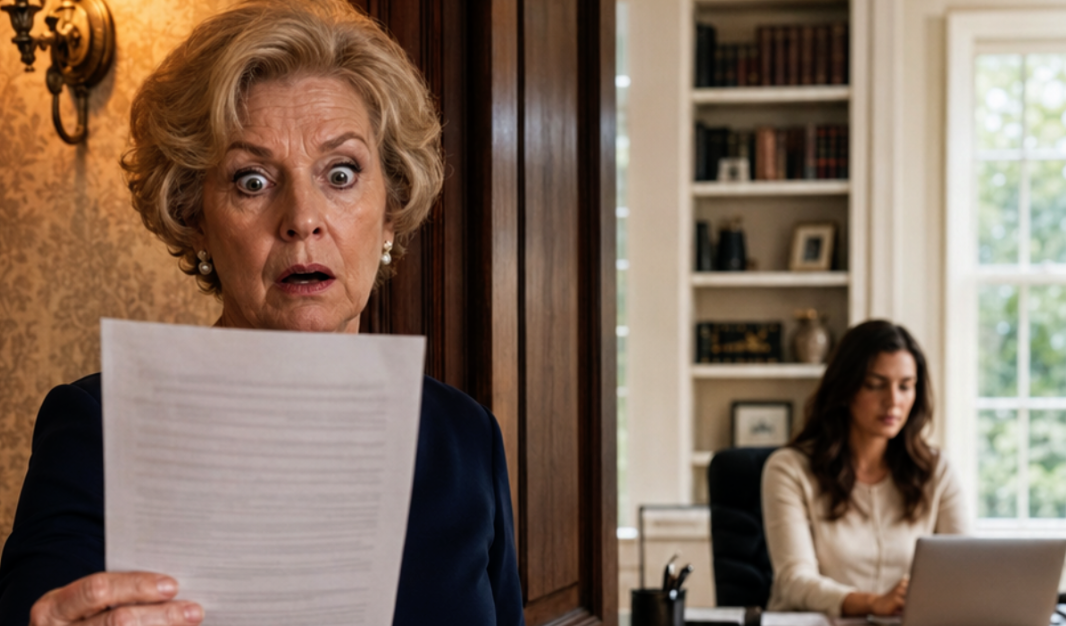
While arranging her belongings in the dresser, Yana noticed a letter from the tax authorities that had arrived the day before.
The envelope had been opened. Someone had roughly torn one edge and then clumsily resealed it with tape.
Inside was an official tax notice. Anyone who understood the numbers could easily calculate Yana’s real income from the amount shown there.
Yana was a highly skilled IT specialist working on projects for major foreign and metropolitan companies.
She stepped into the hallway and ran into Galina Arkadyevna.
The woman hurriedly avoided eye contact and began fussing around, pretending to dust.
That evening, Yana directly asked her husband about the letter.
“It was probably left open on the bedside table. Mom was cleaning and must have accidentally touched it,” Pyotr said dismissively, never taking his eyes off the television.
“Petya. Someone opened it and read it,” Yana said quietly.
Her husband merely shrugged.
The next day, while Yana was working on her laptop, he sat down beside her wearing an ingratiating smile.
“Listen, Yana… Mom was thinking we should renovate the country house. Put up a new fence, build a gazebo. Would you contribute? You have the means, after all.”
Yana froze.
She looked into the eyes of the man she had married out of deep and genuine love.
But now, all she could see in those eyes was calculating hope directed at her wallet.
“Do you all consider me the sponsor of your family?” she asked with a bitter smile.
“Why put it that way? You live here too. It’s only fair, especially since it turns out you’re not poor at all,” Pyotr replied with naive sincerity.
The Taste of Apple Pie and Hypocrisy
Two days later, a courier arrived at the house.
He delivered original company documents Yana had requested for her Schengen visa application: an income statement and an official notice regarding her annual bonus.
Yana left the papers on the table in the bedroom and went to take a shower.
When she returned, she realized the stack had been moved.
On the top page, beside the field showing her total annual income, stood the figure:
7,000,000 rubles.
At lunch, a miracle happened.
Galina Arkadyevna was suddenly unusually quiet. She fussed around Yana, placing the best pieces of meat on her plate and gazing into her eyes with an almost reverent, ingratiating expression.
The following morning, her mother-in-law entered the young couple’s bedroom without knocking, ceremoniously carrying a hot, golden-brown pie.
“Yanochka, my precious girl! Good morning!” Galina Arkadyevna sang so sweetly that Yana’s teeth nearly hurt. “I baked your favorite apple pie. We started off all wrong. I’m a mother, after all. I was simply worried about my son… You’re such a clever girl, such a hard worker. Eat up, put on a little weight.”
The woman’s face shone with false affection.
All her contempt had evaporated the instant she discovered how much the “poor little orphan” earned.
That evening, Pyotr brought flowers.
And once again, he began his familiar song.
“Yanochka, perhaps we really should upgrade the car? Mom says we could buy an excellent crossover if we add some of my money to yours…”
Yana looked at her husband and then at the untouched slice of apple pie on the table, which she had been unable to swallow.
Suddenly, the wealthy brick mansion felt unbearably suffocating.
The Road Home
When everyone left to run errands, Yana took out her few belongings.
She carefully folded her simple T-shirts and favorite jeans.
She placed the framed orphanage photograph on top of them.
The bouquet of wildflowers, long since dried inside the crystal vase, she left on the table.
Beside it, she placed the keys to the mansion and a short note:
“Poor girls don’t belong here.”
In the taxi, she closed her eyes.
Where should she go?
There was only one choice.
She gave the driver the address of an old Soviet-era apartment building on the outskirts of the city.
Nina Petrovna and Oleg Ivanovich lived there, an elderly couple who had once taken Yana under their wing after she left the orphanage. They had been unable to adopt her officially, but they had given her all the love that had remained unspent in their hearts.
An hour later, Yana stood before the familiar, battered apartment door.
The doorbell creaked nervously.
The door swung open.
Nina Petrovna, dressed in a house robe, gasped when she saw pale-faced Yana standing there with a suitcase.
“Yanochka! My girl!” the elderly woman cried, throwing up her hands before pulling her into a tight embrace.
She smelled of raspberry jam, comfort, and true, genuine warmth.
“Why are you standing in the doorway? Come inside, sweetheart. I’ll put the kettle on.”
“Can I stay with you for a little while?” Yana whispered, feeling treacherous tears run down her cheeks.
“What are you talking about, my dear girl?” Oleg Ivanovich protested as he stepped into the hallway. “This is your home. You can always come back.”
That evening, they sat for a long time in the tiny kitchen.
Yana cried as she told them everything: about the cold, judgmental looks, the opened letters, and how quickly her husband’s love had turned into calculation.
Nina Petrovna stroked her hand while Oleg Ivanovich frowned sternly beneath his gray eyebrows.
“You did the right thing, daughter,” the elderly man said firmly. “Family is where you’re loved for who you are, not for your wallet or for how useful you can be. You did well not to let them break you.”
For the first time in months, Yana took a deep, free breath.
Simply Being Herself
A year passed.
Yana rented a bright, spacious apartment in the city center. She barely thought about her disastrous marriage anymore.
Only during the first few months had her phone been flooded with calls from Pyotr, begging for forgiveness.
Galina Arkadyevna joined him, replacing her anger first with kindness and later with pathetic pleas to lend them money for her father-in-law’s “medical treatment.”
Yana listened exactly once.
Then she blocked their numbers forever.
She chose herself.
One autumn afternoon, while sitting in a cozy city café with a friend, Yana happened to turn around.
Pyotr was standing near the cash register.
He had lost noticeable weight. His shoulders drooped, and dark circles had settled beneath his eyes.
Her former husband looked up at her.
His eyes were filled with painful regret and fear of approaching her.
Yana felt neither anger nor triumph.
She simply gave him a light, polite nod and turned back to her friend.
That was someone else’s life now.
That evening, she bought a large fruit cake and drove to the outskirts of the city.
Opening the apartment door with her own key, she entered the tiny home filled with the smell of fresh baking.
“Our daughter is here!” Nina Petrovna called happily from the kitchen, wiping her hands on her apron.
They sat around the old table, drinking tea and laughing.
Nina Petrovna lovingly adjusted Yana’s hair and said with boundless tenderness:
“You are our greatest treasure. Never forget that, my girl.”
And Yana knew it was the absolute truth.
Because a person’s true worth is not measured in the square footage of brick mansions or in the number of zeros in a bank account.
It is measured by the ability to love the people beside you, no matter what.
Have you ever experienced something similar, when complete strangers became closer and dearer than the very people who were supposed to protect and love you?
Share your thoughts in the comments. Do you believe that fate eventually protects us from false and insincere people?