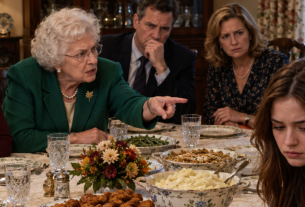
The mother-in-law entered the newlyweds’ new apartment, ran her finger along the windowsill, and announced loudly enough for everyone to hear:
“Dust. I knew it. Does this girl even know how to take care of a home?”
Vera stood three steps away and heard every word. Only yesterday, she had scrubbed the entire apartment until it shone—the windows, the floors, even the baseboards, which she had wiped down on her knees with a damp cloth. Yet her mother-in-law had found a speck of dust. One single speck that she herself had probably brought in from the street on her shoes.
“Tamara Petrovna, I cleaned yesterday,” Vera said quietly.
“Yesterday was yesterday.” Her mother-in-law took off her coat and hung it on the new rack in the hallway without asking. “And today there’s already dust. A home needs looking after every day. My Kostya was raised to appreciate cleanliness.”
Kostya—Vera’s husband—stood nearby in silence. He stared down at the toes of his slippers as though instructions on how to behave were written there. And his silence cut Vera more deeply than his mother’s words.
They had been married for only four months. They had purchased the apartment together: Vera’s mother had provided half the money after selling her country cottage, and Vera and Kostya had taken out a mortgage for the rest. It was a bright two-bedroom apartment on the seventh floor. Their own place. The first roof they had ever truly owned.
And now Tamara Petrovna sat in their kitchen, inspecting her daughter-in-law’s property like an auditor.
“Pour me some tea,” she ordered, settling more comfortably into the chair. “And show me where everything is kept. I need to know how things are arranged here.”
Vera put the kettle on. Her hands trembled slightly.
Later, she would remember the first year of her marriage as one long siege. Her mother-in-law arrived without warning, opening the door with her own key—a key Kostya had given her before the wedding and had refused to take back even after his wife asked him to.
“Mom is just worried about us,” he would say every time. “That’s love.”
“Kostya, this is our home. She can’t just burst in whenever she feels like it.”
“She’s my mother. She raised me alone. Do you want me to forbid her from visiting her own son?”
And Vera would fall silent. It was impossible to argue with that. Her mother-in-law always hid behind the phrase “I’m his mother” as though it were a shield. Any insult or intrusion could be justified by it.
Tamara Petrovna rearranged things in the kitchen to suit herself. She moved the jars of grains, rehung the towels, threw away the “wrong” cleaning cloths, and brought her own. One day, Vera came home from work and discovered that all her spices had been thrown into the trash.
“They were expired,” her mother-in-law explained curtly. “I bought you new ones. Proper ones. You can’t poison my son with all those chemicals.”
The spices had been fresh. Vera had bought them only a month earlier from a good shop. But there was no point trying to prove anything.
In the evenings, Vera attempted to talk to her husband.
“Kostya, I can’t live like this anymore. She runs our home as though it belongs to her.”
“What’s so terrible about that? She’s helping us. She cleans and cooks.”
“I didn’t ask for help. I asked for respect.”
“There you go again.” Kostya would turn irritably toward the wall. “Mom is trying her best, and nothing is ever good enough for you. Maybe you’re the problem.”
That phrase—“Maybe you’re the problem”—began to appear more and more often. Eventually, Vera truly began to doubt herself. Perhaps she was too sensitive. Perhaps her mother-in-law really did mean well. Perhaps Vera was the one who didn’t know how to be a grateful daughter-in-law.
Month after month passed this way. Vera seemed to dissolve inside her own apartment, becoming quieter and less noticeable. She stopped inviting her friends over because her mother-in-law might arrive at any moment and conduct an inspection. She stopped rearranging the furniture because it would only be put back the way it had been. She stopped arguing.
Then Vera’s mother fell ill.
Olga Ivanovna suffered heart trouble at the end of winter and was admitted to the hospital. Vera rushed between work, the hospital, and home. During those days, Kostya was surprisingly quiet. He brought supplies to the hospital and drove Vera there in his car. Vera even thought that perhaps hardship was bringing them closer and that things might finally improve.
Her mother recovered by spring, but the doctors warned that she needed peace and must avoid stress.
“Verochka,” Olga Ivanovna said, holding her daughter’s hand in the hospital room. “I’ve been lying here thinking about everything. Are you happy?”
Vera could not lie to her mother. She looked away.
“Then you aren’t,” Olga Ivanovna said softly. “I could feel it.”
Vera told her everything. About the keys, the spices, the constant “Maybe you’re the problem,” and her husband’s silence. Her mother listened without interrupting, her expression growing steadily more serious.
“My darling,” she finally said. “Whose name is the apartment registered under?”
“Mine and Kostya’s. Half each.”
“And the money I gave you from selling the cottage—did you document it properly? Was there a gift agreement stating that the money was specifically for you?”
“Yes. You insisted on it. The lawyer prepared everything.”
Olga Ivanovna nodded with relief.
“Good. That means your share belongs to you. Whatever happens, remember that, Vera. Remember it well.”
At the time, Vera did not understand why her mother insisted on this so strongly. She understood later.
Several more months passed. Meanwhile, her mother-in-law grew completely brazen. She began saying that the apartment was “too large for two people.”
“The two of you are rattling around in two whole rooms,” Tamara Petrovna declared over a dinner to which she had, of course, invited herself. “And I’m suffering alone in my tiny one-bedroom apartment. Perhaps we should all live together. Sell this place and buy a larger three-bedroom apartment. I’ll have my own corner, and you’ll have more space.”
Vera nearly choked on her tea.
“Tamara Petrovna, we weren’t planning to sell the apartment.”
“No one is asking you,” her mother-in-law snapped. “This is a family matter. Isn’t that right, my Kostya?”
And Kostya—while Vera stared directly at him—nodded.
“Mom has a point. It would be more convenient for the three of us. You’d have help with the housework, and Mom wouldn’t be lonely.”
Vera put down her fork. Something inside her turned cold.
“Kostya, my mother paid for half this apartment by selling her country cottage. She gave me the last valuable thing she owned. And now you want us to sell it so that your mother can move in?”
“What’s wrong with that?” Kostya did not even look embarrassed. “We’re family. Everything is shared.”
“Shared?” Vera felt something inside her stretch to the breaking point. “Then why does your mother continue living separately without any intention of selling her apartment? Why is it only my property that goes into the shared family pot?”
Tamara Petrovna pursed her lips.
“Well, look at you, counting every penny. That’s what modern wives are like. Everything is measured in money. No respect for a mother-in-law whatsoever.”
“Respect,” Vera repeated quietly, “has to be earned.”
Silence filled the room. Kostya stared at his wife as though he were seeing her for the first time.
“Apologize to my mother,” he hissed.
“For what?”
“For your tone.”
Vera rose from the table.
“I won’t.”
They did not speak that night. The following morning, after Kostya left for work, Vera called her mother and told her everything.
“Don’t you dare sell anything,” Olga Ivanovna said with unusual firmness. “Do you hear me? Under no circumstances. That apartment is your protection. Your only protection.”
“Mom, Kostya is insisting—”
“Kostya can insist as much as he likes. Legally, your share cannot be sold without your consent. No one can force you. Hold on to it, my darling.”
Vera ended the call and sat in the kitchen for a long time, staring out the window. Beyond the glass, bare branches swayed in the wind. Something inside her was changing. Slowly, but irreversibly.
A week later, something happened that put everything into perspective.
Vera returned from work earlier than usual because they had let her leave after a meeting. She went up to the seventh floor, unlocked the door, and heard voices coming from the kitchen. Her mother-in-law and Kostya. They had not heard her enter.
Vera froze in the hallway.
“The main thing is to wear her down,” Tamara Petrovna was saying in a low voice. “Make her sign the consent form for the sale. Once the apartment is sold, we’ll register the money in your name. She won’t even notice.”
“Mom, what if she refuses?”
“Then put pressure on her. Gently. Bring her flowers, say something sweet. Women love that sort of thing. Then suddenly, before she knows it, she’ll have signed everything. We’ll sell the apartment and buy a three-bedroom place in my name. You’re my son, so eventually you’ll inherit it. And that woman…” Her mother-in-law lowered her voice. “She should be grateful anyone married her at all. Half an apartment is hardly much of a dowry.”
“That’s pretty harsh, Mom.”
“It isn’t harsh. It’s clever. Why do you think I keep coming here and moving her things around? I’m training her. Teaching her to know her place. By the time she signs, she’ll already be completely obedient. Breaking a woman isn’t difficult. You just need patience.”
Vera stood in the hallway, and the world around her seemed to slow down. Each word pierced her like a cold needle. So that was the truth. It was not love. It was not concern. It was not “I’m his mother.” It was calculation. Cold, carefully planned calculation.
And Kostya knew.
Kostya had known everything from the beginning.
All those months—the spices, the keys, the constant “Maybe you’re the problem”—it had all been part of a plan. They had been methodically breaking her down, drop by drop, so that when the right moment came, she would sign whatever document they placed in front of her with a trembling hand and without a word of protest.
Vera took a deep breath. To her own surprise, she felt no pain. Only a strange, cold clarity.
She quietly stepped back out onto the landing. She stood there for a minute. Then she opened the door again, this time loudly, jingling her keys.
“I’m home!” she called in an exaggeratedly cheerful voice.
There was a sudden bustle in the kitchen. By the time Vera entered, her mother-in-law was already pouring tea with a welcoming smile, while Kostya scrolled through his phone with an innocent expression.
“Verochka!” Tamara Petrovna sang. “We were just waiting for you. Sit down and have some tea. I brought a pie—your favorite.”
“Thank you.” Vera returned the same friendly smile. “How sweet of you.”
And for the rest of the evening, she played her part. She nodded, agreed, and thanked her mother-in-law for the pie. She watched Tamara Petrovna congratulate herself and saw Kostya relax, convinced that his wife had finally become “completely obedient.”
Inside, however, Vera was calm and solid as stone.
The next day, she took time off work and visited a lawyer—the same woman who had prepared the gift agreement from Vera’s mother. Irina Valentinovna, a middle-aged woman with attentive eyes, listened carefully to Vera’s story.
“Here is the situation,” the lawyer said, spreading the documents across the desk. “You own half of the apartment. It was registered to you using money transferred through a gift agreement from your mother. That makes it your separate property, not marital property. This is extremely important.”
“So they can’t force me to sell it?”
“No one can force you in any way. Not your husband, not your mother-in-law, and not a court. You can sell your share only of your own free will. And the entire apartment cannot be sold without your consent.” Irina Valentinovna smiled slightly. “Your mother was very wise to arrange everything this way. It was almost as though she sensed what might happen.”
Vera exhaled. Her shoulders, which she had held tense for many months, finally relaxed.
“What should I do now?”
“Do you want a divorce?”
Vera paused. Strangely, when she asked herself that question honestly for the first time in a long while, she realized that she did. She had wanted one for a long time. She had simply been afraid to admit it.
“Yes,” she said aloud. The word made it easier to breathe. “I do.”
“Then we proceed calmly and legally,” the lawyer said with a nod. “No one will touch your share. We’ll divide the mortgage obligations. Most importantly, don’t sign any documents, regardless of what they tell you. Not under any circumstances.”
Vera left the lawyer’s office and stepped into the spring sunshine. For the first time in a year, she no longer felt like a victim. She felt like the owner of her own life.
When she returned home, her mother-in-law was there again—as always, without warning. This time, she had brought a folder of documents and spread them across the kitchen table.
“Verochka, look,” Tamara Petrovna cooed. “I spoke to a real estate agent I know. He says we could get a very good price for our apartment. You only need to sign your consent right here, and we can begin the process. There’s no reason to delay.”
Kostya stood beside her, wearing a forced smile.
“V-Ver, seriously, let’s just do it. It will be better for everyone.”
Vera walked over to the table. She picked up the document and read it. It was a consent form authorizing the sale of her share. At the bottom was an empty line for her signature.
She carefully placed the paper back on the table.
“No,” she said calmly.
Her mother-in-law and Kostya exchanged glances.
“What do you mean, no?” Her mother-in-law was still smiling, but the smile had become strained.
“I mean no. I will not sell my share. Not now and not later.”
“Vera,” Kostya said with a frown. “We already agreed.”
“We didn’t agree on anything.” Vera looked him directly in the eyes. “You made an agreement with your mother. In this very kitchen. A week ago.”
The room fell silent. The smile vanished from Tamara Petrovna’s face.
“What are you talking about?”
“I’m talking about how you planned to ‘wear me down.’ How ‘breaking a woman isn’t difficult—you just need patience.’ How you intended to put the money in Kostya’s name and tell me to be grateful that anyone married me at all.” Vera spoke evenly, without raising her voice, and her composure made her mother-in-law grow visibly pale. “I heard everything. I was standing in the hallway, and I heard every word.”
Kostya opened his mouth but could not speak.
“All these months,” Vera continued, “you were trying to break me. The spices, the keys, the constant criticism. You called it concern. But it was training. You wanted me to sign whatever you put in front of me when the right day came.”
She picked up the document and slowly, calmly tore it in half.
“I will not sign it.”
“How dare you!” her mother-in-law erupted. “I’m his mother! I raised my son!”
“You raised a son,” Vera agreed. “And at the same time, you raised a man who betrays his own wife whenever his mother tells him to. Congratulations on your parenting.”
“Kostya!” His mother turned toward him. “Do you hear the way she’s speaking to me? Say something!”
But Kostya remained silent. He stared at the floor, just as he had on that first day when his mother had discovered “dust” on the windowsill.
Only now, his silence no longer mattered.
“I don’t need him to say anything,” Vera said. “I’ve made my decision. I’m filing for divorce. My share remains mine. I’ve spoken to a lawyer and verified everything. And you, Tamara Petrovna…” She looked her mother-in-law directly in the eyes. “You will never open this door with your key again. Give it to me. Now.”
Her mother-in-law gasped indignantly.
“Kostya, say something!”
Kostya raised his eyes to his mother and suddenly muttered quietly, almost plaintively:
“Mom… maybe you shouldn’t have discussed all that while I was there.”
Vera almost laughed. That was all he was capable of. Not remorse. Not shame. Only annoyance that their plan had failed.
“The key,” she repeated, holding out her open palm.
With hands trembling from rage, Tamara Petrovna pulled the key from her handbag and threw it onto the table.
“You’ll regret this,” she hissed. “Where will you go alone, with this apartment and the mortgage? You’ll come crawling back.”
“I won’t,” Vera said, picking up the key. “You know, Tamara Petrovna, I’m actually grateful to you. Had I not overheard that conversation, I might have continued tolerating this for years. But now I’m free. So thank you. The door is over there.”
The divorce was finalized within two months. Kostya did not resist. Once he realized he would not get Vera’s share, he had no reason to prolong the process. The mortgage obligations were divided: Vera took responsibility for her portion, while his portion was transferred to him.
Tamara Petrovna attempted to assert her rights through a lawyer she knew, but Irina Valentinovna destroyed every one of their arguments effortlessly. The gift agreement was airtight.
Vera remained in her apartment.
Alone.
Or rather, not alone.
Her mother was with her.
After recovering from her illness, Olga Ivanovna moved in with her daughter—not to take over or give orders, but simply to be there. Together, they replaced the wallpaper in the bedroom and rearranged the furniture the way they liked it, rather than the way Vera’s mother-in-law wanted it.
They threw away Tamara Petrovna’s “proper” cleaning cloths and bought ordinary ones. They returned Vera’s favorite spices to the shelf.
“You know,” Olga Ivanovna said one day as she poured tea in the kitchen where the conspiracy against her daughter had once been planned, “I always felt that this marriage was pressing you into the ground. You became so quiet. Almost invisible.”
“I really did become invisible,” Vera admitted. “I completely disappeared. I thought that was how it was supposed to be. I thought everything was my fault.”
“And now?”
Vera looked at her mother. Outside the window, the sun was setting, painting the sky in soft colors. For the first time in a long while, she felt whole.
“Now I’m myself again,” she said. “And you know, Mom, thank you. For the cottage. For the gift agreement. For insisting on it.”
Olga Ivanovna smiled and placed her hand over her daughter’s.
“A mother’s heart can take different forms, my darling. For some, it is a shield protecting their child. For others, it is a weapon used against someone else’s child. I wanted to be your shield.”
“You were,” Vera said softly.
Another year passed.
Vera received a promotion at work and became head of her department. She bought the furniture she had dreamed of for years. She adopted a cat—an arrogant ginger creature that immediately claimed the best place on the sofa without asking anyone’s permission.
In the evenings, she met with the friends she could now invite home without fearing that her mother-in-law would suddenly arrive to conduct an inspection.
One day, Vera happened to meet Kostya at a shopping center. He looked tired and unkempt. Tamara Petrovna shuffled beside him, looking older, her lips tightly pursed.
Apparently, they were living together now.
Her mother-in-law had finally moved in with her son—but not into the spacious three-bedroom apartment she had dreamed about. Instead, she lived in his cramped rented one-bedroom apartment. After the divorce, Kostya had no apartment of his own, and he could barely afford the mortgage payments for the share that had been transferred to him.
Kostya saw Vera and appeared to consider approaching her. He opened his mouth.
“Ver… hello. You look good.”
Vera stopped for a moment. She looked at her former husband calmly, without anger or pain. She looked at him as though he were simply a stranger.
“Thank you,” she said with a smile. “I have to go.”
Then she continued on her way—confidently and lightly, without looking back.
Tamara Petrovna hissed something after her, but Vera was no longer listening. Those words no longer had any power over her.
She stepped out of the shopping center into the bright sunlight. Taking out her phone, she called her mother.
“Mom, I’m free now. I’ll pick you up. Shall we have dinner at that new café? Tell Anya to get ready too.”
At home, her little niece was waiting—the child Vera was looking after that evening. Her arrogant ginger cat was waiting. Her mother was waiting.
Life was waiting.
Her own life—a life no one else had the right to rearrange, control, or break.
Her mother-in-law had once called Vera a barren flower and claimed she would be lost without Kostya.
But the opposite happened.
Vera finally blossomed only when she stopped being afraid and began protecting what belonged to her.
Sometimes, the most important decision of your life is made neither in a lawyer’s office nor in a courtroom.
It is made in a dark hallway, while you stand there holding your keys, hear the truth, and suddenly realize:
You have had enough.
And that is the freest moment of all.