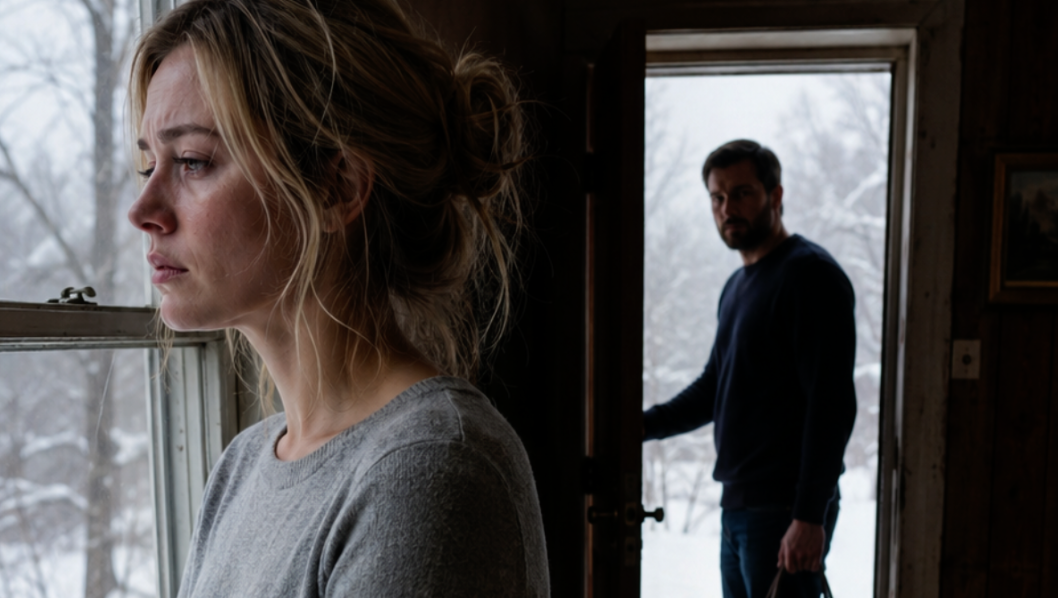
Oleg made a grand exit.
At least, that was how he saw it.
He packed his suitcase carefully, folding his shirts, trousers, and sweater without creasing them. He added his razor, cologne, and phone charger. Then he closed the suitcase, snapped the locks shut, and said:
“Vera, I’m leaving.”
Vera was standing by the window. Outside, it was March—gray and slushy, with patches of dirty snow still lying on the ground. The bare branches of the bird-cherry tree scraped against the glass in the wind. She did not turn around.
“For her?”
Oleg was silent for a moment. Then he said:
“For her.”
“For Katya.”
“For Katya,” he confirmed, as though saying the name changed anything.
Vera nodded slowly, still looking out of the window. Then, unexpectedly, she asked:
“Do you love her?”
“I do,” Oleg said. Then, as though trying to justify himself, he added, “You see, Vera, things between you and me have become somehow… wrong. Like cold soup. It’s still food, but there’s no flavor left. With her, I feel alive.”
“Alive,” Vera repeated. “Well, God bless you.”
Oleg had expected a scandal. He had expected tears. He had expected her to throw herself at him, grab hold of him, and scream, “Don’t leave, you bastard! Where are you going?”
He had even prepared himself for it. He had rehearsed his response in his head:
“Vera, calm down. There’s no point.”
But Vera did not cry. She did not scream. She did not even turn around. Only her back—straight and tense—became even straighter, as though she were carrying something heavy on her shoulders and had no intention of letting it fall.
“Have you packed your suitcase?”
“Yes.”
“Then go.”
Oleg picked up the suitcase and walked into the hallway. At the door, he turned around.
Vera was still standing by the window—slender, dressed in an old house dress, her hair tied into a careless bun. For a moment, he felt sorry for her.
But pity is a poor adviser. People confuse pity with love, although they are entirely different things.
The door slammed shut.
The house became silent.
Katya had been Vera’s best friend.
They had been friends since university. Twenty years. They had gone together to harvest potatoes as students, raised their children together, and cried together when Katya’s mother died.
Vera knew about Katya’s dreams, her migraines, and her strawberry allergy. She knew that Katya had been divorced twice. She knew that Katya had never been able to stay with one man for long.
She knew all of that, and yet she still failed to protect herself.
Oleg arrived at Katya’s house with his suitcase on Thursday.
On Friday, Katya sent Vera a message:
“I’m sorry. It just happened.”
That was all.
Twenty years of friendship had been reduced to three words and a full stop.
Vera did not reply. She blocked her.
Then she cried for the first time since Oleg had left. She cried at night, alone in the empty house, pressing her face into the pillow so no one would hear her.
The first few months passed in a haze.
Vera lived on autopilot. She got up, went to work, came home, and went to bed.
She worked as a nurse at a small rural medical clinic in a remote village about thirty kilometers from the district center. Her job saved her. Sick people, queues, prescriptions, injections, and bandages left her no time to think.
No time to feel sorry for herself.
Naturally, rumors spread through the village.
Everyone knew everything there. They knew that Vera’s husband had left her. They knew whom he had left her for. They knew that Katya was “a snake in the grass.”
Vera’s mother, Anna Stepanovna, walked around looking darker than a storm cloud. She threatened to “rip that Katya’s legs off.”
Vera begged her:
“Mom, don’t. Let them sort it out themselves.”
“What is there to sort out?” her mother fumed. “They’re made for each other. He’s a scoundrel, and she’s a shameless flirt. Where were you looking all this time?”
“I don’t know, Mom. I don’t know.”
“That’s exactly the problem—you don’t know. And how are you supposed to live now?”
Vera did not know that either.
But gradually—very slowly and reluctantly—life began to improve.
Spring came. Then summer.
Vera dug up the vegetable garden, planted potatoes, and started keeping chickens. In the evenings, she sat on the porch, drank tea, and watched the sunset.
And she thought.
She thought a great deal.
She tried not to think about Oleg. But memory is a cunning thing.
Sometimes, for no apparent reason, an image would suddenly appear before her eyes: the two of them together by the river, Oleg laughing, Oleg holding her hand.
Something inside her would collapse.
But she never called him.
She never wrote.
She never tried to arrange a meeting.
Was it pride?
Perhaps.
Or perhaps she simply understood that what was gone could not be brought back.
Meanwhile, things between Oleg and Katya began to fall apart.
The first few months were like a honeymoon. Love, passion, and plans for the future.
Oleg felt like a real man. Here she was—a real woman. With her, he felt alive. With her, he could breathe.
Katya was bright and loud, with a slightly husky laugh. She wore red lipstick and tight dresses.
She was nothing like Vera, who was quiet and modest and always wore an old robe and slippers around the house.
But April passed.
Then May.
Then June.
And the trouble began.
Katya was hot-tempered. Oleg was easily offended.
Katya demanded attention. Oleg wanted peace.
Katya loved guests, noise, and lively gatherings around the table. At the end of the day, Oleg dreamed only of silence.
At first, they argued about small things.
Who had left a cup on the table?
Who had forgotten to take out the rubbish?
Who had looked at whom the wrong way?
Then the arguments became serious.
There were smashed dishes, shouting, and tears.
“You’re not the man I thought you were!” Katya screamed.
“And you’re not the woman I thought you were!” Oleg shouted back.
They were both right.
They had both deceived themselves.
Katya had imagined Oleg to be strong and decisive, a “real man with character.”
Instead, he turned out to be an ordinary, tired person who wanted to be fed dinner and left alone.
Oleg had imagined Katya to be passionate and full of life. He thought that being with her would shake him out of his routine and make him feel young again.
Instead, she turned out to be a hurricane that destroyed everything in its path.
In August, they had their final argument.
True to her habits, Katya threw him out.
Literally.
She carried his suitcase onto the porch, threw his jacket on top of it, and said:
“I don’t want to see you here again, you cheating dog.”
Then she slammed the door.
Oleg was left standing outside with his suitcase.
In the same village where everyone knew him.
Where every second person was either Vera’s relative or acquaintance.
Where everyone remembered how he had made his “grand exit” six months earlier.
He spent the first night at the home of a casual acquaintance.
The second night, he slept in an old construction trailer beside a garage.
On the third night, he went to Vera’s mother.
Why did he go to her?
Who else could he turn to?
He had no relatives of his own in the village.
By then, he had no friends either.
He stood by Anna Stepanovna’s gate, shifting nervously from one foot to the other and twisting his hat in his hands.
“Aunt Nyura…” he began.
Anna Stepanovna’s informal name was Nyura, and out of old habit he still called her that.
“Could you… could you let me stay the night? I’ll sleep in the bathhouse. I have nowhere else to go.”
The old woman looked at him for a long time without speaking.
Her eyes were like Vera’s—gray and slightly narrowed.
Only angrier.
She stood in the doorway with her legs planted wide apart in patched felt boots and her arms crossed over her chest.
She said nothing.
Oleg was about to turn around and leave when she finally spoke.
“You can sleep in the bathhouse. I won’t let you into the house. And don’t tell Vera. If I find out you told her, I’ll throw you out. Understood?”
“Understood.”
“Go.”
And he went.
The bathhouse was old and blackened with smoke. It was heated in the traditional way, without a chimney, and smelled of smoke and birch branches.
There was a narrow wooden bench in the changing room.
Oleg lay down on it, placed his jacket under his head, and covered himself with the only thing he could find—an old patchwork blanket.
He lay there for a long time, staring at the dark ceiling.
Thinking.
What did he think about?
He thought about how quickly love could end.
He thought about how foolishly he had behaved.
He thought about the fact that Vera had not called him once during those six months. She had not reproached him or begged him to return.
She had not contacted him at all.
And she probably never intended to.
Not because she was proud, but because he had made the decision himself.
He had left.
He had destroyed everything.
He also thought about how the bench, the bathhouse, and the mother-in-law who had taken pity on him were now all that he had left.
And how he deserved it.
A week passed.
Then another.
Oleg continued living in the bathhouse.
During the day, he took whatever work he could find. He chopped firewood for one person, repaired a fence for another, and helped someone else dig up potatoes.
In the evening, he returned.
Anna Stepanovna silently brought him a small pot of soup or some boiled potatoes in their skins.
He ate.
He thanked her.
Then he returned to the bathhouse and lay down on the bench.
They hardly spoke.
What was there to say?
Everything was clear without words.
The old woman despised him.
He knew that.
But she also felt sorry for him because a human being was wasting away before her eyes.
And it was a sin not to pity a lost soul, even when that person was a scoundrel.
Oleg began to change.
He became quieter.
He stopped shaving, and his stubble grew gray and coarse.
His clothes became worn.
He looked at the floor and spoke very little.
And he thought about Vera more and more often.
Her quiet voice.
Her hands.
The way she had stood silently by the window when he left.
Vera discovered everything by accident.
She came to visit her mother one weekend to help with the household chores.
When she entered the yard, she noticed a pair of men’s boots beside the bathhouse.
They were old and worn, but familiar.
She remembered them.
She had bought them herself three years earlier at the market in the district center.
She stopped.
Her heart began to beat faster.
Then she entered the house.
“Mom, whose boots are those beside the bathhouse?”
Anna Stepanovna was sitting near the stove, peeling potatoes.
Her hands trembled.
She put down the knife and looked at her daughter with a long, heavy gaze.
“His.”
“Whose?”
“Your Oleg’s. Your former husband.”
The silence became thick, like water beneath a layer of ice.
Vera stood in the middle of the kitchen, gripping a bag of treats she had brought for her mother—gingerbread and sweets.
The bag slowly slipped to the floor.
“He… lives here?”
“He sleeps in the bathhouse. Katya threw him out. He had nowhere else to go, so I let him stay.”
“You let him stay,” Vera repeated.
Her voice sounded unfamiliar.
“You let him stay after everything he did.”
“What was I supposed to do, throw him out into the cold?” Anna Stepanovna stood up. Her eyes shone, but her voice remained firm. “Yes, he’s a scoundrel. No one is arguing with that. But he’s still a human being. A living person. He needs food and shelter. Was I supposed to take a sin like that upon my soul before God?”
“He isn’t your family. He’s your former son-in-law.”
“Former family isn’t the same as a stranger. You lived together for twelve years. I treated that fool almost like a son…”
She did not finish.
She waved her hand, sat down again, and returned to peeling the potatoes.
Vera remained standing.
She did not know what to do.
Two emotions were fighting inside her.
One screamed:
Go out there and throw him out. He betrayed you. He trampled all over you. He left you for your best friend.
The other voice was quiet and dull:
He is out there in the bathhouse, lying alone on a bench, unwanted by everyone.
And he is your husband.
Your former husband.
But somehow, he is still yours.
“Where is he now?” Vera asked.
“Chopping firewood for Sergeich. He’ll be back soon.”
“I’ll wait.”
“Vera…” Her mother raised her eyes. “Don’t do anything rash. Think first.”
“I’ll think,” Vera said.
Then she sat down on the bench by the window.
Oleg returned in the evening.
He entered the yard looking exhausted and hunched over.
He noticed Vera’s bag beneath the window and stopped.
Then he saw Vera herself as she stepped onto the porch.
He froze.
They stood facing each other.
She was on the porch.
He stood in the middle of the yard, holding a splitting axe, wearing someone else’s padded jacket, unshaven and visibly older.
They remained silent for a long time.
Vera spoke first.
“Hello.”
“Hello,” Oleg said.
His voice was hoarse, like the voice of someone with a bad cold.
“You live in the bathhouse?”
“In the bathhouse.”
“Katya threw you out?”
“She did.”
“And you came to my mother.”
“I did. I had nowhere else to go.”
Vera nodded.
She walked down the porch steps and approached him.
She studied him the way someone might examine an old possession that they had once loved, then lost, and later found lying in a rubbish heap.
Not knowing whether to pick it up or walk past.
“Why did you leave?” she asked quietly.
Oleg said nothing.
He looked at the ground, at his boots, and at the axe in his hand.
Then he raised his eyes.
“I don’t know. I thought it would be better there. I thought it was love. But it turned out…” He stopped himself. “It turned out that things aren’t better anywhere. Wherever you go, you’re still yourself. I’m still me. You can’t run away from yourself. Do you understand?”
“I understand.”
“I don’t deserve you.”
“That, I already know,” Vera said.
Then she suddenly smiled.
It was a tired and sad smile, but it was still a smile.
“You don’t deserve many things. But you are the father of my children. And you are a living human being. Living people need somewhere to live.”
She paused.
Then she said:
“Pack your things. We’re going home.”
Oleg raised his head.
There were tears in his eyes, perhaps for the first time in many years.
“Vera… are you… are you serious?”
“I’m serious. But on one condition. You will live in the house only if you come back permanently. And if I ever see you with Katya or any other woman again, you will be out of the house that very minute. Understood?”
“Understood,” Oleg said. “I… I swear.”
“Don’t swear. Oaths are only words. Show me through your actions.”
He nodded.
Vera turned toward her mother, who was standing in the doorway watching them.
“Mom, thank you for letting him stay. But from now on, we’ll handle things ourselves.”
Anna Stepanovna pursed her lips, but something resembling approval flashed in her eyes.
Silently moving her lips, she made the sign of the cross over her daughter and went back inside.
Oleg returned home.
He packed his suitcase again.
Only this time, he did it quietly, without theatrical gestures or grand words.
They walked home through the entire village.
It was already dark.
Large, bright northern stars hung above the road.
Dogs barked somewhere in the distance.
The air smelled of autumn, smoke, and dry grass.
They walked in silence.
Vera went ahead, while Oleg followed slightly behind her like a dog that had misbehaved.
Then she slowed down until they were walking side by side.
Suddenly, she took his hand.
“Your hand is so cold,” Oleg said.
“It’s all right,” Vera replied. “It will warm up.”
And they continued walking.
Together.
A year passed.
Oleg never looked at another woman again.
He worked, repaired the house, and brought home firewood.
He carried Vera in his arms—literally—when her back began to hurt, carrying her from the bedroom to the kitchen.
She laughed and said:
“You old fool, you’ll drop me.”
“I won’t,” he replied. “I already dropped you once. Once was enough.”
Katya left the village a month after the incident.
No one knew where she went.
No one asked.
Anna Stepanovna continued to look suspiciously at her son-in-law for a long time.
Eventually, however, she softened toward him.
Especially after he built her a new bathhouse to replace the one in which he had slept.
“Now you’ll be able to enjoy a proper steam bath, Aunt Nyura,” he told her. “You deserve it.”
“I certainly do,” the old woman replied. “As for you—you haven’t earned it yet. But never mind. We’ll live and see.”