Natalia put the kettle on and looked out the window. Down in the courtyard, a vehicle loaded with boxes was being unloaded. Alyona Viktorovna stood beside the driver, directing him where to carry everything as though the apartment had belonged to her from the very beginning.
“Bear with me. I’ve just sold my house, and for now I simply have nowhere else to go,” her mother-in-law said as she crossed the threshold carrying two bags. “I’ll stay for a week, two at the most.”
Natalia nodded and stepped aside, allowing the boxes to be carried into the hallway. She had spent fifteen years of marriage to Alexey living exactly like this—giving way, stepping back, making room for other people’s demands.
She had bought the apartment long before the wedding, back when she worked as an accountant at a factory and saved every bonus and every bit of vacation pay. She had paid off the mortgage before she even met her future husband. By the time they married, she already had a home of her own, and Alexey moved in with nothing but one suitcase and a guitar.
“Everything is ours,” he used to say during the first years of their marriage, kissing his wife. “We’re a family.”
Natalia did not argue back then. She worked at the factory before moving to a private company, where she eventually became financial director. Her salary steadily increased, while Alexey’s income rose and fell unpredictably. He took renovation contracts, sometimes earning good money and sometimes going for months without a single job.
Natalia paid the utility bills herself. She also carried the mortgage on the country house they had purchased jointly after Elizaveta was born. Alexey contributed only occasionally, blaming delays on downtime at construction sites or problems with clients.
She had bought her husband’s car with her own savings and paid for its insurance and maintenance as well.
All of it accumulated inside her like water beneath thin ice, but Natalia kept silent for the sake of their daughter. Elizaveta was fourteen, and Natalia wanted her childhood to pass in a peaceful home without shouting and slamming doors.
Three days after moving in, Alyona Viktorovna rearranged the sofa in the living room, dragged the cabinet to another wall, and threw away an old shelving unit that had stood in the hallway for years.
“It was taking up space,” her mother-in-law said with a shrug when Natalia asked where the furniture had gone. “I thought you wouldn’t mind.”
Natalia said nothing. The shelving unit had belonged to her grandmother, and throwing away someone else’s belongings without asking was, to put it mildly, strange. But starting a scandal over a piece of furniture seemed petty.
A week later, Alyona Viktorovna began talking to her granddaughter about Natalia. At dinner, while Natalia washed the dishes, her mother-in-law told Elizaveta stories about how cold and heartless her mother supposedly was, how she “counted every last penny” and “never felt sorry for anyone.”
“Grandma, Mom isn’t like that,” Elizaveta objected once.
But a month later, the girl had begun looking at her mother differently—with caution, as though trying on her grandmother’s words and wondering whether they might fit.
At the same time, Alyona Viktorovna was working on her son.
Natalia heard fragments of their conversations through the wall. Her mother-in-law spoke quietly but persistently, repeating the same points in different ways: the apartment was shared property, official registration gave Alexey rights, and a wife could not throw either her husband or her husband’s mother out of their own home.
Alexey listened and nodded. Then he would come to his wife and repeat exactly the same phrases as though he had memorized them.
“Mom is right,” he said one evening, sprawled across the sofa. “I’m officially registered here, so I have a say in what happens in this house.”
“Registration doesn’t give you ownership rights, Alexey,” Natalia replied as she folded laundry. “You know how it works.”
“Oh, come on. What difference does it make whose name is on some piece of paper if we’ve been living together for fifteen years?”
Natalia put down the towel and looked at her husband for a long moment, but said nothing. Arguing with someone who was merely repeating another person’s words felt like talking to a wall.
Money began disappearing almost unnoticed, but steadily.
Sometimes Alyona Viktorovna needed money for medicine, sometimes for a new coat, sometimes for a dentist appointment. Natalia paid every time—again for the sake of peace in the house, again ignoring the growing list of expenses.
Then the guests started coming.
Her mother-in-law’s friends arrived for tea without warning, settled themselves in the living room, inspected the furnishings, and discussed apartment prices in the neighborhood as though openly calculating the value of someone else’s property.
“Alyona Viktorovna, perhaps it’s time to look for a place of your own?” Natalia asked one day, trying to keep her voice calm. “Not necessarily permanently. Just so that everyone can have their own space.”
Her mother-in-law pursed her lips, disappeared into her room, and slammed the door so hard the glass in the cabinet rattled.
Ten minutes later, Alexey stormed in, his face crimson.
“How could you even say something like that?! She’s my mother, do you understand? My mother! She isn’t going anywhere, so get that through your head!”
Natalia raised the subject three more times over the following months, and every time the same scene repeated itself: a calm request from Natalia, hysterics from her mother-in-law, and shouting from her husband.
Eventually Natalia stopped trying—not because she had accepted the situation, but because she was gathering strength for something else, although she did not yet understand what that something would be.
The tension in the apartment became almost physically tangible.
Natalia noticed how her shoulders tightened every time she turned the key in the lock of her own home and how her hands began to tremble slightly after yet another conversation with Alexey.
She continued cooking dinners, checking Elizaveta’s homework, and paying the bills. Outwardly, life went on exactly as before.
But inside her, something was methodically rearranging itself, preparing for a final confrontation that Natalia herself could not yet clearly see.
The turning point came on an ordinary Tuesday.
Natalia came home from work earlier than usual because a client had canceled a meeting. As she entered, she heard voices coming from the kitchen.
The door was not completely closed, and through the gap she could hear a conversation between mother and son.
“Go to a notary and get her to sign a general power of attorney over her accounts,” Alyona Viktorovna said quietly but clearly. “Tell her you want to help handle things while she’s busy at work. Once you have that, we’ll see what we can do.”
“Mom, she’ll never sign something like that,” Alexey replied.
There was no confusion in his voice. If anything, he sounded annoyed that the plan might not be so simple.
“Not immediately, of course. Gradually. And when you two get divorced—and that’s where this is heading, you need to understand that—you’ll sue for half the apartment. Fifteen years of marriage, a shared household, a child together. You’ve got every chance.”
Natalia froze in the hallway, pressing her palm against the wall.
The cold plaster beneath her fingers felt almost comforting—the only solid support in a room that had suddenly begun spinning before her eyes.
“And what do we do with Liza if it comes to divorce?” Alexey asked.
“She’ll stay with me—well, with you, of course. The girl is attached to her grandmother, you know that. Her mother can go rent some apartment somewhere. No home, no money—it’ll serve her right. She shouldn’t have been so arrogant.”
Natalia took one step backward, then another, careful not to make a sound.
Her fingers had gone cold and her breathing became uneven, but inside her head there was suddenly a strange, almost ringing silence—as though every doubt she had accumulated over the past fifteen years had collapsed into one simple thought.
She no longer asked herself whether she was doing the right thing by remaining in this marriage for her daughter’s sake.
Now the question was different:
How much longer was she willing to endure before there truly was nothing left for her?
That same evening, Natalia waited until Alexey went out to meet a friend and Alyona Viktorovna shut herself in her room to watch television.
Then Natalia opened the safe inside the wardrobe and took out a folder of documents.
The apartment ownership certificate.
Statements from her personal bank accounts, which her husband had no access to.
The contract for the country house showing who had actually made the monthly payments.
Receipts for the car, insurance, repairs—everything that had accumulated over the years as proof of her financial independence was now arranged in a neat stack on the table.
Elizaveta was doing homework in her room, and Natalia quietly looked in on her.
“Liza, there’s going to be an unpleasant conversation between the adults tonight,” she told her daughter. “If anything happens, stay in here, all right? I don’t want you involved in this.”
Elizaveta looked up from her notebook, and something unexpectedly mature flashed in her eyes—as though she had long sensed that a storm was building inside the house but had never known when it would finally break.
“All right, Mom,” she answered quietly.
Natalia closed the door to her daughter’s room and walked into the hallway.
Alyona Viktorovna’s bags and boxes were still there—the same ones she had arrived with several months earlier.
Slowly and methodically, Natalia began placing her belongings near the front door: her robe, slippers, jars of cream from the bathroom, a bag of medicines.
Her hands moved calmly, almost mechanically, as if she were simply tidying the apartment before cleaning.
Alyona Viktorovna came out of her room after hearing the noise and froze in the doorway when she saw her bags in the hall.
“What is this?” her voice shot upward. “What do you think you’re doing?!”
“I’m packing your things, Alyona Viktorovna,” Natalia replied evenly. “It’s time for you to find somewhere else to live.”
“Oh, I’ll show you somewhere else to live!”
Her mother-in-law grabbed her phone and began dialing her son with trembling fingers.
Twenty minutes later, Alexey burst into the apartment without even removing his jacket and immediately saw his mother’s boxes arranged by the door.
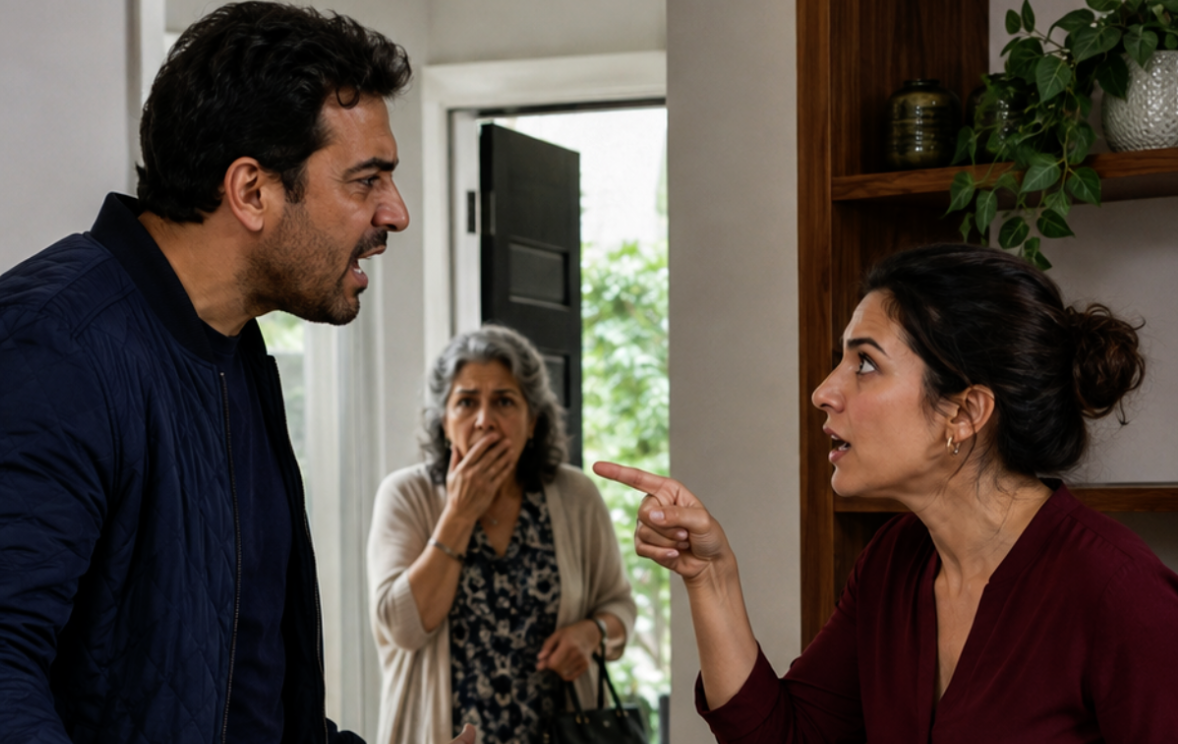
“Who the hell are you to throw my mother out of the apartment?!” he shouted, hurling his keys onto the cabinet so violently that they bounced onto the floor.
Natalia stood beside the table where the folder of documents lay.
She did not flinch.
She did not take a single step backward.
She looked at her husband calmly, without the habitual readiness to surrender that had lived inside her for fifteen years.
“I am the owner of this apartment, Alexey,” she said. “And I’m not going to keep explaining obvious things to you.”
“This is our home!” Alexey stepped forward, his face turning red. “We’ve been together for fifteen years! We have a child together!”
“I supported this family by myself for fifteen years,” Natalia said, picking up the folder and opening it in the middle of the table. “I paid the mortgage on the country house, the utilities, your car, its insurance and repairs. I put up with your mother, her demands, the money for her medicine and her coats. I endured all of it because I wanted Liza to grow up in a peaceful home.”
She looked directly into his eyes.
“And today I heard you and your mother discussing getting power of attorney over my bank accounts and dividing my apartment after the divorce you’ve already planned without me.”
Alexey opened his mouth, but for several seconds no words came out.
His face twitched, revealing that the conversation had indeed happened exactly as his wife had described it.
“I didn’t… We were just talking,” he muttered.
“You decided Liza would stay with you and I would leave with no home and no money,” Natalia continued.
Her voice did not tremble, although inside everything was tightening painfully.
“Well, none of that is going to happen.”
Alyona Viktorovna, who had been silently watching until then, rushed toward the table and tried to snatch the folder from her daughter-in-law’s hands.
“Give me those documents immediately!” she shouted, grabbing the edge of the folder. “Who are you in this family to order everyone around?!”
Natalia held on to the folder and stepped half a pace backward.
Seeing that his mother could not take it from her, Alexey tried to seize the papers by force, grabbing his wife by the wrist.
“Enough of this hysteria. Give it here,” he hissed through clenched teeth.
Natalia pulled her hand free and backed toward the wall, pressing the folder against her chest.
Alyona Viktorovna continued shouting insults—that Natalia had never been worthy of their family, that without her husband and his mother she was nobody, that the apartment ought to belong to whoever was the “real master” of the home.
Without saying a word, Natalia took out her phone and called the police.
“Good evening. I need help,” she said evenly into the phone. “My husband’s relatives are trying to take my documents from me by force and are refusing to leave my apartment after I asked them to.”
Alexey froze when he heard the word “police.”
Alyona Viktorovna fell silent for a second, but immediately started complaining again that her daughter-in-law was humiliating the family in front of the entire building.
The officers arrived fifteen minutes later—two uniformed men, calm and clearly accustomed to situations like this.
Natalia showed them her ownership certificate, her bank statements, and the contract for the country house showing who had actually been making the payments.
“Ma’am,” one of the officers said to Alyona Viktorovna, “according to these documents, Natalia is the sole owner of this apartment. Your son being officially registered here does not give him the right to control the property, much less to evict the owner or take her documents by force.”
“But I’m his mother! I have more rights than this little—” her mother-in-law began.
The officer interrupted her gently but firmly.
“If the owner of the apartment is asking you to leave the premises, you will have to leave. Otherwise, we will file an official report.”
Alyona Viktorovna looked at her son, expecting support.
But Alexey stood silently with his eyes lowered to the floor, as though for the first time that evening he truly understood that the plan he and his mother had so carefully constructed was collapsing before his eyes.
Realizing that her son would not defend her, Alyona Viktorovna grabbed her bags and walked out, muttering curses as she went.
One of the officers held the door open and escorted her to the stairwell.
The apartment became quiet.
Alexey sat on the edge of the sofa with his head in his hands while Natalia carefully gathered the documents, returned them to the folder, and put it into her bag.
“Tomorrow I’m filing for divorce,” she said calmly, without spite and without the slightest hesitation in her voice.
“Natasha, wait.”
Alexey raised his head, and for the first time that evening genuine fear appeared in his eyes.
“I lost my temper. Mom put those ideas in my head. I didn’t mean to…”
“You spent fifteen years listening to your mother instead of listening to your wife,” Natalia said, shaking her head. “I’m not angry anymore, Alexey. I’m simply tired.”
That same night, after her husband went to sleep in the living room and Elizaveta finally fell asleep, Natalia sat down at the computer and spent the rest of the night sorting out their finances.
She separated their joint accounts, revoked every power of attorney she had ever issued in her husband’s name, changed the passwords to her banking apps, and submitted requests to block any additional bank cards issued in his name.
By morning, Alexey no longer had the slightest ability to access or control her money.
Natalia filed for divorce the very next day.
Alexey tried several times to change her mind. He called her from work, came to see her during her lunch break, and once even broke down crying in the kitchen, admitting that his mother had always exercised too much control over him and that he had failed to notice when he had become her puppet.
Natalia listened calmly, without anger, but also without any intention of changing her decision.
“I understand that this is difficult for you to hear,” she told him one evening when he once again came to ask forgiveness, standing in the doorway like a teenager who had been caught misbehaving. “But this isn’t about one argument, Alexey. It’s about fifteen years during which you chose your mother over me every single time you had a choice.”
The court hearing took place three months later.
Alexey’s lawyer tried to insist that the apartment should be divided, citing the length of the marriage and the fact that they had a child together.
But the documents spoke for themselves.
The apartment had been purchased before the marriage was registered, and every mortgage payment had been made from Natalia’s personal account long before she had even met her future husband.
The judge rejected Alexey’s claim to a share of the property with hardly any lengthy debate. There was simply no basis for a different decision.
After the divorce, Alexey and his mother rented a small apartment on the outskirts of the city.
At first, he tried to see Elizaveta on weekends. He took her to cafés and bought her gifts, but more and more often the girl returned from her father’s home quiet and thoughtful.
“Grandma was saying bad things about you again,” Elizaveta admitted to her mother one day as she sat in the kitchen with a cup of cocoa. “And Dad didn’t stop her. He just sat there and said nothing.”
Natalia stroked her daughter’s hair without trying to comment on or make excuses for her former husband.
“You’ll decide for yourself how you want to deal with that, Liza,” she said quietly. “I’m not going to force you to choose sides.”
Several months passed.
Then Elizaveta, entirely on her own and without any pressure or persuasion, asked her mother to reduce her visits to her father to a minimum.
“I don’t feel comfortable there, Mom,” she admitted one day. “Grandma is always saying things, and Dad just sits there silently. I want to be at home with you.”
Natalia hugged her daughter tightly, feeling the weight of the previous fifteen years finally beginning to lift.
The apartment she had once bought through her own hard work became quiet and peaceful again.
There were no more чужие voices behind the walls, no more arguments over official registration, no more endless demands from a man who had never learned to put his family ahead of his mother’s instructions.
Natalia made herself a cup of tea, sat down at the table beside her daughter, and for the first time in a very long while felt that the apartment belonged to the two of them again—without conditions, without someone else’s bags cluttering the hallway, and without the fear of one day overhearing a conversation through the wall in which other people were deciding her fate.