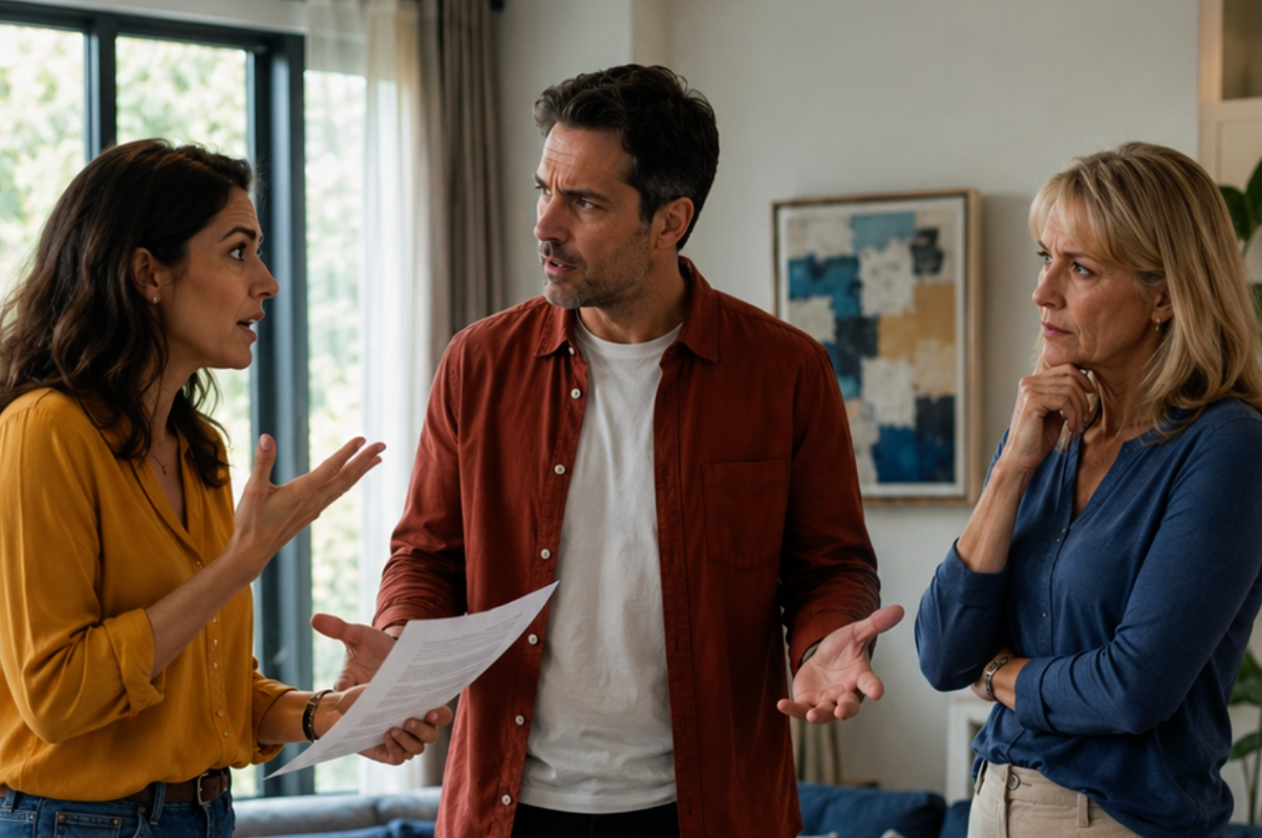
The kettle was coming to a boil slowly, with that long, drawn-out hum Elena could always recognize even from another room. Oleg sat at the table, scrolling through something on his phone, radiating the familiar calm of an ordinary evening—the kind of calm that, perhaps, had made getting married for the second time in her life worthwhile.
“Listen, how about going to the Kuznetsovs’ country house on Saturday?” Oleg asked without looking up from the screen. “They invited us last week.”
“Sure,” Elena said, pouring tea into their cups. “I just wanted to stop by the market first.”
“We’ll go in the morning. We’ll have plenty of time.”
The conversation drifted along lazily, without tension, the way an ordinary evening unfolds for people who have lived together for six years and long since learned not to argue over trivial things.
The apartment was small but cozy—a two-room apartment overlooking a quiet courtyard, which Elena had bought ten years before she even met Oleg. Back then, at thirty, she had taken out a mortgage and paid it entirely on her own, without anyone’s help. She had made the final payment two years before their wedding.
During all those years, it had never even occurred to her that the apartment might belong to anyone but her. That was simply how things had always been, and Oleg had always seemed to accept it.
“By the way,” Oleg said, putting down his phone, “Mom called again today.”
“How is she?” Elena asked, placing a cup in front of her husband.
“Complaining. Says her knees are really bad now and her blood pressure keeps jumping. She says it’s getting hard to manage on her own.”
“Maybe you should get her a proper doctor instead of letting her listen to advice from some old lady next door?” Elena smiled, not maliciously, but with the usual domestic irony.
“I suggested that. She refuses.” Oleg shrugged. “Says she’s used to putting up with it.”
At the time, the conversation seemed completely ordinary to Elena—just one of dozens of similar conversations they had had over the years.
Valentina Arkadyevna called often and complained often. It was simply part of the familiar family landscape, like the neighbor’s cat sitting on the windowsill or the creak of the third stair on the staircase.
Elena had no idea that this particular evening would mark the beginning of an entirely different story.
About a month later, the calls became more frequent. Valentina Arkadyevna was now calling her son almost every day, sometimes twice—once in the morning and again in the evening.
Elena would hear fragments of their conversations as she passed the room where Oleg usually went to talk privately on the phone.
“Mom, just hold on, I told you…” she heard him say one evening. “All right, all right. I’ll think of something. I’ll figure out how to help.”
When Oleg came into the kitchen afterward, his face was tense, as though he had been thinking something over for a long time and still couldn’t bring himself to say it aloud.
“Lena,” he began, sitting across from her. “We need to talk.”
“I’m listening.” Elena put down her book.
“Mom is feeling really bad. Imagine living completely alone. The neighbors don’t help, and I can’t always get over there after work…”
“Then hire a caregiver if things are really that difficult,” Elena suggested. “Or finally persuade her to see a doctor and get properly examined.”
“She’s not talking about doctors.” Oleg shook his head. “She’s talking about being lonely. She says nobody needs her.”
“That’s difficult, of course,” Elena said sincerely. “But what does that have to do with us?”
Oleg fell silent, staring at the tabletop as though the right words might be written there.
“I was thinking… maybe she could stay with us for a while? Two or three weeks, until she gets back on her feet?”
Elena froze with the cup in her hand. The question sounded casual, almost as though it were being mentioned in passing, but there was something much more serious hidden behind that casual tone.
“Oleg, we have a two-room apartment,” she said carefully. “Where are we supposed to put her?”
“Well, we’ll squeeze in a little. We can unfold the sofa. We’ll put up with it for a while…”
“I’m not against helping your mother,” Elena interrupted. “I really am not. We can split the cost of a caregiver, visit her more often, even rent her a place closer to us so it’s easier to see her. But having her live here is different.”
“Why is it different?” Irritation entered Oleg’s voice. “It’s only temporary.”
“Because this is my apartment, Oleg. My only apartment. And I don’t want to turn my home into a place where anyone can simply move in whenever they want.”
Elena said it calmly but firmly.
That conversation ended without any resolution. It simply stalled, like an engine cutting out, leaving behind an unpleasant aftertaste.
Oleg went to bed earlier than usual without saying another word.
A few days later, the situation took a new turn.
Marina, Oleg’s sister, called. She was young, energetic, and accustomed to saying exactly what she thought.
“Hi, Lena,” Marina began without any introduction. “Listen, why are you throwing Mom out onto the street?”
“What?” Elena was genuinely confused. “Who told you that?”
“Mom herself. She’s telling everyone. Crying and saying her daughter-in-law is throwing her husband’s own mother out of the house and leaving her with nowhere to live.”
“Marina, I’m not throwing anyone anywhere.”
Elena felt something heavy rising inside her, a mixture of hurt and anger.
“Your mother lives in her own apartment. I simply refused to have her move into mine.”
“Well, where is she supposed to go if she can’t manage by herself?” Marina sounded genuinely bewildered, as though there simply were no possible solution other than moving her mother into Elena’s home.
“There are options,” Elena said, trying to keep her voice even. “Someone can help her around the house. She can see a doctor. We can hire a caregiver if necessary. But moving into my apartment is not one of them.”
“You’ve become kind of hard,” Marina sighed. “You two used to get along perfectly well.”
After the conversation, Elena sat for a long time with the phone in her hands, staring blankly ahead.
The feeling was disgusting—as though she had somehow been turned into the villain simply because she refused to let someone else take over her home.
From that moment on, arguments with Oleg became almost a daily occurrence. Every evening began with the hope of having a calm conversation, and every evening ended with another round of exactly the same dispute.
“Do you even think about my feelings?” Oleg demanded one evening as he paced around the kitchen. “She’s my mother! She raised me!”
“I think about your feelings and mine,” Elena replied. “But for some reason, nobody in this conversation seems interested in my feelings.”
“What do your feelings have to do with it? We’re talking about a sick elderly woman!”
“We’re talking about my apartment, Oleg. The only one I have. And I have the right to decide who lives in it.”
“You’re heartless,” he snapped one evening, slamming the refrigerator door hard enough to make the jars inside rattle pitifully. “You have absolutely no respect for family.”
“Maybe it isn’t about being heartless. Maybe I simply want to live in my own home without other people moving in?” Elena shot back, struggling not to raise her voice.
“She isn’t some stranger! She’s my mother!”
“And I’m your wife. And this is my apartment.”
Every such conversation left Elena exhausted, as though she had spent several hours pushing a heavy boulder uphill.
Oleg did not give up. On the contrary, he became more persistent with every passing day, as though he believed that just a little more pressure would finally make his wife surrender.
About three weeks after their first conversation, Oleg entered the room looking like a man who had made a final decision.
“Lena,” he said without preamble, “it’s settled. Mom is moving in.”
“What do you mean, it’s settled?” Elena put down the television remote. “Settled by whom?”
“By me. I decided. I’m tired of going around in circles over this.”
“Oleg, this isn’t a decision you can make by yourself.” Elena’s voice hardened. “This is my apartment.”
“Family isn’t about ‘yours’ and ‘mine,’” he snapped. “Family lives together and helps one another.”
“Then why am I the only one expected to pay the price for helping?” Elena asked, staring directly at him. “I’m willing to help with money, time, anything else. But not by giving up my apartment without my consent.”
“Mom is moving in,” Oleg repeated as though he had not heard a word she said. “End of discussion.”
“If that happens without my consent,” Elena said, looking him straight in the eyes, “I will not allow you to dispose of my property as though it were yours. Remember that.”
Oleg merely snorted and left the room without bothering to reply.
Elena remained sitting in silence, feeling an ominous premonition growing inside her—the kind that usually comes before events that change everything permanently and irreversibly.
Her premonition proved correct the very next day.
Elena stayed at work later than usual because the quarterly report needed her attention. She did not get home until eight in the evening, tired and hungry.
Something seemed wrong before she had even fully entered the apartment.
There were unfamiliar suitcases sticking out into the hallway, cardboard boxes, and a rolled-up plaid blanket she had definitely never seen in the apartment before.
The living-room door stood slightly open.
Inside, surrounded by half-unpacked boxes, a short elderly woman in a colorful housecoat was busily arranging porcelain figurines on the windowsill with the confidence of someone who had already settled permanently into her new home.
It was Valentina Arkadyevna.
“Valentina Arkadyevna?” Elena’s voice was tight with astonishment. “What is going on?”
“Oh, Lenochka.” Her mother-in-law turned around without the slightest trace of embarrassment, as though she had expected the question and prepared her answer in advance. “I’m moving in little by little. Olezhek helped with my things and hired a van.”
Elena walked into the kitchen and stopped dead.
Her favorite cezve had disappeared from the stove. In its place stood an unfamiliar enamel pot.
There was a different tablecloth on the table as well—faded from years of washing, covered in tiny flowers, and completely out of place with the rest of the room.
“Oleg!” Elena called, forcing herself to keep her voice steady. “Come here, please.”
Her husband appeared from the bedroom with an expression that was guilty and stubborn at the same time—the expression of someone who knew perfectly well he was doing something wrong but had decided to go through with it anyway.
“What does this mean?” Elena asked, gesturing toward the boxes in the hallway. “We never agreed to anything.”
“Mom is moving in. I told you,” Oleg said with a shrug, as though it were the most natural thing in the world.
“You told me that you had decided. I told you that I did not agree,” Elena reminded him. “Those are two different things.”
“Lenochka,” Valentina Arkadyevna interjected as she came into the hallway carrying another box, “why are you acting like I’m some stranger? Where is an old woman like me supposed to go?”
“Back to your own apartment,” Elena replied, trying to remain calm even as something dark and heavy was beginning to burn inside her. “The apartment where you’ve lived for the last thirty years.”
“I’m frightened there by myself.” The elderly woman put the box directly in the middle of the hallway. “At least here there are people around.”
“Leave this apartment immediately.”
Elena turned toward both of them, looking first at her husband and then at her mother-in-law.
“Take your belongings and leave. Today.”
“Mom isn’t going anywhere.”
Oleg stepped between his wife and his mother, folding his arms across his chest.
“Enough with the scenes.”
“This isn’t a scene, Oleg. This is my apartment, and I’m demanding that you leave it.”
“Put up with it and keep your mouth shut! Mom is going to live here for the rest of her life!” her husband hissed, moving so close that Elena could smell the mint tea on his breath.
For a second, she remained silent, looking up at him.
Not because she was afraid.
Because at that moment she finally understood that there was nothing left to solve with words.
She turned around, went into the bedroom, and returned a minute later carrying a folder.
Without saying anything unnecessary, she placed it on the coffee table and opened it.
“What’s that?” Oleg frowned at the documents spread out in front of him.
“The certificate of ownership,” Elena replied evenly. “The purchase agreement. An extract from the Unified State Register of Real Estate. Everything was registered solely in my name ten years before we got married.”
“And what is that supposed to prove?” Valentina Arkadyevna scoffed as she moved closer. “You live together as husband and wife. That means everything belongs to both of you.”
“No, it doesn’t.” Elena shook her head. “Personal property acquired before marriage is not divided and does not automatically become jointly owned. That’s the law, not something I invented.”
“I couldn’t care less about your stupid papers!” Valentina Arkadyevna suddenly shrieked, taking half a step backward as though she had been struck. “You’re going to throw your own mother out! Shameless woman!”
“Mom, calm down,” Oleg said, trying to stop her, though he sounded unconvincing, as though he himself no longer knew whose side he was on.
“I will not calm down!” the old woman shouted even louder. “I’ve lived my whole life, and now some… some…”
She stopped herself and waved a hand toward Elena with obvious contempt.
“Give me those documents,” Oleg demanded, grabbing the edges of the papers. “We’re not going to let this go. We’ll take the apartment from you through the courts, I promise you. I’ll hire a lawyer—the most expensive one I can find. You’ll regret this.”
“Take every document if you want.”
Elena did not fight him for the folder and released it almost immediately.
“Copies are stored at the bank, and the official records are in Rosreestr. You won’t prove anything because there is nothing to prove.”
Without another word, she took out her phone and dialed a number, raising it to her ear as calmly as though she were calling a plumber to repair a leaking faucet.
“Who are you calling?” Oleg asked warily.
“The police,” Elena replied simply. “I’m going to report that unauthorized people are inside my apartment and are refusing to leave.”
The police arrived about twenty minutes later—two officers, an older sergeant and a very young lieutenant who was clearly still in training.
The moment Valentina Arkadyevna saw the uniforms, her expression changed completely. She immediately tried to portray herself as a frail, helpless old woman.
“Boys, help me,” she wailed, pressing one hand against her chest. “My daughter-in-law, that snake, is throwing an old woman out onto the street…”
“Ma’am,” the sergeant said calmly, clearly having witnessed scenes like this many times before, “please provide documents showing your legal right to reside in this apartment.”
“What documents? I’m the mother of this woman’s husband!” Valentina Arkadyevna exclaimed indignantly.
“I have the documents,” Elena said, handing the sergeant the blue folder. “The apartment is my sole property. It was registered in my name long before the marriage.”
The officer carefully examined the papers, nodded, returned the folder, and turned toward Oleg and his mother.
“This woman has provided documents confirming her exclusive ownership of the property,” he said in an even, slightly weary voice. “You cannot reside in this apartment without the owner’s consent. I am asking you to leave the premises voluntarily. Otherwise, we will have to proceed with a forced removal and draw up an official report.”
“How dare you!” Valentina Arkadyevna exploded.
The sergeant merely spread his hands, making it clear that further arguments were pointless.
“Mom,” Oleg said, touching the elderly woman on the shoulder, “pack your things. We’ll deal with this later.”
“Oh, we’ll definitely deal with it,” he said through clenched teeth, now addressing Elena as his mother frantically stuffed the porcelain figurines back into a box. “In court. You have no idea who you’re dealing with.”
“I know perfectly well,” Elena replied calmly. “I’m dealing with a man who wanted to live at my expense without even bothering to ask permission.”
It took them a long time to leave.
Box after box. Suitcase after suitcase.
All the while, Valentina Arkadyevna muttered under her breath about ingratitude and the cold-heartedness of modern young people.
At the door, Oleg turned around as though he wanted to say something else, but in the end he merely shook his head and followed his mother out, slamming the door loudly behind him.
The court hearing was scheduled a month and a half later.
Oleg really did hire a lawyer—a young, self-confident man who arrived with a folder full of arguments about “joint household management” and the “de facto status of family property.”
Every one of those arguments collapsed against a simple, indisputable fact: the apartment had been purchased and paid for in full by Elena long before the marriage was registered.
It had never been transferred into joint ownership, had never been the subject of substantial joint investment, and there was no legal basis whatsoever for dividing it.
“Your Honor,” Oleg’s lawyer began during the hearing, “my client lived in this apartment for six years, contributed toward utility payments, and made contributions to the family budget…”
“Contributing toward utility payments does not establish ownership rights to residential property,” the judge replied in the even, practiced tone of someone who had spent years hearing such cases. “The plaintiff has presented no evidence that he invested personal funds in the acquisition or substantial improvement of this property, which was registered in the defendant’s name before the marriage.”
The hearing lasted less than an hour.
The court rejected Oleg’s claim in full, confirming Elena’s sole ownership of the apartment and finding that there were no grounds whatsoever for dividing the property.
Valentina Arkadyevna, who was sitting beside her son during the hearing, whispered something indignantly into his ear, but loud protests inside the courtroom were no longer of any use.
The divorce was finalized quickly—mutual consent, minimal bureaucracy, and a short hearing before a magistrate.
On the day Elena collected the final documents from the civil registry office, a light summer rain was falling outside.
As she stepped out of the building, she inexplicably held out her palm beneath the raindrops, almost as though she needed to make sure they were real.
She had changed the locks on the apartment on the very day of the confrontation a month and a half earlier—just in case anyone tried to return using old keys.
She blocked Oleg’s number immediately after the court hearing.
She deleted Marina and the rest of his relatives from her contacts as well—the ones who had called her with accusations, lectures, and moralizing speeches.
Not once during the months that followed did she feel any desire to explain herself to those people again or prove anything to them.
Everything that had been said in court was a complete answer to every one of their accusations.
Elena decided to transform the room where Valentina Arkadyevna had briefly managed to establish herself into something Elena had dreamed about for years but had never found the right reason to create—a small library with an armchair beside the window.
The old wardrobe was taken to a friend’s country house. The walls were repainted a calm gray-blue, and Elena ordered simple wooden bookshelves for one wall.
At last, she had somewhere to put the books that had accumulated for years in boxes in the storage room without ever finding a proper place.
One evening, a couple of months after the divorce, Elena’s longtime friend Nastya stopped by.
Just for tea. No particular reason.
“Wow,” Nastya said, looking around the newly finished room and running a finger along the spine of one of the books. “It’s exactly the way you wanted it. Remember? You told me about this about five years ago.”
“I remember.” Elena smiled as she poured tea into two cups. “I just never got around to it. Now I finally have.”
“Do you regret it?” Nastya asked, nodding vaguely in the direction of everything that had happened.
“Regret what?” Elena shrugged as she settled into her new armchair beside the window. “That I stopped tolerating other people’s demands in my own home?”
Nastya laughed.
And Elena, watching the evening light fall through the curtain onto the spines of the books, felt for the first time in a very long while that her home finally belonged entirely to her again—without someone else’s suitcases in the hallway, without someone else’s voices telling her how she was supposed to live.