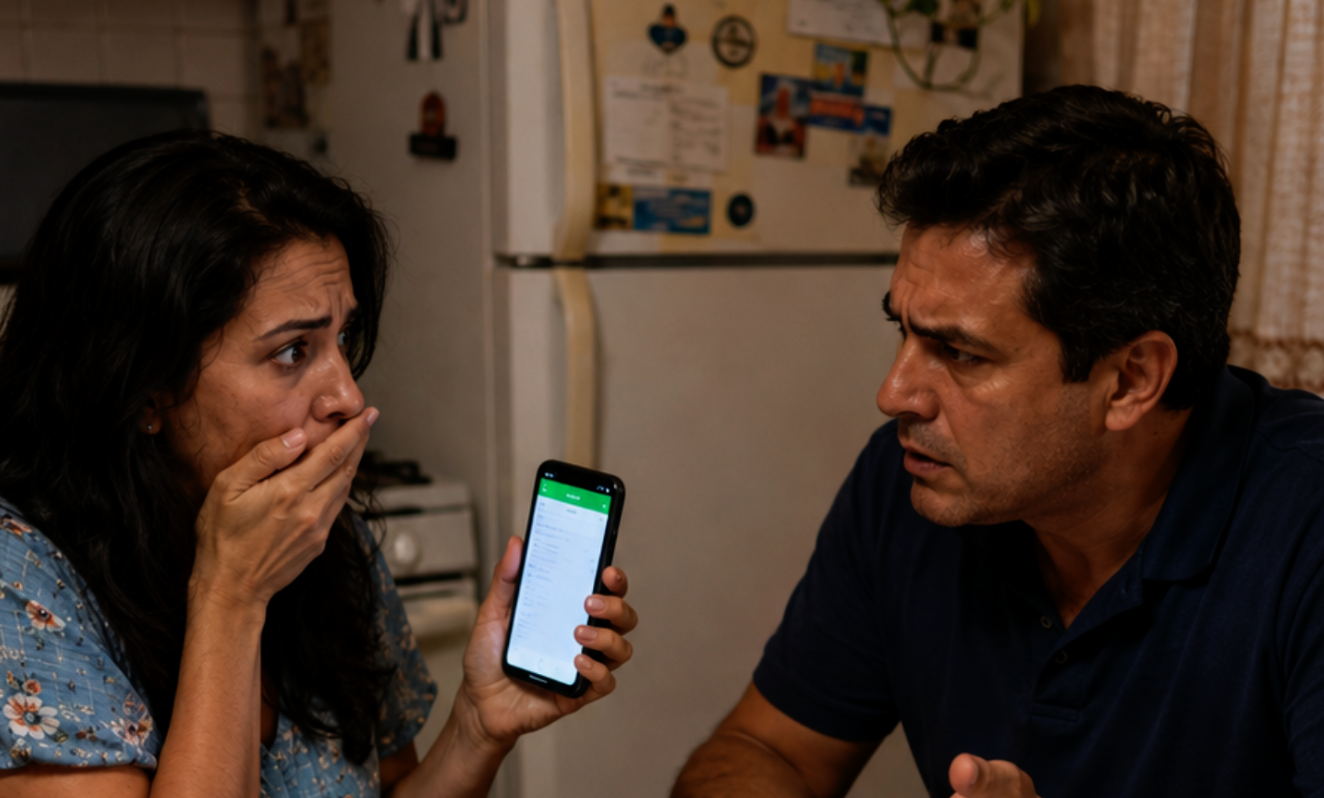
“We’re family. Sveta was genuinely in trouble, and you would have started asking a hundred questions and refused anyway. I knew the money would be paid back.”
At first, Lena did not even understand what money her husband was talking about. In twelve years of marriage, they had taken out loans only three times: a mortgage they had paid off long ago, a small car loan, and an installment plan for their kitchen. She had not applied for any new loans, and the amount shown in her banking app was far too large to dismiss as some kind of mistake.
There was a consumer loan for 680,000 rubles in Lena’s name. Because of the interest, she would have to repay considerably more by the end of the term, and the next payment was almost 25,000 rubles. The money had been received two months earlier and transferred that same day, in several separate transactions, to her husband’s sister.
Oleg did not confess immediately. At first he said he would explain everything, then asked Lena not to get upset, and when she demanded that he tell her directly who had taken out the loan, he finally said:
“I did. But Sveta is paying it back. You won’t have to do anything at all.”
After that sentence, the family discussion stopped being a conversation about helping relatives.
Lena wanted to understand something else: how her husband had decided that he had the right to make her a debtor to the bank without even asking her.
Before this, they had hardly ever argued about money
Lena was 39 and Oleg was 42. They lived in Samara and were raising their 11-year-old son. Lena worked as an economist at a large company and earned around 118,000 rubles a month. Oleg repaired industrial equipment and made an average of 145,000–160,000 rubles.
The family was financially stable. They owned a two-bedroom apartment, had a car, about 1.1 million rubles in savings, and no debts. Every month, they tried to save at least 30,000–40,000 rubles because in a few years they wanted to move into a three-bedroom apartment.
They handled money differently. Lena liked to calculate major purchases in advance and avoided loans if they could simply wait a few months. Oleg took a more relaxed approach. He was not a spendthrift, but he often said that money existed to solve problems and that when someone close to you was in trouble, you should not lecture them about financial literacy.
This was especially true when it came to his younger sister, Svetlana.
Sveta was 35. After her divorce, she was raising her 8-year-old daughter alone, working as a beauty salon specialist, and had spent several years trying to develop her own small private studio. Oleg had helped her before. He might give her 20,000 rubles until payday, pay for a car repair, or buy something for his niece.
Lena did not object as long as the amounts remained reasonable.
Two years earlier, Sveta had asked for 200,000 rubles for equipment. Lena suggested giving her 100,000 as a gift and letting her save the rest herself. Oleg agreed.
But Sveta remembered that conversation differently.
Lena later learned that her sister-in-law had told her brother:
“If it were up to you, you’d help me. It’s just that Lena controls every kopek in your house.”
“I did. But Sveta is paying it back. You won’t have to do anything at all.”
After that sentence, the family discussion stopped being a conversation about helping relatives.
Lena wanted to understand something else: how her husband had decided that he had the right to make her a debtor to the bank without even asking her.
Before this, they had hardly ever argued about money
Lena was 39 and Oleg was 42. They lived in Samara and were raising their 11-year-old son. Lena worked as an economist at a large company and earned around 118,000 rubles a month. Oleg repaired industrial equipment and made an average of 145,000–160,000 rubles.
The family was financially stable. They owned a two-bedroom apartment, had a car, about 1.1 million rubles in savings, and no debts. Every month, they tried to save at least 30,000–40,000 rubles because in a few years they wanted to move into a three-bedroom apartment.
They handled money differently. Lena liked to calculate major purchases in advance and avoided loans if they could simply wait a few months. Oleg took a more relaxed approach. He was not a spendthrift, but he often said that money existed to solve problems and that when someone close to you was in trouble, you should not lecture them about financial literacy.
This was especially true when it came to his younger sister, Svetlana.
Sveta was 35. After her divorce, she was raising her 8-year-old daughter alone, working as a beauty salon specialist, and had spent several years trying to develop her own small private studio. Oleg had helped her before. He might give her 20,000 rubles until payday, pay for a car repair, or buy something for his niece.
Lena did not object as long as the amounts remained reasonable.
Two years earlier, Sveta had asked for 200,000 rubles for equipment. Lena suggested giving her 100,000 as a gift and letting her save the rest herself. Oleg agreed.
But Sveta remembered that conversation differently.
Lena later learned that her sister-in-law had told her brother:
“If it were up to you, you’d help me. It’s just that Lena controls every kopek in your house.”
There was a consumer loan for 680,000 rubles in Lena’s name. Because of the interest, she would have to repay considerably more by the end of the term, and the next payment was almost 25,000 rubles. The money had been received two months earlier and transferred that same day, in several separate transactions, to her husband’s sister.
Oleg had not defended his wife back then. He had only asked his sister not to bring up the subject again.
What happened to Sveta
In the spring, Sveta decided to expand her studio. She found a larger space, ordered equipment, and made arrangements with two other specialists. The plan was simple: invest for several months, then income from renting workstations and from her own clients would increase her earnings.
But some of the equipment turned out to be more expensive than expected, the renovation dragged on, and the property owner demanded a security deposit.
Sveta needed around 650,000 rubles.
The bank offered her a loan, but the interest rate and monthly payment seemed too high. On top of that, she already had around 170,000 rubles of credit card debt.
She called her brother.
Oleg first offered her 150,000 rubles from his own available money. Sveta said that was not enough.
“If I don’t pay now, I’ll lose the premises and everything I’ve already invested.”
Oleg told his wife about it. Lena listened and immediately said she would not give 600,000–700,000 rubles from the family’s emergency savings.
“That money is for our new apartment.”
“Lena, her business will collapse.”
“Then she should take out a loan herself and figure out whether the business can support it.”
“They’re offering her terrible terms.”
“And who exactly is supposed to offer us cheap money?”
The conversation lasted about twenty minutes. At the end, Oleg said he understood her position.
Lena was sure the matter was settled.
A few days later, her husband did things his own way.
How the loan ended up in Lena’s name
Lena had long used the banking app where her salary was deposited. The bank regularly showed her pre-approved offers, including a loan of up to roughly one million rubles. Lena ignored them.
Oleg knew her phone passcode. The spouses had never particularly hidden their devices from each other. He could take her phone to look at a photo, use the navigation app, or reply to their son.
Lena had never deliberately given him the password to her banking app, but login was configured through biometrics and the device passcode. In addition, some confirmations were sent to the same phone.
One evening, Lena went to bed early. Oleg took her phone, saw the bank’s offer, and began the application. According to him, at first he only wanted to check the terms.
Then he saw the amount of 680,000 rubles and the monthly payment, messaged his sister, and decided to complete the application.
The money was deposited into Lena’s account.
Oleg transferred it to Sveta in several installments.
He deleted the notifications.
A few days later, he took his wife’s phone again and disabled some of the bank’s push notifications so that the loan would not be discovered immediately.
While explaining this to Lena, he repeated several times:
“I was going to make all the payments myself.”
Lena asked:
“Then why isn’t the loan in your name?”
Oleg replied that his bank had offered worse terms, while she had received a good interest rate.
“So you actually compared which one of us would be cheaper to put into debt?”
Her husband said that at the time the situation had seemed urgent and he had not seen it as something terrible.
Lena did.
Oleg really did make the payments for two months
That was why the loan was not discovered immediately. Her husband made the first payment from his own card and the second as well. Lena did not notice the roughly 25,000 rubles missing from the family budget because Oleg had received a bonus during that period.
She discovered the debt by accident when she opened the section with her credit history before applying for a new cashback credit card. That was where she saw an active consumer loan.
At first, Lena thought she had become the victim of outside fraudsters.
She immediately opened the banking app, found the agreement, checked the dates, and reviewed the movement of funds.
Almost the entire amount had gone to Svetlana.
That was when she called her husband into the kitchen.
Oleg admitted that his sister had already started paying the money back. But she was transferring it to her brother, not directly to the bank. Over two months, she had sent him 40,000 rubles, and he had covered the rest of the payments himself.
Lena calculated the balance.
“She transferred 40,000 to you, while almost 50,000 in required payments have already gone out. And the principal barely decreased. Did either of you even calculate the interest?”
Oleg admitted that they had not done so in detail.
Sveta had promised that after a few months she would start paying back 40,000–50,000 rubles a month.
Lena asked whether they at least had a written loan agreement.
They did not.
There was no signed acknowledgment of debt either.
So Lena was officially the debtor to the bank, the money was with her husband’s sister, and the family arrangement existed only in messages between the brother and sister.
Lena’s mother-in-law also thought she was being too harsh
The next day, Oleg’s mother, Raisa Petrovna, learned about the conflict. She was 66 and immediately called her daughter-in-law, asking her “not to destroy the family over money.”
Lena asked:
“Which family exactly? Ours or Sveta’s?”
Her mother-in-law said she understood why Lena was angry, but her husband’s sister had been in a difficult situation and Oleg had only wanted to help.
More details
Participation in Charitable Aid Programs
Configuring Data Management Systems
Watching Movies in an Online Cinema
“We’re family. Wouldn’t you help your own brother?”
“I would ask my husband first before making him responsible for a 680,000-ruble debt.”
Raisa Petrovna tried to explain that Oleg was the one making the loan payments anyway.
Lena replied that the bank did not care in the slightest which member of the family had promised to pay. Her name was on the contract. If Oleg lost his job, fell out with his sister, or simply stopped making payments, the bank would pursue the loan registered in Lena’s name.
Her mother-in-law said:
“But Oleg is your husband, not some stranger.”
And that logic irritated Lena more than anything else. Apparently, the closer the family relationship, the less necessary it was to obtain someone’s consent before using their name and financial reputation.
She ended the conversation and told her husband that from that point on, she would act not as an offended wife, but as a person who had discovered a loan she had never taken out.
Oleg became frightened for the first time when Lena mentioned the police
Lena called the bank and reported that she had not personally applied for the loan and had never given her husband permission to act on her behalf. The bank registered her complaint and asked her to provide a written statement describing the circumstances.
Afterward, she told Oleg:
“I’m going to formally document that I was not the one who took out this loan.”
Her husband went pale.
“You’re going to report me?”
“What exactly do you suggest I tell the bank? That I voluntarily borrowed 680,000 rubles for your sister?”
Oleg began asking her to give him a few days. For the first time, he realized that the family phrase “I just did it myself using your phone” might look very different from the bank’s point of view than it did inside the household.
The mere fact of marriage does not give one spouse the right to enter into a credit agreement on behalf of the other. For a credit obligation to arise, the intent and consent of the specific borrower matter. If an agreement is concluded using another person’s information and without their consent, the dispute goes far beyond an ordinary disagreement about the family budget.
More details
Learning Foreign Languages Online
Stories
Downloading and Completing Legal Forms
Depending on the circumstances, using another person’s phone, account, confirmation codes, and obtaining money in that person’s name may also have criminal-law implications. The method used, intent, movement of funds, and evidence all matter, so it would be wrong to automatically label every relative a fraudster simply because of a family dispute.
But for Lena, one thing was enough: there was no family law that allowed a husband to take out a loan in his wife’s name “because we’re family.”
Sveta came over that evening
At first, Lena’s sister-in-law spoke with her brother. Then she asked to speak to Lena alone.
She admitted that she knew Oleg’s wife had refused to give her money from the family savings. But her brother had told her he would “solve the problem himself.” When the money arrived, Sveta had asked where it came from.
Oleg had replied:
“We had an approved amount available.”
Sveta had not asked whose name the loan was actually in.
Lena asked:
“When did you find out it was in my name?”
“Today.”
“If you had known from the beginning, would you still have taken the money?”
Sveta was silent for a long time.
“I probably would have asked you first.”
Lena considered that a weak answer, but at least it was honest.
She asked Sveta to show her how much of the money was left. It turned out that around 420,000 rubles had already been spent on equipment, rent, and renovation. About 170,000 rubles were still sitting in Sveta’s account. Part of the money had disappeared into ordinary operating expenses.
Lena suggested selling whatever equipment could still be returned or quickly resold rather than waiting for the new studio to become profitable.
Sveta burst into tears.
“Then everything I’ve been working on will fall apart.”
“Sveta, your business is currently standing on a loan you didn’t take out and on consent I never gave. Why am I the one who has to preserve it?”
After that, Sveta stopped arguing.
Her husband had to find 680,000 rubles for himself
Oleg asked his wife not to turn the matter into a criminal case and offered to pay off the loan completely.
The problem was that he did not have 680,000 rubles freely available. His “personal” share of the family savings existed more in theory than in practice because the spouses kept most of their money jointly, and Lena was no longer willing to let him take the whole amount from it.
She set one condition: her savings would not be used to repay the debt.
Oleg took out a loan in his own name. The terms were indeed worse than Lena’s. He covered part of the amount with the 170,000 rubles that Sveta returned immediately. Another 120,000 came from his bonus and money he had kept separately for a car. He borrowed the remainder in his own name and fully repaid Lena’s loan.
Only after her banking app showed a zero balance and she received confirmation that the debt had been fully discharged did Lena agree not to continue pursuing the conflict in the same direction.
Oleg asked:
“Do you trust me at all anymore?”
She did not answer immediately.
“As my husband, I want to trust you. As someone I can hand my phone with banking access to, not yet.”
He remembered that sentence.
His sister signed a proper loan agreement
This time, Lena insisted that there be no more verbal arrangements between Sveta and Oleg along the lines of “I’ll pay it back once I start earning.” They documented in writing the amount Sveta owed her brother, the repayment schedule, and the repayment procedure. Oleg did not demand enormous interest from his sister, but the monthly payment became specific.
Under Article 808 of the Civil Code of the Russian Federation, a loan agreement between individuals for an amount exceeding 10,000 rubles must be concluded in writing. A borrower’s receipt or another document confirming the transfer of money can also serve as evidence of the loan.
Lena specifically told her husband:
“I don’t want you two falling out in two years and then your mother telling everyone the money was actually a gift.”
Raisa Petrovna was offended when she learned about the written agreement.
“A biological sister has to sign an IOU for her own brother.”
This time, Oleg answered her himself:
“That’s exactly why she’s signing it. We already tried doing things ‘as family’ once.”
His mother did not argue anymore.
Four months later, Sveta’s studio really did start working
That was the part of the story Oleg later especially liked to point out. His sister had not spent the money on a vacation, an expensive handbag, or a car. The studio opened, clients appeared, and she rented out two workstations to other specialists.
Her income increased.
Sveta first began transferring 30,000 rubles a month to her brother, then 45,000. In good months, she paid more.
One day Oleg said to his wife:
“See? I told you she’d pay it back.”
Lena replied:
“You still don’t understand what the problem was, do you?”
He fell silent.
She explained again. Even if Sveta repaid every last ruble, it would not make the way the debt had been created acceptable. You can help a relative and be correct about their business prospects while still violating another person’s boundaries so badly that the success of the project changes nothing.
For the first time, Oleg agreed without qualifications.
By then, he himself had been paying for four months on the loan he had voluntarily taken in his own name and understood perfectly well the difference between an obligation you knowingly accept and a debt you discover after the fact.
What happened to their family finances
After the incident, Lena completely changed the way access to their finances worked. Her husband no longer knew her phone passcode. Banking apps were protected separately, notifications were enabled, and Lena began checking her credit history regularly.
At first, Oleg saw this as a deliberate display of distrust, but he did not argue.
They kept a joint account for shared expenses. They had no mortgage debt, and both continued contributing to their savings. But from that point on, any major financial help to relatives was governed by a clear rule: up to 10,000 rubles, each person could decide independently. Larger sums had to be discussed if they were coming out of the joint budget.
Lena did not stop helping Sveta either. She gave money as a birthday gift to her niece and once personally brought a good work chair to Sveta’s studio.
But nobody ever took out loans for anyone else again.
Her mother-in-law changed her mind when a smaller version of the same situation happened to her
Six months later, Raisa Petrovna’s brother asked her for 150,000 rubles to repair his car. He promised to return it within two months.
She refused.
Oleg asked:
“Mom, what about family?”
Raisa Petrovna snapped:
“I have a pension and savings. I can’t just give away amounts like that.”
Oleg simply looked at his mother.
She immediately understood and said:
“Yes, I know what you’re going to say.”
That incident unexpectedly helped her understand Lena better than all the previous explanations had.
It was one thing to talk about helping family when somebody else’s money was at risk. It was quite another when someone was asking for a large amount directly from your own account.
Later, Raisa Petrovna told her daughter-in-law herself:
“I was wrong to pressure you back then. You should help people only with what you yourself are prepared to risk.”
Lena replied that this was exactly what she had wanted from the beginning.
If Oleg had come to her and said, “I want to take out a 680,000-ruble loan in my own name and help my sister,” they might have argued, but the decision and responsibility would have been his.
Instead, he had chosen another option: transferring the risk onto his wife because the bank had offered her better terms.
A year later, Sveta’s debt was almost fully repaid
She turned out to be more disciplined than Lena had expected. The studio continued operating, Sveta gradually paid off her credit cards, and she became more careful about managing expenses.
By the anniversary of the incident, she had repaid most of the money to her brother. About 110,000 rubles remained.
One day, Sveta brought up the subject with Lena herself.
“I still think that if Oleg had asked you back then, you would have refused.”
“Most likely.”
“So I wouldn’t have this studio now.”
“Possibly.”
Sveta was quiet for a moment and then asked:
“And you still think he did the wrong thing?”
Lena was almost surprised by the question.
“Of course. The fact that a bad decision produced a good result doesn’t turn it into a good decision.”
After that, Sveta never brought up the subject again.
Two months later, she paid off the remaining debt.
Oleg showed his wife the final transfer and said:
“Now it’s definitely over.”
Lena looked at the amount and replied:
“With the money, yes.”
Trust took longer.
Why Lena did not divorce him
Lena’s friend was certain that after something like this, she should leave. In her view, taking out a debt in a spouse’s name without consent was such a serious betrayal that there was no point discussing the future of the marriage.
During the first few days, Lena also thought about divorce, especially while her husband was still trying to justify himself by talking about the favorable interest rate and his family obligations.
But in the end, Oleg did not shift responsibility onto his sister or his mother. He paid off his wife’s loan, took the less favorable debt onto himself, restored the notifications, did not interfere with Lena’s dealings with the bank, and admitted that he had never had the right to make such a decision.
For the next several months, he did not even touch her phone unless she asked him to.
The couple went to a family therapist, but the biggest changes were very practical. They began discussing things they had previously taken for granted: who they were willing to lend money to, how much each person could spend independently, what financial information could be shared with relatives, and where the family concept of “ours” ended.
Lena told her husband:
“I don’t want to live with a man who always puts his sister first.”
Oleg replied:
“She isn’t first.”
“Then never put me in front of a fait accompli for her sake again.”
He agreed.
Nothing similar happened again over the following year.
Now the phrase “we’re family” means something different in their household
Oleg still helps his sister. He may pick up his niece, take Sveta’s car to the repair shop, or help fix something in her studio. Lena does not object.
Sveta also began helping them more often. When Lena got sick, she picked up her nephew from school for several days. They worked together on renovations at their parents’ country house and calmly divided the expenses.
They were still family.
They had simply removed the supposed right to control someone else’s money from the definition of family.
Lena now says that the phrase “he took out a loan for his sister” prevented her for a long time from fully understanding the scale of what had happened. It almost sounded noble: a man saved someone close to him and took a risk for the sake of his family.
But he had not taken out the loan in his own name.
He had not risked only his own money.
That detail changed everything.
If someone believes that helping a relative is necessary, they can give away their own savings, take out their own loan, accept the repayments, and bear the consequences themselves.
Another person’s consent cannot be replaced by the assumption that your spouse will “understand later.”
Recently, Oleg joked that from now on, before transferring any money to his sister, he would bring his wife a written application for approval.
Lena replied:
“Up to 10,000, you’re allowed to do it without an application.”
“What about 11,000?”
“We convene a family council.”
They both laughed.
What would you have done in Lena’s place if you discovered a 680,000-ruble loan that your spouse had taken out in your name, without your consent, to help his sister?