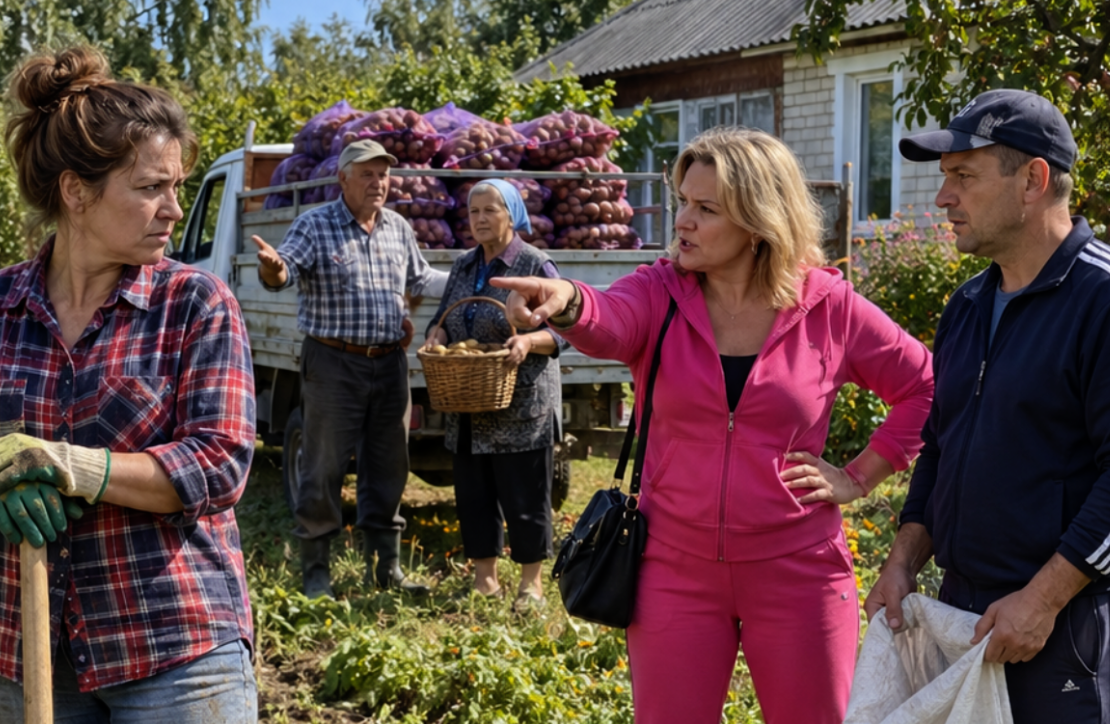
In the family group chat, they were already dividing up potatoes that were still in the ground. Nadezhda checked her phone over breakfast and saw a message from Andrei: “Eight mesh sacks for Inna, two for Mom. The rest is ours.” No question, no “What do you think?”—not even any idea of how much would be left after sorting.
She reread the message and said nothing. The potato tops were already turning yellow, and only a few days remained before the harvest. Looking at those two hundred square meters of land, Nadezhda understood something clearly for the first time: if she kept quiet again, by next summer her husband’s relatives would consider not only the harvest but the entire dacha some kind of shared family warehouse.
The property was not jointly owned. Nadezhda had bought the six-hundred-square-meter plot four years before getting married. It included a small house, a shed, a well, and land that she had spent the first two seasons restoring almost from scratch. After they married, Andrei began going there with her. He helped with heavy work, sometimes mowed the grass, and carried out minor repairs. Nadezhda had never divided every garden bed into “mine” and “yours.” The problem appeared later, when his relatives became accustomed to a different arrangement: Nadezhda did all the work, while the word “ours” began to appear whenever harvest time approached.
When “We Planted It” Became a Convenient Phrase
In the spring, Inna herself suggested expanding the potato patch.
“Prices in the stores are outrageous, and you have plenty of land anyway,” she said during a family lunch. “Plant more potatoes. We’ll come and help, of course. I need about eight sacks for the winter, and we should save some for Mom too.”
Nadezhda corrected her:
“Not ‘you should plant,’ but ‘we should plant.’ Two hundred square meters isn’t just five rows beside the fence.”
Inna promised that her whole family would come on Saturday. Nadezhda bought additional seed potatoes to supplement those she had saved from the previous year, ordered manure, and prepared the tools. By the end of the season, she had spent 9,430 rubles on seed potatoes, delivery, fertilizer, and pest control. She recorded every expense in a notebook because otherwise, by August, it always seemed as though everything in the garden had grown for free.
On the appointed Saturday, Inna sent a message after nine in the morning. Her older son’s plans had changed, her husband had to drive him somewhere, and she had no one with whom to leave the younger child, so they would not be able to come. Andrei was also delayed in the city and promised to arrive toward evening.
By noon, Nadezhda’s back ached, and half the potato patch was still empty. Her neighbor, Sergei Ivanovich, noticed her through the chain-link fence and asked:
“Are you handling this entire battlefield alone?”
“Looks that way.”
Ten minutes later, he returned with his own shovel. They finished planting toward evening. By the time Andrei finally arrived, all that remained was to gather up the crates and put away the tools.
The following day, he was speaking to his sister on the phone while standing on the porch. In passing, he said:
“We planted potatoes yesterday. Two hundred square meters. We should get a decent crop.”
Nadezhda heard him through the open window. At the time, it seemed foolish to make an issue out of one word.
During the summer, however, she discovered that the problem was not merely a word.
In June, Inna came with her children “to get some fresh air.” While Nadezhda watered the greenhouse, her sister-in-law filled a container with strawberries and cut a large bundle of herbs.
“Inna, at least leave some for this evening,” Nadezhda asked.
“They’re for the children. You’ll grow more.”
Andrei, who was doing something near the car, called out:
“Nadya, come on. Don’t be stingy with the berries.”
Several weeks later, while Nadezhda was in the city, Andrei allowed his sister to visit the property and gave her his key to the gate. By evening, almost all the good cucumbers had disappeared from the greenhouse. Two days later, however, a photograph of jars in Inna’s kitchen appeared in the family chat with the caption: “Our first harvest from the dacha.”
“I was planning to preserve those cucumbers myself,” Nadezhda told her husband.
“We’ll buy some if we don’t have enough.”
“Buy cucumbers after I spent the entire summer growing my own?”
Andrei grimaced.
“Inna took them home. She didn’t sell them. We’re family—why count every cucumber?”
The next day, Nadezhda changed the lock cylinder on the gate. She gave her husband a new key but warned him:
“You’re not giving it to anyone else or making any copies without my permission.”
“Are you seriously doing this because of some cucumbers?”
“No. I’m doing it because people have stopped asking my permission on my own property.”
Ten Sacks Someone Else Was Expected to Fill
At the end of August, Nadezhda dug up three plants to test the crop. The potatoes had grown well—not record-breaking, but even in size, with noticeably more large potatoes than small ones. Andrei saw the partially filled bucket on the veranda and immediately brightened.
“See? I told you we’d get a good crop. There’ll be enough for Inna.”
“Why is the first thing you think about whether there’ll be enough for Inna?”
“Because we promised her.”
Nadezhda reminded him who had come to plant the potatoes in the spring, who had weeded the patch after the rain, and who had hilled the rows twice. Her husband had helped, of course. He had carried water, used the hiller once, and brought supplies. But he had allocated eight sacks to his sister and another two to his mother without discussing it with his wife.
On Tuesday, Inna called.
“We’re going to the recreation center on Friday, but we’ll stop by after lunch on Sunday,” she announced. “Dig up the potatoes by then. Just leave them under the shelter for a while so the soil can dry. We’ll bring the mesh sacks.”
Nadezhda was silent for a moment.
“If you need potatoes, come on Saturday and dig them up with me.”
“I just told you we’re going away.”
“Then I can’t promise you any potatoes.”
Inna’s voice became irritated.
“Nadya, I asked you to plant them in the spring. Andrei said you would plant some for us.”
“You asked. You also promised to help.”
“Oh, for heaven’s sake. You’re counting everything again.”
“I’m starting at nine on Saturday. Come with shovels.”
Inna exhaled sharply and said:
“You’ll harvest the potatoes yourself, and we’ll come later to collect the sacks. I don’t see the problem.”
That evening, Nadezhda told her husband about the conversation. At first, Andrei dismissed it, saying that his sister spoke harshly but did not mean anything bad.
“Are you going to the recreation center with them?” Nadezhda asked.
“I promised I would. We’ll leave on Friday evening and return on Sunday.”
“So you won’t help dig either?”
“I’ll help carry the sacks on Sunday.”
“Carrying potatoes that have already been harvested isn’t the same as digging them up. I’m not going to harvest ten sacks for your sister and mother by myself. If no one comes to help me on Saturday, I’ll offer the potatoes to the neighbors. Whoever helps dig them up can buy them.”
Andrei shrugged.
“Do whatever you want. Just don’t start a scandal afterward.”
That sentence was enough for Nadezhda.
The Neighbors Did Not Come Empty-Handed
The following day, she posted in the village group chat that she would be harvesting potatoes over the weekend. The price was thirty-five rubles per kilogram, and the condition was simple: buyers had to help dig and sort the potatoes and take their share home that same day.
Sergei Ivanovich replied first. He needed about a hundred kilograms for himself and another hundred for his daughter’s family. Then a woman from the next street responded, followed later that evening by a young couple who had recently bought a house in the village.
At nine on Saturday morning, four people stood outside Nadezhda’s gate with their own shovels, buckets, and gloves. Including Nadezhda, there were five of them. They agreed on the price, divided the rows among themselves, and began working.
The weather was dry. They spread the potatoes in a thin layer on burlap beneath the shelter, let them dry for a while, and then sorted them. Cut potatoes went into one pile, small ones into another, and the good potatoes were placed in mesh sacks. After lunch, Sergei Ivanovich brought an electronic scale. To keep it from wobbling on the ground, they placed it on a wide, level board.
By evening, they had harvested almost the entire patch. They finished the remaining rows on Sunday morning. After sorting, they had slightly more than four hundred kilograms. Nadezhda sold 330 kilograms and kept around seventy for herself—some to eat and some to use as seed.
The potatoes she sold brought in 11,550 rubles. Some people transferred the money to her bank card, while others paid in cash. Nadezhda recorded everything in her notebook beside the gardening expenses.
She did not make a large profit. The potatoes alone had cost her 9,430 rubles over the course of the season, without counting her journeys to the dacha or her own labor. But the neighbors had not asked her to give them the harvest for free or explained that she could never eat so much anyway. They had arrived in the morning with shovels and done exactly what they had agreed to do.
The final sack was taken away at around noon. Nadezhda swept the soil from beneath the shelter, put away the scale, and placed the seed potatoes in wooden crates.
At half past two, Andrei’s car appeared on the road.
An Empty Trunk for a Ready-Made Harvest
Inna was the first to get out. Her husband opened the trunk, and Nadezhda saw a package of new mesh sacks inside. Inna took several of them and walked confidently toward the shed, as if all that remained was to decide which potatoes to put into them.
“Well, where are ours?” she asked.
Nadezhda was sitting beneath the shelter, sorting the seed potatoes.
“There aren’t any potatoes for you.”
“What do you mean?”
“The neighbors helped me harvest the potatoes, so they bought them.”
Inna looked under the shelter. Only a few crates and a small sack of potatoes for eating remained.
“You sold everything?”
“Not everything. I kept some for myself.”
“What about us?”
“I told you on Tuesday to come and help dig. You said you would come later to collect the filled sacks.”
Her sister-in-law turned sharply toward her brother.
“Andrei, are you hearing this? You promised me eight sacks. I promised Mom two. We bought these mesh sacks especially for the potatoes!”
Andrei was the last person to get out of the car. He looked at the empty potato patch.
“Nadya, did you really sell everything to the neighbors?”
“I didn’t give it away. I sold it for thirty-five rubles per kilogram. They helped harvest it.”
Inna threw up her hands.
“Wonderful! You’ll sell to strangers, but you begrudge your own family a few potatoes?”
Nadezhda took out her notebook and placed it on the table.
“Here are my potato expenses—9,430 rubles. I’m not asking you to pay half, and I never have. But I’m not obligated to dig up eight sacks by myself simply because you decided in advance that they belonged to you.”
“Are you going to record every shovel now? This is becoming ridiculous.”
“I’m not recording shovels. I’ve simply stopped giving away things that other people divided up without consulting me.”
Inna looked at her brother again. Andrei ran his hand over the trunk lid and did not answer immediately.
“She warned us.”
“What?”
“She said on Thursday that she would sell the potatoes to the neighbors if we didn’t help dig them up.”
“And you allowed her to do it?”
“It isn’t a question of whether I allowed it. We went away to relax. Those people came and helped.”
Inna threw the mesh sacks back into the trunk.
“Wonderful. So I’m the only one to blame now.”
Nadezhda did not bother discussing who was to blame.
“Keep the sacks until next spring. Plant your own potato patch, and they’ll come in handy.”
A few minutes later, they drove to Andrei’s mother’s house without any potatoes.
That evening, her husband finally asked why she had needed to sell the harvest “so demonstratively” when she could at least have saved a couple of sacks for his mother.
“I would have given some to your mother if you had asked me properly,” Nadezhda replied. “But you didn’t ask. You wrote in the group chat, ‘Two for Mom,’ as if the sacks were already packed and labeled. I don’t want people confronting me with decisions that have already been made.”
Andrei argued at first. Then he looked through the notebook containing the expenses and fell silent.
“I really didn’t realize it cost so much.”
“The money is only half of it.”
He nodded. Nadezhda did not try to determine how well he had understood everything. It was enough that no one in the family group chat divided up her harvest that evening.
The following spring, she marked out the potato patch in advance. She planted her own section herself. She left several rows for Andrei. He wanted to grow potatoes for his mother, and this time he bought the seed potatoes himself, arrived early in the morning, and worked until everything was finished.
They also left a strip of land beside the fence for Inna. Nadezhda sent her a single message:
“If you want potatoes for the winter, we’re planting on Saturday, starting at nine.”
Inna replied that she would see how things went.
She was not there at nine on Saturday.
She had not arrived by lunchtime either.
Nadezhda planted beans in the empty strip.