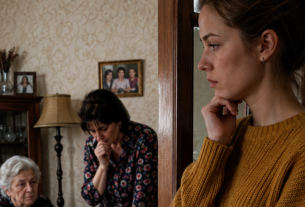
«Please sign here, Marina Andreevna, and the house will officially be transferred to your mother-in-law,» the lawyer said, handing her the pen across the table without even glancing at her.
Marina froze. The office was stuffy, the air thick with the smell of coffee and the plastic heat from an old heater. Wet snow, the first of December, was falling outside the window. Inside her, something snapped—a string holding her world together was suddenly gone.
Tamara Viktorovna sat beside her, hands folded in her lap, staring at the wall with an expression of gentle suffering. In seven years of marriage, Marina knew that look down to every wrinkle. Her mother-in-law always wore it when she was getting her way. Quiet, mournful, «sacrificing herself for the family.»
«Wait,» Marina pushed the pen away. «What house? This is my grandmother’s country house. What does my mother-in-law have to do with any of this?»
«Marina, here you go again,» Tamara Viktorovna turned to her, her voice soft and thick, like honey left out in the sun. «We talked all about this yesterday. Kostya explained it to you.»
Kostya. Her husband. Her Konstantin, who this morning suddenly got ‘stuck at the work site’ and couldn’t come. Who last night spent the entire evening glued to his phone, answering her in monosyllables.
Marina’s fingers turned cold.
«No,» she said softly. «We didn’t talk things through. Kostya said we needed to handle paperwork for my grandmother’s land. Something about mapping. I came to help.»
The lawyer cleared his throat and looked at the two women with barely hidden discomfort. Meanwhile, her mother-in-law was already fishing a white handkerchief out of her purse, ready to dab her perfectly dry eyes.
«My dear girl,» she began, «why are you always like this? I’m just trying to help you. You’re young, inexperienced in these matters. I’ve lived a full life and I know how these things work. It would be safer if the house were in my name. Fewer worries. Debts, heirs—anything could happen…»
«What exactly do you mean by ‘anything could happen’?» Marina’s voice stayed steady, but it trembled all the same.
Her mother-in-law sighed reproachfully.
«It’s always the same. I come to her with kindness and she acts prickly. A typical daughter-in-law. So ungrateful.»
The word hit the table like a stone. «Ungrateful.» Marina had heard it over seven years—in countless variations. «Incompetent,» «not truly family,» «hopeless.» Her mother-in-law always said it with a heavy sigh, as if carrying a terrible burden that nobody, nobody appreciated.
Marina slowly stood up. She gathered the papers and put them back in the lawyer’s folder.
«I’m not signing anything today.»
«Marina!» her mother-in-law jumped up. «What are you doing, acting this way in front of a stranger?»
«I’m going home. And I’ll be speaking with my husband.»
Outside, the wind and wet snow hit her as soon as she stepped out. Marina walked toward the bus stop, her insides shaking—not from the cold, but from realization. Kostya knew. He knew, and he sent her on her own because he didn’t have the courage to face her.
This house was passed down to Marina from her grandmother Zoya. It’s small and old, with a creaky porch and an apple orchard that her grandmother planted herself. Marina spent her entire childhood there. On the veranda stood a round table, where her grandmother would pour tea from the samovar and say, «Marisha, remember—never give away what’s yours. You must cherish what you have.» The embroidered towels her grandmother made still hang on the wall.
Now, Grandmother had been gone for four years. And only Marina could protect her garden now.
At home, Konstantin was sitting in the kitchen, stirring his cooling tea and scrolling through his phone. He seemed far too calm for someone who claimed to be ‘stuck at work.’
«You’re back already?» He looked up and tried to smile. «So, did you get everything settled?»
Marina set her bag down on the stool.
«You knew.»
His smile faded from his face, just like paint washed away by rain.
«Marish, let’s not do this…»
«You knew your mother wanted to put Grandma’s house in her name. You knew—and you sent me there alone. So I wouldn’t get in your way, right?»
Konstantin sighed—one of those special sighs men use to show a woman just doesn’t understand the serious things.
«Mom’s just worried. We have a mortgage, it’s a tough time. If the house is in her name, then if anything happens, they won’t touch it…»
«If anything happens? The mortgage is on the apartment, what does the house have to do with it?»
He hesitated. Looked away.
«Well… if we run into trouble…»
«Kostya,» Marina stepped closer. «Just tell me straight. What kind of trouble?»
He was silent for a long time, twisting the spoon in his hands. Then he finally forced out a reply:
«I took out another loan. A small one. For Mom. She needed treatment for her back, a rehab stay, things like that. She asked, and I couldn’t say no. And when we talked… well, I sort of promised her the house would be the collateral.»
Marina sat down on the chair. She just had to sit, because suddenly her legs felt like jelly.
«You promised Grandma’s house to someone else.»
«Not to someone else. To Mom. She’s my mother.»
«And who am I to you, Kostya?»
He stayed quiet.
«Who am I to you?» she repeated, louder. «Your wife? Or just someone passing by? This house was left to me by Grandma. Not to you. Not to your mother. Me. And you were ready to give it away without even asking.»
«Marish, we’re family. We share everything.»
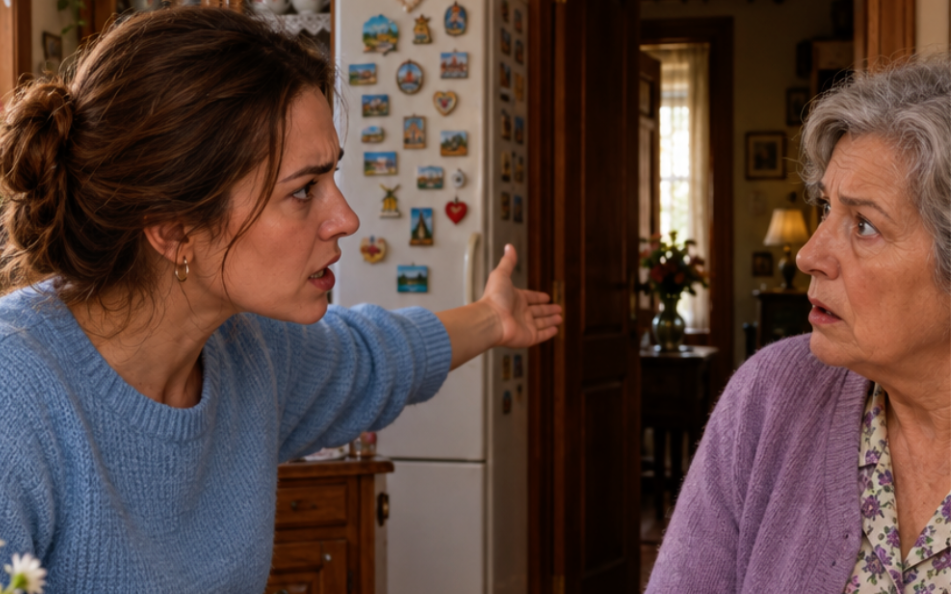
«Share,» Marina repeated bitterly. «We share things only when it’s about taking what’s mine. But when your mom’s been walking all over me for seven years, it’s always: ‘That’s just how she is, put up with it.'»
She stood up and left the kitchen, closing the door softly behind her. In the bedroom, she sat on the edge of the bed and stared at one spot for a long time.
Aunt Galya’s place smelled of baked milk and fresh pancakes. It was a small apartment on the first floor of an old five-story building, the same place Marina used to run to after school as a child. Everything here felt simple and honest. No hidden meanings, no little jabs in every exchange.
«Come on, tell me everything,» Aunt Galya said as she sat Marina at the table, slid over a plate of pancakes, and poured her some tea.
And so Marina began her story. From the very beginning. Seven years ago, she married Konstantin—head over heels in love, full of happiness. But from day one, her mother-in-law started to “help.” Little by little, that help became constant control. Tamara Viktorovna would go through Marina’s things in the wardrobe, supposedly to organize. She insisted on teaching Marina how to cook borscht, saying, “My Kostya is used to it my way.” When little Verochka was born, her mother-in-law announced she’d be the one to handle raising her—after all, “the mother is clueless.” And not once—not even once—did Kostya stand up for Marina. He always had an excuse for his mom. “But she’s old.” “She means well.” “Just put up with it, what’s so hard?”
And so Marina would cry at night, facing the wall, trying to make sure her husband wouldn’t hear.
And finally, she told about today. About the lawyer. About the house.
Aunt Galya listened silently, her lips pressed together. Then she got up, rummaged in an old china cabinet, and pulled out a worn faux-leather folder.
«Marisha, your grandmother Zoya, when she was really declining, gave this to me. She said, ‘Keep it safe until it’s needed.'»
«What is it?»
«Open it.»
Marina opened the folder with trembling hands. Inside were copies of documents for the house. And on top—one separate, thick sheet with a notary’s stamp.
«Your grandmother was not as simple as she seemed,» Aunt Galya said, sitting across from her. «She figured your Kostya out right away. Even at the wedding, she told me, ‘Galya, remember this: that boy will always put his mother before his wife.’ And she set up the house, not just as an inheritance, but as a gift deed. With a condition attached.»
Marina read and her eyes widened. In black and white, the document stated: the house is given as a gift to Marina Andreyevna with a restriction. For the next 25 years, if she’s forced to sell, gift, or mortgage it, the gift is canceled and the property goes to the second heir—Galina Petrovna. With the right to return it to Marina, free of charge, at her discretion.
«So…» Marina looked up.
«So, if you’re ever forced to sell or sign over the house, it immediately goes to me. And I’ll give it back to you when things calm down. Your grandma thought of everything, Marisha. She’s still looking out for you. I’m sorry I never told you. I always hoped things would get better, that Kostya would come to his senses. But he didn’t.»
Marina dropped her head onto her aunt’s shoulder and cried. Not from sadness, but from that warm, saving relief when you realize you’re not alone. That even now, her grandmother is still standing behind her.
«Thank you, Grandma,» she whispered.
The next morning, Marina returned home. Calm, collected, with copies of the documents in her bag. The originals remained with Aunt Galya, tucked inside an old tin cookie box—hidden so well that sometimes even Aunt Galya forgot where she’d put them.
Konstantin opened the door for her, looking disheveled and sleep-deprived. Clearly, he’d slept on the living room couch.
«Marish, finally. Mom was so upset yesterday her heart started acting up. Maybe we should go and make peace?»
«Is your mother at home?»
«Yeah, she’s at her place.»
«Alright. Let’s go to the kitchen.»
They sat down across from each other. Marina placed the folder in front of her husband.
«What’s this?» he asked suspiciously.
«Open it and read. Take your time.»
Konstantin opened the letter. He read it slowly, and Marina watched his face change: at first he looked confused, then she saw him realize the meaning, next came bewilderment, and finally — pure panic.
«So the house… can’t be transferred?»
«It can. But then it will go to my aunt Galya. And you’ll be stuck with your loan, without any security for it — which, by the way, you promised without even asking anyone. Your mother will end up with nothing too. And I’ll be left with my aunt, who truly loves me.»
Konstantin ran his hand over his face.
«Why didn’t you tell me before?»
«Because you never asked, Kostya. You just decided that my house was a resource for you and your mother. Your mother thought it belonged to her. You assumed that what was mine was everyone’s. But did anyone even ask me? Not once in seven years?»
He sat silently for a long time, staring at the table before finally saying in a hollow voice:
«I’ve acted like a complete fool.»
«Yes,» Marina didn’t argue.
«Did Mom really just want peace? Or…»
«Your mom, Kostya, wanted you on her leash for your whole life. She wanted me to be the one blamed for every little issue you had. Do you think she really needed a vacation home? What she wanted was power. Over you, over me, over Verochka. The house is just another tool — another hook.»
Konstantin was silent for a long time. Then he quietly asked:
«So what do I do now?»
Marina exhaled. She had spent the whole night preparing for this conversation.
«I’m giving you one chance. Just one, Kostya. And this isn’t a threat — it’s the condition for me to even consider staying in this marriage.»
He looked up at her.
«First. You go see your mother on your own and tell her directly: she’s not getting the house. Any house. Not mine, not yours. And she can only come to our place if she’s invited. You take her keys to our apartment back. Today.»
«But she…»
«No ‘buts.’ Second. The loan you took out for your mom — you pay it off yourself. How you do it is up to you. Take a side job, sell your car if you have to, but I’m not involved in that debt and I’m not taking responsibility for it.»
«Marina, that’s so hard…»
«Hard?» She nodded. «And did you think the last seven years were easy for me? Third. We’re going to see a family therapist. Because I do want to save our family. But not at the cost of losing myself by the time I’m forty. And if you hide behind your mom again — I’m filing for divorce. Then you’ll see Verochka on weekends. This isn’t blackmail, Kostya. This is my boundary. The first one I’ve set in seven years.»
Konstantin sat there, pale. It seemed like he was truly hearing his wife for the first time — not as someone who served him, not as an extension of his mother, not as background noise. But as a real person, someone with her own terms and her own ‘no.’
«I… agree.»
«Don’t agree with me. Go talk to your mother. And don’t come back home until you do.»
He pulled himself together and left that very evening.
Marina was left alone. She walked through the quiet apartment, stood by the window, and suddenly felt something unfamiliar inside — peace. Real peace, not the tense, forced calm she’d worn for years like a dress that was too tight.
Marina didn’t find out about Kostya’s conversation with his mother right away—and certainly not from him. Tamara Viktorovna was shouting so loudly, the whole building could hear. She screamed about being ‘betrayed,’ claimed her ‘daughter-in-law bewitched her son and turned him against his own mother,’ and threatened to tell everyone ‘what kind of snake Kostya has taken in.’ According to those who heard, this was the first time Konstantin ever raised his voice to his mother. He told her that if she ever called Marina a ‘barren flower’ again, he would never set foot in her house.
For two weeks, his mother refused to answer the phone. Then, one day, she called herself. She invited them over ‘for tea, to make peace.’ Konstantin told her, ‘Mom, only if you start respecting my wife. Otherwise, there’s nothing to talk about.’
Tamara Viktorovna just breathed heavily into the phone for a long time. But in the end, she agreed.
Three weeks later, they showed up together. Konstantin’s mother was uncharacteristically quiet. She didn’t try to take charge in the kitchen and didn’t say a word about Vera’s drawing stuck to the fridge—even though she used to comment every time that ‘the child just scribbles, she needs to join an art club.’ Only once, as Marina was pouring the tea, did Tamara Viktorovna cough and say:
‘Marina… this is awkward. I guess I was wrong.’
‘Wrong about what, Tamara Viktorovna?’ Marina wasn’t about to help her out. She would have to say it herself. Completely.
Her mother-in-law hesitated, turning her cup in her hands.
‘For meddling where I shouldn’t have. With the house. And… in general.’
‘Accepted.’
‘Will you forgive me?’
Marina looked at her. At the woman who, for seven years, had been slowly poisoning her life, drop by drop. And she felt no anger, no old resentment. Only calm.
‘I’m not ready to forgive you yet, Tamara Viktorovna. Forgiveness isn’t just a word, it takes time. But I’m willing to try again. With new rules.’
‘What rules?’
‘You come visit when you’re invited. You don’t gossip about me with the neighbors outside. You don’t try to raise Vera over my head. And you never, ever use the word “barren flower” around me again.’
Her mother-in-law lowered her head. She was quiet for a long time.
‘Okay,’ she finally said.
‘Then let’s drink our tea before it gets cold.’
A year passed.
Marina and Konstantin spent six months seeing a therapist. It wasn’t always easy. After some sessions, they argued until they were both hoarse. Sometimes they wouldn’t speak for days. Once, Marina even packed a bag, ready to leave—but stayed. Because she could see that Kostya really was changing. Slowly, and not without struggle, but changing. He was learning how to be a husband, not just a son. Learning how to tell his mother ‘no.’ And, more importantly, how to say ‘yes’ to his wife.
He paid off the loan himself. Sold his car—the one he’d dreamt of for three years—and started taking the bus. He never once reminded her of it.
Now, Tamara Viktorovna visited once a month. She was always reserved, always brought a treat for Vera. One day, she gave Marina a jar of her signature Antonovka apple jam—placed it on the table silently, without a word. For her, it seemed, that was her apology. Real, in a way words never were.
The house remained Marina’s. She kept the deed with its conditions safe, in the same tin box at Aunt Galya’s. One evening, after they’d reconciled, Konstantin said:
‘Marisha, you know, your grandmother saved me.’
‘From what?’
— From myself. I would’ve kept living like my mother’s puppet. I would’ve lost you—and not even noticed.
Verochka is six now. In the summer, the whole family travels to grandma’s house. Verochka runs through the garden among the old apple trees that great-grandma Zoya once planted, picking green, still tart apples while Marina laughs and doesn’t scold her.
Grandma Toma—that’s what Vera calls her mother-in-law—comes over on weekends and teaches her granddaughter how to bake pies. They have their own little game: who can make the messiest ones. Usually, Tamara Viktorovna wins, and Verochka bursts out laughing.
Sometimes Marina finds herself realizing she’s become a completely different daughter-in-law. Not the one who stayed silent and swallowed her tears, but the one who knows her worth and doesn’t give away what is hers.
And when other women she knows complain about their mothers-in-law, overbearing relatives, or husbands who are always hiding behind their mom’s back, Marina doesn’t rush to offer advice. She just says:
— Your home is your home. And no one except you has the right to decide how you live in it.
Because that is really the most important thing her grandmother and aunt taught her. The most important thing she lived through herself—to the last tear and to the last bit of courage she could find inside.
Home isn’t the walls or the roof. Home is a boundary. And a boundary is respect. For yourself. And for those who truly love you—not for what they can get from you.