It took Viktor a month and a half to build the carport. Grey metal supports, a roof that kept everything dry even in a heavy rain, and walls made of wooden slats. Sunlight broke through and cast stripes onto the paving stones, just like light through blinds. On the left, he placed a trash container and hung up their bikes. On the right, there were still two parking spaces left for cars.
The first time his father came to see it, he walked around for a long time. He knocked on the metal support with his knuckles, checked to see if the slats were straight, and crouched by the paving stones.
“Well done,” he finally said. “But why do you need two spaces? You only have one car.”
“Just in case, Dad.”
“Just in case,” Dmytro Valeriyovych grunted. “Son, you still haven’t learned how to manage your money.”
Viktor stayed quiet then. He already knew why he’d built that second spot. He just didn’t know how to tell his parents about it in a way that wouldn’t make them refuse.
* * *
For twenty-six years, Dmytro Valeriyovych drove people around Uman. At first, in a yellow ‘Bogdan’ bus, which wouldn’t start in winter unless he begged it for a long time, and later in a newer minibus that the carrier bought when his father’s hair had already turned grey. He woke up at half past four.
His mother, Iryna, would get up with him, even though her shift at the post office didn’t start until eight. She put the kettle on, poured tea into a thermos, and wrapped two bacon sandwiches in a newspaper.
Viktor remembered these mornings through the thin wall of his room. His parents whispering in the kitchen, the click of the lock, footsteps on the stairs. In January, there was also a scratching sound: his father was scraping frost off the minibus windshield, which he parked under their windows because the depot was too far away.
The family never had their own car. His father always said he had enough time behind the wheel at work. Much later, Viktor realized it wasn’t really about the driving.
When Viktor was accepted to the Polytechnic in Kyiv, his father started taking weekend shifts. Saturdays, Sundays, holidays. His mother found extra work too—after her regular shift, she sorted packages at another post office. Viktor never knew about any of this. He would call home and talk about exams, about dorm life, about how everything in Kyiv cost more than any advertisement promised. His mom would listen and say:
“Just focus on your studies. Don’t worry about money.”
In his third year, he came home for Easter and was looking for his father’s screwdriver in the closet. Instead, he found a squared notebook wrapped in a plastic bag. His father wrote everything in it: fuel, lunches, minor repairs. Neat columns of numbers, dates. And after every few pages, the same line, underlined twice: “For Viktor’s dorm.” “For Viktor’s books.” “For Viktor’s jacket.”
Viktor put the notebook back. He didn’t say anything to his father. But he remembered that line for all the years that followed.
* * *
After that, everything turned out just as his parents had hoped. An engineering degree, a good job where he was promoted to department manager within a few years. Then came Kateryna: calm, clever, the kind of person who’d quietly set a bowl of soup before you exactly when you needed it. The wedding, their daughter Zlata. And just last year, they bought a house outside Kyiv—big, with a garden, and a tall pear tree already growing. They started turning it into their home.
You’d think now it was his chance to repay them. But his parents refused to take anything.
For his mom’s birthday, Viktor sent her money to her card, but the very next day it was returned, labeled ‘Sent by mistake.’ He tried to buy his parents a new washing machine, but his dad wouldn’t let him bring it over, even after a call.
‘Ours still spins just fine. Why toss out something that works?’ his dad said over the phone.
‘Dad, it sounds like a jet taking off.’ Viktor replied.
‘Let it roar. We’re used to it.’ his dad insisted.
So the washing machine sat in Viktor’s garage, still in the box, for half a year before he finally sold it to a neighbor. In the spring, Viktor suggested his parents go on a trip to a resort in Truskavets, all expenses paid. His mom thanked him endlessly, but then said they just couldn’t leave their seedlings at home.
One evening, Viktor sat in the kitchen, turning an empty cup in his hands but not drinking anything.
‘It’s like they’re building a wall between us,’ he told Kateryna. ‘I’m not a stranger—I’m their son. Why do they accept gifts from others, but not from me?’
‘Because from others, it’s a gift,’ Kateryna said, sitting across from him. ‘But when it’s from you, it feels like a payment, like you’re settling a debt. And they never felt like they owed you anything.’
‘So what, am I just supposed to call every Sunday for the rest of my life?’
‘Vitya, they don’t know how to receive. All their lives, they’ve only known how to give. If you ask them, they’ll always say «You don’t have to.» That’s just who they are.’
Viktor stared out the window for a long time, looking into the dark garden.
‘What if I don’t ask?’ he wondered aloud.
* * *
He finally made up his mind in September. His father had been retired for a year. The bus route was handed to a younger driver, and Dmytro Valeriyovych, still used to waking up at 4:30am, wasn’t sure what to do with himself. Now his parents had a country house twenty kilometers outside the city, and they traveled there by bus—twice a week, with a transfer.
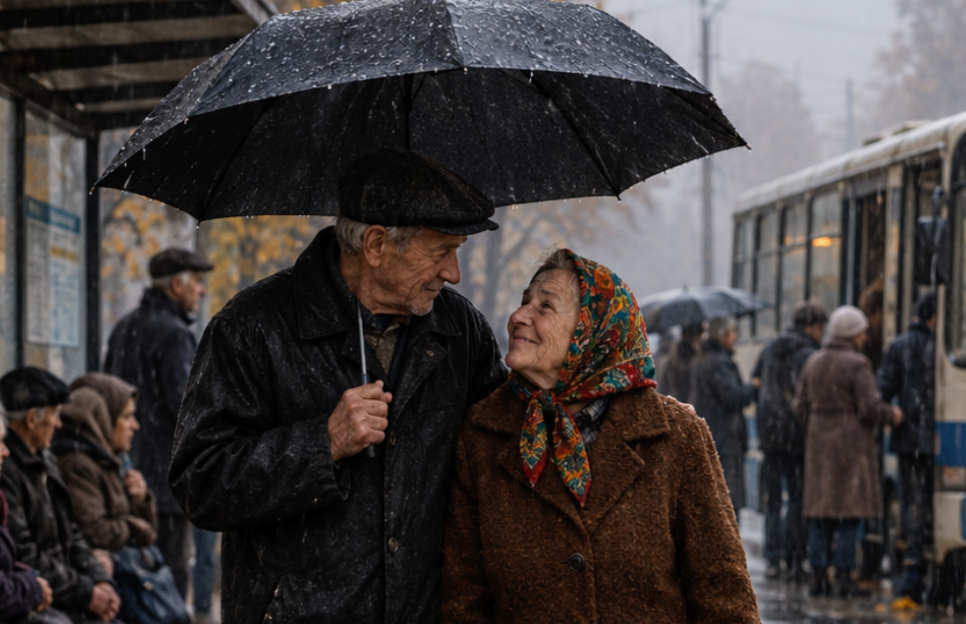
One time, Viktor happened to run into them at the bus station. He was traveling for work to Vinnytsia and hopped over to Uman for an hour. That’s when he saw his mom standing in the rain with two bags—seedlings sticking out—while his dad held an umbrella over her, getting soaked to the shoulders. The bus was late. They didn’t even complain. They just stood quietly, chatting as if it were nothing out of the ordinary.
That day, Viktor gave them a ride to their country house. The whole way, his mom rubbed her knees and waved off his concern, saying, ‘It’s just the weather.’ His dad sat up front, eyes on the road. Viktor noticed how his dad’s right leg would twitch slightly every time he needed to brake—twenty-six years behind the wheel don’t vanish overnight.
That evening, Viktor didn’t call anyone or ask anyone’s advice, not even Kateryna’s. For the first time in his life.
He spent nearly a month choosing the right car. He wanted one that was practical, not flashy—a spacious black Volkswagen, big enough for seedlings, sacks of potatoes, and Zlata’s child seat. The kind where his mom wouldn’t have to stoop low to get in, and his dad—used to the high seat of a city bus—would feel at home behind the wheel. Viktor handled all the paperwork, drove the car home, and parked it under the carport, right in the second spot.
Then he went to the closet and pulled out a grid-lined notebook. His dad had given it to him years ago, along with some other odds and ends while they were clearing out the storeroom—he probably didn’t even remember what was inside. Viktor opened the last filled page, grabbed a pen, and carefully wrote, mimicking his father’s handwriting: ‘For Dad — for a car.’ And he underlined it twice.
He placed the notebook in the glove compartment.
* * *
He brought his parents over for Saturday, supposedly for a barbecue to celebrate Zlata’s name day. All the way there, his mother kept asking if they remembered to buy the granddaughter a doll, while his father grumbled that the car’s navigation system talked too loudly. Viktor just smiled and didn’t argue.
When they pulled into the yard, his father was the first to notice the black car under the canopy.
«Oh, you have guests? Whose car is that?»
Viktor turned off the engine. For some reason, his hands suddenly felt cold.
«It’s yours, Dad.»
His father let out a short laugh, the kind you make at a bad joke.
«Sure. Mine. And did you buy Mom a helicopter, too?»
Viktor silently handed him the keys. His father looked at them, then at his son, then back at the keys. The smile slowly faded from his face.
«Vitya, are you out of your mind?» he said quietly. «Do you know how much this costs? You have a house, a child—your own expenses. You bring this back tomorrow.»
«I’m not taking it back.»
«I’m telling you—»
«Dad,» Viktor interrupted his father for the first time in his life. «Listen to me, just this once. I’ve never done anything without asking you both. Which university to go to, work, the wedding, even this house—I always asked. And you always said, ‘Don’t worry, son, we’ll manage on our own.’ Well, this time I didn’t ask.»
Dmytro Valeriyovych was silent.
«For twenty-six years you drove other people in someone else’s car,» Viktor said, now softer. «So I could study. I know everything, Dad—the weekend runs, and Mom’s care packages. Let me do something for you now. Not as a debt. Just because.»
His mother stood nearby, covering her mouth with her hand. Father slowly took the keys, walked over to the car, opened the driver’s door, and stared at it for a long time, as if expecting someone to tell him it was a mistake. Then he sat down. He placed both hands on the steering wheel. His palms were broad, with cracked skin on his fingers. Viktor knew every one of those cracks.
«Ira,» his father called hoarsely. «Come here. Smell how it’s new.»
His mother sat in the passenger seat. The two of them sat in silence, two gray-haired people in a new car interior, and Viktor could see through the glass how his father’s shoulders trembled. Dmytro Valeriyovych had never cried in front of his son—not when Grandpa died, not when Viktor left for school in Kyiv. But now he sat holding the steering wheel and couldn’t stop.
Kateryna came out onto the porch with Zlata in her arms and quietly said:
«Let’s go, sweetheart, Grandpa’s busy.»
Mom was the first to reach for the glove compartment. Viktor saw how she pulled out a squared notebook, how she recognized it, and silently handed it to Dad. He opened it to the marked page. He read. He traced his thumb over the two lines under the last sentence.
Then he got out of the car, walked over to his son, and hugged him tighter than he ever had before.
«Thank you, son,» he said into Viktor’s shoulder. «Thank you.»
He didn’t say anything else. And he didn’t need to.
* * *
The next Saturday at seven in the morning, Viktor’s phone rang.
«Son, did I wake you?» Dad’s voice sounded unusually cheerful. «Your mom and I are heading to the country house. We’re driving ourselves.»
In the background, Mom could be heard talking about seedlings and reminding him the tomatoes needed to be transported carefully.
«Drive safe, Dad.»
«I really am calm. I’ve been driving calmly for thirty years,» Dad paused for a moment. «Listen. I added another line in the notebook, just below yours.»
«What did you write?»
«You’ll see when you get here,» said Dmytro Valeriyovych, and Viktor could tell he was smiling. «You’re not the only one who can surprise us.»