That evening, she was trying to save Sonya’s white blouse. Her daughter had managed to spill a glass of cherry juice all over it at the school celebration, creating a big brown stain on the front, shaped suspiciously like the map of Australia. Katya poured salt on the spot, then doused it with hydrogen peroxide. The peroxide fizzed and foamed white. The kettle on the stove squeaked with its broken whistle—it didn’t whistle so much as hissed, like it had a cold. On the windowsill, Sonya’s sneakers were drying, stuffed with newspaper.
Her phone buzzed on the table, and the screen lit up with ‘Oleg.’ Katya stared at the name for a long moment. Two weeks ago, she would’ve renamed him something a lot less flattering, but then decided that was giving him too much importance.
“Yes.”
“Katya, hi. Listen, I’ve got something to tell you.” Oleg’s voice sounded upbeat and businesslike, as if he was arranging a tile delivery, not calling his almost ex-wife. “My mom fell at the dacha on Saturday. Missed a step by the bathhouse. Broke her wrist. The right one.”
Katya paused for a second, her hand stilling over the stain.
“How is she?”
“She’s okay, they put her in a cast. But it’s really hard for her to be alone now. She can’t even open a jar or go shopping. There’s still potatoes left to dig up at the dacha, the water needs to be drained and everything closed up for winter. She needs rides to the clinic for checkups every week. Basically, since you live nearby, just two bus stops away, maybe you could check in on her? Once or twice a week. And go to the dacha with her on weekends.”
Katya placed the blouse into a washbasin and sat down on a stool.
“Oleg, why can’t you do it yourself?”
“I can’t. I have work. And…”—he hesitated—“Kristina’s allergic to cats, and my mom has Timofey. She can’t go to my mom’s, and I don’t want to leave her alone, we’re going through a rough patch right now. You understand.”
Katya understood. Kristina was twenty-nine, a manager at the dealership where Oleg bought his new SUV, and six months ago had begun her own ‘rough patch’ with someone else’s husband. Two weeks ago, Oleg packed a bag, sat at this very kitchen table—right where Katya was now—and said he was filing for divorce. That he had ‘finally found true love.’ That fourteen years of marriage had been a ‘youthful mistake.’ And that, as a decent man, he would leave everything as the law required.
The next day, he filed the paperwork in court.
“Darling,” Katya said, surprised at how calm and almost cheerfully her voice sounded, “you’ve filed for divorce. Why on earth should I help your mother?”
“Why not? She’s practically family. You’ve known her for fourteen years.”
“Exactly. Fourteen years. And what are you to me now?”
Oleg went silent. When he spoke again, his voice was harsher.
“Katya, don’t start. I thought you were reasonable. My mother always stood up for you, by the way. And now, just out of spite, you’re abandoning an old, sick woman.”
“Oleg,” Katya said, “I’m not abandoning her. You are. Her own son. All because your new love is allergic to her cat. Hire a sitter if you won’t do it yourself. Or sign her up for grocery delivery. You’ve got money, you just bought a new SUV.”
“What I buy is none of your business!” he barked and hung up the phone.
Katya looked at the basin with the blouse. The foam had settled, the stain had faded but was still there. She sighed, poured out the water and sprinkled fresh salt.
Sonya peeked out from her room. She was fourteen, and for the past two weeks, she’d been wandering around the apartment like a shadow, headphones on, her face distant.
«Mom, was that Dad calling?»
«Dad.»
«What did he want?»
«He wants me to visit Grandma Nina. She broke her arm.»
Sonya took off her headphones.
«Grandma broke her arm? Why didn’t anyone tell me?»
«I just found out myself, sweetheart.»
«And you’re not going to go?»
Katya looked at her daughter. There was something in her eyes that made Katya feel awkward.
«Sonya, your dad left us for another woman. He’s filed for divorce. And now he wants me to take care of his mother because he’s too busy. Don’t you think that’s a little weird?»
Sonya shrugged.
«Maybe. But what does Grandma have to do with it?»
Katya couldn’t find an answer.
That night, she couldn’t sleep for a long time. She lay on her side of the bed—she’d never learned to sleep in the middle, even though she could now. She thought about Nina Arkadyevna.
Her mother-in-law was a complicated woman. A former chemistry teacher, straight as a ruler and just as cold at first glance. When Oleg had first brought Katya home to meet her, Nina Arkadyevna looked over her glasses and asked, «And what do you do for a living, if you don’t mind me asking?» Back then, Katya worked as a supply manager at a wholesale base. Nina Arkadyevna sniffed. For the first three years, Katya thought her mother-in-law quietly despised her.
But then Katya ended up in the hospital with appendicitis, Oleg was on a business trip, and Nina Arkadyevna spent three days with two-year-old Sonya, cooking broths and bringing them to the hospital in a thermos wrapped in a towel. She never said anything, just set the thermos on the nightstand and left. On the fourth day, Katya said, «Thank you, Nina Arkadyevna.» Her mother-in-law replied, «Don’t mention it. So, when are you going to give me a grandson?»
Katya never did have a son. But something changed between her and her mother-in-law after that. They didn’t become friends, but they were something like allies. Nina Arkadyevna taught her how to salt milk mushrooms, Katya took her to the market and helped deal with the electric meters. On Sonya’s birthdays, her grandmother always gave her books—always thick, always smart, and Sonya would then read them nonstop.
Two weeks ago, when Oleg left, Nina Arkadyevna didn’t call. Not once. Katya figured she’d taken her son’s side, as any mother would. She felt hurt. Silently, to herself.
And now it turned out her mother-in-law was sitting alone with a broken arm, with her cat Timofey and unharvested potatoes.
At four in the morning, Katya got up, drank some water and said out loud to herself in the dark kitchen:
«I’m not going to him. I’m going to her.»
But she didn’t have to go—her mother-in-law called herself. The next day, during Katya’s lunch break.
«Ekaterina,» said Nina Arkadyevna. She always used her full name when the conversation was serious. «I need to talk to you. Not over the phone.»
«Nina Arkadyevna, how’s your arm? Oleg said…»
«The arm will heal. This isn’t about my arm. Can you come over on Saturday? Around noon.»
«I can.»
«Come over. And bring Sonya, I miss her. Just, don’t tell Oleg I invited you.»
Katya was surprised, but she promised.
On Saturday morning, Sonya got ready as if she were going to a prom. She tried on three different sweaters, put on mascara and then wiped it off. She baked a charlotte for her grandmother—by herself, following a recipe she found online. One side of the charlotte got a little burned, and Sonya was upset.
«Grandma won’t even notice,» Katya reassured her. «And if she does, she’ll just say that it’s even better that way, the crust is crunchier.»
They left earlier than planned—Katya was nervous about traffic on Moskovskaya Street, but there were no jams after all. They arrived at her mother-in-law’s house at half past eleven.
Oleg’s SUV was parked at the entrance. Big, black, shiny. Katya stopped.
«Mom, Dad’s here,» Sonya said.
«I see.»
«Shall we go?»
Katya hesitated. Nina Arkadyevna had asked her not to tell Oleg. That meant she didn’t want them to meet. That meant she didn’t know he was coming.
«Let’s go,» she finally said. «Grandma’s waiting for us.»
Katya had a key to her mother-in-law’s apartment. Nina Arkadyevna had given it to her years ago, when she went to a sanatorium and needed someone to water her plants. The key had stayed on Katya’s keyring ever since, and her mother-in-law had never asked for it back.
No one answered the doorbell. Katya rang again, waited, then put the key in the lock.
Nina Arkadyevna’s apartment was old, two-roomed, with a long hallway lined with bookshelves up to the ceiling. It smelled of books, dried herbs, and cat food. Timofey the cat—huge, ginger, with a torn ear—ran up to greet them and rubbed against Sonya’s legs.
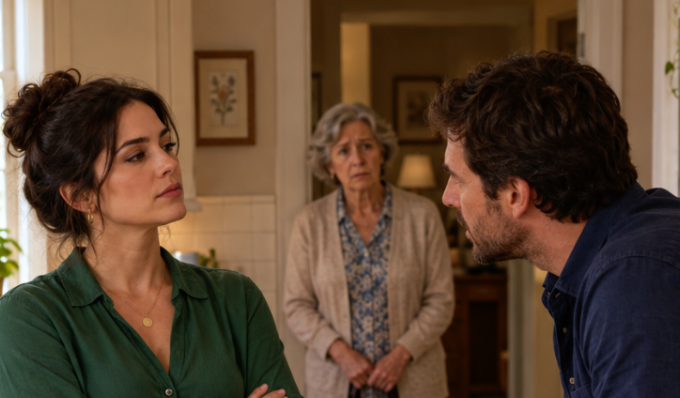
From the far room, where her mother-in-law’s study was, voices carried out. Katya motioned to Sonya—quiet—and stopped near the first bookshelf.
«Mom, why are you being so stubborn?» Oleg was saying. «It’s just a simple paper. You sign it and that’s it. Nothing will change.»
«If nothing will change, then why do you need it?» Nina Arkadyevna’s voice was calm, like a teacher’s.
«Because it’s safer this way. Mom, I’m going through a divorce. Katya’s going to want to split everything. If you give me the apartment as a gift now, she can’t get it—it’ll be mine alone. But if you write a will, someday… well, then it’ll be inheritance, and that also doesn’t get split, but who knows when that’ll be. I need it now.»
«Why do you need it right now?»
Oleg paused.
«Well… Kristina and I want somewhere to live. Renting is just throwing money away. This place has two rooms, it’s in the center. You spend the whole summer at the dacha anyway. You could move out there for good; the air is better, there’s a garden. I’ll buy you a new stove. I’ll insulate it for you.»
«You’ll insulate it,» Nina Arkadyevna repeated. «Oleg, I’m seventy-one. My arm is in a cast. The nearest pharmacy is four kilometers down a dirt road. In winter, the bus comes twice a day.»
«But I’ll come visit you!»
«You don’t visit now. In two weeks, you came to see me once—and that was today, with your paper.»
Katya suddenly felt Sonya squeeze her hand.
«Mom, let me explain again…»
«No need to explain, I’m not a child.» There was steel in her mother-in-law’s voice. «I spent thirty-five years teaching children how hydrochloric acid reacts with iron. And here you are trying to explain how to evict your own mother from her apartment. No, Oleg. I’m not signing.»
«Why not?!»
«Because the apartment is already signed over. To Sonya. I made a will two years ago at the notary’s office. Everything’s legal.»
Silence hung in the air. Katya could hear the kitchen clock ticking and Timofey noisily crunching his food.
«To Sonya?» Oleg repeated. «Mom, have you lost your mind? Sonya is fourteen! And Katya—she’s her mother! That means Katya will have control over the apartment!»
«Sonya will grow up,» her mother-in-law replied calmly. «And Katya, unlike you, has never tried to take anything that didn’t belong to her.»
Oleg cursed. Then his phone rang. He answered, and his voice instantly changed—gentle, almost purring:
«Yeah, babe. No, I’m still here. No, she’s being stubborn. Says she wrote the will for Sonya. Can you believe it? Don’t worry. We’ll sort it out. The main thing is, I already transferred the car to Seryoga like we planned. A hundred thousand officially. Katya won’t get it during the split—the car’s ‘gone,’ at least on paper. And after things calm down, Seryoga will transfer it back to me. He’s one of us, won’t let me down. Okay, love you, see you soon.»
Katya stood by the bookshelf, feeling her fingers turn cold.
The SUV. The same shiny black one parked outside. They had bought it in March for a million and a half. Katya had been against it—why get such a beast when Oleg only drove to work and to the country house? But Oleg convinced her: it was an investment, a good car, would hardly lose value over time. Katya’s yearly bonus—two hundred thousand—had gone toward the down payment. She’d saved that money to renovate the kitchen. The rest was a loan they both paid off together from their joint funds.
And now, on paper, the car belonged to some guy named Seryoga. For a hundred thousand.
Suddenly, Sonya let go of Katya’s hand and stepped out from behind the bookshelf.
«Dad,» she said loudly. «Hi.»
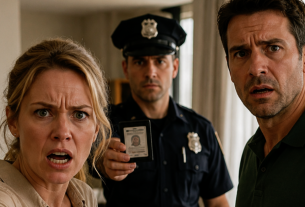
Oleg walked into the hallway with his phone in hand. He saw his daughter. Then he saw Katya. His face first went pale, then blotched with red.
«Have you… Have you been standing there long?»
«Long enough,» Katya replied.
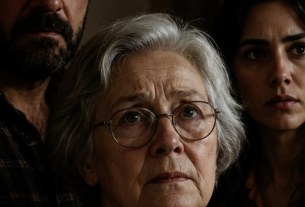
Nina Arkadyevna came out of the study. She was small, gray-haired, wearing a blue housecoat, her right arm in a sling. She looked at Katya, then at Sonya clutching a bag with the charlotte cake, and suddenly her usually stern face softened.
«Sonyechka,» she said. «Granddaughter. Come here.»
Sonya rushed over to her grandmother and hugged her carefully, making sure not to bump her arm. Nina Arkadyevna stroked her hair with her good hand and looked at her son over Sonya’s shoulder.
«And you, Oleg, go. Take your piece of paper. And leave the key to the country house on the side table—you took it last time.»
«Mom, are you doing this because of her…»
«Not because of her. Because of myself. Go.»
Oleg stood there gripping his phone. Then he threw the country house key onto the table, shoved his feet into his shoes without tying the laces, and slammed the door so hard that a porcelain dog fell off the shelf. It didn’t break—just rolled under the cabinet.
Timofey watched him leave with a look of disdain and went back to finishing his food. Sonya crawled under the cabinet for the little porcelain dog and gently returned it to its shelf.
Afterwards, they sat in her mother-in-law’s tiny kitchen, sipping tea from blue cups rimmed with gold. They cut the charlotte cake, and Nina Arkadyevna—after biting the burnt edge—said exactly what Katya had predicted she would:
«The crust is good. Nice and crunchy. Well done, Sonya.»
Sonya was beaming. Then she went to her room to cuddle with Timofey, and Katya was left alone with her mother-in-law.
«Please don’t be upset with me for not calling you these past two weeks,» she said.
«I thought you were on his side,» Katya replied.
«On his side…» Nina Arkadyevna shook her head. «I was ashamed, Katya. You understand? Ashamed. I raised him on my own since he was nine, after my husband left. I thought I’d raised a decent person. But a month ago, he came to see me, sat right here where you’re sitting, and said: ‘Mom, I’ve fallen in love, I’m leaving, Katya is boring, always with her discounts and receipts.’ And as I listened, I thought: Lord, he’s repeating his father’s words. Word for word. His father said exactly the same to me when he left. ‘You’re so boring, Nina, always with your notebooks.’”
Katya stayed silent.
«I wanted to call you then,» her mother-in-law went on. «Picked up the phone five times. Put it down every time. I thought: what could I possibly say? ‘Sorry, I raised a scoundrel’? Then at the dacha I fell off the steps. Laying on the grass, my arm hurting, I thought: who do I call now? Not him. I would have called you. But my pride got in the way, curse it.»
«Nina Arkadyevna…»
«And another thing. I knew about the car. Last week, he blurted out on the phone that ‘Katya’s not getting anything.’ At first, I didn’t understand what he meant. Today I finally got it after hearing this. Don’t just let it go. That’s your money, too.»
«I don’t know what to do,» Katya admitted honestly. «If the car is in someone else’s name already…»
«On paper,» her mother-in-law snorted. «You can write anything you want on paper. Go see a good lawyer. And tell them that if needed, I’ll testify in court. That I heard everything with my own ears.»
«You would testify against your own son?»
Nina Arkadyevna put down her cup.
«I’ll stand for the truth, Katerina. Let my son decide for himself whose side he’s on.»
On Monday, Katya took the day off work and went to see a lawyer. She got a recommendation from the company accountant, who went through a divorce two years ago. The lawyer’s name was Inna Borisovna—a full-bodied, energetic woman of about fifty-five, with a short haircut and a huge mug on her desk that read, ‘I’m not arguing, I’m explaining.’
Katya told her everything. Inna Borisovna listened, jotting things down in her notebook, then leaned back in her chair.
«Classic case,» she said. «I hear stories like this every month. Husband ‘sells’ the car to a friend for peanuts before the divorce, thinking he’s so clever. Let’s break it down. Was the car bought during the marriage?»
«In March this year.»
«Then it’s joint property, split in half. Doesn’t matter whose name is on the papers or who’s driving. Now, your husband sold it. Legally, one spouse can sell a car without written consent from the other, unlike with an apartment—the law is softer here. But! There’s a big ‘but’. If the sale wasn’t real, just for show—to hide property during the split—the court can rule that the deal was fake. Meaning it never happened at all.»
«How can you prove that?»
— And here’s where things get really interesting. First, let’s talk about the price. A car worth one and a half million was sold for just a hundred thousand, only six months after it was bought. Any judge would be astonished by that. Second, it was sold to a friend, not a random person. Third, who is actually driving the car now?
— Oleg. I saw it parked near my mother-in-law’s building on Saturday.
— Perfect. So, the car has basically stayed with him. The buyer doesn’t even use it. Take several photos of the car with the date visible, in various places where your husband goes — at his work, at his new girlfriend’s house. That will be proof the sale was just for show. And the ultimate witness is his mother, who heard the phone call. That’s a real gift.
— And what will happen if the court decides in our favor?
— There are two options. Either the car is returned to the shared property and divided, or the court will count its real value as part of your husband’s share — which means he’ll owe you compensation, half of the actual market price. We’ll also subtract the loan you both were paying off together, we’ll calculate everything. Either way, you’ll get your money.
For the first time in three weeks, Katya felt like she could finally breathe easy.
— And what about your mother-in-law’s apartment? He wanted her to give it to him, didn’t he?
— If she had, during the divorce the apartment wouldn’t be split. A gift counts as the personal property of the one who receives it. He was right about that. But she can only give it of her own free will — no one can force her. And since she’s already written a will for her granddaughter, she should just live in peace. By the way, she can still change her will anytime she wants. That’s her right, not yours or his.
— Her right, — Katya repeated.
— And another thing, — Inna Borisovna leaned forward. — Are we going to file for child support for your daughter?
— We are, — Katya said. Before, she would have hesitated, worrying about hurting Oleg’s feelings. Now, she had no doubts.
On Saturday, Katya and Sonya went out to the dacha. Nina Arkadyevna was sitting on a stool by the garden beds, rubber boots on her feet and an old jacket, giving orders with the one good arm.
— Dig deeper, Katya! Don’t cut the potatoes! Sonya, bring the bucket here. Set aside the small ones for seed.
There were a lot of potatoes—twelve hundred square meters’ worth, her mother-in-law always planted extra, “for the whole family.” Katya dug, Sonya gathered, and they had left Timofey in the city with a neighbor. It was cold and gray, the air carried the smell of wet earth and smoke—someone on a neighboring plot was burning old plant tops.
By three o’clock, Katya couldn’t straighten her back. They sat down on the porch, right on the same step by the bathhouse where her mother-in-law had fallen. Nina Arkadyevna pulled out a thermos of tea and cheese sandwiches from her bag.
— You know, — she said, looking out at the field with the dug-out furrows, — I didn’t just write that will for Sonya for no reason. Two years ago, Oleg told me something. We were sitting here at the dacha. He’d had a little to drink. And he said: Mom, don’t worry, when you’re gone, I’ll sell the apartment right away and put the money into my business. And he said it so easily, like it was just an old wardrobe. That’s when I thought: he didn’t even ask how I was feeling. He’s already selling it. The very next day, I went to the notary.
— You never told me about this.
«Why should I have told you? You’d think I was his mother, just trying to sway you. Or, even worse, that I’m handing you the apartment through my granddaughter, just so you’d feel obligated when I’m old and need help.»
Katya laughed. For the first time in a very long while.
«Nina Arkadyevna, do you really think I would turn my back on you?»
Her mother-in-law looked at her over her glasses. Just like she did fifteen years ago, when she first asked Katya what her job was.
«No, Katerina. You wouldn’t. I realized that back at the hospital, when you told me ‘thank you.’ He hasn’t said ‘thank you’ to me as many times in his whole life as you did in a single month.»
Oleg found out about the counterclaim three weeks later. Inna Borisovna had filed for the division of property and, separately, for the car sale to be declared invalid. Oleg received a court summons.
That same evening he showed up at Katya’s place. He rang the doorbell for a long time, insistently, then started banging with his fist.
Katya opened the door but left the chain on.
«What are you doing?» he hissed through the crack. «Are you out of your mind? What fake deal? I sold the car fair and square! I have the contract!»
«Then show it to the court,» Katya replied.
«Katya, let’s be reasonable. I’m leaving you the apartment anyway. This one. Stay here. What else do you want?»
«Oleg, this apartment is mine. I bought it before we were married, with the money from selling my grandmother’s house. You can’t ‘leave’ it to me because it was never yours. And you know that perfectly well.»
He got flustered. Apparently, he’d hoped she had forgotten.
«Well… well, I did the renovations!»
«You put up new wallpaper in the hallway. Eight years ago. If you want, I can give you the leftover roll—it’s still up on the shelf.»
«Your mother put you up to this, didn’t she?» He suddenly started yelling. «It’s her! That old witch! Turning her own son against his wife…»
«Don’t you dare,» Katya said quietly, but so firmly that he stopped mid-sentence. «Don’t you dare talk about her like that. She held your hand when you fell off your bike at five and broke your collarbone. She told me about it. She raised you on a teacher’s salary all by herself. And now here you are, coming to take an apartment from her with a broken arm—for Kristina. Go, Oleg. We’ll see each other in court.»
She closed the door. Stood there, listening. He lingered in the hallway for another minute, then left. The entrance door slammed shut.
Sonya came out of her room.
«Mom, are you okay?»
«I’m fine,» Katya said—and realized she really meant it. «You know, Sonya, I’m really fine.»
They sat in the kitchen. Sonya poured her mother some tea, doing it on her own, and put two spoonfuls of sugar in the cup, even though Katya hadn’t taken sugar in five years. Katya didn’t correct her.
«Mom,» Sonya said, staring at the table. «Do you still love Dad?»
Katya was silent for a long time, turning the cup and watching the sugar swirl at the bottom.
«I don’t know, Sonya. Honestly. Maybe I love the dad you used to have. The one who carried you on his shoulders at parades. Who ran out in the middle of the night for ice cream when I was pregnant with you. But this one, the man pounding on my door right now—I don’t. I don’t know him.»
«Me neither,» Sonya whispered. «I don’t know him either. Yesterday he texted me that if I take your side, he won’t get me anything for my birthday.»
Katya set her cup down so abruptly that tea splashed onto the tablecloth.
«Did he actually write that?»
«Yeah. I didn’t answer him.»
«Sonechka,» Katya took her daughter’s hand, «there are no sides here. He’s your father, and you’re his daughter. No court ruling can ever change that. We’re dividing the car and the money with him, but no one can divide you. Do you understand? You can love him. You can see him. You can even be angry with him. All of that is your right.»
Sonya nodded and then burst into tears—the first time she’d cried in all these weeks. Katya hugged her and held her close until she calmed down.
The court process lasted two months. Katya snapped photos of the SUV just like Inna Borisovna had advised: outside Oleg’s office, at the fitness club he went to now, near the shopping mall on the edge of town where, as it turned out, Kristina lived. Once, she photographed the car by her mother-in-law’s building, where Oleg had gone again—to persuade his mom ‘not to embarrass herself in court.’
Nina Arkadievna wouldn’t be persuaded.
One day at the shopping center, Katya was caught by the parking lot security guard—a gruff older man with a mustache and a uniform jacket. He walked over and sternly asked why she was photographing the same car for the third time that week.
«It’s not someone else’s car,» Katya sighed. «It’s my car. Half of it. My husband ‘sold’ it to his friend so he wouldn’t have to split it with me in the divorce, but he still drives it. My lawyer told me to gather proof.»
The security guard was silent for a moment, twirling his mustache. Then he said:
«My first wife did the same thing. Only with the garage. Here’s what you do: we’ve got cameras here, and the footage is saved for a month. If the court asks, I’ll confirm that he parks here every evening. I already memorized the plate number.»
Katya almost cried from the surprise. Later, when Inna Borisovna heard the story, she laughed and said there are still good people in the world, especially among the divorced.
At the hearing, she sat in the front row in her dark blue suit—the one she’d only worn before to graduation parties. The cast was already off, and she rested both hands on her purse, just as she used to at school staff meetings. When she was called up, she stood, walked to the lectern, and calmly told everything: about the phone call, about «Seryoga’s a pal, he won’t rat me out,» and about «he’ll sign it back over to me later.»
Oleg sat there, red-faced and avoiding his mother’s gaze.
Then they called Seryoga: Sergey Viktorovich Lopatin, forty-three years old, air conditioner installer. He walked in, glanced at Oleg, and you could see he finally understood what he’d gotten himself into.
Inna Borisovna only asked him a few questions.
«Sergey Viktorovich, did you buy Oleg Vladimirovich’s car for one hundred thousand rubles?»
«Well… yeah. On paper.»
«Did you give him the money?»
«Well… we agreed I would later.»
«So you haven’t paid him?»
Seryoga started sweating.
«No, I haven’t paid yet.»
«Who’s driving the car now?»
«Oleg,» Seryoga replied, then suddenly waved his hand. «Look, I’m done lying. I didn’t buy anything. Oleg asked me, said it was for a month or two while the divorce went through. Said his wife was greedy, would take everything. So I signed. What do I care? But now, I guess I’m the one who has to answer if anything happens? No way, I don’t agree to that. I’ve got enough problems of my own.»
Oleg covered his face with his hands. The judge, an older woman with a tired expression, scribbled something quickly and looked at him over her papers with that same look Nina Arkadyevna must have given students who copied their tests. Katya sat there too, feeling not joy, but a huge, crushing exhaustion.
The court declared the transaction a sham. The car was returned to the couple’s joint property. To keep the car, Oleg now had to pay Katya half its market value, minus their joint loan debt. That came out to almost six hundred thousand. Plus child support for Sonya.
After the hearing, Inna Borisovna shook Katya’s hand.
«See, I told you. Paperwork isn’t everything. What matters most is what really happened.»
Kristina left Oleg a week after the trial. Katya only found out from her mother-in-law. Nina Arkadyevna shared the news not with glee, but rather tiredly:
«He came to see me. Sat right here where you’re sitting. He said, ‘Mom, she told me she doesn’t need a man who owes his ex-wife six hundred thousand, lives in a rented place, and won’t have a flat—or maybe even a car.’ She packed up and left for some old friend of hers. He just sat there crying. And I thought, well, there it is. Forty-two years old, but crying like he did at five, after falling off his bike.»
«And what did you say to him?»
«I told him: ‘Son, I love you. You’re my son and that’s forever. But the flat is Sonya’s. And your conscience is yours alone. I can’t fix either of those things for you.’»
Two weeks later, Oleg showed up at Katya’s door with a bouquet of chrysanthemums, wearing a new jacket, clean-shaven, and smelling of expensive cologne.
«Katya,» he said. «Can we talk? I’ve done a lot of thinking. I realize I made a lot of mistakes. Kristina—that was just… some kind of madness. But you—you were always real. Maybe we could start over? I’ll take back my filing, and you yours. Things will be as they were before.»
Katya gazed at the chrysanthemums. Yellow and fluffy, wrapped in crisp cellophane. There was a time she loved chrysanthemums, and Oleg would give them to her every autumn. Then he stopped.
«Oleg,» she said. «The divorce is already final. The court’s decision came into effect last week. There’s nothing left to take back.»
«Well, we could get married again!»
«Sure, we could,» she nodded. «But why? You didn’t come because you realized anything. You came because Kristina left, you have no money, and nowhere to live. If she hadn’t left, you’d be sitting with her in my old car right now, laughing about what a fool I am.»
«Katya…»
«Go, Oleg. Bring the chrysanthemums to your mom. She loves them too. And thank her—for not leaving you, even though you almost left her all alone at the dacha.»
He stood for a moment, bouquet lowered. Then he turned and walked down the stairs. Katya never found out if he brought the flowers to his mother. But two days later, Nina Arkadyevna called and, as if in passing, said:
«Oleg came by. Brought chrysanthemums. Yellow ones. We had some tea. For the first time in a year, we had a real talk. He even fixed my kitchen faucet—it’s been dripping for half a year. Maybe there’s still hope for him. In another ten years or so.»
Katya and Sonya rang in the New Year at her mother-in-law’s place. Nina Arkadyevna baked her famous cabbage pie, Sonya made a crab stick salad, and Katya brought along some aspic. Timofey, their ginger cat, sat perched on the windowsill watching the fireworks with the look of a cat who has truly seen it all.
At half past eleven, the doorbell rang. Oleg was there on the doorstep holding a bottle of champagne and a box of chocolates.
«Mom, is it okay? I won’t stay long. Just wanted to say Happy New Year.»
Nina Arkadyevna glanced at Katya. Katya just shrugged her shoulders.
«Come in,» her mother-in-law said. «Take your shoes off. And wash your hands, I keep things clean around here.»
He stayed for an hour. Mostly, he was quiet, watching Sonya, who had suddenly grown up a lot these past months. He told Katya, «Happy New Year,» and nothing else. He left just after midnight.
As Katya was washing dishes in her mother-in-law’s tiny kitchen, she suddenly realized that this year, she ended up with a really strange but very real family. Her former mother-in-law turned out to be closer than her own mother. Her daughter had learned to bake apple pie. Their ginger cat with a torn ear. And her ex-husband who drops by for an hour, fixes the pipes, and then goes. Maybe this is even better. More honest.