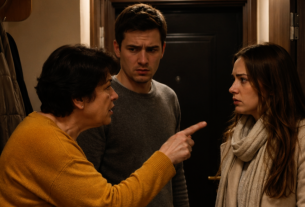
“Sasha, isn’t this a bit much?”
Nadya stood in the fitting room of a shopping mall, wearing a dark blue knee-length dress, gazing at herself in the mirror with her head pulled into her shoulders. The dress was simple, with thin straps and a slightly flared skirt. It suited her beautifully.
“I think it’s perfect,” Alexandra said. “Just straighten your shoulders. You look like you’re on the cover of a magazine in this dress.”
“Really?”
“Really.”
Nadya straightened her shoulders, took another look in the mirror, and suddenly smiled. It was an unsure, almost surprised smile.
“Dad would say it’s too short.”
“Dad doesn’t know anything about dresses,” Alexandra laughed. “Take this one. You’ll be the best-dressed at the graduation.”
Three weeks remained until ninth grade graduation. Alexandra and Gennady’s wedding was just a month and a half away.
At the checkout, Nadya asked Alexandra to hold the bag while she looked for her phone in her purse. On the escalator down to the parking lot, she said, “Thanks for coming with me. If I’d gone with Dad, we’d have spent two hours looking and bought nothing.” Alexandra thought then that everything would be okay. That they would manage.
She met Gennady three years ago at a mutual friend’s birthday party. He was tall, a bit stooped, already graying at the temples, with kind and tired eyes. He hardly spoke all evening, sitting in a corner with a plate of salad, but at the end he was suddenly next to her on the balcony—they’d both stepped outside for some fresh air.
He told her about his wife on their third date. Sveta had fallen seriously ill. By the time the illness was found, it was too late, and she passed away after six months. Nadya was eight years old at that time. For the last six months, Gennady lived between work, the hospital, and his daughter. After the funeral, he was left alone with his eight-year-old girl, who woke up crying every night.
«I promised her,» he said, looking out the cafe window. «Sveta. In her final days. That nobody would ever hurt Nadya. That I’d protect her no matter what.»
Alexandra took his hand then. It felt like the right thing to do. That this was exactly how a good father should act.
Their relationship moved slowly. Gennady didn’t rush. He only introduced her to his daughter after six months. At that point, Nadya was almost thirteen, quiet and wary. She watched Alexandra closely, from beneath her brows, answering in single words. But little by little, she thawed.
Alexandra never tried to become her mother. She understood that Nadya had a mother, and no one could replace her. She never asked Nadya to call her mom, didn’t push advice, didn’t demand anything. She was simply there. Went to the movies with them. Helped out with English homework when Gennady couldn’t. Taught them how to make pancakes. Went shopping with Nadya whenever she needed new clothes, while her dad just shrugged in confusion.
Nadya started inviting her for walks. She asked Alexandra for advice about a boy from another class. She was the one to ask for help picking out a dress for the graduation.
In three years, they hadn’t had a single argument.
They held the wedding in mid-June. It was modest: a civil ceremony, dinner at a small restaurant, about twenty guests. Nadya wore that same dark blue dress, her hair down. She looked beautiful—and so serious.
All evening, she barely smiled. She sat next to her father, holding his hand under the table. When Gennady went to dance with Alexandra, Nadya watched them intently, her face on the verge of tears.
Alexandra noticed. She thought, it’s okay—what a heavy day for the girl, her father is getting married, it’s understandable. She’ll get used to it.
After the wedding, Alexandra moved in with them, into Gennady’s three-bedroom apartment on Solnechnaya. She planned to rent out her studio in the neighboring district. The ad had been up for a week but no one had called yet.
On the second day after the wedding, Nadya stopped greeting her.
In the morning, Alexandra came into the kitchen and said, “Good morning.” Nadya was sitting at the table with her phone, not looking up. Alexandra assumed she hadn’t heard her, so she repeated it. Nadya stood up, took her mug, and left for her room without saying a word.
On the third day, Nadya left a pile of dirty dishes in the sink—her oatmeal bowl, the pan from her eggs, three mugs, some spoons. Before the wedding, it was always her habit to wash her own dishes—Gennady had taught her that.
Alexandra washed them. She didn’t say anything.
On the fourth day, Nadya walked into their bedroom without knocking at half past ten in the evening. Alexandra was in the middle of changing.
«Dad,» Nadya said, looking only at her father. «I need the laptop charger.»
«Nadya,» Alexandra said gently as she pulled on her t-shirt, «please knock. We’re still…»
Nadya glanced at her, her look cold and piercing.
«This is my apartment, actually. I’ve lived here my whole life.»
She grabbed the charger from the table and left, slamming the door behind her.
The next morning, at breakfast, Gennady said to Alexandra:
«Nadya says you kicked her out of the bedroom. Don’t do that. She’s having a tough time as it is.»
«Gena, I didn’t kick her out. I just asked her to knock. I was changing.»
«Well, she’s just a child. She’s fifteen. Everything feels sharper to her right now. Just don’t be too hard on her, okay?»
On the fifth night, just before three in the morning, Nadya knocked on their bedroom door. It was quiet but persistent.
«Dad. Dad, I feel bad.»
Gennady jumped out of bed as if stung.
«What? What’s wrong?»
«My stomach hurts. And I’m scared. Can you sit with me?»
Gennady left. He came back two hours later, at five in the morning, and immediately fell asleep.
The following night, it happened again. But this time Nadya wasn’t feeling unwell—she’d had a nightmare. Gennady stayed with her again until morning.
Alexandra lay alone in the dark, staring at the ceiling. She understood what was happening. You didn’t have to be a psychologist to see it.
Nadya was scared. A girl who lost her mom at eight and had only her dad since then was now terrified of losing him too. Before the wedding, Alexandra was just a guest. She’d come and go, go to the movies with them. But now she was here to stay. She slept in the room where mom used to sleep. She cooked with mom’s pots. Her makeup sat on mom’s bathroom shelf. And it seemed Nadya had decided her dad would now choose his new wife. That she, Nadya, would no longer belong.
That’s why Alexandra tried not to react. She didn’t respond to the coldness, she didn’t complain to her husband, and she didn’t make any remarks. She washed the dishes. She would knock on Nadya’s door, even though Nadya never knocked before coming into her bedroom. She said ‘good morning,’ even if there was no reply.
A couple of times, she tried to talk to Gennady.
«Gena,» she said on the fifth evening, after Nadya had gone to her friend’s house. «I think Nadya is scared. She’s afraid that you love her less now. Because of me.»
«Why do you think that?»
«Well, just look at how she’s acting. The late-night visits to you. The dirty dishes. She’s testing whose side you’re on. Maybe you should talk to her? Spend some time together, just you and her. Go somewhere. Let her know that nothing has changed, that she’s still your number one. She really needs that right now.»
Gennady frowned.
«Are you saying I’m a bad father?»
«No, Gena. I’m saying she needs some reassurance.»
«She already has reassurance. I’m always on her side. Always.» His voice turned hard. «And I don’t understand why you’re discussing her behind her back. Do you have something against her?»
«I have nothing against her. I’m just trying to help.»
«Don’t help. I’ll handle things with my daughter myself.»
«With my daughter.» Alexandra fell silent.
Every time she tried to talk about Nadya, Gennady didn’t hear her request or advice—he heard an attack. As if his wife wanted to take his daughter away or hurt her. As if he was defending Nadya, not from her own fears, but from Alexandra herself.
On the sixth day after the wedding, Alexandra discovered her locket was missing.
It had been in a jewelry box on her vanity table. Silver, oval-shaped, on a thin chain, with tiny flowers engraved on the lid. Inside was a photo of her grandfather as a young man in military uniform. Her grandmother had worn the locket her whole life, never taking it off. Shortly before her grandmother passed away, she took off the locket and placed it in Alexandra’s hand.
«Keep it with you, Sashenka,» she had said. «Let Grandpa protect you too, like he always protected me.»
The locket was probably only worth a couple thousand rubles. The silver was old, a bit worn out. But for Alexandra, it was more precious than anything else she owned.
The jewelry box was still there. But the locket was gone.
Alexandra searched the entire bedroom. Under the bed, behind the vanity, in the pockets of her clothes. Nothing. Then she went to Nadya’s room and knocked.
«Nadya, can I come in?»
Nadya didn’t open the door right away. She stood in the doorway with her phone in hand, looking guarded.
«What?»
«Nadya, did you happen to see my locket? Silver, oval. It was in the jewelry box.»
Nadya averted her eyes. Her face turned red.
«Well… I borrowed it. Yesterday. For Katya’s party. It was pretty, and it matched my dress.»
«So where is it now?»
«I don’t know.» Nadya stared at the floor. «The chain must have broken or something. I came home and it was gone. I thought it would turn up.»
Alexandra stood silently in Nadya’s doorway.
It hurt deeply inside. The locket with her grandfather. Her grandmother’s hand. ‘Let Grandpa protect you.’ Lost at someone’s party, probably lying on the floor of a stranger’s apartment, in the carpet, in a car, somewhere outside.
She didn’t yell. She didn’t argue. She took a deep breath.
«Nadya,» she said calmly. «Listen to me. I’m not angry, really. But you can’t just take other people’s things without permission—especially something like this. My grandmother gave me this locket in her last days. There’s a picture of my grandfather inside. He means more to me than anything else in the world. If you had asked, maybe I would’ve let you borrow it for the evening. But you didn’t ask.»
«It’s just some trinket,» Nadya muttered.
«It’s not just a trinket, Nadya. Not to me.»
Nadya looked up at her, eyes brimming with tears. Then she burst out crying—loudly, uncontrollably—and ran past Alexandra into the hallway.
«Daaaad!»
Gennady was in the kitchen. Nadya rushed in and buried her face in his chest.
«She… she yelled at me! Over some stupid trinket! Over an old piece of junk! She humiliated me! She said I was a thief!»
«I never said that,» Alexandra said as she walked into the kitchen. «Gena, I was just trying to explain…»
«Enough,» Gennady cut her off.
He stroked his daughter’s head and looked at Alexandra over Nadya’s hair. The look in his eyes was heavy, distant.
He didn’t ask what happened. He didn’t ask about the locket. He didn’t ask why, for the first time in six days, his wife had scolded his daughter. He only saw one thing: Nadya was crying. And to him, that was all the proof he needed.
«Come on, Nadya,» he said, and led his daughter to her room.
Alexandra stayed alone in the kitchen.
Gennady spent the entire evening with Nadya. He didn’t come to the bedroom that night. The next morning, he left for work without saying a word to Alexandra.
In the evening, he came back. He walked past her in the hallway without looking. He opened the built-in closet in the corridor, where her things were kept on the top shelf: her travel bag, a box with her winter boots, and the big gray rolling suitcase she had brought with her six days ago.
Gennady took out the suitcase and set it down in the middle of the hallway.
Then he turned to her.
«If you can’t get along with my daughter, there’s no place for you here,» he said evenly, without raising his voice. «Take your suitcase and go.»
Alexandra looked at her husband. He stood in the hallway, still wearing his work shirt, his briefcase in hand. He spoke calmly and matter-of-factly, as if telling her about a broken faucet: unpleasant, but fixable.
That calmness was what shocked her the most. Not shouting, not a fight, not slamming doors. He wasn’t even angry. He had simply made a decision and stated it.
Three years. They’d been together for three years. She knew his habits, his jokes, his nightmares about the hospital where Sveta had passed. She held his hand when he talked about his wife. She taught Nadya how to make pancakes. She went dress shopping with her. A week ago, she put a ring on his finger at the registry office. A week ago, he danced with her and whispered in her ear, «You are my happiness.»
And none of that meant anything. Not three years, not the wedding, not the ring. Her place in this family depended on whether Nadya was happy. If Nadya was content—Alexandra could stay. If Nadya cried—the suitcase went into the hallway.
«Gena,» Alexandra said quietly. «You didn’t even ask me what happened.»
«What’s the point? Nadya told me everything.»
«Nadya said I called her a thief. I never said that.»
«Are you trying to say my daughter is lying?»
Alexandra gave him a long look. Then she quietly walked to the bedroom.
She packed her things quickly. She hadn’t really unpacked over the past week anyway. Clothes, makeup, laptop, documents. She even took the empty jewelry box from the dressing table.
When she came out into the hallway with her bags, Gennady was still standing in the same spot. Nadya’s door was slightly ajar. Through the gap, Alexandra could see a bit of the room, the edge of the bed. But Nadya herself wasn’t visible.
“The keys are on the nightstand,” Alexandra said.
He nodded.
She didn’t ask him to reconsider. She didn’t cry. She didn’t ask, “Why?” She simply opened the door, rolled her suitcase out onto the landing, and called the elevator.
A studio apartment in the neighboring district greeted her with the smell of dust and silence. The ad for renting it was still up: no one had called all week. Alexandra rented it that very evening.
She sat down on the couch, still in her coat, and stayed like that for a long time. Eventually, for the first time that day, she broke down and cried.
Gennady called four days later.
“Sasha,” he said. His voice was calm, almost casual. “Let’s talk.”
“Okay.”
“I’ve been thinking. Maybe I overreacted. Come back.”
Alexandra was silent.
“But let’s make an agreement,” he continued. “You don’t try to teach Nadya anything anymore. No criticism. No ‘knock,’ no ‘don’t touch.’ She’s a child, she’s been through trauma, she can’t handle it. You’ll just live with us, take care of the home, and that’s it. Deal?”
Alexandra listened to him and understood.
He didn’t apologize. He didn’t ask how she was. He didn’t mention the locket. He was calling to lay down his terms. She could come back, but only if she stayed silent. She would cook, clean, live in the apartment. Tolerate dirty dishes, midnight knocks on the door, cold stares—and never speak up. Just be the woman for the house and his daughter. Convenient, quiet, voiceless.
He didn’t want a wife. He didn’t want an equal, someone with her own boundaries, opinions, and feelings. He wanted a woman to fill the void left after Sveta. Someone to make soups, iron shirts, go shopping with Nadya. And under no circumstances ever say a word against his daughter.
“No, Gena,” she said.
“What do you mean, no?”
“I’m not coming back.”
A week later, she filed for divorce.
Gennady refused to file with her at the civil registry office. He must have thought she would come to her senses. She had to go through the courts instead. The judge gave them a month for reconciliation.
The whole time, Gennady kept calling and texting.
“Sasha, this is ridiculous. Are you serious? We’ve only been married two weeks! You’re going to destroy the family because of teenage jealousy? Nadya’s fifteen, she’ll calm down! Aren’t you a grown woman? Don’t you get it?”
“I get it, Gena.”
“Then come back!”
“No.”
“But why?! Is it because of Nadya?”
Alexandra thought for a long time about how to answer. Then she finally said:
“It’s not because of Nadya.”
That was true. Nadya had long since stopped being the main reason for her decision.
A fifteen-year-old girl who’d lost her mother at eight and was now terrified of losing her father too. Of course, she was jealous. Of course, she was testing boundaries. Of course, she took things without asking, left dishes, snuck to her father’s room at night. Of course, she cried and exaggerated. She was a child, frightened and jealous. Alexandra could understand that fear. It was even possible to feel sorry for her.
Gennady was forty-three. A grown man, a father, a husband. He chose to get married, put the ring on her finger himself, danced with her at their wedding. But at the very first conflict, on the sixth day of their marriage, he didn’t listen to his wife, didn’t ask what happened, didn’t try to understand. He didn’t even make an effort to talk or defend their marriage. Instead, he simply placed his suitcase in the hallway.
He was the one who needed to take responsibility for his choice. Not fifteen-year-old Nadya.
For Alexandra, one time was enough to understand everything. She wasn’t about to wait for it to happen again.
At the end of July, a week before the court’s decision, Alexandra received a message from an unknown number.
“Hello. This is Nadya. I found the locket. It was in Katya’s car, under the seat. The chain broke, but the locket itself is fine. Can I bring it over?”
Alexandra stared at the screen for a long time before replying: “You can.”
Nadya came the next day, after lunch. She buzzed the intercom from downstairs, and Alexandra went down to meet her.
Nadya was standing by the bench in jeans and a hoodie, her hair down, clenching something in her fist. When she saw Alexandra, she reached out and opened her hand.
On her palm lay the locket. Silver, oval, engraved with flowers. The broken chain lay next to it, snapped in half.
“Here,” Nadya said, looking away. “I looked inside. That’s your grandpa, right?”
“Yes.”
“It’s beautiful.”
Alexandra took the locket and opened it. Her grandfather looked back at her from a yellowed photograph—young, in uniform, with a determined chin. He was intact, not a scratch on him.
“Thank you, Nadya.”
Nadya shifted from foot to foot.
“I…,” she hesitated. “I lied to Dad back then. Told him you called me a thief. But you didn’t.”
“I know.”
“I’m sorry.”
Alexandra closed the locket and squeezed it in her hand.
“Nadya,” she said. “The divorce isn’t because of you. About the locket, and telling your dad something untrue—you know what happened and understand why. But what he did, that was his choice. It’s not your fault.”
Nadya looked up at her with surprised, teary eyes.
“But Dad says it’s all my fault.”
“It’s not because of you,” Alexandra said. “It’s because of your dad. Tell him that someday, when you’re older.”
Nadya didn’t answer. She stood there a moment longer, nodded, turned, and started walking toward the bus stop. Halfway there, she glanced back and awkwardly waved.
A week later, the court granted their divorce. Gennady didn’t show up for the final hearing. His absence didn’t stop the divorce from being finalized.
That evening, Alexandra went to a small jewelry shop by the metro. The elderly jeweler peered at the locket under a lamp for a long time, then said it would be better to replace the chain rather than fix it: the old one was worn in several places and would break again.
He made a new chain in just twenty minutes. Silver, with a sturdy weave.
At home, Alexandra put on the locket, standing in front of the hallway mirror in her studio. She fastened the clasp, adjusted it to hang straight, then opened the cover and looked at her grandfather.
“There you go,” she said to him out loud. “You really did keep me safe.”
She closed the locket, tucked it under her sweater collar, and went to the kitchen to put the kettle on.