«Anna Mikhailovna, I beg you, at least let me organize the forty-day memorial!» Lyudmila clasped her hands to her chest, struggling to steady her trembling voice. «Petya has been gone just a month… I haven’t even had time to come to terms with it yet.»
«You haven’t had time, you say!» her mother-in-law slammed her teacup onto the table so hard the tea splashed onto the tablecloth. «And what about the fact that I’m left all alone in my little apartment? That my arthritis is acting up, my blood pressure’s all over the place? My only son is in the ground, and here you are lounging in his apartment!»
Lyudmila turned to the window, holding back tears. May had been warm this year, the lilacs beneath the windows had already bloomed and scattered purple petals over the pavement. Petya had loved this season… They used to walk in the park when the lilacs blossomed, taking photos together. Now he was gone. Forty-five—was that any age for a man? Such a stupid, pointless accident. In a single moment, life split into «before» and «after.»
«Anna Mikhailovna, this apartment is registered under both our names,» Lyudmila said quietly, not turning around. «Petya insisted when we got married. It’s not just your share that counts here.»
«Share!» her mother-in-law scoffed. «And who paid the first down payment? Who paid for the renovations? Do you think I don’t know how you two lived? Pashka got by on an engineer’s pennies, and you with your side jobs… Without my help, you’d still be squeezed into a dormitory!»
Lyudmila finally turned around, meeting her mother-in-law’s gaze head-on. Anna Mikhailovna was nearly seventy, but she held herself upright, spoke sharply, her eyes were piercing. A strong-willed woman, used to having her opinions respected—especially by her son, quiet, yielding Petya, who had never dared contradict his mother.
«I’m grateful for your help,» Lyudmila replied, her voice restrained. «But Petya and I paid off the mortgage for ten years, we both worked. I also put in my share for this apartment—with both money and effort.»
«And for what?» her mother-in-law pursed her lips. «Twelve years together, and you didn’t even have kids. You’re not a woman, just a barren flower. My Petya wanted a son, wanted to give me a grandson… But you always made excuses—too soon, not enough money, focusing on your career. Well, you built your career, and now you’re left alone.»
Those words hurt the most. Lyudmila clenched her fists so tightly her nails dug into her palms. Her mother-in-law didn’t know, could never know, how many tears had been shed over the inability to have children. Petya had never told his mother about their visits to doctors, the failed attempts, the diagnosis. He wanted to spare her nerves. And he’d asked Lyudmila to say nothing.
«I didn’t have the chance to have a child,» she said quietly. «Petya and I went through it together. We accepted it. We were getting our documents ready for adoption…»
«You’re lying!» her mother-in-law cut her off. «Petya never said a word about adoption! You’re just making things up to soften me. It won’t work!»
Anna Mikhailovna slowly got up from her chair, leaning on her cane—the past years her knees had become unreliable—and headed for the door.
«I’m giving you a week to pack,» she tossed over her shoulder. «After that, I’ll come back with a lawyer. I need this apartment more—you can’t do much with my pension, and at least you still have a job.»
As the door closed behind her mother-in-law, Lyudmila finally let herself break down. She collapsed into the armchair, covered her face with her hands, and her shoulders shook with sobs. How could life be this unfair? First, she lost Petya, and now they want to take away the home they built and cherished together. Every corner of this place held memories of her husband—his books lined the shelves, his collection of model ships sat quietly, and his old chair by the window was right where he used to read in the evenings…
A phone call interrupted her bitter thoughts. NINA—the name of her friend from their university days—flashed on the screen.
«Lyuda? How are you?» Nina’s voice was full of concern. «I’ve called you three times already. Are you okay?»
«No,» Lyudmila answered honestly. «I’m really not okay, Nina.»
«What happened? Is it Anna Mikhailovna again?»
«Yes,» Lyudmila choked out. «She just came over. Told me I have to move out of the apartment. Gave me a week to pack my things.»
«My pension was used to support you, now give the apartment back,» her mother-in-law demanded from the widow.
«She’s lost her mind!» Nina exclaimed. «That apartment was yours and Petya’s! Legally, half of it belongs to you!»
«I know,» Lyudmila wiped the tears from her face. «But she thinks she has more of a right to it. She says she helped us with money, that her pension was supporting me…»
«That’s nonsense!» Nina scoffed. «Petya made good money these last years. And you’re not earning peanuts at your ad agency either. Since when were you living off her pension?»
Lyudmila sighed. She didn’t want to explain the complicated relationship with her mother-in-law to her friend. Petya really did help his mother—buying her medicine, groceries, clothes. But his mother had also helped them—she sent money for their first mortgage payment when they got married and helped out a few more times when Petya had trouble at work.
«It’s more complicated than it looks, Nina,» Lyudmila finally said. «We did get help from her, but Petya was always helping her too.»
«Listen,» Nina’s voice took on a businesslike tone, «you need a lawyer. Right now. I know someone good—he specializes in housing disputes. I can set up a meeting for you.»
«I don’t know, Nina…» Lyudmila hesitated. «Taking my mother-in-law to court… Petya would never have approved.»
«Petya is gone, Lyuda,» her friend said gently but firmly. «And you have to go on with your life. Forgive me for saying it, but you can’t end up homeless because of Anna Mikhailovna’s old grudges and claims. Petya would want you to be protected.»
After her conversation with Nina, Lyudmila sat by the window for a long time, watching the courtyard fall asleep. Her thoughts raced, her head aching from crying and stress. Maybe she really should talk to a lawyer? But it just felt wrong—taking her late husband’s mother to court, especially so soon after his passing. On the other hand, where would she go? Her parents were long gone, and besides this apartment, she had no home of her own. Renting a place on a designer’s salary wouldn’t be easy, especially now when the ad market has slowed and there are fewer commissions.
continued in the comments
A New Day, A New Decision
The morning brought clarity. Lyudmila woke up feeling determined. She decided she wouldn’t take her mother-in-law to court. But she also wasn’t going to just hand over the apartment. It was time to talk—honestly, calmly, without shouting or blaming. She needed to explain the situation and offer a compromise.
Lyudmila dialed Anna Mikhailovna’s number and listened to the long rings. Finally, her mother-in-law answered, her voice wary.
«Anna Mikhailovna, we need to talk,» Lyudmila said firmly. «Calmly, like adults. May I come see you today?»
«Come then,» her mother-in-law replied after a pause. «But no lawyers or your girlfriends. Family business should stay in the family.»
Anna Mikhailovna’s apartment was in an old five-story building on the edge of the city. A small one-bedroom with a view of the industrial zone. Petya, her son, had often suggested she move in with them to the new district, but she refused—she didn’t want to abandon her garden plot, six hundred square meters in the gardening collective nearby.
Anna Mikhailovna opened the door and gave her daughter-in-law a sharp, searching look.
«Come in,» she said curtly. «Would you like some tea?»
«Yes, thank you,» Lyudmila replied, taking off her shoes and heading to the kitchen.
Nothing had changed since she last visited—those same faded curtains, the same plastic tablecloth, the same photos on the walls. Petya in his school uniform, Petya in the army, Petya fishing with his father… The father had passed away when their son was fifteen. Since then, Anna Mikhailovna had lived only for him, breathed for him, dreamed of his happiness. And then Lyudmila came along—who in her mother-in-law’s eyes was never good enough for her son.
«Well, speak,» Anna Mikhailovna put the cups on the table and sat down heavily. «What brings you here?»
Lyudmila took a deep breath.
«Anna Mikhailovna, I understand your pain. Petya meant everything to you. But he meant everything to me, too. We were a family for twelve years. I can’t just walk away from our home.»
«My pension went to support you,» her mother-in-law said sharply. «Every month I gave Petya money—for the mortgage, for repairs. Now hand over the apartment. I have the right to live there.»
«You have your own apartment,» Lyudmila replied softly. «I don’t have anywhere else to live.»
«You have a job, you’re still young,» Anna Mikhailovna pressed her lips together. «You can rent a place, or get a mortgage. Where am I supposed to go at my age? Rent? With my bad legs and high blood pressure?»
«I’m not suggesting you rent,» Lyudmila shook her head. «I’m suggesting a compromise. Let’s live together, in the apartment Petya and I shared. It has two rooms, there’s enough space for both of us. And this apartment can be rented out—for extra income for both you and me.»
Her mother-in-law eyed her with suspicion.
«Live together? You and me?» she smirked. «Don’t be ridiculous. I know you—you wouldn’t last a month living with me under one roof. You’d run off.»
«I won’t run off,» Lyudmila said firmly. «For Petya’s memory, for you—I won’t run. Let’s try, at least. We can see how it goes.»
Anna Mikhailovna stared thoughtfully out the window, tapping her fingers on the table. The wrinkles on her face looked deeper than usual, and shadows lingered under her eyes. She was suffering too, spending sleepless nights mourning her son.
“Why would you do this?” she suddenly asked. “Live with a grumpy old woman? You’re thirty-five, you have your whole life ahead of you. You’ll get married again.”
“I don’t want to get married,” Lyudmila replied quietly. “And I’m not thinking about that right now. You… you are part of my family, Anna Mikhailovna. The only one I have left. Petya would have wanted us to take care of each other.”
Something flickered across her mother-in-law’s face—maybe surprise, maybe gratitude.
“But can we get along?” she asked, her tone now softer. “I know how you used to talk about my habits. Petya told me everything.”
Lyudmila blushed. It was true, she had sometimes complained to her husband about his mother—her bossiness, the constant phone calls and checking up, the household advice and criticism. She never thought he’d repeat those talks to his mother.
“We’ll do our best,” she said after a pause. “For Petya. He would have wanted that.”
“Petya wanted grandchildren,” Anna Mikhailovna suddenly said, her voice trembling. “A boy. He said he’d name him after his father—Nikolai.”
Lyudmila felt a lump in her throat. Petya had never told her that. He’d protected her feelings, knowing about her diagnosis.
“I couldn’t have children,” she said softly. “I have… problems. We found out during our third year of marriage. Petya didn’t want to tell you, he wanted to spare your nerves.”
“I know,” her mother-in-law said unexpectedly. “Petya told me. When we had already decided to submit the adoption papers.”
“He told you?” Lyudmila looked at her, confused. “But then why…”
“Why did I call you barren?” Anna Mikhailovna gave a bitter smile. “Out of pain, silly. Out of grief. I buried my son, never saw grandkids. That’s why I take it out on everyone. It’s just who I am—you know that.”
They fell silent. Outside, rain began to fall—a warm May rain, carrying the scent of lilacs and fresh greenery. Somewhere far off, thunder rumbled.
“We should close the window,” Anna Mikhailovna muttered, slowly getting to her feet.
“Sit, I’ll close it,” Lyudmila rushed over to the window.
After shutting the casement, she turned and saw her mother-in-law crying silently, her face covered by wrinkled hands, shoulders shaking.
“Anna Mikhailovna,” Lyudmila knelt in front of her and gently took her hands. “Please don’t. Petya wouldn’t want you to cry.”
“I know,” her mother-in-law whispered. “He always said, ‘Mom, don’t get so upset, take care of your heart.’ But how can I not? How do you live after losing your son?”
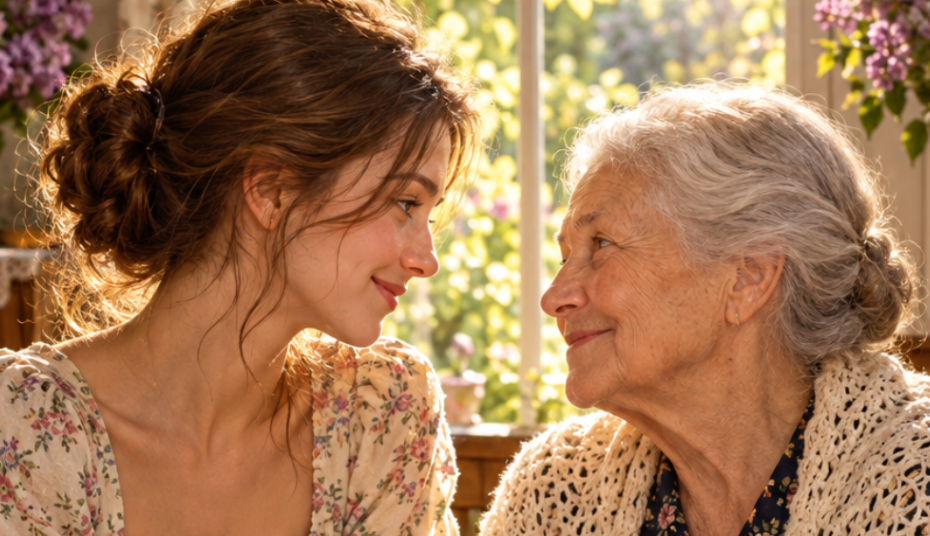
Lyudmila silently hugged her, pressing the gray head to her shoulder. That’s how they sat—two women who had lost the most precious person in their lives, brought together by shared grief.
“Alright,” Anna Mikhailovna finally said, pulling away and wiping her tears. “We’ll try, like you said. We’ll live together. But remember: I wake up early and watch TV loudly. And I soak in the bath for a long time—the joints need warming.”
“And I work late and sometimes go to the kitchen at night for tea,” Lyudmila smiled through her tears. “But we’ll manage.”
“We’ll manage,” her mother-in-law nodded. “We have no other choice.”
A New Beginning for Anna and Lyudmila
The following week, Anna Mikhailovna moved into her son and daughter-in-law’s apartment. Lyudmila gave her the small room they had once planned to turn into a nursery with Petya. It used to be her husband’s study, but Lyudmila moved his things into the bedroom—it was easier for her to hold onto memories of him that way.
At first, it was tough. The two women had to get used to living together, learning to respect each other’s boundaries and share the space. There were arguments, tears, and mutual accusations. But there was also something else—shared dinners, heartfelt conversations about Petya, and reminiscing over cherished happy moments.
Slowly, the ice between them began to melt. Lyudmila noticed one evening that her mother-in-law had baked her favorite cabbage pie for dinner. Anna Mikhailovna appreciated how her daughter-in-law had set up her room—new curtains hung at the window, and a comfy chair was brought in for her sore legs.
One evening, as they drank tea together in the kitchen, Anna Mikhailovna suddenly said:
“You know, I’ve always been a little envious of you.”
“Of me?” Lyudmila asked in surprise. “What could you possibly envy?”
“Petya loved you so much,” her mother-in-law replied simply. “Like he never loved anyone before. All those girls before you—they were fleeting passions. But you… you became his whole world.”
Lyudmila felt tears well up in her eyes.
“I loved him very much too,” she said softly. “And I miss him every single day.”
“I know,” Anna Mikhailovna nodded. “I see how you look at his photograph. How carefully you keep his things.”
They fell silent again, but it was a warm silence this time—the kind shared by two people who truly understand each other.
Then Anna Mikhailovna suddenly said, “You know, I’ve been thinking. About the adoption. Maybe you should go ahead with it?”
Lyudmila froze, her cup in her hand.
“Are you serious?”
“Why not?” Anna Mikhailovna stubbornly lifted her chin. “Petya wanted it. You wanted it. And me… I need grandchildren. Someone’s got to eat my pies when you’re at work.”
Lyudmila laughed through her tears.
“Can you imagine how much paperwork we’d have to gather? How many checks we’d have to go through?”
“We can handle it,” Anna Mikhailovna declared confidently. “Together. I spent my whole life working in social services—I know all the ins and outs. And you’re young, full of energy. We’ve got this.”
And suddenly Lyudmila realized they really could do it. That life hadn’t ended with Petya’s death. That it was possible to move forward—just differently than planned. That sometimes, the most unexpected support comes from the person you least expected.
A year later, a new member joined their household—a three-year-old boy named Kolya, a funny little guy with serious eyes and unruly hair. He settled in quickly, soon calling Lyudmila “Mom” and Anna Mikhailovna “Grandma Anya.” The old woman bloomed, looking ten years younger. She got up at night when the boy cried, read him bedtime stories, and made him pancakes.
And in Kolya’s room, in the most prominent spot, stood a photo of Petya—so the little boy would know what his father looked like. The father who had wanted a son so much, and who would have loved him with all his heart if he were still here.
My dear readers! The story of Lyudmila and Anna Mikhailovna shows us that even in the toughest times, it’s possible to find common ground if we focus on what unites us, not what sets us apart. Grief can bring people closer together, and love for someone who is no longer with us can give us the strength to keep moving forward.