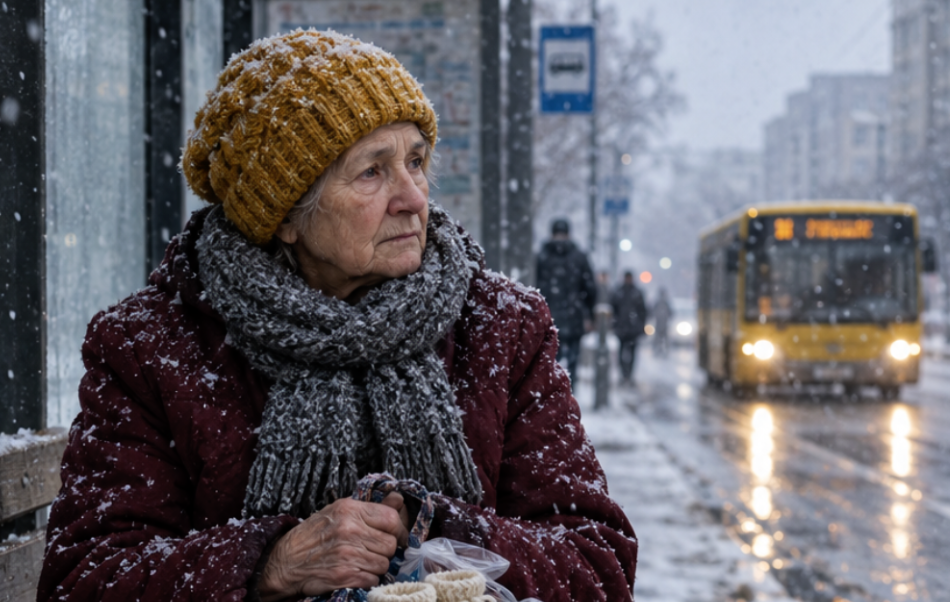
The third number nine bus passed by the stop in an hour, and Iryna Hryhoriyivna thought she now knew this route better than the drivers themselves.
«If I sit here much longer, they’ll hire me as a dispatcher,» she muttered and hugged her bag even tighter to her lap.
Inside her bag were three dozen homemade eggs wrapped in newspaper, poppy seed and cabbage pastries, and a pair of white wool booties she’d been knitting all October. The rest of her bags had gone in the trunk. She wasn’t about to let her grandson take this one from her.
Wet snow had started falling since midday—not the kind that settles like a white blanket, but the kind that melts in the air and finds its way down your collar. Even through her coat, the bench under the shelter was cold, so Iryna Hryhoriyivna slipped a plastic bag under herself—the one she always carried in her pocket ‘just in case.’ And today—just in case had finally come.
Her grandson had promised to be back in ten minutes.
Almost two hours had passed.
* * *
Yet the day had started out so well.
She’d woken up at half past four, even though her alarm was set for five. She just couldn’t sleep. The night before, she stayed up late baking, packing, carefully wrapping jars in towels so they wouldn’t clink. A three-liter jar of pickled cabbage with carrots, bacon just like Vlad likes—with a good streak—homemade cheese, raspberry jam, and a linen bag of dried mushrooms.
Her neighbor, Vira Ostapivna, saw the heap of bags by the gate and gasped in surprise:
«Ira, are you going to see your grandson or heading to the market to sell something?»
«To see my great-grandson,» Iryna Hryhoriyivna corrected her with pride. «Tymofii is already a month old, and I’ve only seen him on the phone. I want to hold him while he’s still tiny and smells like milk.»
Vlad’s mother had been working abroad for eight years, so Iryna Hryhoriyivna saw her grandkids almost as her own children. Vlad spent every summer with her: biking to the pond, carrying frogs in his pockets, and crying every August when it was time to go back to the city. Yulia, the younger one, would follow him everywhere and was always the first to scold him if he got into trouble.
It took two and a half hours by train with a transfer. During the whole ride, Iryna Hryhoriyivna gazed out the window at bare groves, black fields, and smoke rising above chimneys, thinking how Vlad must have changed. After all, he was a father now.
And he really had changed. When she arrived at the regional center’s platform, she hardly recognized her grandson in this unshaven, tired-looking young man glued to his phone.
«Grandma!» He put away his phone, gave her a hug, and scooped up her bags. «Did you bring the whole village with you?»
«Not the whole thing. I left the beets at home—I couldn’t carry it all!»
He laughed, and for a moment she saw the same freckled-faced little Vladik she’d always known.
But then his phone rang again in the car. Vlad listened, nodded, and his face grew more and more tense with each minute.
«Yes, Oleg Viktorovych. I understand. I’ll be right there.»
He put down the phone and glanced apologetically at his grandma.
«Grandma, there’s a problem at work… The system that runs the warehouse is down. I just need to stop by the office for ten minutes and check it out. It’s almost on our way.»
«Go on, of course. Work is work.»
The office was behind a barrier, in the yard of a former factory, and security didn’t let outsiders in. Vlad slowed to a stop by the sidewalk, just a few steps away from the bus stop.
“Sit here under the awning, okay? If you sit in the car without the engine running, you’ll be freezing in five minutes, but here at least there’s a bench. I’ll just be a minute.”
“And the bags?”
“They’ll be fine in the trunk.”
“I’m not trusting you with the eggs,” Irina Hryhorivna shot back, grabbing the most precious bag from the back seat. “You used to break at least one every time you carried them from the chicken coop when you were little.”
Vlad smiled, waved, and the car disappeared behind the barrier.
* * *
For the first half hour, Irina Hryhorivna waited patiently. She watched people go by. A girl in white sneakers hopped over puddles, almost making it each time but not quite. A man with a pom-pom hat was talking on his phone so seriously that the old lady couldn’t help but smile: the pom-pom bounced with every word he spoke.
After that, she called Vlad. It just rang and rang. She tried again. Still just ringing.
«He’s busy,» she decided. «Let him work. I’m not a child, after all.»
After the first hour, she started counting buses. The boots she’d saved “for going out” weren’t as warm as she’d thought when she tried them on next to the stove at home, and Irina Hryhorivna stood shuffling her feet, almost as if she was dancing something very slow.
A boy about ten years old with a huge backpack sat down next to her. He sniffled and kept glancing at her bag, from which the smell of pastries was coming.
“Are you hungry?” Irina Hryhorivna asked him.
“No,” the boy said, swallowing hard.
“Go ahead, take one—I have too many anyway. Would you like one with poppy seeds or cabbage?”
“Can I have one with poppy seeds?”
The pastry was gone in four bites. The boy said, “Thank you, it was really tasty,” and jumped onto his bus. Irina Hryhorivna watched after him, thinking that Vlad used to eat the same way at that age: fast, a bit greedily, and always leaving crumbs on his chin.
Her phone rang when it was already getting dark. On the screen, it said “Yulechka” with a photo of her granddaughter sticking out her tongue. Yulia had bought this phone for her grandmother herself and set it all up: big letters, loud ringtone, and a picture for every contact so she wouldn’t get confused.
“Hi, Grandma! So, did you see Tymko? Who does he look like, Vlad or Katya? Be honest!”
“For now, Yulia, all I see is bus number nine. It doesn’t look like Vlad. At least the bus actually shows up.”
“What?” Yulia didn’t understand. “Where are you?”
Irina Hryhorivna explained. Calmly, even with a smile, as if it wasn’t about her. Yulia listened without a word, then let out a breath so hard it crackled through the phone.
“Two hours?! You’ve been out in the cold for two hours?!”
“I’m not standing, I’m sitting. On a plastic bag. I’m not silly, you know.”
“Grandma, this isn’t funny!”
“Well, I find it funny,” Irina Hryhorivna admitted honestly. “Yulia, don’t bother your brother. Something fell at his work, and he’s picking it up. Once he’s done, he’ll come get me.”
“I’m going to call him right now.”
“He’s not answering. I already tried.”
“Then I’ll text him! In all caps!”
Yulia hung up, and Irina Hryhorivna shook her head. Her granddaughter had always been like that: ready to defend her brother, but the first to scold him too.
Across from the bus stop, a small coffee kiosk glowed. Irina Hryhorivna had glanced at it a few times, but kept looking away: forty-five hryvnias for a paper cup seemed almost scandalous to her. At home, you could buy… well, there were plenty of things you could buy for that.
Suddenly, the kiosk door opened and a woman around fifty, bundled in a puffer jacket and a woolen headband, peeked out.
«Ma’am! You’ve been sitting there for so long, I can see you. Come here and warm up before you freeze to that bench.»
«I’m waiting for someone…»
«You can see the bus stop from here too. Come on inside, I insist.»
Inside the kiosk, it was cramped but cozy, warm, and smelled like cinnamon. The woman’s name was Larisa. She seated her guest on a box covered with cardboard, and without asking any questions, set a cup of something hot topped with a fluffy white foam in front of her.
«What is this?»
«Cappuccino.»
Iryna Hryhorivna took a careful sip, and a white mustache formed above her lip.
«I thought you poured me soap,» she admitted. «But it’s delicious. How much do I owe you?»
«Nothing. I just couldn’t stand watching you out there.»
Iryna Hryhorivna quietly opened her bag and placed four pastries on the counter.
«Let’s make a trade then. Two with poppy seeds, two with cabbage. No arguments.»
Larisa took a bite, closed her eyes and said she hadn’t tasted anything like that since her mother used to bake. Within twenty minutes, the two women knew more about each other than some neighbors do in twenty years. Larisa wrote down the dough recipe on the back of a receipt, and Iryna Hryhorivna learned Larisa also had a grandson, that he was «always busy,» and that cappuccino should be drunk before the foam disappears.
* * *
Vlad left the server room at half past six. The system was back up, the warehouses could see their invoices again, and Oleh Viktorovych even shook his hand. As Vlad walked the corridor, he could think of only one thing: he’d soon be home, have something to eat, and maybe get an hour in on his coursework while Tymko slept.
He pulled his phone out of his jacket pocket. The sound had been off since the morning’s meeting.
Fourteen missed calls from Yulia. Six from Grandma. And a message in big, capital letters:
«VLAD!!! WHERE IS GRANDMA??? YOU FORGOT HER AT THE BUS STOP!!!»
He stopped in the middle of the corridor. First he felt hot, then instantly cold, as if someone had dumped a bucket of water down his collar.
Grandma. He had forgotten about Grandma.
Vlad couldn’t remember how he ran down the stairs, rushed past the security guard, or got himself outside the barrier. The bus stop was empty. Wet snow was falling, the yellow glow of a streetlight, a bench with a neatly folded plastic bag on it.
Vlad’s knees almost buckled.
«Grandma!» he called out, looking around. «Grandma!»
And then laughter floated over from the kiosk across the street. Familiar, clear, a little hoarse from the cold. The kind of laugh Grandma had when Grandpa Mykola told her that same joke about the godfather and the goat for the fourth time.
Vlad yanked open the kiosk door. Iryna Hryhorivna was sitting on a box, cheeks rosy, holding a cup, and telling Larisa how once, at her friend’s wedding, the guests finished all the aspic before the bride and groom even arrived.
«Oh!» she exclaimed when she saw her grandson. «Larisa, meet him. This is the famous Vlad, who lost his grandma at the bus stop.»
«Grandma…» Vlad’s voice trembled. «Grandma, I’m so sorry. I don’t know how it happened. I sat down at the computer and everything slipped my mind. And you were out here in the cold for two hours… Please, grandma, forgive me.»
He stood in the doorway, tall, awkward, his hair wet from the snow, looking like he was about to cry. Iryna Hryhorivna set her cup aside.
‘Come on now, what’s with you? Look, we found Grandma. She’s safe and sound, all warmed up, and even got a fancy coffee with foam. Just wait till I tell folks in the village—they’ll never believe it.’
‘I didn’t mean to…’
‘I know you didn’t mean to. If you had, you’d have dropped me off at the other end of the city so I’d have to look even longer!’
Larisa stifled a laugh into her hand. Vlad smiled too, although his eyes were still wet.
As they said goodbye, Larisa tucked a little packet of cinnamon into Grandma’s pocket, and Iryna Hryhoriivna promised to bring her a recipe for beet and cabbage next time, ‘just like my mom used to make.’ They exchanged phone numbers. Vlad watched this and couldn’t understand how, after sitting outside in the cold for two hours, someone could make a new friend.
* * *
Vlad and Katya were renting a one-room apartment on the ninth floor. There was a stroller in the entryway, tiny baby pants drying on the radiators, and on the kitchen table, among bottles and a pack of diapers, an open laptop lay waiting.
Katya came out to meet them, little Tymko in her arms. She looked pale, wearing Vlad’s stretched-out sweater, her hair messily twisted up with a pencil.
‘Iryna Hryhoriivna, please forgive us,’ she began apologizing from the doorway. ‘Yulia called me, I couldn’t sit still here. Vlad hasn’t been himself lately…’
‘Oh hush, dear. Let me hold this little sunshine instead.’
Katya gently handed over the bundle wrapped in a blue blanket. Tymko squirmed, pouted, on the verge of tears. Iryna Hryhoriivna pulled him close, softly rocked him, and began to hum the same wordless tune she once sang to Vlad, and before that, to his mother.
A few minutes later, Tymko snuggled up and fell asleep.
Katya watched, as if witnessing a miracle.
‘He never falls asleep like that for us,’ she whispered. ‘We have to walk with him for two hours.’
‘That’s because you two worry and he feels it. But grandmas, we’re not afraid of anything anymore,’ Iryna Hryhoriivna winked. ‘Go lie down. I’ll stay here.’
‘But how can I…’
‘I said go. My legs still haven’t warmed up from the bus stop, so I need to sit anyway.’
Katya fell asleep the moment her head touched the pillow.
* * *
At one in the morning, Iryna Hryhoriivna went to the kitchen for a glass of water. Vlad was sitting there, his laptop open in front of him. Next to him was a mug of cold tea and a plate with a half-eaten pastry. His head was resting on his arm as he slept, the computer cursor blinking in the middle of an unfinished sentence.
She quietly sat down opposite him, looking at her grandson: the rounded shoulders, the stubble on his cheeks, the frown line between his brows that hadn’t been there last summer.
Vlad started and lifted his head.
‘Grandma? Why aren’t you asleep?’
‘Why aren’t you?’
He rubbed his face with his hands.
‘Writing my thesis. Finals in three weeks, and I’m only halfway done.’
He hesitated, then started talking quickly, as if he was afraid he wouldn’t get it all out. ‘Grandma, I wanted to explain all evening, but I didn’t know how. Two people got laid off at work, now I’m doing the job of three. They said they’d pay extra, but it’s barely anything. I’m studying part-time for my master’s, hoping it’ll help me find something better. Katya’s on maternity leave. Tymko doesn’t sleep at night, we take turns carrying him. In the evenings, I take on extra website work for people, otherwise there’s no way we’d make it to payday. Rent, diapers, formula… I can’t remember the last time I slept more than five hours.’
He lowered his eyes.
— Today, as I was sitting in that server room, the only thing on my mind was: make it on time, make it on time, make it on time. And I forgot about you. You, Grandma. The one who taught me how to tie my shoelaces.
His voice broke.
— I’m so ashamed that I can’t even look you in the eye.
Iryna Hryhoriyivna reached across the table and placed her hand over his—her hand rough and warm, still scented with Larysa’s cinnamon.
— Oh, my dear, it’s all right, — she said. — I’m not upset. You hear me? Not one bit. It turned into quite the adventure, now I’ll have something to tell the neighbors. Vira Ostapivna will be so jealous it didn’t happen to her.
Vlad managed a weak smile.
— But I do worry about you, — she continued more seriously. — Something has to change, Vladyk. Today you forgot about me, and who knows who you’ll forget next. Maybe Katya. Maybe even yourself. You can’t run on just willpower for long.
She paused for a moment. Then she said what she must have already decided back in the kiosk while drinking her first ever cappuccino.
— Let’s sell your grandpa’s motorcycle.
Vlad immediately sat up straight.
— The Jawa?
— The Jawa. It just sits in the garage doing nothing anyway. Grandpa loved it when he could still ride. Now it just sits under its cover, and every time I go in for potatoes I say ‘good day’ to it. Mykola’s been gone for six winters now, and it’s still waiting. I definitely won’t be riding it anymore.
Iryna Hryhoriyivna squinted at him mischievously.
— Although, between you and me, I took it for a spin a couple of times. Just around our yard, in circles, when Grandpa went to the market. He never found out.
— Grandma! — Vlad laughed for the first time all evening.
— What? I was young once too. And this way, you’ll have some money to get through these tough times. People who know about these things say you can get a good price for it. You’ll be able to buy what the little one needs. You can quit those night side jobs. Finish your term paper and finally get some proper sleep.
— No, — Vlad shook his head. — I can’t. It was Grandpa’s. Every spring he would take it apart and put it back together. He used to sit me on it as a kid in the garage, and I’d pretend to ride. I can’t take your money like that.
Iryna Hryhoriyivna looked at him long and hard—the same look she gave him as a child when he refused to eat his borscht.
— Vladyk. What do you think Grandpa would say if he saw you now? Sitting there, tired, at the computer at one in the morning?
Vlad stayed silent.
— He’d take that Jawa out of the garage himself and hand you the keys. And he’d scold us for not saying so sooner. A motorcycle is just metal. But I have only one grandson.
Vlad stared at his grandma’s hand resting on his for a long time. Then he nodded.
— All right. But only under one condition.
— Now you’re giving me conditions?
— Yes. From now on, I’m the one picking you up at the station and bringing you all the way to the front door. And my phone will be off the whole time.
— Deal, — Iryna Hryhoriyivna nodded. — But you also have to promise not to argue with your grandma anymore. Otherwise, next time I’ll forget you at the bus stop.
Vlad laughed so hard that Katya called out sleepily from the next room to check if everything was all right.
* * *
A young guy who restored old motorcycles bought the Jawa in December. Before loading it into his van, he walked around it for ages, stroked the tank, and kept saying, “what a find.” Iryna Hryhoriyivna served him tea with raspberry jam and made him promise to send a photo when the Jawa shines again.
He sent the photo in the spring. It was red and shiny, looking brand new, as if it had just come from the store. Iryna Hryhoriyivna showed it to all the neighbors, and Vlad made it his phone wallpaper.
That same December, he quit his night jobs, finished his exams, and finally got a good night’s sleep for the first time in half a year. For New Year’s, the three of them visited Grandma, and Tymko, now chubby-cheeked and curious about everything, reached out to his great-grandma as if he remembered who once put him to sleep in five minutes.
Now Iryna Hryhoriyivna and Larysa chat every Sunday. They exchange recipes and news about their grandchildren, who are “always busy.”
She kept telling the story about the bus stop for a long time. Each time it changed a bit: sometimes five buses passed by, sometimes seven, sometimes at the kiosk they gave her not a cappuccino, but something with a name you couldn’t even pronounce. Vira Ostapivna would listen, gasp, and start asking questions:
“And you didn’t get mad at him? Not even a little?”
“Why get mad?” Iryna Hryhoriyivna would shrug. “He forgot, so he forgot. What matters is that he remembered later. And not just about me.”