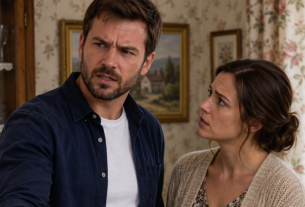
— Are you serious right now? You seriously mean what you’re telling me?
Vera didn’t even turn around. She was standing by the stove, stirring sauce in a small coffee pot, and watching last year’s leaves swirl around the yard outside the window in the wind. Her husband’s question hung heavily in the air, sticky and dense like the steam from boiling coffee.
— Vera!
— I heard you, Zhenya. And yes, I meant what I said. You don’t have to repeat yourself every thirty seconds.
Evgeny was standing in the middle of the kitchen, feet set apart like he was bracing for a fight. His worn-out home t-shirt stretched tight across his shoulders. He looked confused, even scared, and that lost, almost childlike expression—just a year ago—would have softened Vera, would have made her come closer, rest her hand on his chest and say, “Okay, let’s talk.” But not now. Now that face only filled her with a steady, deep exhaustion.
— You’re selling the car, — Zhenya said slowly, enunciating each syllable like he was explaining the obvious to a child. — Our car. Without asking me. Just acting like it’s a done deal. You really think that’s normal?
Vera finally turned around. She set the spoon down on its stand, wiped her hands with a kitchen towel, and looked her husband straight in the eye.
— Zhenya, I’m not selling “our” car. I’m selling the car I bought three years ago with my own money. I paid off the loan last month. The title is in my name. I told you because we live together, not because I need your permission.
— What difference does it make whose name is on it! — he threw up his hands in frustration. — We’re a family! Everything’s supposed to be shared! Or have you forgotten about that already?
Vera smirked. It was a bitter, crooked, almost mangled kind of smile.
— Shared, huh? And when you got that bonus at work last year and bought yourself a new laptop, did you ask me first? Or when you borrowed money from your mom to redo the garage? Did we discuss those things as a family? Because I sure don’t remember that.
Zhenya fell silent. The muscles in his jaw clenched. He was clearly searching for the right thing to say, but all he could summon was a raw, almost childlike resentment that his wife was suddenly refusing to make things easy for him.
This conversation didn’t start today. Or even yesterday. It had been brewing for years, like a sore that would subside for a while and then flare up again, but never quite heal. And that morning, over breakfast, Vera had just casually mentioned she’d found a buyer for her “Volkswagen”, and Zhenya had choked on his sandwich.
The event that became the trigger was almost laughably ordinary. No cheating scandals, no crime involved. Vera, an accountant at a construction company, decided it was time for a full renovation of their apartment—not just a touch-up, but a major overhaul. She had been saving for it for two years. In fact, that’s why she planned to sell the car—to free up the money without having to touch their main savings account. For the past five years, Vera had been working two jobs, handling freelance accounting in the evenings and on weekends, taking small firms as clients, and every penny in their home was hard-earned by her. Zhenya worked as a sales manager at a car dealership. A steady, but modest job. His salary covered the utility bills, groceries, and his personal wants: a new phone every year, winter tires for the very car Vera now wanted to sell, and regular nights out at the bar with friends. He had no savings. When Vera brought up the renovation, he was excited at first: «Finally! The bathroom tiles are falling off already.» But when he found out it meant selling the car, he froze. Not because the car was so essential to him, but the simple fact that she was making such decisions about their property without asking—it hurt his pride. And beneath that, deeper issues stirred: his mother and sister saw Vera as someone who owed them a share. If she was selling the car for the renovation, she clearly had plenty of money. And if they thought she had enough, why wasn’t she helping her husband’s family? Why not share the wealth?
Zhenya hadn’t brought this up yet. But Vera knew: he’d call his mother tonight, and tomorrow the drama would begin.
To really understand how Vera ended up in this situation, you have to rewind ten years. They met when she was twenty-six and he was twenty-eight. Vera had just bought out her apartment—a two-bedroom in a nine-story building on the outskirts of the city, given to her by the state as an orphan. Her parents had died in a car accident when she was twelve. The apartment started as public housing, then came privatization, then a string of long court cases, but by twenty-five, Vera finally owned those forty-six square meters. She renovated it herself, putting up wallpaper at night after work, priming the walls, lugging bags of plaster up to the fifth floor with no elevator. No one helped her. Her father’s sister, the only living relative and living somewhere in Novosibirsk, called once to congratulate her and then disappeared from her life. So, when Vera met Zhenya—easy-going, always smiling, with dimples on his cheeks and willing to hang a shelf for her—she thought: here it is, a real family. She was finally not alone anymore.
Zhenya moved in with her after six months. A year later, they got married. He introduced her to his family. Alina Sergeyevna, his future mother-in-law, lived in the next neighborhood over, in a three-room apartment that belonged to her late husband, with her daughter, Svetlana. Sveta was five years older than Zhenya, divorced twice, with two kids from different marriages, and absolutely convinced that the world owed her something. When visiting, Vera kept a low profile, tried to make a good impression, and brought a homemade cake. Alina Sergeyevna tasted the cake and gave her a compliment. But after Vera stepped into the bathroom, she overheard something through the thin door—words from Alina Sergeyevna to Zhenya:
“She’s got quite the grip on you, you know. Her own apartment, her own car, always working so hard. Careful she doesn’t start bossing you around. Girls like her, who come from nothing and work their way up, they end up getting a bit uppity.”
Back then, Vera just acted like she hadn’t heard a thing. She stayed silent—and kept that silence for ten whole years. She said nothing whenever her mother-in-law would gift her books about family happiness and feminine wisdom for every single holiday. She kept quiet when Svetlana would show up unannounced and start rummaging through her closets, gasping, “Oh Vera, where did you get this blouse? I bet you bought it at that boutique that never has any discounts?” She never said a word even when Alina Sergeevna organized family dinners and would pointedly seat Vera at the very end of the table, with Zhenya at the head right beside her. Vera put up with it, thinking, “Every family has their quirks. They’ll get used to me, they’ll appreciate me eventually.” She even always did her part to help—not because she had to, but because she truly believed that if they’re family to her husband, then they’re family to her, too.
She paid for Sveta’s massage courses when Sveta decided to try a new career—fifty thousand, without even blinking. A month later, Sveta quit, said it was boring and not for her. She never gave the money back or even mentioned it. When Alina Sergeevna’s washing machine broke, Vera bought her a new one—not expensive, but nice, just over twenty thousand. Her mother-in-law accepted the gift as if doing Vera a favor: “Well, you could’ve bought a pricier one, but thanks, I guess.” Every New Year, Vera would bring bags of groceries—caviar, red fish, good sausage, candies. Alina Sergeevna would lay it all out and comment, “Did you get this caviar at the supermarket? It’s fake there. Next time, buy it at the market, from people you trust.” Not once—not a single time in ten years—did Vera hear a simple “thank you.” Instead, every time, she got new advice and a hint of disdain.
About three years ago, Vera started her own business and began managing the accounting for several small firms. It was a monumental effort—office work by day, private clients in the evening, reports at night. She lost weight, looked exhausted, and her eye would twitch from constant lack of sleep. But finally, things started to work out. She began making real money. Vera bought a car so she could visit her clients, and furnished her apartment with solid, custom-made oak furniture—not that IKEA stuff. That’s when the family’s attitude changed for good. If before there was condescension, now it was thick, sticky, dark envy.
One day, Svetlana came over with her kids, saw the new kitchen set—light wood, stone countertop, perfectly matching range hood—and let out a long whistle.
“Whoa, Vera, what did you do, rob a bank? Or is Zhenya making that much money for you now?”
“Zhenya has nothing to do with it,” Vera replied calmly. “I work for myself, Sveta.”
“Oh, sure, sure…” Svetlana walked around the kitchen, ran her finger along the countertop. “That’s what happens when you don’t have kids. You can spend all your money on yourself.”
Vera stayed silent then. She clenched her teeth, managed a smile, and offered tea. But that night, she lay awake, staring at the ceiling, replaying those painful words in her mind — «don’t have your own kids.» It was the most hurtful blow she could have received, because Vera really couldn’t get pregnant. Doctors could never find anything wrong, but it just wouldn’t happen. Five years of trying, hormone therapy she saved for separately, crying into her pillow when Zhenya was asleep. And Zhenya… He never supported her. Not once. «Well, there aren’t, so what,» he’d say, flipping through TV channels. «Guess it’s just fate. Relax, don’t dwell on it.» He didn’t care. But she did. And Sveta knew it. She knew exactly where to strike and didn’t hesitate, didn’t even try to hide it.
Two days after that talk about selling the car, her husband’s family showed up for a visit. Vera wasn’t expecting them, but she wasn’t surprised either. She’d noticed a pattern: whenever she was about to make a decision at home, Alina Sergeevna and Svetlana appeared at the door, as if they could sense it. Zhenya probably called them and complained. And every time they came, it wasn’t to support her, but to «figure things out,» which really meant gentle, family-style pressure.
The three of them sat together in the living room. Alina Sergeevna lounged in an armchair like a queen. Svetlana curled up on the sofa. Zhenya paced near the window, pretending none of this involved him. Vera stepped into the room, poured tea, and set a dish of candies on the table. The conversation started off neutral: weather, health, Svetlana’s kids — as always, «bad grades in math, the teachers are fools, we need a tutor.» Then, as Alina Sergeevna stirred her tea, she smoothly shifted gears:
«Verochka, Zhenya told us you’re selling your car. I can’t believe how practical you are! How much are you asking?»
«Market price,» Vera replied, feeling the tension building inside her like a wound-up spring. «A good car, should go for about eight hundred thousand.»
«Eight hundred!» Svetlana exclaimed, throwing up her hands. «Wow! Listen, would you maybe… think about directing some of that money towards the family? You see, we’re in a bit of a tough spot right now. Kirusha has a knee problem and needs surgery. It’s a sports injury, not covered by standard insurance, only available privately. Two hundred thousand. I’ve tried everything… Zhenya says you guys have some extra funds. Would you be able to help?»
Vera slowly turned her gaze to her husband. He was staring at the floor, studying the carpet pattern as if it held the secrets of the universe.
«Zhenya,» she called softly. «Did you tell Sveta that we have extra money? What money, exactly?»
«Well…» he hesitated, scratching his head. «I just said you were selling the car for eight hundred. And that the renovation could be done for less. So the rest… why not? We’re family, after all.»
Vera laughed. The sound was dry, like sandpaper scraping.
«Zhenya, the renovation we planned costs six hundred thousand. I calculated it. We need new pipes, electrical work, the bathroom completely redone. That leaves two hundred. I want to set that aside as an emergency fund — because we don’t have one. Because you never save. What ‘extra money’? Do you even realize what you’re doing right now? You promised my money to your sister behind my back.»
«Why do you call it ‘your’ money right away?» Svetlana snapped. «You’re married—it’s shared money! Zhenya deserves a say!»
«Zhenya,» Vera turned to her husband, ignoring Svetlana, «do you really believe your nephew’s surgery is more important than repairing our house? The house where the bathroom pipe leaks so badly we’re flooding the neighbors below?»
Zhenya looked up. His eyes held real anguish—not from guilt, but from being forced to choose and give an answer.
«Lera, he’s a child. Don’t you get it? Kiryusha is suffering. The renovation can wait. The pipes haven’t burst yet. You’ve always been kind, always helped. What’s changed?»
That’s when something finally snapped inside Vera.
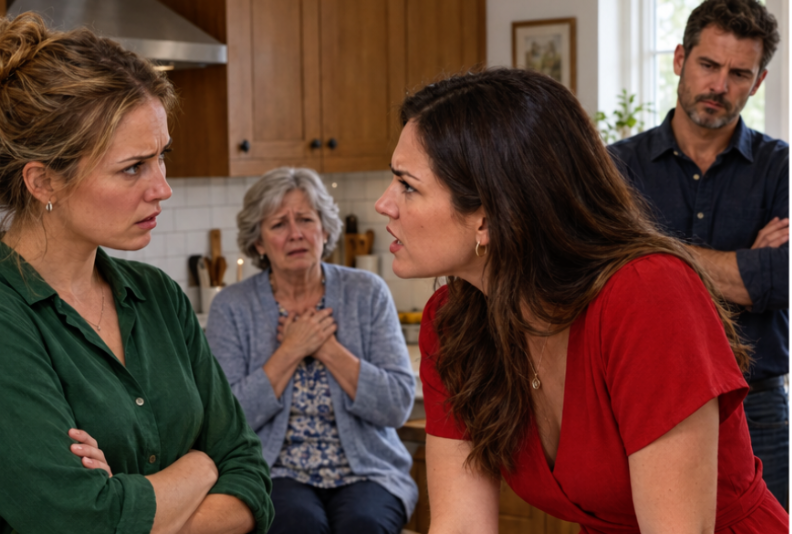
«What’s changed?» She stood up, her chair scraping loudly behind her. «You want to know what’s changed? Ten years, Zhenya. For ten years I’ve listened to your mother telling me how to live. For ten years your sister has come to my house, counting all my things. Ten years I’ve paid for your courses, your washing machines, your birthdays—and what do I hear back? ‘You could’ve bought something pricier.’ Ten years you’ve all sat on my shoulders, in my apartment, convinced that’s how it should be!»
Svetlana jumped up from the couch.
«Oh, so that’s how you talk now! Sitting on your shoulders! So we’re leeches and you’re the queen, is that it?! You, a rootless orphan, got a free apartment and now think you’re something special! Think we don’t know how you bully Zhenka? Don’t think he doesn’t tell us? You’re always dissatisfied, nothing is ever good enough, we always owe you!»
«Shut up, Sveta!» Vera stepped forward, her eyes blazing with dry, unshed anger. «Don’t tell me about my apartment. Your mother got her three rooms from her husband and feeds you and your two kids. In ten years you haven’t held down a steady job a single day. You live on child support and your mom’s pension. What right do you have to judge me? What right?!»
Alina Sergeyevna slowly rose from her armchair. Her voice trembled—not from weakness, but from rage.
«I knew it. I’ve known from day one. You’re not one of us. A commoner. No matter how much you feed a wolf, it’ll turn on you anyway. I told Zhenya not to marry you, that you were only thinking about yourself, that you’d devour him. And just look. Now, you’ve got your ‘money’! Who are you to have money? You crawled out of an alley, and we’re a respectable family! My late husband, Zhenya’s father, was an engineer. We are respected people, but you… You’re nothing, and the only reason you even have that apartment is because your aunt took pity on you—otherwise you’d have spent your life scrubbing floors!»
This was more than an insult—it was a blow to the soul. Vera froze. Ten years’ worth of loneliness, the pain of childlessness, always feeling like an outsider, knowing her efforts meant nothing and that she was only being used—all exploded inside her in a blinding flash. And yet, she didn’t scream. Instead, her voice dropped to a whisper—quiet, but terrifying.
«You’re all going to leave my house now. All of you. You, Alina Sergeyevna. You, Svetlana. And you, Zhenya. You too. Because now I want to see what your ‘respectable family’ has really taught you.»
«Are you serious?!» Alina Sergeyevna gasped.
“Leave. Right now. Or I’ll call the police. This is my apartment, I’m the only one registered here. You’re nobody here. Not even you, Zhenya. You just lived here, as a guest. And a guest should at least pay rent, which you never did.”
Zhenya turned pale. He looked at his wife and didn’t recognize her. Always gentle, always willing to wait, to give in, to stay quiet – now she stood before him, straight as a string pulled taut, eyes full of something he had never seen before: complete, absolute indifference.
“Lera, you’re going too far… This is my mom, my sister…” he stammered.
“Out,” Vera repeated as she walked to the hallway to open the front door.
Alina Sergeyevna walked past like a queen, without so much as a glance. Svetlana snatched up her bag and hissed in Vera’s face: “You’ll regret this. He’ll leave you and you’ll be all alone in this apartment. You’ll die here and no one will even bring you water.” Zhenya lingered in the corridor, hoping his wife would change her mind, but Vera silently pointed to the door. And he left. On the other side, his mother immediately started wailing, loudly and dramatically: “Oh, my heart… someone call an ambulance… that witch has ruined me.” Vera closed the door and locked it.
A ringing silence filled the apartment. Vera pressed her forehead against the cold wooden door and, for the first time in many years, started to cry – silently, with big tears streaming down her cheeks, leaving wet trails behind. She wasn’t weeping over this argument. She was mourning ten lost years.
The next few days passed in a heavy, muffled silence. Zhenya didn’t call. Vera suspected his mother had ordered him not to – let her chase after you, let her realize what she’s losing. But Vera had no intention of chasing anyone. On the third day, she called her foreman and told him the renovations would start on Monday as planned. On the fourth, she sold her car. The buyer was great, paid right away. On the fifth day, Zhenya finally called, his voice tired and lifeless.
“Lera, what are you doing? Mom says you have to apologize to her and Sveta. They’re both deeply offended. Sveta even said she’ll never set foot in your house again unless you apologize.”
“And what exactly should I apologize for?” Vera asked, holding her phone with her shoulder while stirring plaster in a bucket.
“Well… you kicked them out. You said some harsh things. Now mom’s lying down with high blood pressure, Sveta is crying. Why did you have to do that? We’re family. Just apologize and everything will go back to normal. I’ll come back. We’ll live like before.”
Vera stopped stirring. She looked out the window. Outside, on a bench in the yard, two elderly ladies and a young mother with a stroller were sitting. Just ordinary life, an ordinary day. But her own life was no longer ordinary. Something had shifted, something had broken inside her.
“Zhenya, I’m not going to apologize. Your mother called me a zero with a rim. Sveta wished I’d die alone. And you stood there, silent. You’re always silent, Zhenya. You never stand up for me. You choose them, because it’s easier for you that way – let them hurt me, just as long as you don’t have to face anything yourself.”
«Lera, don’t get so dramatic! Mom just snapped, she’s an older woman. She’s got her age. And Svetka—well, you know she’s just silly. What did you expect? Just apologize, be the bigger person. You’re the strong one here, you can handle anything.»
«I’m tired of being strong,» Vera said quietly. «You know, I’ve been thinking… If all I am to you is a strong woman who carries everything and forgives everything, then why do you even need a wife? You could just hire an accountant and a housekeeper. That’d be cheaper and easier. I’ll send you the lawyer’s address by text. We need to file for divorce.»
«Vera, what are you saying?!» he shouted into the phone. «You want to break up our family over some silly argument?!»
«Family?» Vera repeated. «What family? The one where I owe everyone but nobody owes me? The one where my husband hands me over to his sister like a discount coupon? No, Zhenya. I don’t want that kind of family. I’d rather be alone.»
She hung up the phone. Her hands were steady. Her heartbeat was calm.
The divorce went smoothly. There was nothing to divide: the apartment was hers from before the marriage, the car had been sold, they had no joint accounts. Zhenya tried to argue about ‘joint property,’ but Vera’s lawyer quickly set him straight: the only things they acquired together were home appliances, and Vera generously let him have those. «Take the TV and the washing machine I gave your mother as a gift,» she said at their final court meeting. He took them. And moved back in with his mom.
Vera went on with the renovations. It became her therapy. As she tore down the old wallpaper, it felt like she was peeling away her old life. Patching up the walls, she was also healing the holes in her own soul. When the workers left, she’d sit on the windowsill in the empty, freshly painted room and watch the sun go down behind the high-rise buildings. She felt sad, but it was a pure kind of sadness. There was no humiliation in it.
About six months went by. One evening, as Vera finished mopping after the final clean-up—the renovations were done, the apartment gleamed, smelling of fresh wood and a new beginning—the doorbell rang. She dried her hands, looked through the peephole, and saw Svetlana’s tear-streaked, gaunt face. Vera didn’t want to open the door, but Svetlana noticed the light in the peephole and started speaking rapidly through the door:
«Vera, please open the door! I’m alone… I really need to talk. I won’t stay long.»
Vera sighed and opened the door. Svetlana came in, slipping off her shoes in the hallway, and froze, taking in the transformed corridor.
«Wow… It’s so beautiful…» she breathed. «Vera, listen… Please don’t kick me out right away, okay? I came to say you were right.»
Vera leaned against the wall and crossed her arms over her chest. She said nothing.
«I’ve thought about so much over these last months,» Svetlana spoke quickly, stumbling over her words. «When you kicked Zhenya out, Mom was so happy. She thought he’d finally be with us, like things used to be. But all he did was sit on the couch. He’s been like that for half a year—not working at all. Mom nags him all day, her pension isn’t enough, but he doesn’t even bother looking for a job. Then she tells me, ‘It’s your fault, you should’ve gone easier on Vera.’ So I told her, ‘You’re the one who called her a zero!’ And that was the first real fight we’ve ever had, can you imagine? A real argument. Later, Kiryukha asked, ‘Where’s Aunt Vera? Isn’t she going to visit me?’ That’s when I realized… my God, I just realized we’ve lost you because of our own stupidity. You were the only normal one in our family. You carried us, and we… we hated you for being better than us. It was just plain envy. Typical, nasty jealousy. Now I look at this fool, my brother—he’s nothing without you. Mom will destroy him, he’ll either drink himself to death or lose his mind. You’re strong, you managed, but he didn’t. He’s weak. You left, and everything fell apart. Continued in the comments.»
Vera stayed silent. She listened as, in the new quiet of her apartment, these late confessions hung in the air. She didn’t feel sorry for Svetlana. She didn’t feel triumphant about being right. She simply listened, like someone who has swum across a raging river and made it safely to the shore, watching those left on the other side—floundering, shouting. But you’re already safe, on land. And the bridge is burned.
«I’m not going back to him, Sveta,» she finally said. «And I won’t be helping you anymore. I have a different life now.»
«I know,» Svetlana wiped her nose on her sleeve. «I’m not asking you to. I just wanted you to know: you’re not to blame. Not for anything. And the things I said about the kids… I’m sorry, Vera. That was the lowest thing I’ve ever said in my life.»
Vera nodded. She walked Svetlana to the door and locked it behind her. She returned to the living room, sat down on her new sofa—cream-colored, with textured upholstery—and tucked her legs underneath herself. Outside, the streetlights came on, flooding the room with a soft orange glow. On the coffee table lay an open planner—tomorrow, she would start a new project, with three major companies, and in a week she’d be on a business trip to St. Petersburg. Life was moving, calling her forward.
She realized that the cause of the divorce wasn’t some incident with selling the car. It wasn’t a fight with his relatives, either. The real reason was the emptiness she’d been trying to fill for years—with someone else’s noise, with money, patience, forgiveness. But the emptiness never went away; it only grew. The divorce didn’t destroy the family—it only exposed what had never truly existed. And now, in her own apartment, in her new, clean, bright life, Vera felt not loneliness, but freedom. Having your own roof isn’t really about the walls—it’s about finally being at home. In yourself. And no one can throw you out, or deceive you, ever again.