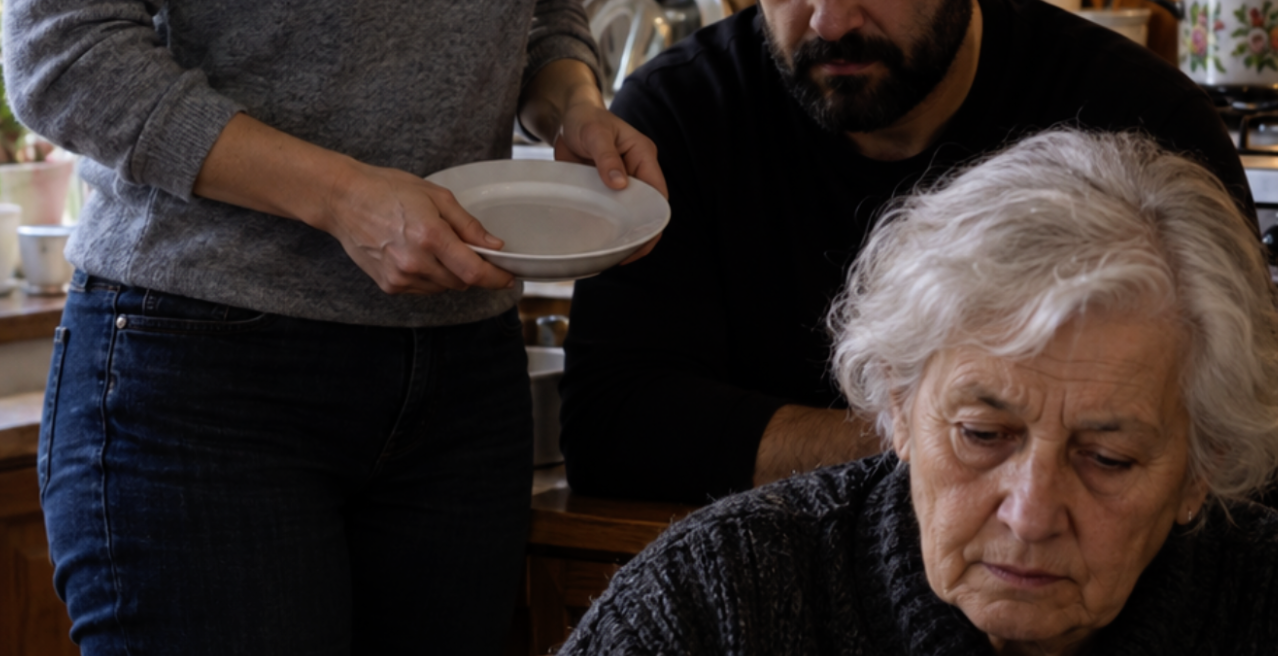
“I’ve already signed the papers at the notary’s office. The apartment is going to your brother. You already have enough as it is.”
Her mother-in-law said it casually while stirring her tea, as though she were mentioning that rain was forecast for tomorrow.
Oksana froze with a plate in her hands. Silence settled over the table, and the ticking of the clock on the wall suddenly became audible.
“Excuse me, what did you say?” she asked.
“You heard me.” Tamara Vikentyevna took a sip of tea. “I’m transferring the apartment to Gena. He has two children, so he needs it more. You two are young. You can earn enough to buy your own place.”
“Den,” Oksana said quietly. “Did you know?”
Her husband did not look up.
Six years. They had lived in this apartment for six years. Oksana had moved there after the wedding with one suitcase and the naïve belief that she was becoming part of a new family. She and Denis had renovated the place with their own money and their own hands. Oksana had scrubbed the old windows, hung the wallpaper, and chosen the bathroom tiles while counting every last kopeck. Back then, Tamara Vikentyevna had always said, “Go ahead, children. Fix it up. One day, all of this will be yours.”
All of this will be yours.
“Denis,” Oksana repeated more loudly. “I’m asking you a question. Did you know your mother was transferring the apartment?”
At last, he raised his head. The moment she saw his face, she understood everything.
He had known. He had known for a long time.
“Oksana, let’s not do this now,” he muttered. “Not in front of Mom.”
“Then when?” Oksana felt a wave of heat rising to her throat. “After the two of you have finished deciding everything behind my back?”
Tamara Vikentyevna carefully set down her cup.
“Do not raise your voice in my home,” she said with dignity. “For the time being, it is still my home.”
Oksana rose from the table. Her legs were trembling.
She went into the kitchen—the small, cramped kitchen where she had spent hundreds of evenings preparing dinner for the whole family. The kitchen where she had taken care of her mother-in-law when she had the flu. Where she had heated broth for her, gone out to buy groceries, and washed her dishes because, as Tamara Vikentyevna always said, “Your hands are still young.”
Her mother-in-law followed her and stopped in the doorway, folding her arms across her chest.
“You have to understand,” she said, her voice becoming soft and soothing. “I’m doing this because I care about you. Gena is struggling. He has a mortgage and children. But you and Denis are strong and capable. It won’t be difficult for you to buy an apartment of your own. I’ll give this one to Gena. It’s only fair.”
“Only fair,” Oksana echoed.
“Of course. You didn’t really think I would give the apartment to you, did you?” Her mother-in-law smiled. “You’re an outsider to us, after all. You’re his wife today, but who knows what you’ll be tomorrow? Gena is my own flesh and blood.”
An outsider.
For six years, she had been treated as one of them whenever they needed her. The most useful one. The most accommodating one.
And now she was an outsider.
“Tamara Vikentyevna,” Oksana said, struggling to keep her voice even, “we invested almost three hundred thousand rubles in this renovation. Our own money. Do you remember?”
“You lived here and benefited from it,” her mother-in-law replied with a shrug. “It wasn’t as though you were living on the street. Consider it payment for your accommodation.”
Oksana turned toward the window. Beyond the glass lay a gray October courtyard, where the bare branches of poplar trees swayed in the wind.
She understood one thing clearly: this had been planned. Not yesterday or today, but a long time ago. Her mother-in-law had kept Oksana tied to the apartment for years with the promise that “one day, all of this will be yours,” while secretly preparing the paperwork for her other son.
And Denis had known.
He had known and remained silent.
“Where is Denis?” Oksana asked without turning around.
“In the other room. Go and calm down first. You can talk afterward.”
Oksana walked into the living room. Her husband was sitting on the sofa, staring at his phone—the very sofa they had chosen together in a store three years earlier, arguing over the color and celebrating when they discovered it was on sale.
“Explain this to me,” she said quietly. “When did you find out?”
Denis sighed and put down his phone.
“Oksana, why are you getting so worked up? Mom is right in a way. Gena really is struggling. And we’ll eventually buy a place of our own.”
“When did you find out, Denis?”
He remained silent for a moment.
“Six months ago,” he finally forced out. “Mom told me. I thought the whole thing would somehow blow over.”
Six months.
For six months, he had lived beside her, eaten the dinners she prepared, and slept in the same bed with her—all while keeping silent. For six months, she had made plans for their future and talked about turning the back room into a nursery when they had a baby.
And he had known there would be no nursery. He had known the apartment would never be theirs.
“And you didn’t tell me anything,” she said. It was not a question, merely a statement.
“What difference would it have made?” Denis spread his hands. “It was Mom’s decision. What could I have done?”
“You could have told me. I’m your wife.”
“That’s what I’m saying—don’t make such a big deal out of it. We’ll rent an apartment for a while, and then we’ll get a mortgage. Everyone lives that way.”
Oksana stared at her husband and did not recognize him.
No, that was not true. She did recognize him. She was simply seeing him clearly for the first time.
He had always been this way. She had merely taught herself not to notice it during their six years together.
Whenever his mother criticized Oksana’s cooking, Denis remained silent. Whenever Tamara Vikentyevna came over without warning, rearranged things in their cupboards, or scolded Oksana because the dishes were “put away incorrectly,” Denis buried himself in his phone. Whenever his mother called him ten times a day and demanded that he drop everything and come to her “right this minute,” Denis went.
A mama’s boy.
Oksana had driven that phrase from her mind for six years. She had never wanted to think of her husband that way.
But now the truth stood directly before her.
“I understand,” she said, then left the room.
In the hallway, she put on her jacket.
“Where are you going?” Denis followed her.
“Home. To my mother.”
“Oksana, stop it. Where are you going at this hour?”
“I have a mother, Denis. A real one. I’m going to her.”
Tamara Vikentyevna appeared in the corridor.
“That’s the right thing to do,” she said, nodding with satisfaction. “Cool down and think everything over. Then you’ll understand that I’m right.”
Oksana took hold of the door handle and turned around.
“Do you know what the funniest thing is, Tamara Vikentyevna? I genuinely considered you my second mother.”
Then she left.
Her mother opened the door, looked at her daughter, and understood everything without a word. Raisa Petrovna had always been able to understand her daughter without words.
“Come in,” she said simply. “I’ll put the kettle on.”
They sat in the tiny kitchen of the old Soviet-era apartment where Oksana had grown up. The same floral oilcloth covered the table, and the familiar smell of valerian and dried herbs hung in the air.
Everything here was real.
“Tell me what happened,” her mother said as she poured the tea.
And Oksana told her everything: the notary, being called an outsider, and Denis knowing for six months. Her voice broke several times, but she held herself together.
Raisa Petrovna listened without interrupting. Then she said, “I warned you, remember? Before the wedding. I told you to take a good look at his mother. The way a mother treats her son determines how that son will treat his wife.”
“You did,” Oksana admitted.
“Well, there you have it. That Tamara of yours has always twisted Denis around her little finger, and he has been perfectly happy to let her do it. It’s convenient, after all. Mom makes the decisions, Mom does the thinking, and Mom decides who is to blame.”
Oksana wrapped her hands around her cup. Warmth gradually began returning to her body.
“Mom, I don’t know what to do.”
“What is there to figure out?” Raisa Petrovna shrugged. “You keep living. But from now on, use your head instead of your heart.”
“I invested so much in that apartment. My energy, my money, my soul.”
“You said you spent money on the renovation?” her mother asked, narrowing her eyes. “Did you keep the receipts?”
Oksana looked up.
“What receipts?”
“For the materials and the work. You’re an economist, aren’t you? Surely you kept records.”
And suddenly Oksana remembered.
She had kept records. It was a habit. Working in finance had taught her to enter every expense into a spreadsheet. When they began renovating, she created a separate file: tiles, wallpaper, laminate flooring, plumbing fixtures, and payments to contractors. Everything was documented with receipts and screenshots of bank transfers.
The file had been sitting untouched in cloud storage for six years.
“I still have them,” she said slowly. “Mom, I still have everything.”
“There you go.” Raisa Petrovna smiled. “That’s what your head is for.”
Oksana did not go to work the following morning. She took the day off, sat down at her laptop, and opened the old file.
The numbers lined up before her like soldiers.
Two hundred and eighty-seven thousand rubles.
That was how much she and Denis had spent renovating the apartment that belonged to his mother. The money had technically come from their shared household funds, but Oksana earned more—she had always earned more—and the majority of the expenses had been paid from her bank card. The transfers to contractors and payments at building-supply stores had all come from her account.
She opened another file containing details of the personal savings she had kept separately for a rainy day. Over six years, she had managed to save four hundred thousand rubles. It was not a fortune, but it was her money, painstakingly saved from bonuses and side jobs.
Denis knew nothing about it.
Neither did his mother. Oksana had never advertised the fact.
She sat staring at the screen for a long time. Then she began calculating properly.
Denis called around lunchtime.
“So, have you calmed down? When are you coming home?”
“Denis,” Oksana said, “I want the money we spent on the renovation returned to me. Two hundred and eighty-seven thousand rubles. I have all the receipts.”
Silence filled the line.
“What are you talking about? What receipts? We’re family.”
“A family that transferred the apartment to another son without consulting me. Since that’s how things are, let’s be fair. You all seem to care so much about fairness. I invested my own money in someone else’s property. I want it back.”
“Oksana, you’ve lost your mind. Mom won’t give it back.”
“Then I’ll take her to court. I have all the documents—the receipts, bank transfers, and contracts with the workers. It’s called unjust enrichment. I’ve consulted a lawyer. My chances are good.”
That was true. She had spent an hour that morning speaking to a lawyer recommended by a friend.
Denis remained silent.
“And one more thing,” Oksana added. “I’m filing for divorce.”
Tamara Vikentyevna stormed into Raisa Petrovna’s apartment the following day. Oksana happened to be there with her mother.
Her mother-in-law burst inside like a whirlwind, flushed and no longer wearing her usual mask of calm dignity.
“What kind of stunt is this?” she demanded the moment she saw Oksana. “What court? What money? Have you decided to destroy our family?”
Raisa Petrovna calmly emerged from the kitchen, drying her hands on a towel.
“Tamara Vikentyevna,” she said evenly, “we do not shout in my home. Either we speak calmly, or you leave.”
Her mother-in-law stopped short. She glanced around the cramped hallway and pursed her lips.
“I came to talk,” she said more quietly. “Like reasonable human beings.”
“Come in. Would you like some tea?”
“I don’t want your tea.”
They sat down in the living room. Tamara Vikentyevna nervously fiddled with the strap of her handbag.
“Oksana,” she began again, her voice softer and familiarly affectionate, “why are you behaving this way? I didn’t do it out of spite. I only wanted what was best. Gena really is struggling, while you and Denis are still young.”
“Tamara Vikentyevna,” Oksana replied calmly, without raising her voice, “I’m no longer angry. Truly. You made your decision, and you had every right to do so. The apartment belongs to you. But I also have the right to make my own decision. I invested two hundred and eighty-seven thousand rubles in the renovation. I have every receipt. I want the money returned. That is all.”
“Where am I supposed to get that kind of money?” her mother-in-law exclaimed, throwing up her hands. “I live on a pension!”
“You own an apartment—the same apartment you’re transferring to Gena. Let Gena reimburse me. Or you can reimburse me yourselves. Work it out between you. It is no longer my concern.”
Her mother-in-law turned pale.
“You… you have no shame. I treated you like my own daughter.”
“Like your own daughter?” For the first time, Oksana raised her voice. “Yesterday you called me an outsider. You said it in front of your son—in front of my husband. You called me a stranger. So if I am a stranger, then our relationship will be conducted as it would be between strangers: according to the law, with receipts and written agreements.”
Tamara Vikentyevna opened her mouth and then closed it again.
For the first time in six years, she had nothing to say.
“And what about Denis?” she finally forced out. “You’re destroying your family!”
“You destroyed this family,” Oksana said quietly, “when you went to a notary behind your daughter-in-law’s back. And your son destroyed it when he kept silent for six months. I am merely drawing the final conclusion.”
The divorce and the court case proceeded simultaneously.
At first, Denis was furious. He called Oksana and accused her of everything. Then he came to make peace, looking confused and pathetic.
“Oksana, can’t we make everything the way it was? Mom acted too hastily. I’ll talk to her.”
“It’s too late, Denis,” Oksana replied. “You should have talked six months ago—to me. Instead, you kept silent.”
“I didn’t know how!”
“That is exactly the problem. You never know what to do. Your mother always decides everything for you. And you know what? I don’t want to be married to a mama’s boy anymore. I want a husband—an adult man.”
He did not understand. He looked at her with the wounded eyes of a child whose toy had been taken away.
And Oksana thought sadly that this was the result of everything. His mother had never allowed her son to enter adult life, and he had never been eager to do so.
The court case lasted four months. The lawyer had been right. The receipts, bank transfers, and contracts with the workers formed an ironclad body of evidence. Tamara Vikentyevna hired her own attorney and tried to prove that the money had been “a gift to the family.”
But a gift had to be proven, and Oksana had not given anyone a gift.
She had invested money—and kept records of everything.
The court ruled in her favor. Her mother-in-law was ordered to repay the full two hundred and eighty-seven thousand rubles.
Tamara Vikentyevna repaid the money in installments, reluctantly and bitterly. But she paid it all back. When Gena discovered that the apartment came with this unexpected financial burden, he was not pleased either. Cracks began to appear in the relationship between the two brothers and their mother.
But that was no longer Oksana’s story.
Six months after the divorce, Oksana stood in an empty one-bedroom apartment on the outskirts of the city.
Her own apartment.
She had the two hundred and eighty-seven thousand rubles she had recovered from her mother-in-law, the four hundred thousand rubles in personal savings that nobody had known about, and a modest, manageable mortgage calculated down to the last kopeck by her economist’s mind.
Everything came together. It was enough for the down payment on a small apartment in a newly built residential complex.
The empty walls smelled of fresh plaster. Outside the window were construction sites, cranes, and new buildings. It was on the outskirts, far from the city center.
But it belonged to her.
Completely and unconditionally, with no empty promises that “one day, all of this will be yours.”
Raisa Petrovna walked around the apartment, inspecting every corner.
“It’s small,” she said, “but bright. The windows face south. That’s good.”
“I chose it myself, Mom. I earned the money myself. I bought it myself.”
“I know, sweetheart.” Her mother put an arm around her shoulders. “I’m proud of you.”
Oksana looked through the window at the gray winter courtyard and the bare branches of the young trees planted along the new road.
In a few years, they would grow. The courtyard would turn green. For now, everything was bare and empty, with the whole future still ahead.
She would renovate another apartment. She would do it with her own hands, just as she knew how.
But this time, she would be doing it for herself.
Every receipt, every tile, and every roll of wallpaper would be for her own home.
Her phone chimed. It was a message from Denis:
“How are you? Maybe we could meet and talk?”
Oksana looked at the screen, then slipped the phone into her pocket without replying.
Not today.
Not tomorrow either.
That story was over.
Another one—her own—had begun.
“Mom,” she said, “why don’t we have some tea? I only have one stool and a kettle for now, but the kettle is the most important thing.”
Raisa Petrovna laughed.
“It certainly is, sweetheart. The most important thing of all.”
They took turns sitting on the apartment’s only stool, drinking tea from paper cups and gazing at the empty walls behind which the future seemed to be waiting.
For the first time in a very long while, Oksana felt light.
Her former mother-in-law never called again. Denis sent a couple more messages and then stopped. People said he still lived with his mother. Tamara Vikentyevna had taken him back under her wing, cooking for him, looking after him, and making all his decisions.
Perhaps he was happy that way.
Perhaps he had never wanted anything else.
But Oksana had wanted something different.
And now she had it.
Her own apartment.
Her own life.
Her own mind—which had calculated everything correctly.
Sometimes the kindest thing you can do for yourself is to stop making yourself convenient for people who call you an outsider.
Everything was going to be all right.
She knew that for certain.
Because now everything depended on her alone.