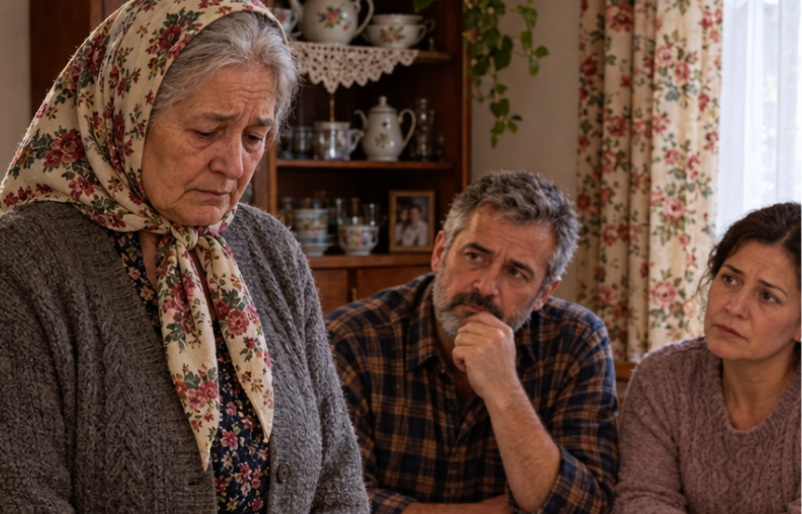
Tamara Ivanovna raised three children entirely on her own. Her husband, Petr, passed away far too young—he didn’t even make it to forty. She was left alone with three little ones: Olya had just started first grade, Andrey was still in a stroller, and, on top of that, Tamara had her hands full managing the household, the garden, and the cow. Looking back now, those years felt like a blur to her. She’d be up before dawn most days, often barely eating, hurrying off to work at the farm. By day, she was a milkmaid, surrounded by people; after work, she’d come home to be a mother to her kids, and at night she’d take care of the livestock again. Sleep came in short snatches, and she’d finish whatever the kids left behind on their plates. As for her own needs, she could go years without buying anything for herself.
Somehow, she managed. The children grew up, got an education, and made their own way in life. Olga moved to the city and found a job at an office. Andrey stayed in their hometown and became a foreman at a sawmill. That summer, both came back home to remember their father—forty days had passed since his death, so the whole family gathered at Tamara Ivanovna’s house.
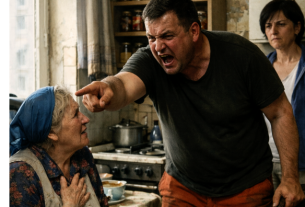
Everyone settled around the table. At first, the conversation was calm and respectful: they shared memories of their late father, talked about what he had been like. But as the meal went on—and as it often happens—the talk gradually shifted to old grievances and pent-up resentments. And that’s when things started to get heated…
“You spent your whole life working at the farm, Mom,” Olya suddenly said, pursing her lips disapprovingly. “But you did nothing for me or Andrey. I left for the city because there was no future here, no real life. And who made me go there? No one. I did it all on my own.”
Andrey immediately backed up his sister. He’d already had a drink and was feeling bolder—not really watching his words:
“And I’m no better. I remember telling Dad, even when I was nine, ‘Dad, teach me how to do something.’ But then he was gone, and all the responsibility landed on you. You, Mom, were always around, but what did I get from you? Just food and the occasional smack. No trade, no skills, no help to make something of myself. Now I’m on my own, making my own way through hard work.”
Tamara Ivanovna listened to her children in silence. Her thin, gaunt face grew even paler as she did. She put down her spoon and looked up at her son and daughter. Her eyes were quiet, a grayish blue, faded by the years she’d lived.
“How is it,” she asked quietly, “that you both feel I did nothing for you?”
“That’s just how it is,” Andrey snapped back. “You never even had a kind word for us. It was always the same: ‘Don’t bother me,’ ‘Don’t touch that,’ ‘I don’t have time for you.’ That’s all the motherly love we ever got from you.”
Olga didn’t argue; she just silently agreed with her brother and looked away.
And at that very moment, something inside Tamara Ivanovna broke. There was no flare of indignation, no surge of anger—just something that snapped deep inside, quietly and finally, like a string stretched too far.
She stood up from the table and went into the living room. Suddenly, the house filled with sounds: a dresser drawer creaked open, then something clattered loudly in the hallway. After a while, Tamara Ivanovna returned, carrying an old, worn-out leather suitcase—the very same one that had been gathering dust in the closet for who knows how many years.
She placed it on a stool and flipped open the lid.
«Alright, take a look over here,» she said. «But don’t say anything, just watch.»
Olga and Andrey exchanged glances, frowning, but they still approached the suitcase.
But inside that old suitcase there weren’t any treasures or valuable items. Instead, there were yellowed school notebooks, neatly stacked and tied with string. Nearby were children’s mittens, mended so many times it was almost impossible to count the stitches. There were a few envelopes, some handkerchiefs that had long lost their former look, and at the very bottom, a stack of faded official documents.
Tamara Ivanovna took one of the notebooks from the top and handed it to her daughter.
«Here you go, Olya. This is your third-grade diary. You wanted to throw it away back then—you said it was full of silly things. But I kept it, thinking that one day when you grew up, you might open it again and remember the little girl you used to be.»
Olga took the notebook, opened it, and began reading the uneven lines of her childhood handwriting. Suddenly, she stopped, as if she had found something completely unexpected. On the yellowed page, in a childish, still unsure script, it read: “Today mom came home from the farm late at night. I heard her softly crying into her pillow. I pretended to be asleep. I felt so sorry for mom. Right then, I decided that when I grow up, I’ll buy her a beautiful coat, so she never has to be cold in winter again.”
Andrey stood beside her, pale. His gaze shifted from his sister to the old suitcase, then back to their mother.
Meanwhile, Tamara Ivanovna kept taking things out, one by one. She picked up a small mitten. There was a hole on the thumb, carefully mended with thread.
«And I saved this one of yours, Andrey. Do you remember how you lost it on your way to school during a hard frost? I later found the mitten in the snow, brought it home, and patched it up. But by then, you were already wearing a new pair. I even knitted you another pair that night, unraveling part of my own shawl. I never wore that shawl again after that.»
Then she took out an envelope.
«And here, Olenka, are your letters with your father. When he left to work up North, you used to write to him in pencil. In the evenings, I’d sit with you, teaching you how to write properly—sometimes staying up late at night. And Pyotr would write me in return, always repeating: ‘Stay strong, Tamara, raise the kids, give them an education.’ So I did my best to hold on.»
Andrey was the first to break the silence and asked:
«Mom, why did you keep all of this?..»
“And then, my son,” Tamara Ivanovna replied calmly, “so I wouldn’t forget myself why I lived all these years. You say now I did nothing for you. But do you remember how many nights I spent by your crib when you were little, falling sick over and over again? Of course you don’t remember. I begged doctors to see you out of turn, almost bowing to their feet. And when we had no medic, I carried you in my arms to the neighboring village myself. In winter, through snow up to my waist. If I hadn’t made it, who knows if you’d even have grown up, to say things to me like this now.”
Her voice trembled slightly, but she managed to stay composed.
“And Olya, I made your graduation dress out of my old skirt. Remember? You felt embarrassed it wasn’t from a store. But I worked nights by lamplight after my job, making tiny, careful stitches, just to finish in time and not be late for the farm in the morning. I always hoped one day you’d grow up and understand. Does that mean nothing to you either?”
A hush fell over the room, so deep that even the faintest rustle could be heard.
Olga stood with her head bowed, tears streaming down her face one after another. Andrei was silent, his fists clenched tightly. The muscles in his jaw worked visibly. It wasn’t anger he was feeling, but the heavy realization of his own guilt—the kind that hits when you understand you’ve crushed what was most precious to you with your words.
“You see, my dear children,” Tamara Ivanovna continued. Now her voice no longer held any resentment, just the deep exhaustion of someone who has carried an unbearable burden for years and at last has stopped to catch her breath. “I didn’t spend my whole life at the farm for nothing. I did it for you. So you’d have your first school notebooks, not empty pockets, so there’d always be bread on the table, so that you could grow up and move to where you say there are opportunities and a better future. I did all for you. But now here you are, standing before me, saying I gave you nothing.”
She glanced into the suitcase again and took out one last thing, something clearly especially dear to her. It was a small, worn cross on a thin chain.
“This little cross came from my grandmother, from our great-grandmother. I wanted to leave it to you, to pass it down as an heirloom. But it seems it wasn’t meant to be.”
With these words, Tamara Ivanovna set the suitcase down on the floor and closed its lid.
The silence that followed stretched on—a heavy silence, like that gray autumn sky just on the verge of bringing the first snow.
Olga was the first to break down. She stepped up to her mother, wrapped her arms tightly around her, and pressed her tear-streaked cheek to her thin shoulder.
“Mom, please forgive me… I was so foolish… Forgive me… I didn’t even realize what I was saying. I just blurted it out without thinking…”
Andrei also came closer. A bit awkwardly, he placed his hand on his mother’s shoulder. In the eyes of this grown, strong man—a man who’d never allowed himself to cry before—tears glistened.
«And forgive me too, Mom. I never meant to hurt you… I just had so much bottled up, and I ended up taking it out on you. If it weren’t for you…»
He couldn’t finish his sentence. The emotion caught in his throat and left him speechless.
Tamara Ivanovna stood for a moment between her now-grown children, both of whom were crying like little kids, and suddenly she felt the icy heaviness that had gripped her chest at the table start to melt away. She hugged them both—no longer little ones, but still just as dear and beloved.
«That’s enough now,» she said softly. «A mother’s heart is like the earth—it can be trampled on, forgotten, but somehow, grass keeps growing over it again. You will always be my most precious ones, my light. I don’t hold a grudge against you. Just remember for next time, my children: before you say something, think about it carefully. Words can not only hurt, but wound deeply. And you only have one mother.»
So there they stood, the three of them, in the middle of the room as dusk settled in, next to the old suitcase. All its life, it had kept for them things that seemed worthless at first glance, but turned out to be truly priceless.
From that evening on, many things changed in Tamara Ivanovna’s house, even though it was subtle. Olga and Andrei began to visit their mother much more often. They didn’t just come on holidays anymore; they would drop by for tea, help out in the garden, or come over for no reason at all—just to be near her.
They started calling regularly, something they often forgot to do before. And they never asked their mother what she had done for them anymore. Instead, they went out of their way to ask how they could help her:
«Mom, is there anything you need? Please, just say the word, don’t hesitate.»
And Tamara Ivanovna, looking at her grown children, would smile secretly and answer with the same words she used to comfort them in childhood, pressing her palm to their foreheads:
«I don’t need anything, my dears. All I want is for you not to have to go through as much as I did. I want you to live peacefully and happily, like decent people.»
Once again, her heart felt light and calm, as if the earth itself, after a long, cold winter, had finally warmed under the first rays of spring.
Because her children had finally understood the most important thing: a mother’s love isn’t always spoken in beautiful words. More often, it hides in old mittens, sleepless nights, carefully sewn stitches, and thousands of little acts no one notices or counts.
Whoever is able to understand this, will carry the meaning of a mother’s love in their heart for a lifetime.