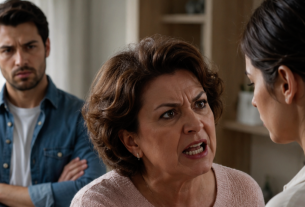
“Clear this nonsense off the table!” Dima threw his fork so hard it bounced off the plate and fell to the floor. “What even is this? Store-bought cutlets from a package?!”
Sonya was standing by the stove and did not turn around. Only her shoulders tensed slightly.
“Regular cutlets,” she said evenly. “Homemade. I fried them myself.”
“They taste like rubber! Mom makes them properly, and this is impossible to eat!”
He got up from the table without touching his dinner and went into the room. He did not slam the door—he simply closed it, which somehow felt even more insulting. As if she was not even worth a scandal.
Sonya looked at the frying pan. At the cutlets with their golden crust, which she had turned over so carefully. Then she picked up her phone and wrote one message—to the bank manager.
“Tomorrow at ten, as agreed.”
With Lyudmila Pavlovna, her mother-in-law, it had all begun on the wedding day.
She had arrived with two heavy bags, arranged some jars, bowls, and plastic containers on the table, and announced to the guests, “I cooked everything myself. I don’t trust store-bought food.”
Sonya had kept silent then. In fact, she had kept silent for a long time. Almost three years.
Lyudmila Pavlovna was the kind of woman who knew how to seem sweet exactly until something stopped going according to her plan. She smiled broadly at the neighbors, wrote on the local forum about “warm family relationships,” but at home she could show up without calling, open the fridge, and say, “And what is this? What are you even feeding my son?”
Around her, Dima turned into another person. More precisely, into a child. He would sit down, fold his hands on his knees, and look at his mother with a submissiveness that Sonya had at first mistaken for respect. Later she understood: it was not respect. It was habit.
Lyudmila Pavlovna commanded her son as naturally as she rearranged cups in someone else’s kitchen. She knew what curtains they should have, when they needed to renovate, and—most importantly—that Dima should eat only her food.
“He’s been eating homemade food since childhood. His stomach is used to it,” she would say with the air of a doctor making a diagnosis.
Sonya tried to find something funny in it. She couldn’t.
That morning, Lyudmila Pavlovna arrived without warning—as usual. She rang the doorbell at half past ten, just as Sonya was getting ready to leave. She stood on the threshold in a flowered housecoat under an unbuttoned coat, holding two bags.
“I brought something for Dimochka,” she said, squeezing into the hallway. “Everything’s fresh. I made it yesterday.”
“Lyudmila Pavlovna, we have food.”
“So what if you do?” Her mother-in-law was already heading to the kitchen. “His food and your food are two different things.”
Sonya watched as she opened the fridge and began rearranging everything her own way—moving Sonya’s containers, placing her own bowls on the first shelf. As if it were her fridge. As if it were her apartment.
“Lyudmila Pavlovna,” Sonya began.
“Sonya, don’t interfere. I know where everything goes,” the woman replied without turning around.
It was their apartment. Bought with Sonya’s money and Sonya’s mortgage—well, almost. Almost, because the mortgage was still in both their names. For now.
That was exactly what Sonya was thinking about as she rode the metro to the bank. She sat by the window, looked at the dark tunnel, and thought that three years was a long time. That she was tired of explaining why her cutlets were “tasteless,” even though Dima had eaten them happily before his mother started coming over every three days. That she was tired of watching her mother-in-law rearrange her things, comment on her cleaning, and tell the neighbors that “Sonechka tries, of course, but she’s nowhere near truly homemade.”
The manager’s name was Artyom. Young, precise, and brief.
“So we’re refinancing it in your name alone?” he clarified, laying out the documents.
“Yes,” said Sonya. “In my name alone.”
“Is your husband aware?”
“My husband will be aware,” she answered. “A little later.”
Artyom looked at her for a second—not judgmentally, just professionally assessing the situation—and nodded. It was her right. It was her apartment, her down payment, her salary from which the payments had been made. Dima was listed on the mortgage formally—his income had not been enough, and the bank had asked them to add a co-borrower. But things had changed: Sonya had received a promotion six months earlier, her income had increased, and now she could take the loan on by herself.
While she was signing the papers, her phone vibrated. A message from Dima:
“Where are you? Mom is asking if you’ll have lunch.”
Sonya put the phone back into her bag.
That evening, Lyudmila Pavlovna stayed for dinner. That, too, had become a habit—she would come over supposedly “for a minute” and stay half the day. She sat at the head of the table, served everyone food from her containers, and said:
“Now this is normal food. Sonya, try it. You might learn something.”
“I’m not hungry,” said Sonya.
“Your loss.” Her mother-in-law shrugged. “Are you planning to lose weight? You’re already skin and bones.”
Dima chuckled. He did not defend her—just chuckled and reached for the bread.
Sonya stood up, poured herself some water, and went out onto the balcony. She stood there for a minute, looking down at the yard. The swings, the sandbox, someone’s car with a cracked bumper. Tomorrow the documents would go for review. In two weeks—the bank’s decision. If everything went the way Artyom had said, by the end of the month the apartment would be registered in her name alone.
Lyudmila Pavlovna’s voice drifted from the kitchen:
“Dimochka, want seconds?”
Sonya slightly closed the balcony door.
She wondered what her mother-in-law would say when she found out. And what Dima would say. Would he start a scandal? Get offended? Run to complain to his mother?
Let him run, Sonya decided. Let him eat his mother’s food. Let him do whatever he wanted.
The apartment would be hers.
The documents went to the bank on Thursday. On Friday, Sonya worked from home—she did financial analysis at a small auditing firm, and her boss had long allowed her to skip the office two days a week. It was convenient. Especially now, when she needed to keep a cool head and avoid unnecessary movements.
Dima left for work at eight. Sonya made coffee, opened her laptop, and worked in silence for almost two hours—the kind of silence she had long forgotten how to take for granted. Silence was rare in their apartment.
At half past ten, the intercom rang.
Sonya was not even surprised.
“It’s me,” Lyudmila Pavlovna said into the receiver. “Open up.”
“I’m working, Lyudmila Pavlovna.”
“Then work. I won’t bother you. I brought soup.”
Soup. Of course.
Sonya pressed the button and went to close her laptop, because she knew: “I won’t bother you,” translated from Lyudmila Pavlovna’s language, meant at least an hour and a half of talking, rearranging things, and quiet remarks about absolutely everything.
Her mother-in-law came in and, as always, filled the whole space from the doorway. Large, loud, wearing her usual wide coat, which she did not take off even in summer—“there are drafts everywhere.” She went into the kitchen, put the pot on the stove, and looked around.
“Sonya, did you wash the dishes yesterday?”
“I did.”
“Look here, there’s a stain.” She jabbed a finger at a pot on the drying rack. “You need to scrub properly, not like this.”
Sonya poured herself coffee and did not answer.
Lyudmila Pavlovna opened the fridge, moved something around, closed it. Then opened it again.
“Where did my containers go? I left three here on Wednesday.”
“I washed them and put them in the cabinet.”
“Why in the cabinet? They should be ready to use.”
“Lyudmila Pavlovna,” Sonya said calmly, “this is my cabinet.”
Her mother-in-law turned around. She looked at her with an expression Sonya knew very well by now: a mixture of hurt and mild superiority.
“Well, well,” she said. “Someone’s become clever.”
And she went into the room.
At lunch—Lyudmila Pavlovna stayed after all, because of course she did—the conversation turned to renovation. Her mother-in-law had long been pushing the idea of redoing the wallpaper in the bedroom. Not because the wallpaper was bad. Simply because she wanted it.
“I found good workers,” she announced, stirring her soup. “They don’t charge much. Tamara’s daughter-in-law used them and praised them. We can book them for next month.”
“We weren’t planning a renovation,” said Sonya.
“So what? You’ll plan one. The wallpaper has been up for three years. It’s time.”
“Lyudmila Pavlovna,” Sonya put down her spoon, “we’ll decide for ourselves when to renovate.”
“Dima, do you hear how she’s talking to me?” Her mother-in-law appealed to her son, who was sitting beside her and pretending to be very busy with his bread.
“Mom, come on,” he mumbled.
“What do you mean, come on? I care about you, and she…”
“I’m going to work,” said Sonya, standing up.
She heard Lyudmila Pavlovna saying something quietly to her son behind her. The words were indistinct, but the intonation was familiar: martyr-like, soft, designed to make Dima feel guilty for someone else’s harshness.
Sonya closed the door to the study and called Artyom.
“How are the documents?”
“Everything is fine,” he said. “They’re under review. About two weeks, as I told you.”
“Good,” she said. “Thank you.”
She hung up and looked out the window. In the yard, someone’s dog was running, dragging its owner behind it on the leash. The owner was laughing.
In the evening, Dima came in.
He sat on the edge of the sofa and rubbed his palms against his knees—the way he always did when he wanted to say something but did not know how.
“Why were you like that with Mom?”
“Like what?”
“Well. Rude.”
Sonya put down her book.
“Dima, I asked her not to touch my things in my cabinet. Is that rude?”
“She just came to help.”
“She came without calling for the third time this week, rearranged things in the fridge, made a comment about the dishes, and announced that we were going to renovate.” Sonya spoke evenly, without shouting. “That is not help, Dima.”
He was silent. He looked at the floor.
“She doesn’t do it on purpose,” he said at last.
Sonya thought: that was it. That phrase held all three years. She doesn’t do it on purpose. Never on purpose. Always only with the best intentions.
“All right,” said Sonya. “Go. I’m working.”
He left. Again without a scandal, without clarifying anything, without saying, “Let’s talk”—he simply left, and ten minutes later the sound of his mother’s soup being reheated came from the kitchen.
Sonya opened her laptop. On the screen was an email from the bank:
“Your application has been accepted for processing.”
She looked at those words for a long time.
Then she wrote to her sister, Rita, who lived on the other side of the city and always answered directly:
“Can you meet tomorrow? I need to talk.”
Rita replied a minute later:
“The café on Prostornaya, at twelve. Is everything okay?”
“Yes,” Sonya wrote.
And for the first time in several days, it was true.
Rita met her at the entrance to the café—short, quick-moving, already holding a paper cup. She looked at Sonya, said nothing, and simply hugged her. They sat by the window.
“Tell me.”
Sonya told her. Calmly, without tears—she had cried everything out long ago, back when she realized she was crying not from hurt, but from exhaustion. Rita listened without interrupting, only nodding occasionally.
“The apartment will definitely end up in your name?” she asked when Sonya fell silent.
“Artyom says everything is clean. My income qualifies, the down payment was mine. Dima is listed as a co-borrower in the agreement, but I’m refinancing—he comes out of the deal.”
“Does he know?”
“No.”
Rita was silent for a moment. Then she said:
“Are you sure?”
“Yes,” Sonya answered. “I’ve been sure for a long time. It just took me a while to gather myself.”
She returned home at three. Dima was at work. Thank God, Lyudmila Pavlovna was not there. Sonya went into the bedroom, took down a suitcase from the top shelf—a large blue one she had bought before marriage—and began packing.
Not everything. Only her own things: documents, laptop, clothes, several books.
She did not hurry. She did everything carefully, methodically, as if she were packing for a business trip.
Dima came home at half past six. He entered, took off his jacket, called from the hallway, “Is there anything to eat?”—and stopped short when he saw the suitcase by the sofa.
“Sonya, what is this?”
“I’m leaving,” she said simply.
He looked at the suitcase, then at her. For a long time.
“Where?”
“To Rita’s for now. Then I’ll rent a place.”
“Wait.” He was truly confused, almost childlike. “Are you serious?”
“Serious.”
“Because of Mom, right? This is because of Mom again?”
Sonya zipped the side pocket.
“Not because of your mom, Dima. Because of us. Because there hasn’t been an us for a long time.”
He sat down on the sofa. Rubbed his face with his hands.
“But we can talk. We can figure it out.”
“We’ve been figuring it out for three years.”
She took the suitcase and slung her bag over her shoulder. Dima sat there, looking at her as if what was happening were some kind of mistake, a misunderstanding that would disappear by itself any moment.
“I’ll call Mom,” he said at last.
“Call her.”
Sonya left.
The divorce was finalized three months later. Without scandals—or rather, there were scandals, but not where Sonya had expected them.
Lyudmila Pavlovna called the day after Sonya left. Her voice was so quiet, almost affectionate, that it was immediately clear she had prepared for the call.
“Sonechka, what is this foolishness? All families quarrel. You’re an intelligent woman.”
“Lyudmila Pavlovna, I’ve filed for divorce.”
A pause.
“You understand that this apartment isn’t only yours?” Her tone changed instantly.
“I understand. That’s why I arranged everything in advance.”
Another pause. A long one.
“What do you mean—in advance?”
“The mortgage has been transferred to me,” said Sonya. “Dima has been removed from the agreement. It’s legal, all through the bank, everything is clean. You can check if you want.”
Lyudmila Pavlovna hung up.
She called back an hour later in a different voice now—hard, with no trace of affection. She spoke about “cunning,” about “how could you,” about “we accepted you into our family.” Sonya listened calmly, then said:
“Lyudmila Pavlovna, from now on, through my lawyer.”
And she ended the call.
Sonya did have a lawyer—Vera Nikolaevna, fifty years old, with short gray hair and the gaze of a person who had stopped being surprised by people after twenty years of practice. She reviewed the documents and nodded.
“You did everything correctly. It will be difficult for them to challenge the refinancing. You were the sole payer, the down payment was yours, and that is confirmed by bank statements. Your husband may try to claim marital property, but his position is weak here.”
“Will they try?”
“Most likely.” Vera Nikolaevna folded the papers. “But you’re not the first person to go through this. Hold on.”
Dima did try. He hired a lawyer—or rather, Lyudmila Pavlovna hired one. She was the one who came to the first consultations, spoke for her son, and interrupted him. The lawyer looked at the documents and gently explained to the clients that they had few prospects.
Dima called himself after that conversation. His voice was quiet, with his mother nowhere nearby.
“Sonya. Did you really want this?”
“Yes, Dima.”
“I didn’t know things were that bad.”
She was silent for a moment.
“You knew. You just didn’t want to see it.”
He did not answer. And she did not continue.
The apartment remained hers. Officially, with new documents, with her name on every page.
The first evening she returned there alone, she walked through the rooms and opened the fridge. It was empty—she had deliberately not stocked it while the divorce was going on. Now she went to the store and bought everything she wanted: yogurt, cherries, a piece of cheese Dima did not like, asparagus, which Lyudmila Pavlovna called “inedible grass.”
She cooked dinner for herself. Quietly, without anyone else’s comments.
She put the plate on the table and sat down. Outside the window, the yard was noisy—children’s voices, someone’s music, a dog barking. Ordinary life. Alive, real, belonging to no one but herself.
She ate slowly, without hurrying.
The cutlets turned out good.
Six months passed.
Sonya was sitting in her kitchen—that was exactly how she now thought of this place: her kitchen—and drinking morning coffee. Outside the window, the city hummed; somewhere below, the entrance door slammed, and someone ran past with a dog. An ordinary morning.
A note with a number was hanging on the fridge—the remaining balance on the mortgage. Sonya looked at it every morning. Not out of anxiety, but simply to remember why she got up at seven and went to the office, why she took on extra projects and did not waste money on nonsense.
Her phone vibrated. A message from Dima:
“Mom is sick. Thought you should know.”
Sonya read it. Thought for a second. Wrote, “I hope she gets better,” and put the phone away.
Without anger. Without pain. She simply put it away.
Rita came over on Saturday with a cake and news. They sat in the kitchen, drank tea, talked about nothing—work, neighbors, how expensive cherries were this year. Then Rita looked at her sister and said:
“You’ve changed.”
“How?”
“You’re calm.” Rita paused. “You used to always have this face.” She demonstrated—shoulders slightly raised, eyes alert. “And now you don’t.”
Sonya smirked.
“It’s just that no one comes over without calling anymore.”
They both laughed.
In the evening, after Rita left, Sonya went out onto the balcony. The yard below lived its own life—swings, benches, someone walking a red-haired dog. The air was warm, summery.
She thought about how a year ago she had stood in this same place and felt like a guest in her own home. Not anymore. Now every corner of this apartment was hers: the kitchen with yogurt in the fridge, the cabinet where no one rearranged things, and the silence no one disturbed unless she wanted them to.
It was not much.
And at the same time, it was very much.
Sonya finished her coffee, already cold, and smiled.
Everything was right.