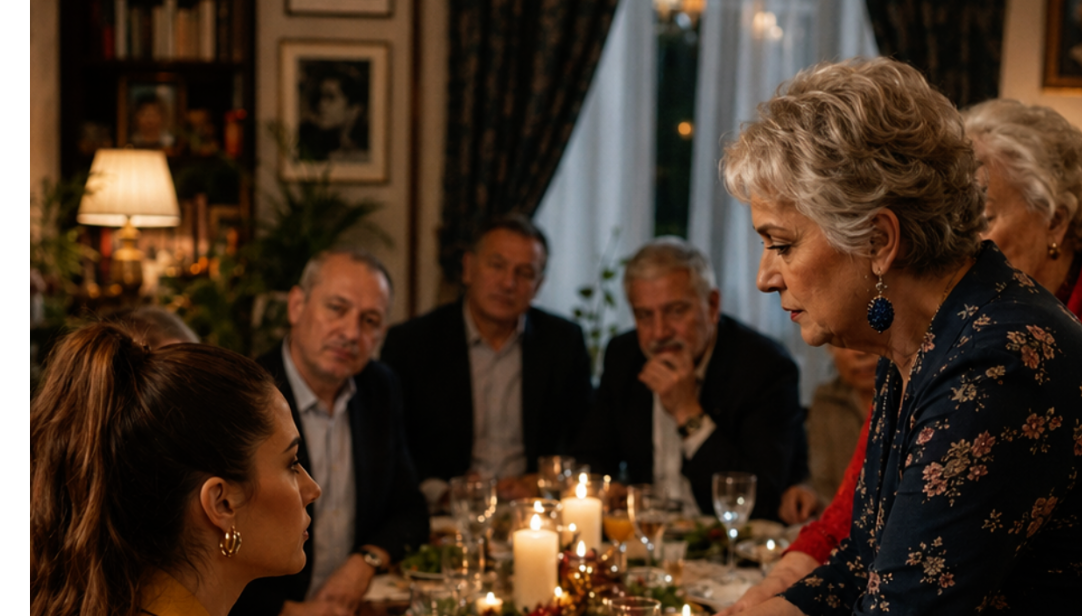
“Give me the card. From today on, I’ll be the one managing your money,” the mother-in-law declared, reaching her hand across the festive table.
The clinking of glasses stopped. The relatives froze with their forks in their hands, shifting their gazes from Tamara Sergeyevna to her daughter-in-law. Andrei stared down at his plate. Olga looked for several seconds at her mother-in-law’s outstretched hand—confident, impatient—and felt something inside her finally fall into place.
“Are you sure you want to discuss this matter right now?” she asked calmly.
Tamara Sergeyevna nodded confidently, adjusted her necklace, and looked around for support. The relatives remained silent, but their silence carried an unspoken approval. The mother-in-law had no idea that within a few minutes she would learn the truth about her own son.
Olga and Andrei had met ten years earlier. He was charming, spoke beautifully, and knew how to listen. During the first few years, they lived modestly: they rented a one-room apartment on the outskirts of the city, carefully counted their expenses, and made plans for the future.
“You’ll see, in five years we’ll have everything,” Andrei used to say while flipping through a catalog of country houses.
Olga laughed and believed him.
Andrei worked as a sales manager. The job paid reasonably well and was stable. But four years ago, the company underwent restructuring, and his position was eliminated. At first, they both took it calmly.
“It’s temporary,” Olga said one evening as she set the table. “You’ll find something better.”
Andrei nodded, sent out résumés, and went to interviews. Then he suddenly decided that he first needed to take some marketing courses. After that came the idea of opening an online store, though it never progressed beyond a few Excel spreadsheets. Then there were investments, cryptocurrency, and various financial literacy webinars.
While Andrei was searching for himself, Olga worked. Persistently, methodically, without unnecessary complaints. She rose from an ordinary specialist to the head of a department at a large company. Her salary eventually became substantial—the kind of income they had once only dreamed about together. With her money, they bought an apartment, paid off the mortgage early, and purchased a new car.
Tamara Sergeyevna knew none of this. Andrei carefully maintained the image of himself as the family breadwinner in front of his mother. Every time his mother visited, Olga heard the same comments:
“Why do you need a gym membership? You can exercise at home.”
“A cosmetologist is a luxury, not a necessity.”
“You’re traveling somewhere again? You’d be better off spending your vacation at the country house.”
Several times, Tamara Sergeyevna suggested creating a joint family account under her control “so the money wouldn’t disappear.” Olga politely avoided the subject.
For the time being.
Olga knew how to endure. She had developed that ability long ago, back in childhood, when she had learned to wait and remain silent in situations where others would argue.
She tolerated her mother-in-law’s criticism, her lecturing tone, and the judgmental looks she gave Olga’s new boots or handbags.
But something else irritated Olga even more than the criticism—her husband’s silence.
Andrei never defended her. Not once.
Whenever Tamara Sergeyevna started another lecture about her daughter-in-law’s supposed extravagance, Andrei suddenly found a reason to step out onto the balcony or become deeply absorbed in his phone.
After Olga bought herself a car—a white, compact model she had wanted for a long time—her mother-in-law began calling almost every day. The message was always the same: Olga was spending an unacceptable amount of money, and the family was supposedly standing on the edge of financial ruin.
The turning point came on an ordinary Tuesday.
Olga came home from work earlier than usual and stopped in the hallway when she heard her husband’s voice coming from the kitchen.
“Yes, Mom, I understand. She’s completely stopped caring about how much things cost.”
Olga leaned against the wall.
“She bought the car without asking me. I told her it wasn’t the right time,” Andrei continued. “But you know what Olya is like…”
She stood there listening as her husband complained to his mother about the wife who earned all the money in their household.
He complained calmly, naturally, as though he had been repeating the same story for a long time.
When Andrei stepped into the hallway and saw her face, he fell silent.
“You heard that?”
“Everything,” Olga replied briefly and walked past him.
That night, for the first time, she seriously asked herself why she had spent so many years protecting someone else’s lie.
Why remain silent when she could—and should have long ago—told the truth?
They celebrated her father-in-law’s birthday on a grand scale: a long table, roasted meat, loud toasts. Everyone had gathered—Andrei’s brothers with their wives, an aunt, and several neighbors and family friends.
The atmosphere was warm until Tamara Sergeyevna decided to speak.
It began in the usual way, with a mild criticism. Then her tone grew more serious.
“Olga has updated her wardrobe again,” her mother-in-law said with the tone people use when discussing a genuine crisis. “Young people today don’t think about the future at all. Andrei works and works, while she does nothing but spend.”
Someone at the table nodded in agreement.
An elderly aunt added:
“That’s true. Young people nowadays don’t know how to save money.”
Then Tamara Sergeyevna stood up and extended her hand.
“Give me the card. I’ll manage the money myself and give you what you need. That would be better.”
Olga turned toward her husband.
“Andrei, please explain.”
Andrei remained silent.
He stared into his glass and turned his fork between his fingers.
Olga waited several seconds, then began speaking herself in a calm, quiet voice.
“All right. Then I’ll explain. The apartment we live in is registered in my name because I bought it. The car was purchased with my money. Utilities, groceries, vacations, medical expenses—I pay for all of it myself. And Andrei hasn’t worked for more than three years.”
A deathly silence fell over the table.
Tamara Sergeyevna slowly lowered her hand.
“Olya, enough joking,” Tamara Sergeyevna said with a strained smile. “This really isn’t appropriate.”
“I’m not joking,” Olga replied.
Her mother-in-law turned sharply toward her son.
“Andrei, tell them. Explain what your wife is talking about.”
Andrei slowly lifted his head. He remained silent for a moment and then said what he always said whenever things became difficult.
“Well, these are just temporary difficulties. I’m actually working on a project right now, looking for myself in a new field…”
“Three years,” Olga said quietly. “You’ve been looking for yourself for three years.”
She opened her handbag and placed several documents on the table—the ownership papers for the apartment and the vehicle documents.
The papers landed between salad bowls and wine glasses.
Andrei’s older brother, Viktor, leaned closer, read them, and let out a low whistle.
Aunt Galina suddenly remembered aloud how, two years earlier, Andrei had told her about a successful business venture with partners.
Someone else remembered the story about a major deal that was supposedly about to close.
Then another truth came out.
The renovation of Tamara Sergeyevna’s kitchen had been paid for by Olga.
So had Tamara Sergeyevna’s treatment the previous winter, when she had stayed at a private clinic.
Tamara Sergeyevna turned pale.
For several seconds, she said nothing, and something resembling shame appeared in her silence.
But it did not last long.
“You humiliated your husband in front of everyone,” she finally said. “That is unforgivable.”
“Humiliated him?” Olga calmly gathered the documents and put them back into her bag. “I simply told the truth. He has been lying to all of you for years. And to me as well.”
She did not raise her voice.
She did not cry.
She simply stood up, thanked her father-in-law for the celebration, said goodbye to the guests, and left.
At home, the conversation was harsh.
“Do you understand what you’ve done?” Andrei paced around the room without looking at her. “My mother is in shock. The relatives are going to gossip now. You need to call her and apologize.”
“No,” Olga said.
“What do you mean, no?”
“I mean no.”
She sat down on the sofa and looked directly at him.
“Andrei, find a job. Any job. Start paying at least part of our expenses. That is all I’m asking.”
He did not answer.
The next morning, he packed a bag and went to stay with his mother, silently slamming the door behind him.
Tamara Sergeyevna began calling that same day.
Then again the following day.
Her voice alternated between hurt and accusatory.
Olga had destroyed the family.
Olga did not know how to respect her husband.
Olga had never been a proper wife.
Olga listened.
Sometimes she replied briefly.
But for the first time in many years, those words no longer settled heavily inside her.
They simply sounded—and disappeared without leaving a trace.
Something important inside her had already changed.
Irreversibly.
The divorce was finalized four months later.
Andrei remained with his mother—at first supposedly temporarily, and then somehow permanently.
He eventually found a job as a manager at a small company, earning a rather modest salary.
Tamara Sergeyevna quickly stopped telling the neighbors about her successful entrepreneur son.
The real numbers turned out to be far more ordinary than the legend.
“So, how are you doing now?” Olga’s friend Marina asked one day while they were sitting in a café.
“Good,” Olga replied—and realized that she was telling the truth.
The apartment remained hers. Everything had been properly registered in her name.
The car remained hers too.
Her job, her familiar routine, her morning coffee in silence—all of it was still there.
But the most valuable thing she gained was something else.
Over time, Olga realized that the most precious thing she had received after the divorce was simple inner peace.
She no longer had to explain why she needed a gym membership.
She no longer had to justify buying a new coat.
She no longer had to prove that she had the right to manage the money she herself had earned.
She simply lived.
She earned her own money.
She spent it however she wanted.
And it felt wonderful.