The scissors fell for the second time, and this time Iryna didn’t bother to pick them up.
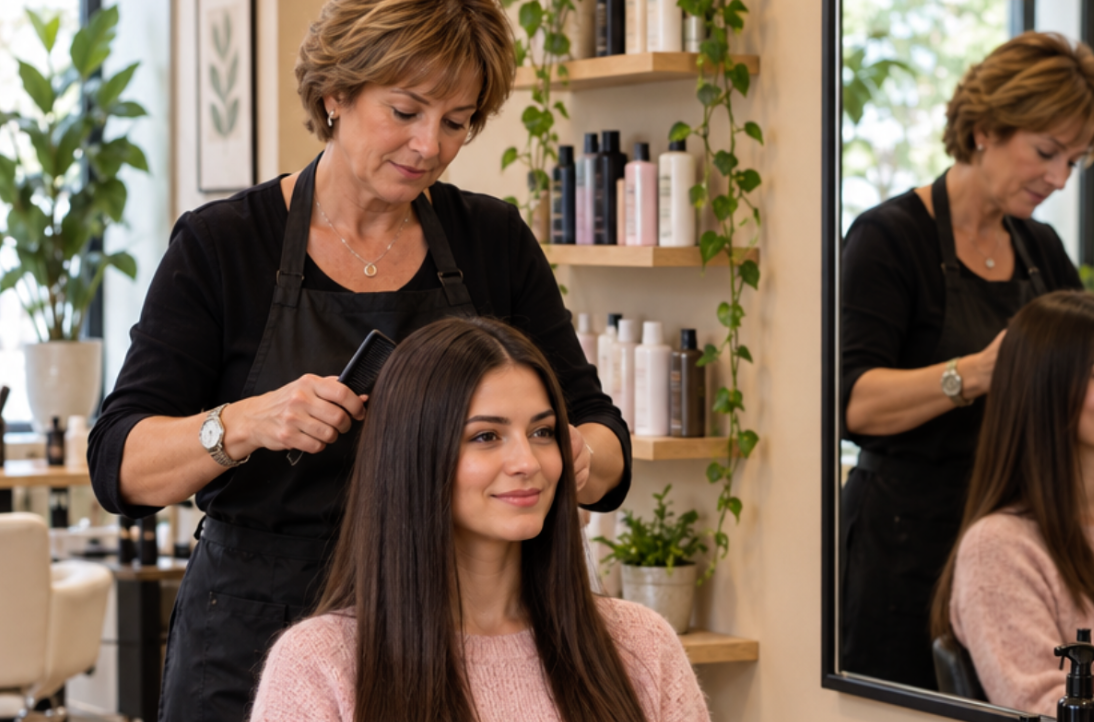
She froze in the middle of the salon: one hand gripping the back of the chair, the other covering her face. Lying on the floor among dark tufts of someone else’s hair were her shining scissors—the ones she’d used for fifteen years. Expensive Japanese ones, bought with her first big bonus. They never failed her. Her hands did.
«Well, what do you know,» she sighed through her fingers. «Thirty years doing hair, and today I can’t even hold my scissors. I’m so sorry, please forgive me.»
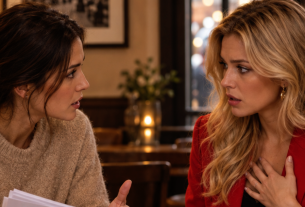
Diana looked at her in the mirror. Her hair was wet, cape in a fine checkered pattern, phone on her lap showing a reminder for the second time this morning: «11:30 — premises.» She had been waiting three weeks for this meeting. The owner of a small space on the corner, where they used to sell flowers, finally agreed to show it as a possible location for her pastry shop. Diana wanted to show up neat, composed—the kind of person you wouldn’t worry about handing over the keys to.
«Please, take your time,» she said. «I can wait.»
«No, really, you have an appointment, you said so yourself. Just a second, I’ll be ready…»
Iryna bent down, picked up the scissors, laid them on the table—and then just stood there. Without really thinking, Diana got up from the chair.
«Come here for a second.»
She hugged the woman she’d only met forty minutes ago. At first, Iryna stiffened, as if she wanted to pull away and say something polite. But then she leaned into Diana’s shoulder and cried. Quietly, like an adult. The way people cry when they haven’t had a place to do it for a long time.
* * *
Iryna’s morning started at half past five, just like always. It was the end of October, gloomy outside, the radiator barely warm—the building management had been promising to turn on the heat «any day now» for the second week in a row. Because of that, Sasha’s soccer sweatshirt, washed the night before, was still damp on the drying rack by morning.
«Oh, come on!» Sasha held it by two fingers, like a wet rag. «I have practice today! What am I supposed to wear?»
«Take the blue one, it’s warm.»
«No one wears blue! It’s supposed to have my number on it!»
He tossed the sweatshirt onto a chair and went to the bathroom, slamming the door so hard a magnet fell off the fridge.
Mykola, the older son, sat over his oatmeal, one earbud in. To Grandma’s reminders—»Finish up,» «Take your hat,» «Don’t forget your change of shoes»—he always answered the same way:
«Yeah, I hear you. Leave me alone.»
Iryna silently packed sandwiches into containers for them. She knew where their prickliness came from. She also knew the boys had overheard last night’s conversation, even though she’d closed the kitchen door.
Last night Olena had called. Her daughter had been living abroad for six years—job, apartment, a whole new life. The boys mostly featured in a monthly line on a wire transfer. Money always arrived on time, every month, with a short note: «For the boys.»
Sasha’s ninth birthday was two weeks away. Iryna gathered her courage and asked outright: are you coming?
«Mom, you know how things are at work for me right now,» Olena’s voice was even, as if she’d rehearsed it. «Buy him that tablet he wanted. I’ll send you the money today.»
«Olenka, he’s not waiting for a tablet.»
«Then what is he waiting for?»
— For you. He’s crossing the days off on the calendar. I haven’t told him you’re not coming, because honestly, I have no idea how to break that to him.
— Just don’t start. You’re always like this—always trying to make it seem like it’s my fault.
The conversation ended the same way all their talks had ended in recent years. Olena hung up. Iryna sat for a long time in the kitchen, holding the phone in her hand. In the next room, a child was lying in the dark, much too quiet to be asleep.
* * *
The hair salon was tiny—just two chairs—in what used to be an apartment on the first floor of a five-story block near the market. The second stylist, Lesia, had the day off, so until lunchtime it was just the two of them. Iryna put the kettle on. She didn’t start talking right away. First, she simply handed her phone to Diana.
The message from Mykola had arrived about twenty minutes before the scissors first slipped from her fingers.
“Sashko cried yesterday because of you. All you know how to do is fight with Mom. If you didn’t upset her, she would have come.”
— He’s just a kid, — Iryna said, as if she were defending not her grandson, but herself. — Twelve years old. He needs someone to blame. His mom is far away, she sends money, and he loves her. And I’m here. So it’s easy to blame me.
Diana was silent for a long time. Then she glanced at the clock, picked up her phone, and stepped out into the small hallway. Iryna could hear snatches: “…I’m so sorry… yes, something unexpected came up… would Thursday work for you? Thank you, thank you so much.”
— Did you reschedule? — Iryna stood up in surprise. — Because of me? You really didn’t have to…
— I did, — Diana sat down on the client’s little couch and cupped her mug in both hands. — Please, have a seat. I want to tell you something.
Her mom spent twenty years working as a cook in a school cafeteria. She got up at five, and by six was peeling potatoes for three hundred servings. She’d come home and start her second shift: laundry, supper, helping Diana with homework, weekends working in grandma’s garden, helping a neighbor, lending money to a friend.
— And you know, I thought that was just how things were supposed to be, — Diana said. — That a mom is a person who needs nothing for herself. She never asked for anything. I was twenty-nine before I ever asked her: Mom, what do you want for yourself? Just like now, over tea, the way we’re sitting here.
— And what did she say? — Iryna asked softly.
— She was quiet for a long time. Then she said, “I wish that, just for one day, someone would take care of me the way I take care of everyone else.” And then she started to cry. I just sat there, counting. Twenty-nine years. Twenty-nine years, and no one in our family had ever thought to ask her that.
She put down her cup and looked intently at Iryna—the way you look at someone you’re starting to know.
— Has anyone ever asked you? Even once? Not about the boys, not about Olena, not about money. Iryna, has anyone ever asked you what you want?
Iryna opened her mouth to answer and realized she had none. The last coat she bought was at a clearance sale four winters ago, and even then only because her old one was too shabby to wear to parent-teacher meetings. Lesia had offered at least ten times to give her a free manicure, ‘just between clients.’ Every time, Iryna had just brushed it off—no time, the boys need picking up from school.
— I don’t remember, — she said honestly. — I can’t even remember the last time I did something just for myself.
* * *
Then she splashed her face with cold water, fixed her hair, walked over to the chair and picked up the scissors.
Her hands weren’t trembling anymore.
For three years, Diana had dreamed of getting a slightly asymmetrical bob, but she never dared to do it. In just two minutes, Iryna managed to convince her—and cut it so well that Diana kept shaking her head in front of the mirror, touching the ends like she couldn’t believe it was really her hair.
Already at the door, fastening her coat, she turned around.
«Can I say one more thing? Please don’t be offended.»
«Go ahead.»
«You do everything for them quietly. Laundry, drying, folding, cooking. And they don’t notice, because it’s just there—like a hallway light: you only notice when the bulb burns out. Don’t scold or reproach them. Just give them some tasks. Nine and twelve isn’t little anymore. Let them fold their own clothes, wash their own dishes, make tea for Grandma. Love isn’t just about receiving—it’s something you have to learn to give. But they won’t learn, as long as you give everything for them.»
* * *
That evening, Iryna came home and didn’t go straight to the stove. She took off her boots, sat down on a kitchen stool and rested her hands on her knees.
The boys peeked out of their room. Usually by that time the whole apartment was already filled with the smell of fried potatoes.
«Grandma, what’s for dinner?» Sasha asked carefully.
«There are potatoes in the cupboard, sausage in the fridge, and bread on the table. Mykola, you peel the potatoes. Sasha, you set the table. If you need help, I’ll show you how.»
Mykola pulled an earbud out of his ear.
«And you?»
«I’ll just sit for a while. And one more thing: on Saturday, you two are cleaning the apartment together. I’ll write a list.»
«Together?! What about you?»
«On Saturday, I’m going to get a manicure.»
Sasha stared as if his grandma had just announced she was flying to space.
«You?!»
«Me,» Iryna smiled for the first time all day. «Imagine that—your grandma wants to look good too.»
The boys glanced at each other. Mykola mumbled something under his breath, but he peeled the potatoes anyway. He cut the skins off so thick that half the potatoes went in the trash, but Iryna saw it and didn’t say a word.
* * *
On Saturday, Lesia spent a long time laying out bottles and finally picked a rich cherry-brown—»perfect for autumn.» Iryna sat with her hands on a towel, afraid to move, as if she’d been entrusted with something delicate and foreign. Afterwards, she wandered the park for half an hour under wet leaves, every so often pulling her hand out of her pocket to admire her nails.
She came home at three. In the building entryway, she could already smell floor cleaner—clearly, nobody had skimped on it. In the kitchen, the table was set. The tablecloth was crooked, the sandwiches had been cut into thick slices, the sausage even thicker. Three cups of tea were waiting, and in one floated a slice of lemon—Sasha remembered that Grandma only drinks it that way.
He was the first to approach and silently handed her a sheet of paper. On it were tulips, each a different color, and at the bottom, in crooked letters:
«Grandma, you’re the best. Sorry I yelled about the sweater.» Mykola stood by the window with his hands shoved in his hoodie pockets.
«Grandma…I did the dishes. And the tub, too.» He paused. «And about that message. Sorry. I didn’t mean to say what I wrote.»
«What did you want to say?»
He shrugged and stared out the window for a long time.
«That I’m sorry too—that she’s not coming.»
Iryna hugged him. At twelve, kids usually think they’re too old for hugs, but this time Mykola didn’t pull away. Sashko snuggled up to her on the other side. And for the first time in a very long while, she felt like crying—but not from exhaustion.
There was a new sheet on the fridge. A list of chores, written in Mykola’s handwriting. Next to the line “Tea for grandma” it said: “Sashko. Every day.”
* * *
A month later, with the first wet snow falling, Diana came to the salon again. She brought a box of pastries: she had finally rented the corner shop, and wanted her very first eclairs from the new oven to go right here.
«So, how are your boys?» she asked, unwinding her scarf.
Iryna laughed.
«Yesterday they made dinner themselves. The pasta all stuck together in a giant lump—we had to cut it with a knife. But for half an hour, I lay on the sofa with a book and no one called me!»
Diana laughed along with her.
Sashko’s birthday went by without his mom. Olena called on video chat and spent a long time asking about school and soccer. But the boys baked the cake themselves with their grandmother, and there was more cream on the kitchen than on the cake. Later Sashko said it was the best birthday of his life. Iryna didn’t ask if he really meant it. It was enough for her that he said so.
After that, Diana became her regular client. She came once a month, and even before taking off her coat, would ask the same question:
«So, Iryna, what did you do for yourself this month?»
And Iryna didn’t hesitate anymore. Sometimes it was new boots she’d wanted for ages. Sometimes it was a concert at the philharmonic, where she went alone and didn’t regret a minute. And once she just answered:
«I slept in on Sunday until nine. Mykola made breakfast.»
And she laughed at how simple that sounded.