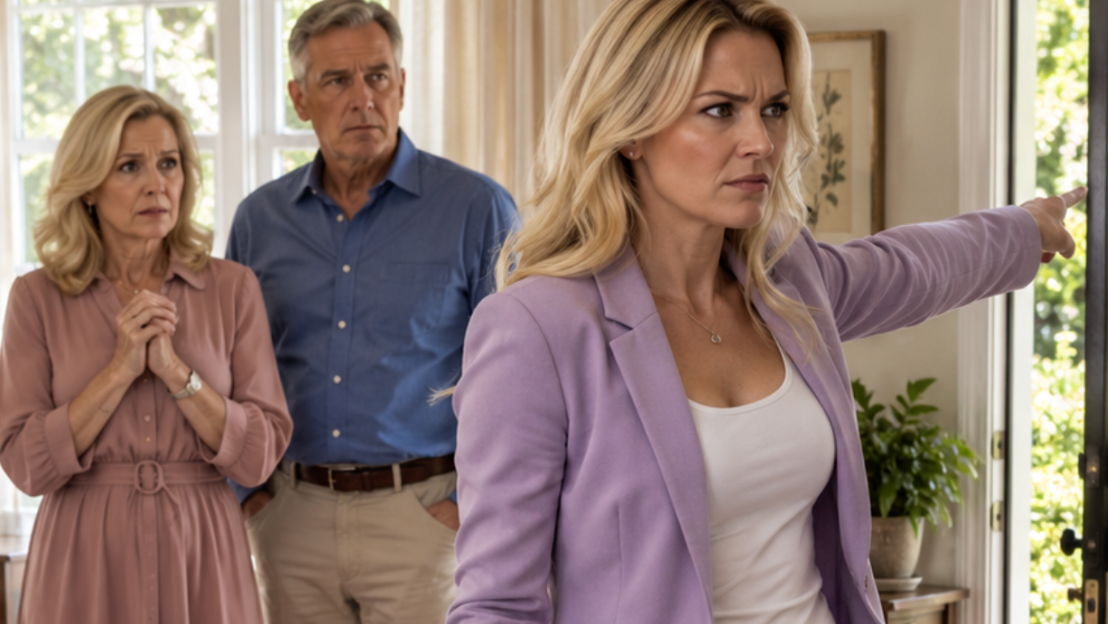
“Now, Tanya, don’t take this the wrong way, but we have to start somewhere,” Maria Sergeyevna said, taking a sip from her porcelain cup decorated with little roses. “And your apartment is simply the perfect place to start.”
I nearly choked on my coffee. Not because it was hot, but because my jaw had practically dropped.
We were sitting in his parents’ kitchen. It was that obligatory Sunday dinner I had to attend once a month so no one could say, “Tanya has no respect for the family.” Well, fine—I didn’t. Not because I was a bad person, but because I wasn’t an idiot.
“Excuse me?” I carefully placed my cup back on its saucer. My voice was icy, and bitterness churned in my stomach.
Maxim sat beside me, tense but silent, like a student taking an exam in structural mechanics.
“You heard correctly, Tanyusha,” Nikolai Petrovich cut in cheerfully. “Maxim’s brother wrecked his car and is now in the hospital. As for the mortgage—well, you understand, that’s fallen through. Maria Sergeyevna and I need somewhere to stay until everything settles down. It might be cramped, but at least we’ll all be together.”
“Cramped? In my apartment?” I looked at Max. “Did you know about this?”
At last, his mouth managed to form something resembling words.
“Tanyush, I just wanted to discuss it with you. But you’re always so busy…”
“Were you planning to register them at my address too?” I stood up. My throat tightened with resentment. “Let’s take this one step at a time.”
The apartment in question belonged to me. I had bought it before we were married—with my own work, my own brains, countless sleepless nights, endless emergencies, and one near-ulcer. My parents were proud of my success, especially my father. He always said, “Never depend on men. It suits them when you have nothing of your own.”
Back then, I used to laugh.
But now…
I had fallen in love with Maxim foolishly—like a girl, not a grown woman. He had seemed gentle, domestic, and dependable. Compared with my exes, he appeared to be a gift from heaven. But after two years of marriage, I was beginning to wonder whether he was really a gift—or an overdue loan.
After dinner, we walked home. It was chilly, and the air smelled of wet asphalt and someone else’s meat patties drifting from a nearby cafeteria. I said nothing. Maxim was silent too.
“Why are you sulking?” he finally asked. “It’s only temporary. They’re having a difficult time…”
“Has it occurred to you that I might be having a difficult time too?” I stopped and looked directly at him. “I never agreed to turn my home into a communal apartment.”
“They’re my parents. Yours wouldn’t be left on the street either if something like this happened to them.”
“My parents have their own home. And a conscience.”
He sighed and lowered his head theatrically. As always.
“I’m just trying to be a good son.”
“And what about me?” I whispered. “Don’t you want to be a good husband?”
The following week felt like a terrible television drama. First came the boxes. Then the phone calls: “When can we bring over the refrigerator?” Then: “Tanya won’t mind if I turn the balcony into a place for my flowers, will she?”
I remained silent.
For the time being.
When I came home from work on Friday evening, exhausted and angry, suitcases were standing right in the hallway. His parents’ suitcases. Maxim stood beside them in a NASA T-shirt, wearing the expression of a man who had just saved the world.
“They’re moving in tomorrow.”
I froze.
“Moving where?”
“In with us, Tanya. Come on… It’s only temporary.”
“You gave them keys?”
“Yes. Why?”
That was when I snapped. I didn’t scream or become hysterical. I spoke with such icy calm that Max nearly jumped out of his slippers.
“Please pack your things. Tonight.”
“What?”
“Didn’t you hear me? I said pack your things. And take your parents’ belongings too. You can stuff everything into their boxes.”
He stood there blinking like a cat caught in a downpour.
“Tanya… Wait, are you serious? This isn’t a reason to…”
“To get divorced?” I tilted my head. “It most certainly is.”
I went into the kitchen and took the documents out of the drawer. The property deed. Mine. Solely and proudly mine.
“I live in this apartment. You are still my husband—for now, until I file for divorce. Your parents have no legal connection to this place. They will not live here. Ever.”
He left, though not immediately. First he tried calling his friends and muttered something about needing “somewhere to spend the night.” I said nothing. I calmly watched him pack his jeans and shower gel. I didn’t help him. I didn’t argue.
He took only one box. He probably left the rest behind “just in case.”
I lay down on the sofa in silence. Complete, impenetrable silence. There was no clattering of his parents’ dishes, no smell of his mother’s old perfume, and no sound of Max mumbling something about family values.
For the first time in a long while, I could breathe easily.
The next morning, my phone screamed as though the building were on fire. It wasn’t the bank or a delivery driver, of course. It was Maria Sergeyevna.
“Tatyana! Have you lost your mind?” Her voice was so shrill that the cat fled under the bed. “You threw my son out? He’s staying with some alcoholic on Matveyevskaya Street!”
I remained silent. I simply listened as a boiling stream of outrage, soap, and disinfectant poured from the phone.
“Do you even know what family means? How could you do this? We’re facing an emergency—a disaster! Maxim’s brother is in the hospital, we’ve been forced out of our apartment, and you… You threw your husband away like a bag of garbage!”
“He packed his own belongings, Maria Sergeyevna,” I replied calmly. “And he gave you the keys himself, without asking me.”
“It was only supposed to be temporary! We simply wanted to get through these difficulties together! You were supposed to support us, not…”
“And why exactly do I owe you support?” I interrupted. “Since when? I’m not a bank, a therapist, or a hostel. I have only one obligation: not to betray myself.”
There was a long silence.
“Well, if that’s how you want it,” she said coldly, “you’d better prepare yourself. This isn’t over.”
Click. She hung up.
At first, I thought it was just another manipulation.
Right. As if.
That same evening, Maxim called. Not to apologize, of course. He called with an ultimatum.
“Tanya,” he began, as if we had merely become separated in a supermarket. “I spoke to a lawyer. He says that if we get divorced, I can demand compensation.”
“For what?” My voice cracked like a light fixture falling from the ceiling.
“For property acquired during the marriage.”
“And what property, for heaven’s sake, did we acquire together? I bought the apartment two years before I met you. Your car is totaled. Your debts belong to you. The only things we acquired jointly, Max, are a toothbrush and your penguin pajamas.”
He was silent. Then he added:
“We still lived there together. That counts too.”
“You know what, Maxim?” I sat on the windowsill and looked into the courtyard. The puddles gleamed like aluminum lids. “You and your lawyer can go jump into one of those puddles.”
Two days later, she appeared at my door. Maria Sergeyevna herself. No phone call. No warning. She was wearing a fur coat even though it was already April, and she carried a folder.
“I’ve come peacefully,” she began, stepping into the hallway as though it belonged to her. “Here are the documents. Maxim’s brother is in the hospital, and their apartment is officially being used as collateral. You have a spare room, so we would like to stay here temporarily.”
“Who is ‘we’?” I leaned against the doorframe.
“Nikolai Petrovich and me. Maxim is staying with a friend for now. But he’ll come back.”
I nearly burst out laughing.
“Have you been watching some movie and decided to imitate it? Or do you seriously think I’m going to let you live here?”
“You have no right to refuse!” she shouted. “Maxim is your husband. That means we’re family.”
“When all of us go on vacation to Turkey together and discuss which wallpaper to choose for the kitchen, then perhaps you can call yourselves family. Until then, you’re strangers.”
She walked farther into the apartment without permission and opened the door to the room I used as my office.
“This is where we’ll stay. I’ll put my bed beside the window.”
I walked over slowly and took her by the arm, carefully, like an orderly escorting a psychiatric patient.
“Maria Sergeyevna, leave. Now.”
“You’ll regret this,” she hissed as she walked out. “You’ll regret it very much.”
“I already regret ever saying yes to your son.”
A week later, I received a court summons. Maxim had filed a claim seeking division of property. I stood there holding the papers, wondering how a person could live beside someone for two years while harboring something like this inside himself.
It had all started with conversations about dumplings and buying a new sofa.
Now it was ending with lawyers and threats.
I could barely concentrate at work. My colleagues started asking questions.
“Tanya, are you sick?”
“Yes. It’s a family condition.”
Humor is the last thing that saves you when everything around you is falling apart.
Then, one evening, the doorbell rang. By that point, I was prepared for anyone: bailiffs, a plumber, even my neighbor Valya with her eternal request to borrow some eggs.
But no.
Nikolai Petrovich stood on the doorstep holding a bag.
“Tanyusha, I don’t want to interfere. But I can’t stay there any longer. She… Well, you know what she’s like.”
“Where are you planning to go?” I asked, drying my hands.
“Could I sleep on your sofa? Just for a day or two. Don’t tell Maria. I’ll say I’m staying with Seryoga.”
I simply stared at him in silence.
Something clicked inside me.
“No, Nikolai Petrovich. That’s no longer possible.”
He nodded sadly, turned around, and left. He wasn’t angry. He simply walked away.
That night, Maxim called me. He was drunk, and his voice trembled.
“Tanya… I understand everything now. I made a mistake. I was under pressure. I never wanted this to go to court…”
“Neither did I. But you’ve already done it.”
“I want to come back. We can fix everything. Please.”
I sat in silence, staring through the window as sparse snowflakes drifted past the streetlights.
And suddenly I understood: I no longer wanted to fix anything.
I wanted to start again.
Without him.
“Tatyana Igorevna? Are you still on the line?”
The voice was polite and masculine, with the kind of hesitant throat-clearing that suggested he was about to sell me replacement windows or offer me a loan.
But no.
It was Maxim’s lawyer.
“I represent your husband’s interests. I would like to discuss a possible settlement in advance so that we don’t unnecessarily prolong the proceedings.”
“Right. May I represent someone too? Perhaps my inner voice assistant: ‘Alice, remind me how to tell my ex to go to hell elegantly.’”
He cleared his throat again. He didn’t understand.
It happens.
“Maxim Nikolayevich is prepared to withdraw his claim to the property if you pay him compensation.”
“Compensation? For what? Wearing out my sofa and burning my frying pan?”
“The court may regard your property as jointly acquired if your husband can prove that he contributed to improving your living conditions…”
“Of course! He put up a shelf in the bathroom. That practically makes me a millionaire.”
“Tatyana Igorevna, we’re simply trying to reach an agreement.”
“And I’m simply trying to get divorced. Quickly. Without pretending we’re still a family or arguing over who gets the pillows.”
The courtroom was quiet and cold. It smelled of office supplies and hopeless anticipation.
Maxim came alone.
He looked… tired. There was no aggression. Only dark circles beneath his eyes, an unshaven chin, and the expression of a lost little boy.
I felt something tighten inside me. But it wasn’t pity.
It was disgust.
Because I remembered the expression on his face when he gave my mother-in-law the keys to my apartment.
The judge was a woman in her sixties with the kind of hairstyle that looked as though her photograph had once been displayed on a Soviet employee-of-the-month board. She studied the documents and then looked at us.
“Are there any grounds for recognizing the apartment as jointly owned marital property?”
“No,” Maxim said quietly. “The apartment was purchased before the marriage. I have no claim to it.”
At first, I could hardly believe it.
He didn’t put on a performance. He didn’t try to play on anyone’s sympathy. He simply… gave up.
Or perhaps he finally understood.
The judge nodded.
“Then the court grants the petition for dissolution of the marriage. The marriage shall be considered dissolved once the judgment enters into legal force.”
That was it.
Three years reduced to a single sentence, like a receipt being printed at a store.
I walked out of the courthouse and suddenly began to laugh—loudly. It was probably a nervous breakdown.
A woman passing by stopped and stared at me curiously.
“Excuse me, is everything all right?”
“Absolutely. I’ve just gotten rid of my husband—and the apartment full of relatives that came with him.”
She smiled.
Then she said, “For me, it was my son. You won’t believe it—he moved into my apartment with his wife and her mother. Two months later, I was the one who moved out.”
We laughed together.
Two strangers.
Two survivors.
The next day, a courier arrived carrying a large box. The label said it was from Maxim.
Inside was a framed photograph from our wedding, turned facedown, and a note:
“Thank you for everything. I’m sorry we couldn’t make it work.”
I looked at the frame, shrugged, and threw it in the trash.
Not out of anger.
There simply wasn’t anything left worth keeping.
A couple of weeks later, Maria Sergeyevna returned. Yes, again. This time she wasn’t wearing her fur coat. She wore an ordinary coat and a sour expression. In her hands was a small plastic bag.
“This is everything of Max’s that was left at your place. His comb, key chain, and blanket. You can take them.”
“They can stay with you. His things belong to you now—just like he does.”
“Do you think you’ve won something? You’re alone now. And loneliness is worse than poverty.”
“You know, Maria Sergeyevna,” I said, adjusting the collar of my jacket, “loneliness is when you live with three relatives in a two-bedroom apartment and all of them think you owe them something. Right now, I have silence, order, and a bed of my own. Believe me—I’ve come out ahead.”
Three months passed.
I renovated the room where Her Majesty and my father-in-law had once planned to stay “temporarily.” Now it is a cozy office with a comfortable chair and a set of dumbbells.
And you know what?
I’ve started taking up much more space in bed.
Not because there is more room now.
But because I can finally breathe again.