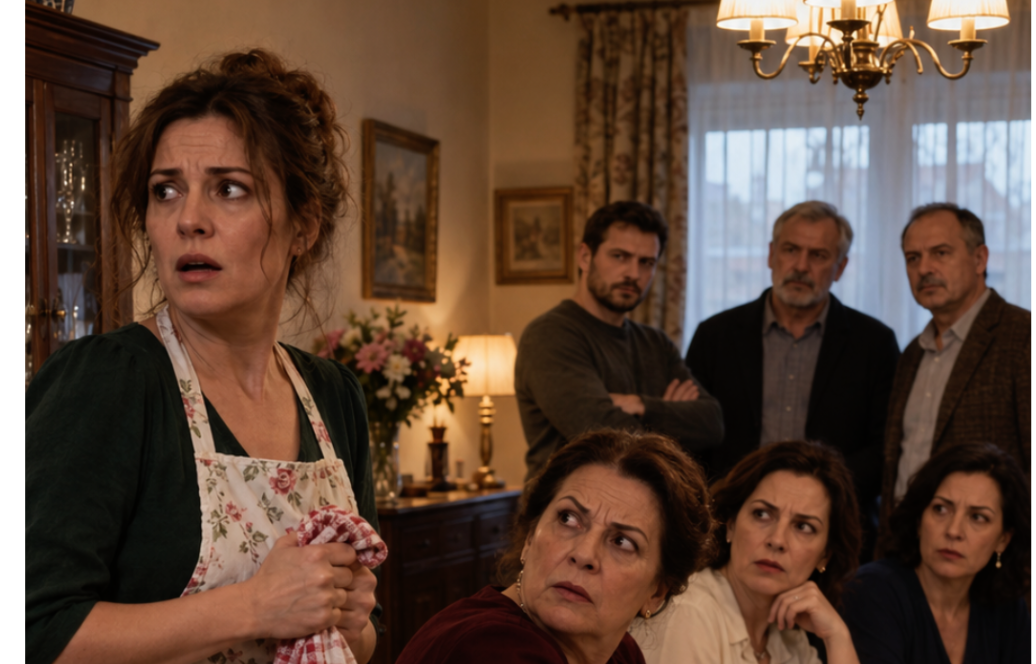
Marina stood at the kitchen sink, mechanically rinsing plates under a stream of cold water. Her hands trembled from exhaustion and suppressed tears. Behind her came the familiar sound of footsteps—firm, commanding, and uncompromising.
“You’re washing the dishes incorrectly again,” Valentina Pavlovna’s voice sliced through the kitchen silence like a knife. “See that spot left on the glass? We don’t do things like that in our family. But how would you know? You’re from some little village…”
Marina pressed her lips together and continued washing the dishes. Three years of marriage, three years of these barbed remarks, insinuations, and constant corrections. Her mother-in-law never missed an opportunity to remind Marina that she had come to Moscow from a small town near Ryazan, that she had “latched onto” their family, and that she was living in their apartment only thanks to fortunate circumstances.
“Marina, can you hear me?” Valentina Pavlovna stepped closer, and Marina could feel her presence with every inch of her skin. “I’m talking to you.”
“I can hear you,” Marina answered quietly without turning around.
“Good. Tomorrow, you’ll need to wash the curtains in the living room. They’ve been hanging there for two weeks, and you don’t seem to care. And when you make soup, remember to add more carrots. Sasha likes plenty of carrots. Though how would you know what my son likes?”
Marina tightened her grip on the sponge. Sasha was her husband, her beloved Alexander, who somehow turned into a helpless little boy whenever his mother was around and dismissed all of Marina’s problems as trivial.
“I remember about the carrots,” Marina whispered.
“What are you mumbling? Speak louder. I’m not accustomed to people behaving like this.”
Marina turned around, and Valentina Pavlovna saw that her eyes were red from holding back tears.
“I said that I remember about the carrots.”
“Oh, I see. So now you’ve started talking back to me?” Her mother-in-law drew herself up to her full height. “Am I not the senior woman in this household? Am I not your husband’s mother? Who raised you—bears in the forest?”
Marina turned back toward the sink. Tears were already rolling down her cheeks, but she tried to keep her sobs from being heard. Valentina Pavlovna stood there for another moment, apparently savoring her victory, and then withdrew to her room.
Marina finished washing the dishes and went to her bedroom—the only place in the apartment where she could be alone. Sasha had not yet returned from work, so she allowed herself to cry openly, burying her face in the pillow.
That was how her husband found her when he came home at around nine in the evening.
“Marinka, what happened?” He sat on the edge of the bed and gently touched her shoulder.
“Nothing,” she sobbed without lifting her head.
“What do you mean, nothing? You’re crying. Did something happen?”
Marina remained silent for a moment, fighting the urge to pour her heart out. She knew what would come next: Sasha would once again say that she was exaggerating, that his mother was only trying to help, and that Marina needed to be more patient.
“Your mother,” she finally whispered. “She did it again… She said I was raised by bears in the forest.”
Alexander laughed lightly and carelessly, as though he had heard an amusing joke.
“Marinka, are you seriously upset about that? Mom is just like that. She’s always blunt. She doesn’t mean any harm. She only wants you to improve, to live up to our family. Don’t take it so personally.”
“But Sasha…”
“No buts. You’re a smart girl; you should understand. Mom has lived a long life and has plenty of experience. You’re still young, and there’s a lot you don’t know. That’s perfectly normal.”
Marina felt hurt and bitter. Even her husband did not understand her. Even the person closest to her considered her feelings nothing more than foolishness.
“I understand,” she said quietly.
“That’s my girl. Go wash your face while I say hello to Mom.”
Sasha left, and Marina remained on the bed, staring at the ceiling. Three years earlier, she had been so happy when they got married. Sasha had seemed like a prince who had carried her away from her small town and into a bigger life. She could never have imagined that this bigger life would turn into daily humiliation.
The following days passed in the usual routine. Valentina Pavlovna criticized Marina’s every move—the coffee was too strong, the shelf had not been dusted properly, she spoke too softly, or she spoke too loudly. As usual, Alexander noticed nothing. He came home from work tired, ate dinner, watched television, and went to bed.
A week before Valentina Pavlovna’s birthday, the atmosphere in the apartment became even more tense.
“Marina, come here,” her mother-in-law called from the living room. “We need to discuss my birthday.”
Marina put down her book and went into the living room. Valentina Pavlovna was sitting in her favorite armchair with a notebook in her hands.
“I’ve invited eight of my friends. We’ll need to prepare a cake, salads, and a main course. I’ve made a shopping list.” She handed Marina a page covered in writing. “You’ll go to the market first thing tomorrow morning. And don’t even think about saving money on the ingredients. It’s my birthday, after all.”
“All right,” Marina said with a nod.
“And one more thing. You’ll do all the cooking. I’m not young anymore, and you sit at home all day. I hope you’ve at least learned how to do something useful over the years.”
Marina remained silent. She had stopped trying to explain to her mother-in-law that freelancing was also work. Marina was an excellent cook; her mother, who had spent her entire life working as a cook in the local cafeteria, had taught her. But Valentina Pavlovna preferred to pretend that all of her daughter-in-law’s abilities were merely accidental and that working from home was not real work.
“I’ll do my best,” she said.
“You’ll do your best?” Her mother-in-law raised her eyebrows. “You should be grateful that I trust you with something so important. Another woman in my position would do everything herself, but I’m allowing you to prove yourself.”
On the morning of the birthday celebration, Marina got up at five. She had to prepare numerous dishes, decorate the apartment, and set the table. Valentina Pavlovna, of course, was not going to sit idly by. She supervised her daughter-in-law’s every movement.
“Marina, you’re slicing the herring incorrectly. Can’t you see that the pieces are different thicknesses? It looks terrible. Do it again.”
“Marina, the cake frosting is too runny. I told you to add more powdered sugar. What are we supposed to do now?”
“Marina, what kind of table setting is this? The forks should be on the left and the knives on the right. These are the fundamentals of etiquette that every properly raised young woman should know.”
By five in the afternoon, Marina was ready to collapse from exhaustion. Her hands hurt and her back ached, but the table was set, the food was prepared, and the apartment gleamed with cleanliness.
“Not bad,” Valentina Pavlovna said as she inspected the table. “Of course, you could have folded the napkins more elegantly, but that is clearly beyond you. Now go and change.”
“Change into what?” Marina asked in surprise.
“What do you mean? You’ll be serving everyone at the table. I prepared something especially for you.”
Valentina Pavlovna took a starched, snow-white apron and a serving cloth out of the cupboard.
“But I thought I would be sitting with the guests,” Marina said, bewildered.
“Sitting with the guests?” her mother-in-law laughed. “My dear, these are mature, educated people. What could you possibly talk to them about? It would be better for you to make yourself useful—serve the food, clear the dishes, and pour the wine. At least then you’ll be of some real use.”
Marina silently took the apron. Inside, she was boiling with hurt and humiliation, but she could not do anything about it. Not that day, not on her mother-in-law’s birthday, and not in front of the guests.
At seven o’clock, Valentina Pavlovna’s friends began arriving. They were women around her age, all smartly dressed, with professionally styled hair and expensive handbags. They gasped with delight when they saw the beautifully arranged table.
“Valya, how beautiful!” one of them exclaimed. “How did you manage to organize everything so perfectly?”
“I certainly worked hard,” Valentina Pavlovna replied with a satisfied smile. “Though I did have some help. Marina, come out and introduce yourself to the guests.”
Marina emerged from the kitchen wearing the snow-white apron and feeling as though she were being interrogated.
“Oh, my goodness!” the guests exclaimed, clapping their hands. “Valya, what a wonderful daughter-in-law you have! She looks just like a real waitress. Not everyone would agree to do that.”
“Of course not,” Valentina Pavlovna said with a nod. “But I’m raising her properly and teaching her how things should be done. She’s from the provinces, you know, so there’s a lot she doesn’t understand. But she’s learning and trying.”
Marina stood there and listened as they spoke about her in the third person, as though she were not even in the room. Her cheeks burned with shame, but she forced herself to smile.
“Marina, serve the wine,” her mother-in-law commanded.
The evening became a form of torture. Encouraged by the attention of her friends, Valentina Pavlovna ordered her daughter-in-law around with increasing shamelessness.
“Marina, clear the plates! Marina, bring out the dessert! Marina, wash the glasses! Marina, wipe the table!”
Her friends watched with interest and approval.
“Valya, you’re doing an excellent job of raising your daughter-in-law,” one of them remarked. “Young people these days have become completely undisciplined, but yours knows her place.”
“I brought her out of the backwoods and taught her everything,” Valentina Pavlovna declared proudly. “When she first arrived, she couldn’t even make soup. Just look at her now—she keeps the house clean and cooks well. Of course, sometimes I still have to remind her how things should be done.”
Marina was carrying another stack of plates away when she heard the conversation continue.
“Valya, could you lend me your daughter-in-law for a week?” one of her friends asked with a laugh. “My grandchildren are coming, and I don’t have anyone to help me. Let her wait on us for a while.”
“Take her. I don’t mind,” Valentina Pavlovna said with a dismissive wave of her hand. “It might even do her some good, and I’ll see how she manages without my supervision. She sometimes gets too comfortable.”
“Excellent! Perhaps you could lend her to me afterward?” another guest joined in. “For my husband’s birthday. Hiring a waitress is expensive, but this way we’d have one in the family.”
“Of course, girls, of course. We’re friends, after all. We’ll rent my daughter-in-law out,” Valentina Pavlovna laughed, and all the others joined her.
Marina stood in the kitchen doorway, clutching the dirty plates in her hands.
Renting out her daughter-in-law. Like an object. Like a servant who could be lent to friends for their celebrations.
All the humiliation she had endured over the years, every tear she had swallowed and every grievance she had suppressed, burst out in a single scorching wave.
Marina placed the plates on the floor, slowly untied the apron, and removed the cloth from her hand.
“That’s enough!” she said loudly and clearly. “I am not your servant!”
A deathly silence fell over the living room. Everyone turned toward Marina, who stood in the doorway holding the apron.
“What did you say?” Valentina Pavlovna asked slowly.
“I said that I am not your servant!” Marina repeated, her voice growing stronger. “I am not an object that you can rent out. I am a human being. I am your daughter-in-law, not your maid.”
She threw the apron and cloth directly into her mother-in-law’s face. Valentina Pavlovna recoiled while her friends sat with their mouths hanging open.
“For three years, I have endured your humiliation,” Marina continued, the words pouring out of her. “For three years, you have reminded me that I’m from the provinces, that I latched onto your family, and that I’m living in your apartment. For three years, you have turned my life into hell, while my husband has treated it as if it were nothing.”
“Marina, have you lost your mind?” Valentina Pavlovna finally managed to speak. “How dare you talk to your elders like that!”
“I dare because I am a living human being, not a doll you can torment for your amusement. I dare because I am tired of being your servant.”
Marina turned and headed for the door.
“Where are you going?” her mother-in-law shouted after her.
“Anywhere, as long as it gets me away from here,” Marina answered without turning around. “Forever.”
She grabbed her jacket and walked out of the apartment, slamming the door behind her. On the landing, she stopped, leaned against the wall, and closed her eyes. Her hands were trembling and her heart was pounding, but for the first time in three years, she felt free.
Marina went downstairs and stepped outside. It was a chilly October evening, but she did not feel the cold. She took out her phone and dialed her friend’s number.
“Lena? It’s me. Can I stay at your place tonight?”
Her friend’s worried voice came through the phone.
“Marina, what happened? Where are you?”
“I left. For good. I’ll tell you everything when I get there.”
Alexander came to Lena’s apartment the following day. Marina saw him through the window. He was standing near the entrance, smoking and nervously crushing the cigarette between his fingers.
“Don’t you want to talk to him?” Lena asked.
“I don’t know,” Marina admitted. “I’m afraid he’ll say I’m exaggerating again.”
But Lena had already opened the window and called down:
“Sasha, come upstairs!”
When Alexander entered, Marina saw that he looked disheveled and lost. Evidently, he had had a difficult night.
“Marinka,” he said, sitting across from her. “Forgive me.”
“For what?” she asked quietly.
“For not listening to you. For refusing to see what was happening. For treating your problems as though they were nothing.” He ran a hand through his hair. “When Mom told her friends what had happened, I realized… I realized what had been going on in our home.”
“And what did you realize?”
“That Mom had turned you into a servant. That she humiliated you every day while I turned a blind eye. That I betrayed you—my wife—just so I could have a peaceful life.”
Marina remained silent. Her husband was saying all the right things, but she was afraid to believe him.
“I spent the entire night thinking about what you said,” Alexander continued. “And I realized that you were right. Mom really did turn our family into some sort of feudal system in which you were the serf.”
“What are you suggesting?” Marina asked.
“We’ll move out. We’ll rent an apartment. Just the two of us.”
“And your mother?”
“Mom is an adult. She’ll manage. And if she doesn’t, that’s her problem, not ours.”
Marina looked at her husband. In his eyes, she saw something she had not seen in a long time—genuine remorse and a willingness to change.
“All right,” she said. “But I have one condition.”
“What is it?”
“If your mother ever tries to speak to me that way again, I’m leaving. Forever. I will not tolerate any more humiliation.”
“You won’t have to,” Alexander said firmly. “I promise.”
A month later, they moved into a rented apartment in another part of the city. Marina found a job at an advertising agency, which was more stable than freelancing. Alexander remained in contact with his mother, but clear boundaries were established.
Valentina Pavlovna tried several times to return everything to the way it had been. Sometimes she called with complaints; other times, she arrived without warning. But each time, she encountered her son’s firm resistance. He had finally understood that his wife was more important than his mother’s ambitions.
One evening, as Marina prepared dinner in their small but cozy kitchen, Alexander came up behind her and wrapped his arms around her.
“Do you regret it?” he asked.
“Regret what?”
“Causing that scene at Mom’s birthday celebration.”
Marina smiled as she remembered that evening—the apron thrown into her mother-in-law’s face, the guests’ astonished expressions, and her own words: “That’s enough! I am not your servant!”
“No,” she said. “I don’t regret it. It was the best decision I made in those three years.”
“Why?”
“Because I finally stopped being a victim. Because I remembered that I am a human being, not an object. And because I finally got a husband who loves and protects me.”
Alexander held her more tightly.
“I love you, Marinka. And I will never allow anyone to humiliate you again.”
“I know,” she whispered. “I know.”