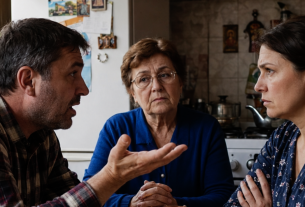
The morning began with Sveta oversleeping. It wasn’t as if she had planned to leap out of bed at six, but she had apparently dismissed the alarm on her phone, set for seven, in her sleep. When she finally opened her eyes, it was already broad daylight outside. Dima was sleeping beside her with his face buried in the pillow. He didn’t even stir when she abruptly sat up, swearing under her breath.
It was 8:42. She needed to be at the bank by nine to withdraw cash; otherwise, she wouldn’t make it to work by ten. There was a deadline waiting for her, along with a boss who regarded every late arrival as a personal insult. And then there was the anniversary celebration.
Sveta threw off the blanket, slipped her feet into her slippers, and headed for the kitchen, trying to gather her scattered thoughts as she walked. Two days earlier, Galina Petrovna, Dima’s mother, had made such a scene over the phone that Sveta’s ears were still ringing. Turning sixty-five was no joke, she had declared. It had to be celebrated in a restaurant—and not some shabby little café, but a respectable establishment with caviar and proper service, so she wouldn’t be embarrassed in front of her friends.
Sveta had looked at Dima then, expecting him to defend her and say that money was already tight, that they had a mortgage and a car loan. Instead, he had merely shrugged and muttered, “Mom is right. She’s done so much for us.”
“Done so much,” Sveta mimicked silently as she switched on the kettle.
During their seven years of marriage, her mother-in-law had accomplished only one thing: she had taught her son that a wife was a kind of household appliance expected to clean, cook, work, and keep quiet. And now Sveta was apparently expected to organize celebrations at her own expense as well.
She reached into her handbag and checked her wallet. Empty. The money was in an envelope on the cabinet in the hallway—her share, fifty thousand rubles. Dima had supposedly already transferred his contribution to his mother’s bank card, while Sveta had been instructed to withdraw cash and pay for the banquet hall. For some reason, that responsibility had also fallen on her, just like everything else.
She didn’t even stop for tea; there was no time. She washed quickly, pulled on jeans and a sweater, grabbed her phone, and was almost out the door when she noticed the envelope. Plain white, without any writing, it lay peacefully on the cabinet.
Sveta bent down, picked it up, and weighed it in her hand. Fifty thousand rubles—two months of her salary. She put the envelope into her handbag, checked that the zipper was closed, and hurried out into the stairwell.
Downstairs, near the elevator, the air smelled of cats and dampness. Sveta pressed the button and shifted impatiently from one foot to the other. The elevator crawled toward her as though it were deliberately tormenting her. Only one thought went through her mind: Please let me reach the bank in time. Please don’t let there be a line.
It was cold outside. It was late September, and the wind tore leaves from the poplar trees and flung them directly beneath her feet. Sveta practically ran toward the bus stop while trying to order a taxi through an app. A car accepted the ride quickly, but they had to crawl through traffic, and she didn’t reach the bank until 9:37.
There were about fifteen people in line. Sveta took her place and tried not to think about what her boss would say. She hated being late, but everything had gone wrong from the moment she woke up.
While she was waiting, Galina Petrovna called. Sveta rolled her eyes but answered, forcing herself to speak calmly.
“Sveta, did you take the money?” Her mother-in-law’s voice was as sweet as sour syrup.
“I’m standing in the bank,” Sveta replied curtly.
“Don’t tell me you forgot. You understand that I can’t afford to embarrass myself. I’ve already told all my friends that we’re having the celebration at a restaurant, not in some shack.”
“I remember.”
“And the tablecloths must be turquoise. I’ve told you a hundred times. Not pale blue, not dark blue—turquoise. And the caviar must be pike caviar, not that… what is it called… pollock. I will not allow them to serve pollock.”
Sveta gripped the phone so tightly that her knuckles turned white.
“Uh-huh,” she managed.
“And don’t ‘uh-huh’ me. Dimochka said you were responsible, so kindly live up to that.”
Sveta ended the call before her mother-in-law could add anything else. A dull fury was rising inside her, and she forced herself to breathe slowly. One, two, three.
Her mother had always said, “Family requires patience.”
But her mother had never met Galina Petrovna.
At last, it was her turn. The woman behind the glass looked at Sveta’s passport, glanced at the envelope, and entered something into the computer.
“You want to withdraw fifty thousand rubles in cash?”
“Yes.”
The banknotes were placed in a neat stack inside the envelope. Sveta counted them, returned the envelope to her handbag, and went outside. It was ten minutes past ten. She might still have been able to catch a minibus to the office, but then she remembered that she had left her security pass at home. The damned pass. Without it, she would have to explain herself to the guards at the entrance, which would cost her another twenty minutes.
Swearing through clenched teeth, she gave up on arriving on time and headed back home. Fortunately, they lived close to the city center.
The entrance hall greeted her with the same smell of cats. Sveta climbed to the fourth floor, trying not to make any noise. Dima might still be asleep, and if she woke him, he would spend half the day complaining about it.
Her key turned in the lock almost silently. She opened the door slightly and stepped into the hallway, careful not to make the floorboards creak.
She took off her sneakers and placed her handbag on the cabinet. The envelope was inside, but for a moment she imagined that she had left it at the bank, so she quickly unzipped the bag to check. It was there.
She exhaled.
And then she heard voices.
They were coming from the kitchen. Dima was speaking quietly but excitedly. The second voice was female, with the familiar patronizing intonation that could belong only to Galina Petrovna.
Sveta froze without removing her jacket.
What was her mother-in-law doing in their apartment at this hour? She had said she would come over in the evening to help prepare the cucumbers. Apparently, she had decided to arrive early.
Sveta was about to walk in and make her presence known, but something stopped her. Something in the tone of their voices.
She remained in the hallway, gripping the strap of her handbag and listening.
“Dimochka, stop getting so worked up,” her mother-in-law said in a quiet, insinuating voice that sounded like the hiss of a snake. “We’ll complete the apartment paperwork tomorrow. She doesn’t suspect a thing.”
Everything inside Sveta seemed to collapse before tightening into an icy knot. She stopped breathing. The room swayed around her, and she instinctively grabbed the coat rack to keep herself from falling.
“Mom, I can’t do it,” Dima said, his voice trembling. “It just feels… wrong.”
“What’s wrong is your wife draining money from you and refusing to give you an heir. We’re merely restoring justice. The apartment was purchased with my savings, so she should be grateful that she was allowed to live here for free.”
Nausea rose in Sveta’s throat.
The apartment. Their two-bedroom apartment. The one for which her parents had sold their country house to provide the down payment. The one whose mortgage consumed more than half her salary every month.
So that was how things were.
She stood there, afraid to move, her mind racing feverishly. What paperwork were they talking about? Which apartment? Were they planning to transfer ownership to her mother-in-law? Or sell it?
She heard a chair being pushed back in the kitchen.
Sveta flinched. She had to do something, or they would catch her.
Slowly, on tiptoe, she backed toward the front door, found the handle, and slipped onto the landing. Her heart was pounding in her throat, and her temples throbbed. She sat on the stairs, not feeling the cold concrete beneath her, and covered her mouth with her hand to keep herself from screaming.
Her mind was in chaos. Her thoughts scattered like frightened birds.
Complete the paperwork? Tomorrow? She doesn’t suspect a thing?
She knew Dima had the day off tomorrow. She also knew that Galina Petrovna always seemed to have business to attend to at one government office or another.
But this?
Sveta forced herself to stand. Her legs barely obeyed her. She walked down one flight of stairs and stopped by the window. Cold air seeped through a crack in the frame and helped clear her head.
She needed to calm down and think.
But how could she think when the ground was disappearing beneath her feet?
She called her friend Anya. Anya answered after the third ring.
“Hello,” Sveta said, her voice trembling.
“Sveta? What happened? Where are you?”
“I… I came home. I forgot something. And I heard them. Anya, they want to transfer the apartment tomorrow. Without me.”
There was a pause on the other end. Anya was a psychologist and knew how to control her emotions, but even she couldn’t hide her shock.
“Okay. Stop. Are you certain?”
“I heard it with my own ears! My mother-in-law said, ‘We’ll complete the apartment paperwork tomorrow. She doesn’t suspect a thing.’ And Dima told her it was wrong. But she’ll pressure him until he gives in. I know she will.”
“Sveta, where are you right now?”
“In the stairwell. Sitting here like an idiot.”
“Get up and come to my place. Immediately. Do you hear me? Don’t confront them. First, we need to think about what to do.”
Sveta sobbed. She felt as though someone had punched her in the stomach and then kicked her while she was down.
“What about work?” she asked, even though work was the last thing she cared about now.
“Call and say you’re sick. Who cares? Just come here.”
Sveta wiped her eyes with her sleeve and forced herself to leave the building. Her mother-in-law’s car was parked outside—old but well maintained. That meant she was still upstairs.
The taxi ride to Anya’s house took about twenty minutes. Sveta stared silently out the window, replaying what she had heard.
“She doesn’t suspect a thing.”
She didn’t suspect a thing!
She—the woman who worked like a horse and supported that mama’s boy who couldn’t even carry his dirty socks all the way to the laundry basket. She—the woman who had denied herself a new coat to make another mortgage payment. She—the woman who had entered into that debt with him when she could have refused.
Anya met her at the door in a robe, holding a cup of coffee. She led Sveta into the kitchen and pushed a glass of water into her hands.
“Tell me everything from the beginning.”
Sveta told her. Her account was disjointed, and she kept jumping from one detail to another, but Anya listened carefully without interrupting. When Sveta finished, her friend leaned back and shook her head.
“What a pair of rats. All right, let’s focus on the facts. The apartment is mortgaged. Is it registered in Dima’s name?”
“Yes. He has an official salary, while part of mine is paid off the books. The bank approved the loan only in his name. But my parents sold their country house to provide the down payment. I told you that.”
“You did. Are you named in the mortgage agreement as a co-borrower? Or perhaps as a guarantor?”
Sveta thought for a moment. She remembered signing a pile of documents. There might have been some kind of guarantee agreement. Or perhaps it was a co-borrower agreement. She couldn’t remember.
“I’m not sure. I need to look at the documents.”
“Where are they?”
“In the wardrobe, in a folder. But I can’t go back there now.”
“Why not? It’s your home. You have every right.”
“Anya, I’m afraid. If they realize I know something, they’ll speed everything up. First, I need to find out exactly what they’re planning.”
Anya studied her for a long moment.
“Sveta, do you understand that if they transfer ownership of the apartment without your consent, you could end up on the street? Do you understand that this could constitute fraud? And that your precious husband may already have signed some documents?”
Sveta covered her face with her hands. She wanted the floor to swallow her.
“What should I do? Tell me.”
“First, calm down. Second, find out what’s in those documents. Do you remember signing anything unusual recently?”
Sveta searched her memory. About two weeks earlier, Dima had brought home a stack of papers and said they needed to renew the apartment insurance. He had asked her to sign several pages marked with little checkmarks. She had been rushing to work and hadn’t read them. She had simply scribbled her signature.
“There was some document about insurance. He said it was just a formality. I signed without reading it.”
Anya grimaced.
“That’s bad. Very bad. If you signed a power of attorney or consent authorizing certain actions, it could be used against you.”
Panic swept over Sveta again.
“But I didn’t know! Surely that matters?”
“It may be difficult to prove in court that you didn’t know if your signature is on the document. All right, there’s another option: collect evidence. If you can record their conversations and photograph the documents, that could help you.”
“How?”
“Use your phone’s voice recorder. When you go home, turn it on. Try to get them to speak openly.”
Sveta shook her head. The thought of pretending and smiling at people who were secretly planning to destroy her made her feel sick.
“I can’t do that.”
“Yes, you can. You’re strong. Just remember that they’re trying to cheat you. You don’t want to be left with nothing, do you?”
Sveta said nothing. She didn’t want to think about what would happen if she failed.
She stayed at Anya’s until evening. She ignored Dima’s calls at first but eventually sent him a message saying she had been delayed at work. She had to go home sooner or later if she wanted to find the documents.
It was around nine when she opened the apartment door. The place smelled of dinner; apparently, Dima had heated something for himself. He came into the hallway wearing a guilty expression.
“Sveta, where have you been? I called you.”
“Work kept me late.” She avoided looking into his eyes. “Why are you home? Your day off is tomorrow, isn’t it?”
“Yes, I’m off tomorrow. Mom and I are going to the public services center. There’s some paperwork concerning the country house.”
Everything inside Sveta turned cold.
So it really was tomorrow.
She took a deep breath and forced herself to smile.
“I see. I’m exhausted. I’m going to bed.”
“What about dinner?”
“I’m not hungry.”
She went into the bedroom, closed the door, and listened. Dima moved around the kitchen for a while, then everything became quiet. Sveta lay in the darkness, staring at the ceiling and mentally rehearsing the following day.
She had to behave as though nothing had happened.
And she had to find that folder of documents.
In the middle of the night, she got up and crept into the study. Dima was asleep, snoring softly. Sveta opened the wardrobe and found a folder labeled “Mortgage.” Inside were contracts, payment schedules, and receipts. She searched for the guarantee agreement or at least some mention of her name.
And she found it.
It was a guarantee agreement stating that she would be responsible for the loan obligations if Dima stopped making payments. There was a signature on it, but it wasn’t hers. She studied the scrawl. It resembled her signature, but it wasn’t quite right.
She didn’t remember signing that particular document.
Or had she?
Sveta photographed every document with her phone, taking care not to make any noise. Then she returned the folder to its place and went back to bed.
Sleep would not come.
She awoke in the morning with a headache. Dima was already up and getting ready to leave.
“I’m going to the public services center with Mom,” he said without looking at her. “I’ll be back this evening.”
“All right,” Sveta said, struggling to keep her voice steady. “What time is the anniversary celebration? I still have to decorate the hall.”
“Mom said to be there by six. You know the Laguna restaurant.”
“I know.”
He left, and Sveta was alone. For the first time in a long while, she felt she could breathe freely—but only for a second. Then the panic returned.
She grabbed her phone and called Anya.
“He went to the public services center with his mother. He said it was about the country house, but we know the truth.”
“Follow them,” Anya said firmly. “Find out where they’re really going.”
Sveta hesitated. Following her husband felt so sordid.
But was it more sordid than what they were doing to her?
She put on dark glasses, tied a scarf around her head to alter her appearance, and went outside. Dima’s car was already pulling away from the building. Sveta quickly hailed a taxi and asked the driver to follow it.
They drove for about twenty minutes before stopping outside a notary’s office. Sveta asked the taxi driver to park a short distance away and crouched low in the back seat.
Dima and Galina Petrovna got out of the car. Her mother-in-law was explaining something energetically, waving her hands. Dima nodded with his head lowered.
Sveta watched them disappear through the glass doors.
They came out forty minutes later. Both looked tense. Galina Petrovna angrily said something to Dima, and he spread his hands helplessly. Sveta watched them get into the car and drive away.
She remained in the taxi, trying to understand what had happened.
A notary. That meant some kind of transaction.
But what kind?
“Where to now?” the taxi driver asked.
“Fourteen Lermontov Street,” she replied, giving him her mother-in-law’s address.
She dismissed the taxi outside the apartment building and walked around the courtyard, pretending merely to be out for a stroll. Zoya Viktorovna, Galina Petrovna’s neighbor, was sitting on a bench nearby. The old woman examined Sveta curiously.
“Hello,” Sveta said with a nod.
“Oh, aren’t you Sveta, Galya’s daughter-in-law?” the woman asked, squinting. “I was wondering why you were wandering around here.”
“I thought I’d stop by, but no one is answering the door. Do you happen to know where Galina Petrovna is?”
Zoya Viktorovna immediately became animated and leaned forward.
“She left early this morning with Dima. I heard them arguing. Galya was shouting that if he refused to sign, she would cut him out of her will.”
“Sign what? What was he supposed to sign?”
“Who knows with those two? But she recently told me she wanted to sell the country house and buy a bigger apartment so she could live with you. I don’t know whether it’s true.”
Sveta felt her heart tighten.
A bigger apartment.
So they wanted to sell their two-bedroom apartment, add the money from the sale of the country house, and buy a three-bedroom place.
But they had no intention of registering any part of it in Sveta’s name. She knew that as clearly as she knew it was raining.
“Zoya Viktorovna, do you know whether they’ve already sold the country house?” Sveta asked, trying to keep her voice calm.
“I don’t think so. Galya keeps asking too much for it, so no one wants to buy. But she’s in a hurry because she has already found an apartment she likes. She wants to complete everything before the end of the month.”
Sveta thanked the old woman and walked away. A plan—or rather, a crazy idea for collecting evidence—was beginning to form in her mind.
She returned home and waited.
Dima arrived that evening looking gloomy and exhausted. Sveta pretended to be absorbed in a television series.
“How did it go?” she asked casually.
“Fine. I’m tired.”
“And the public services center? Did you sort everything out?”
Dima flinched and looked away.
“No, it was only a consultation. Don’t worry about it.”
Sveta nodded and turned her attention back to the screen.
Inside, however, she was boiling.
She couldn’t sleep again that night. Once Dima had fallen asleep, she crept into the hallway and searched his bag. She found a folded sheet of paper and opened it.
It was a draft agreement for the sale of a share in the apartment. It contained names, amounts, and dates.
And a signature that wasn’t hers.
A copy of her passport was attached.
In the section marked “Seller,” her name appeared:
Svetlana Sergeyevna Lapina.
Her vision went dark.
With trembling hands, she photographed the document and returned it to its place.
The following day was the anniversary celebration. Sveta spent the entire day as though she were dreaming. She knew something important would happen that evening, but she didn’t yet know exactly what.
The Laguna restaurant glittered with lights. Galina Petrovna, wearing a turquoise dress and an elaborate updo, played the queen. Her friends, just as pompous as she was, discussed the latest gossip. Dima hovered nearby, refilling the ladies’ wine glasses.
Sveta sat in the corner of the hall, gripping a clutch that contained her phone with the voice recorder switched on. She had already arranged for Anya to come if anything happened.
For the moment, however, she had to play the role of the happy daughter-in-law.
When the main course was served, Sveta rose with a glass in her hand.
“Dear Galina Petrovna!” Her voice sounded bright and almost sincere. “I would like to drink to you. To your wisdom and your care. To the fact that you raised such a wonderful son.”
She paused and looked around the room. Everyone was watching her, including Dima, whose face had gone rigid with anxiety.
“And I would also like to thank this family for teaching me to appreciate my share in our jointly owned apartment. For teaching me the true cost of betrayal.”
The silence was so profound that they could hear cutlery clinking at the neighboring table.
Galina Petrovna turned pale and gripped the edge of the tablecloth.
“What nonsense are you talking?” she hissed.
“Nothing. It’s only a toast.” Sveta smiled and sat down.
Dima stared at her as though she had lost her mind. Sveta calmly lifted her glass and took a sip.
They barely spoke after dinner. They returned home in silence. Sveta could hear her husband tossing and turning in bed, but she didn’t say a word.
The following morning, a local police officer came to their apartment.
Galina Petrovna and Dima had filed a complaint claiming that Sveta was making threats, causing scandals, and damaging property.
Sveta opened the door, looked at the young lieutenant and then at her husband and mother-in-law standing behind him, and smirked.
“Come in. I happen to have something to show you.”
She took out her phone and played the recording on which Galina Petrovna’s voice could clearly be heard saying, “We’ll complete the apartment paperwork tomorrow. She doesn’t suspect a thing.”
Then she showed him the photographs of the draft agreement bearing the forged signature.
The police officer frowned.
Galina Petrovna turned as white as a sheet, and Dima began to stammer.
“It isn’t what you think!” he shouted. “It was Mom’s idea! I didn’t want to do it!”
Sveta looked at him with pity.
“And whose signature is on the power of attorney?”
She didn’t say another word.
The lawyer she hired handled everything quickly: the divorce and the division of their property. Thanks to the evidence Sveta had collected, no criminal fraud case was ultimately opened, but Dima was forced to compensate her for her share of the apartment, which was valued at a substantial sum.
When Galina Petrovna learned that her son could have gone to prison, her blood pressure soared. She became bedridden and required lengthy treatment.
Sveta bought a small apartment on the outskirts of the city. At first, it felt empty and frightening. Then she adopted a cat, painted the walls peach, and realized that, for the first time in many years, she was sleeping peacefully through the night.
One day, while sorting through some old belongings, she found the envelope that had once held the fifty thousand rubles intended for the anniversary celebration.
She had spent the money on her lawyer.
But she had kept the envelope as a reminder.
Her phone rang. She didn’t recognize the number, but she answered.
“Hello, this is the real estate agency. We were told that you’re interested in buying an apartment. We have an excellent option—a two-bedroom apartment in a new building overlooking a park.”
Sveta smiled.
“I’ll think about it. But thank you.”
She ended the call and walked over to the window.
Rain was falling outside.
But inside, everything was quiet and peaceful.