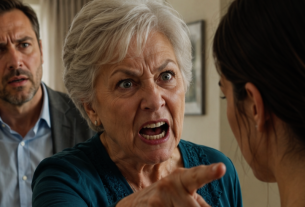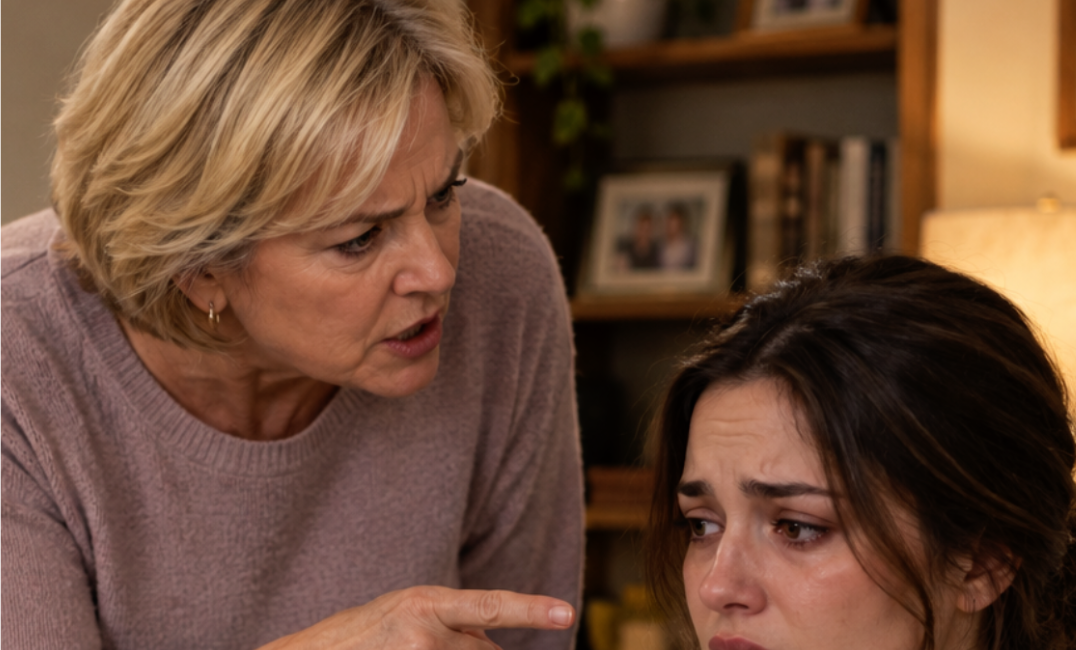
«There will be no divorce!» my mother-in-law said to me. «You still haven’t paid off my son’s loan!»
Antonina Petrovna spoke in a calm, matter-of-fact tone, like announcing the tea had gotten cold. Her hand rested on the linen tablecloth—broad, solid, familiar with soil and dough—and from that hand seemed to radiate a force strong enough that even the wall clock fell silent. The whole family was gathered at the table: my sister-in-law Marina and her husband, cousin Miron, Aunt Zoya in her festive blouse. Everyone stared at their plates intently, as if searching for answers at the bottom. Nikolai sat next to his mother, a bit hunched, looking like a schoolboy who had memorized his lesson and was waiting for the teacher to call on him.
I stood in the doorway with my bag over my shoulder. The keys to our apartment were in my pocket, and the metal burned against my palm. Something hot and sharp smoldered in my chest, as if I’d swallowed a burning coal that refused to cool.
«Are you serious right now?» I asked.
«I never joke when it comes to family,» my mother-in-law snapped. «Sit down and listen.»
To understand how I ended up in this room and why I didn’t immediately turn around and leave, we have to go back a few weeks.
It all started with Nikolai’s phone. He’d left it on the kitchen table while he was in the shower, and the screen lit up with a message: «Miss you, kitty. I’ll open the door as soon as your Lera leaves for work.»
I recognized the number. It was Inga, our downstairs neighbor—she’d borrowed salt from me, sent New Year’s greetings, and left her apple pies for us on the stairwell landing.
I didn’t scream. I sat down on a stool and started scrolling through their messages, like reading a sentence delivered in absentia. More than a year. For over a year, every morning while I waited at the bus stop in the dark, someone downstairs was brewing him coffee. For more than a year, I ironed his shirts so he could wear them down the stairs to see another woman.
When Nikolai walked out of the bathroom, towel-drying his hair, the phone was already in my hand. His face went pale, then red, and then he tried to smile, but the smile came out crooked.
«Lera, this is nonsense. It means nothing.»
«More than a year means nothing?» My voice sounded foreign and oddly calm. «I’m filing for divorce.»
And that’s when he changed. Over years of marriage I’d seen many sides of Nikolai, but this was new. He stopped trying to explain and went on the offensive.
«Look at yourself!» He stepped toward me, the towel dropping to the floor. «You come home after midnight, collapse and fall asleep. The apartment’s dusty, the fridge is empty, I eat whatever I can find for weeks. You can’t even remember the last time you did your makeup. You wear the same sweater all the time. A man needs a woman, and you’ve turned into a permanent business traveler in pants. At least Inga looks like someone who takes care of herself!»
Every word landed on my shoulders like a stone. I really was working a lot. Taking on extra projects, working late, traveling to factories and warehouses—because every month, a large sum from our joint budget went to cover the loan Nikolai had taken. A cash loan. We took it out to help people I once cared deeply about.
“I’m working so we can pay off your loan,” I told him. “Do you even remember why we took it out?”
Nikolai fell silent, then muttered through clenched teeth:
“Talk to Mom. If you’re so righteous, let Mom decide.”
And that’s how this family meeting happened—this old tablecloth, and that hand resting on it.
Back then, the whole loan situation looked different. Olga and Vasily were distant relatives of Antonina Petrovna, through her late cousin. They lived in a village, ran a small farm: cows, goats, a garden, some greenhouses. Nikolai burst in one evening, eyes shining, and told me their barn roof was leaking, their tractor was breaking down, and they couldn’t afford feed. The bank would give us a large cash loan, he said, and we’d pass it to the relatives, who would pay us back little by little, once things improved.
I agreed right away. It felt right to help hard-working people who get up before dawn and never ask for favors. I’d only seen them at a wedding: tall, kind-hearted Vasily, singing so loud the windows shook, and gentle Olga, who gave me knitted socks and a jar of honey. Since then, they only called on holidays, always insisting I come visit. Every time, I’d say I was too busy, that work wouldn’t let me go, but next month for sure. That ‘next month’ never came.
“You joined our family,” Antonina Petrovna said, with every word sounding like a stamp on a contract. “You’ve been paying off that loan, so you took on responsibility. The money is shared, and so is the debt. A decent person doesn’t abandon her husband with debts. Kolya made a mistake—everyone does. You’ll forgive him, and you’ll keep paying, just like before.”
“Lerochka, you understand, don’t you?” Nikolai whispered as he reached for my hand.
“Everybody goes through this,” sighed my sister-in-law Marina, adjusting her earring.
I looked around the room. These people were drinking tea from my cups, looking at me as if I’d tracked mud into their home. Not a single one asked how I felt. Nobody wondered if I was hurting.
Something inside me snapped, like a switch flipping.
“I’ve heard enough,” I said quietly.
“Think carefully,” my mother-in-law called after me as I opened the door. “We’re not letting you go.”
I didn’t argue. There was no point arguing with a brick wall—I’d realized that long ago.
The work trip had been scheduled long before everything happened, and I clung to it like a lifeline. A trip to a regional city, a supplier’s factory, negotiations for a new batch of parts. For three days, I wandered the factory floor in a hardhat, signing documents, smiling at managers—without hearing a word they said. My mother-in-law’s words kept ringing in my ears non-stop.
My business wrapped up ahead of schedule. That evening in the hotel, I spread out a map of the region on the bed, just to keep my hands busy. That’s when I noticed the name of the district center—a stone’s throw from that familiar village. Olga and Vasily lived right nearby.
I stared at the map for a long time. Then I picked up my phone and dialed the number I knew by heart from their holiday cards.
Olga screamed with joy so loudly that I had to pull the phone away from my ear. Within just a few minutes, she was already telling me which bus to take, where to get off, and how not to miss the turn. The next morning, at the crossroads, Vasily was waiting for me in an old truck, broad-shouldered, wearing a faded shirt, with radiant wrinkles around his eyes.
«Lera!» He hugged me like a sister, and to my own surprise, I rested my forehead against his shoulder. «You finally made it! We thought you were avoiding us.»
The house stood at the edge of the village, sturdy, with carved window frames, slightly tilted from age. In the yard, geese strutted around with importance, and the air smelled of freshly baked bread and hay. Olga ran out to meet me, wiping her hands on her apron, and kissed me on both cheeks. I looked around and couldn’t help but notice what my eyes saw: the barn roof was patched with sheets of metal. The tractor under the shed was rusty, slowly sinking on flat tires. The fence barely stood upright.
We sat down at the table, which was overflowing with food. Cottage cheese, sour cream, warm bread, cabbage pies, raspberry jam, and milk in a frosted jug. I hadn’t eaten like that in ages, and I could feel the knot under my ribs slowly loosening.
«Tell us about Antonina Petrovna,» Olga pushed a plate toward me. «How is her health? We worry so much, we can’t sleep at night. We pray for her all the time.»
«Her health?» I repeated.
«Yes,» Olga lowered her voice. «Kolya said her illness is awful. He takes her to doctors, treats her with expensive methods. We understand, Lera, treatment like that costs so much, how could you possibly focus on the farm. Please let Antonina know we light candles for her.»
My spoon froze in my hand.
«What money?» I asked slowly. «What treatment?»
Olga and Vasily exchanged glances. Vasily cleared his throat, stood up, took a battered notebook off the shelf, and placed it in front of me.
Kolya said that the loan you both took out for us went to her treatment. That Antonina Petrovna, being so humble, would feel awkward spending big money on herself, so he takes her to private doctors but never tells her the real price, always understates it. He asked us never to mention her illness on the phone with her. Said she couldn’t handle stress, that her heart wouldn’t take it.
«So we stay quiet,» Olga added softly. «When she calls, we sound cheerful, telling her everything’s great, the farm’s growing with help from the loan, don’t worry. We lie to her—God forgive us—and it eats us up inside. We haven’t seen a single penny from that money, Lera. Kolya said the farm can wait, a mother’s health comes first.»
«Antonina Petrovna is healthy,» I finally said. My voice came out hoarse. «Just two days ago, she was scolding me for how I slice cabbage. She goes for a checkup once a year and then spends half a year complaining she wasted her time.»
Olga dropped her towel. Vasily slowly sat down heavily on the bench, which creaked under his weight.
«She’s healthy?» Olga whispered. «But the money?»
«I’ll get to the bottom of this,» I said. «I promise you. I’ll figure it all out.»
Olga started to cry, covering her face with her hands. Vasily sat in silence, staring at his huge hands resting on the table. I’d never seen such a strong person look so lost.
On the way back in the bus, I stared into the dark window and saw my own reflection. The self-pity had disappeared completely. In its place was a cold, clear anger—sharp as river ice. Now I had a purpose.
Gennady Pavlovich saw clients in a cramped office above the pharmacy. A former investigator—big, weary-eyed, with a habit of tapping a pencil on the desk. I laid everything out in front of him: the credit agreement, payment dates, names. He listened without interrupting, his pencil only keeping time with the rhythm of my story.
«Money always leaves a trail,» he said when I finished. «Give me a week or two.»
A little more than that passed. He called me on Wednesday, and just from his voice I could tell the news wasn’t good.
In his office, he silently slid a thick folder toward me. I turned the pages one by one, while the world around me seemed to grow quieter. Receipts from restaurants I’d never been to. Records for jewelry purchases. Payments for coastal trips Nikolay claimed were for work. A rental agreement for an apartment in the name of a young woman—not Inga. Photos: my husband, laughing and hugging different women I didn’t recognize. One, then another, then a third. Inga turned out to be far from the only one. She just happened to live close enough you could walk to her.
«All the loan money went to this,» said Gennady Pavlovich. «Every last penny. Your husband spent it all on entertainment from day one. There’s even a chat log with one of his buddies. He was bragging about pulling off a perfect scheme. Said the relatives in the village would never see anything, his mother was still sympathetic out of habit, and they were all too trusting anyway. He never planned to give that money back to any of these people in the first place.»
I sat looking at a photo of Nikolay kissing a blonde on the cheek by the sea. He was wearing the shirt I’d ironed for him just before what he claimed was a work trip.
Nothing inside me flinched. I closed the folder carefully, thanked the detective, and my hands were completely dry and steady.
That very evening I packed my things. It didn’t take long—to my surprise, my whole life in that apartment fit into just a few bags. Nikolay was at work. I left the keys on the nightstand and walked out without looking back. Within twenty-four hours, I signed a lease for a small, bright apartment on the other side of town, its windows facing a courtyard with linden trees. A day later I submitted the divorce papers.
Then I went to see Antonina Petrovna. Alone, and without warning.
She opened the door in her housecoat, a spoon in hand, raising her eyebrows in surprise.
«So you showed up. Changed your mind, then?»
«Changed my mind,» I said. «May I come in?»
Her kitchen smelled of bay leaf. I sat in the same chair I’d so often occupied on Sundays, placed the folder on the table, and slid it toward her.
«Please read this. All of it.»
My mother-in-law wiped her hands on the towel, put on the glasses that hung from a chain, and opened the first page. I watched her face change—at first, the usual sternness, then confusion, and finally something flickered by her mouth. She started turning the pages more and more slowly. When she reached the photos, she just sat there, unmoving. The clock on the wall ticked away the seconds, and the soup on the stove quietly simmered.
«So, it’s my health, huh?» she finally said in a dull voice. «He invented the illness. Told the relatives I was sick to get money for my ‘treatment.’ And I, the old fool, kept telling everyone what a caring son I had.»
She took off her glasses and closed her eyes. Her shoulders, always straight as a general’s, suddenly sank.
«Lera,» she said quietly. «Back then, I told you in front of everyone that there would be no divorce. I used to remind you of your duty, as long as that duty was a cover for stealing. Forgive me. I don’t deserve forgiveness, but I’m asking anyway.»
I didn’t reply. I just rested my hand on hers—the same heavy hand—and we sat like that until the soup started to boil over.
Nikolay came in the evening. His mother summoned him with a short call, telling him to come immediately. He entered with a strained smile, saw me, then saw the folder on the table, and froze at the threshold as if nailed to the spot.
«Mom, she made it all up,» he blurted. «She wants to turn us against each other, you know how she is…»
«Be quiet,» said Antonina Petrovna, and he flinched more from her calm words than he ever had from a shout. «I raised you alone. I worked two jobs so you lacked for nothing. And you made up an illness for me. Fooled our relatives in the village. Lied to your wife’s face about family meaning everything to you. Get out of my house.»
«Mom!»
«Out. Leave the keys on the table.»
He did. His hands were shaking. He looked at me pleadingly, and I met his gaze calmly. For the first time in a long while, I didn’t feel sorry for him.
After that, events took on a life of their own. Antonina Petrovna—stern and unyielding—called all the relatives. She didn’t spare her son or soften anything. She told them about the loan, the made-up illness, the affairs, and the country relatives who scraped together money for a debt that never existed. Uncle Miron—the same one who had quietly stared at his plate that day—was the first to call Nikolay and say such things that Nikolay couldn’t forget them for a week. Marina, my sister-in-law, showed up at my place in tears, asking forgiveness for her ‘everyone goes through this.’ Aunt Zoya sent a long letter full of repentance.
Nikolay was left alone. He crashed with various friends, sometimes sleeping on a buddy’s sofa, sometimes on a cot at a former classmate’s place. The friends accommodated him for a couple of days, but then started avoiding eye contact and coming up with reasons why they couldn’t anymore. Rumors in our town spread quickly. The women he spent stolen money on disappeared the moment the funds dried up. Inga stopped answering the door to him, and soon enough, she moved out of our house for good.
I didn’t drag out the divorce. The court hearing was calm, without any shouting or blame. Nikolai sat there looking worn out, in a wrinkled shirt, and didn’t look at me even once. When the judge announced the decision, I stepped outside and, for the first time in many months, took a deep breath. My conscience was clear.
The loan stayed with the person who took it. I stopped paying off my husband’s debt because I had nothing left to pay for. Let the one who enjoyed fancy restaurants and seaside resorts be the one to pay for them. Soon, collectors started to pester Nikolai. They called him day and night, messaged him everywhere, showed up at his friends’ places where he slept, and waited outside his door. He was desperate, borrowing money, begging for more time, but there was no one left to ask. Everyone in his family already knew the truth.
And I just lived. Quietly, peacefully, in a bright apartment with linden trees outside the window. I finally got some sleep. Bought myself the red coat I’d always wanted, and realized the woman in the mirror looked like she’d just stepped out of a long, dark tunnel.
That Saturday, I woke up to the doorbell ringing. On my doorstep stood Vasily—big, shy, in a clean shirt, and holding a box. Just behind him, on the landing, Olga stood shuffling around, holding a jar tied up with string.
“We came into the city for some errands,” Vasily said bashfully. “Thought we’d drop by.”
“For errands,” Olga smiled.
They lugged the box into the hallway, and I gasped. There was cottage cheese in cheesecloth bundles, eggs nestled in straw, a wheel of homemade cheese, bottles of fresh milk, bunches of greens, and a jar of honey—dark and thick. The box smelled like hayfields and fresh morning air.
“This is too much,” I protested.
“It’s not enough,” Vasily cut me off. “You opened our eyes, Lera. We owe you for life now. And, by the way, our farm is finally getting back on its feet. Antonina Petrovna came the other day, brought all the money she could gather, and stayed to help around the place. The roof is fixed already. We’re working on the tractor now.”
We laughed, drank tea, and I felt the kitchen filling with warmth from these people who, as it turned out, had always been my real family—I just hadn’t known it. From then on, they started visiting often, bringing food, inviting me over for weekends. The very next week, I went to visit them for the first time, and I still can’t forget how the dawn rises over the fields there—pink and silent.
That evening, after they left, my phone rang. The screen read «Antonina Petrovna.»
“Lerochka,” said a familiar voice, a little softer than before. “Come visit us this weekend. I’ll make that borscht you love.”
I looked at the jar of honey on my windowsill. The sunlight shone right through it, making it glow with warm, living amber light.
“I’ll come, Antonina Petrovna,” I replied. “I’ll definitely come.”
And for the first time in a long while, I felt like smiling.