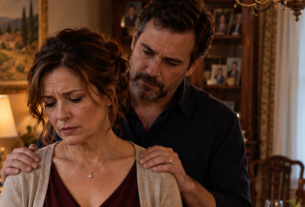
“Your job is to clean up and get everything ready, then you can go watch TV while we relax,” Viktor said, crunching into the apple I had just washed and placed in the fruit bowl for guests.
He stood in the middle of the kitchen, wearing a casual t-shirt, broad and confident, certain he owned everything around him. I held the ladle in my hand. Steam rose from the pot, the clock above the door ticked away the minutes, and my temples throbbed so loudly I was surprised he couldn’t hear it.
“Aunt Zoya is coming on Saturday, with everyone else,” he continued, counting on his fingers. “Make sure to use the fancy tablecloth. Make aspic just like last time—Zoya loved it. And definitely make the cabbage pie. Dust everywhere in the big room, even the chandelier. And don’t let the kitchen smell like your crafts. Got it? No weird odors around the relatives.”
“I hear you,” I replied.
“Good. Just stay away from the table while we’re talking. Serve, clear, and leave. Zoya likes it peaceful, without fuss. But you’re always underfoot, like you’re not content unless you’re in the middle of things.”
He left, whistling. I lowered the ladle into the pot and stared at my hands for a long time. The skin on my fingers was rough from needles and sewing, my nails cut short like any true craftswoman’s should be. Hands that washed, cleaned, cooked, ironed shirts—and hands that could do things he did not understand and didn’t want to understand.
He had decided I would wait on his relatives. He didn’t doubt it for a second. It never even crossed his mind that my answer might be different.
To explain why something quietly clicked inside me that evening, like a lock turning, I have to go back. Way back, to the time when I still remembered how to say ‘no.’
When we got married, I worked at a large construction firm in the supply department. I loved that job: phone calls, contracts, negotiations with suppliers, the smell of new folders and hot coffee in paper cups. People appreciated me. My boss once said in front of everyone that Lyudmila Sergeyevna could see right through any invoice and any scammer. People came to me for advice. I wore heels to work and felt that my life belonged to me.
Then Nastya was born. Viktor would carry our daughter and me—literally and figuratively—and I melted under his care. He would say that a woman is made for family, not for office walls. That a child needs a mother, not a Sunday visitor. That he made plenty of money and could provide for both of us.
“Stay home, at least until the little one grows up,” he’d say, hugging me around the shoulders. “I want you here with us. Is that so much to ask?”
I agreed. I wrote my resignation, and my boss didn’t want to sign it at first, then sighed and said, ‘The doors here are always open for you.’ I believed him. Although, probably, I already knew that would be the end of my career.
Then Pasha was born. It was back to school runs, after-school clubs, sniffles and colds, parent-teacher meetings, endless pots on the stove, and mountains of laundry. Every time I mentioned that the kids were growing up and maybe it was time for me to think about working again, Viktor would find a reason. Sometimes it was that he was going through a tough time and needed me at home. Other times, the kids were sick, and he said nannies just couldn’t be trusted. Then he’d say, ‘Where would you go? You’ve been out of the workforce so long, no one would hire you now.’
That last line hurt most of all because it had a grain of truth. The world outside kept moving forward, while I was stuck at the stove.
The kids grew up so fast, just like they always do. Nastya moved away to study in another city and decided to stay there. Pasha went to college, then got a job, rented an apartment with friends, and would call me on weekends. The house felt empty, but it still needed to be kept in order. Viktor would come home from work and expect a dinner with several dishes. He was so used to having his shirts ironed, his socks matched in pairs, the table set like a restaurant for when his relatives visited. For him, I had become just another part of the kitchen, reliable as a fridge, and just as invisible—unless it broke down.
What saved me was leather.
It all started a long time ago, with my father. He was a cobbler with a tiny basement workshop, and as a little girl, I would sit for hours on a stool, breathing in the scent of tanned leather, glue, and polish. Dad would give me scraps. I stitched purses for my dolls, then bookmarks for books, then watch straps for a classmate. After he passed, I was left with his old sewing machine with its thick needle, a set of tools, and a few rolls of good leather, which I hid away in the attic like other people hide letters.
When the kids left home, I took it all out again. At first, it was just to keep my hands busy. I made a belt for my son. A wallet for my daughter. Then I decided to try making a bag. I cut out the pieces on the kitchen table late at night, after Viktor had gone to sleep. I messed up the first one, the second, the third. Picked out the stitches, started over, got frustrated, laughed at myself. And then suddenly, I finished something that made my breath catch: soft, heavy, the color of ripe chestnuts, with neat stitching and brass hardware. I put it over my shoulder and stood in front of the mirror in the hallway for a long time, barely recognizing the woman with that steady, confident gaze.
I wore that bag the day I went to meet my friend.
Irina was my only connection to the life I used to have. We’d been friends since college, and she never forgot about me, even though I spent years turning down her invitations—either I had to cook dinner or Viktor didn’t like me going out. We sat together in a small café near the metro, she was stirring sugar in her cup when she suddenly stopped.
«Lyuda, wait. Where did you get that?»
«What do you mean?»
«Your bag. Let me see it.»
She picked it up the way you’d lift a living creature. She turned it over, peered inside, and ran her finger along the seam.
«Is it Italian or French? How much did you pay for it?»
«Nothing,» I said, feeling myself blush. «I made it myself.»
Irina looked up at me, and I saw something in her eyes that I hadn’t seen in years. It wasn’t pity, or polite surprise, but real, genuine interest.
— You made that? By yourself? — she asked in disbelief. — Lyuda, do you realize what you’ve done? Do you have any idea how much these things cost in stores? I want one too. No, not the same—mine! I want it to fit me and my colors. Will you make it for me?
I felt lost and mumbled something about it just being a hobby. Irina slammed her hand on the table, making the cups clatter.
— Don’t you dare say that! This is not some silly activity. This is talent. I’ll pay you whatever you ask.
A week later, I brought her a bag in a deep cherry color. Irina burst into tears right in the hallway, then called two friends, then a few more. They all came over, touching and trying on the bags, placing orders. My kitchen table turned into a workshop. I sewed during the day, while Viktor was at work, and cleaned everything into a big box and aired out the kitchen before he came home so the smell wouldn’t give me away.
The money was modest, but it was my own, and when I put it in an old cookie tin for the first time, my hands shook. Not because of the amount. Because I finally felt like I was worth something again.
But I couldn’t hide it for long. Viktor came home earlier than usual and caught me at the table with a pattern and an awl. He stood in the doorway, looking over the pieces of leather, the tools, the scissors, and the box of hardware.
— What’s this? — he asked.
— I’m making bags. My friends are ordering them.
— Friends, — he repeated with a smirk. — Sure. And how much did they pay you, a whole fortune?
— Not much. But it’s enough for materials, and there’s still some left over.
— Lyudochka, — he sat across from me and picked up a finished piece, twirling it around before tossing it carelessly on the table, — you’re a grown woman. Shouldn’t you be doing something useful? This stuff makes the whole house stink. I come home and it smells like a cobbler’s shop in here.
— My father was a cobbler, Vitya.
— Exactly. Your father spent his whole life tinkering with other people’s shoes, and what did he get from it? I don’t want my wife messing around with this stuff. Enough with the games. The wallpaper in the bedroom is coming off, it’s high time for some repairs. That’s work that matters. Go buy paint, check color samples, you can handle it yourself.
I stayed silent. Back then, I still kept quiet. But that night, lying next to my husband who was already snoring, I stared at the crack in the ceiling and thought: «Nonsense.» To him, everything I thought up on my own, anything not for his comfort, was nonsense.
There were many more conversations like that. Viktor would find me at the table and heaved such heavy sighs you would think I was committing a crime. He’d say people laughed at me: the wife of a department head sitting there gluing together wallets. He called my work «toys,» «child’s play.» Once, with friends over for dinner, he joked and said:
— And now my Lyudmila is a designer! She sews bags for rich ladies. Soon she’ll be showing at Fashion Week!
Everyone laughed. I smiled and slipped into the kitchen so no one would see my face. My hands shook so much I dropped a plate. Someone shouted from the room, «Lyuda, are you okay in there?» — and I answered that everything was just fine.
Orders just kept coming in. Irina brought her friends, and they brought theirs—one of them, a doctor’s wife, ordered three bags for her daughters. I worked through the nights, since the house demanded all my days. Viktor insisted on hot lunches, clean shirts, order everywhere. Somehow, I managed it all and would collapse from exhaustion. But every time a customer hugged her finished bag to her chest and said, “Lyudmila, you’re a magician,” something inside me straightened up, like a branch bent for centuries.
When my daughter found out about all this over the phone, she screamed so loudly I had to pull the receiver away from my ear.
«Mom! You’ve been making bags and kept quiet about it? Show me the photos! Right now!»
I sent a few pictures. An hour later, Nastya called back, and her voice sounded strange, almost choked.
«Mom, this is unbelievable. Do you realize you’re more talented than half the designers I know? You need to start your own business. I mean it.»
«Nastusha, come on. Your dad says…»
«Mom,» she interrupted. «I’ve known what Dad says since I was a kid. What do you think?»
Her question just hung between us. I couldn’t find anything to say.
And now, on the eve of Aunt Zoya’s birthday, I stood in the kitchen with a ladle in hand, listening to my husband walk into the living room and turn on the TV. I had to clean up, cook, set the table, serve, then disappear into the bedroom to quietly watch TV shows while his relatives rested at my table, under my chandelier, eating the food I prepared. The same old story awaited me: Zoya would glance around with a critical eye and comment that the tablecloth had yellowed. Viktor’s cousin would talk about how women belonged in the kitchen. Aunt Zoya’s daughter-in-law would whisper in the corner about how old I looked. Viktor would graciously accept compliments for the food, as if he’d cooked it himself.
I’d put up with this my whole life. Year after year. Every fall, every summer, every birthday for someone or other.
That night, I didn’t sleep. I lay next to Viktor, listening to his steady breathing. Faces drifted through my mind: young Lyuda in a strict suit, Lyuda with a baby in her arms, Lyuda bent over a pot, Lyuda with a needle in hand. Something inside me finally settled, calmly, with no drama. It’s like swimming against the current for so long, and suddenly realizing you can just get out onto the shore.
In the morning, while Viktor was having breakfast, I said:
«Vitya, I need to talk to you.»
«Later,» he waved me off, not looking up from his phone. «Let’s talk after the party. My mind’s busy.»
«Alright,» I said. «After.»
He nodded, pleased. He was sure everything was following its usual routine.
On Friday I did everything expected of me. Dusted, washed the windows, polished the floors. But on Saturday morning, when Viktor went out for his aunt’s cake and flowers, I put an empty plate on the kitchen table. Next to it, I set a note. Then I took the travel bag from the closet—the one that had been waiting for this moment for so long. I packed my things, the cookie tin full of money, my tools, patterns, and two rolls of leather that used to belong to my dad. I called Irina.
«Come over,» my friend said, not even waiting for me to finish. «I’m waiting for you. The room is ready.»
The taxi was waiting outside my building. I glanced back at the windows of our apartment. Behind them were thirty years of my life, yet I felt no fear or regret. Just a strange, clear lightness—like the feeling you have as a child after a long illness.
In the note, I wrote just a few words: «Vitya, I’m leaving. Set the table yourself.»
My phone started ringing while I was still driving along the embankment. First, it was Viktor, his voice calm but surprised: «Where are you? The guests will be here soon.» Then he sounded irritated. Eventually, he was yelling. I watched the bridges flashing by and didn’t answer. Later, my cousin called unexpectedly to ask, «Lyuda, is it true you left him?» Aunt Zoya apparently sat in silence all evening, then left before everyone else, saying on her way out: «He drove his wife away and now he’s surprised.»
But for me, that evening no longer belonged to me. I sat in Irina’s kitchen, drinking tea with honey, and for the first time in many years, I wasn’t in a hurry to go anywhere.
Viktor came to see me the next day. He stood in the doorway, rumpled, angry, bewildered.
«Lyudmila, stop this nonsense. Come back home. You’ve embarrassed me in front of the whole family.»
«I didn’t embarrass anyone, Vitya. I just left.»
«Why? Over one simple request? This is how everyone does it! Don’t you understand that it’s the woman who holds the family together?»
«I do understand,» I said. «That’s exactly why I’m leaving. I’ve been holding it together for too long.»
«You’re out of your mind. Where will you go? Who needs you with your bags? In a month, poverty will force you to come back.»
«We’ll see,» I said, and closed the door.
I filed for divorce on Monday. My hands only trembled when I signed the papers. After that, I felt calm.
Nastya flew in for the weekend, bringing a laptop, a camera, and a whirlwind of ideas. Pasha came with a friend who was a photographer. We spread out everything I had sewn over the past years on Irina’s apartment floor, and the kids set to work taking pictures. Nastya circled around me, muttering about «style,» «presentation,» and the «brand story.» Pasha, who was always the quiet one, suddenly started talking about how important it was to show people how each item is made.
«Mom, you know every piece you make has its own story,» he said as he set up the lights. «About Dad, about the workshop. People love that stuff. They’re tired of soulless bags—they want something with heart.»
They created social media pages for me, came up with a brand name, and designed a simple, elegant symbol: a needle threading through a leather loop. When I looked at that symbol, tears welled up in my eyes. I remembered my father’s hands, his words: «A good thing, Lyudochka, isn’t made quickly, but honestly.»
We found a small workspace in an old building not far from the center. High ceilings, wide windows, brick walls. Irina lent me some money to get started, though I tried to refuse. The kids video called me almost every evening, helping with photos, texts, and replying to messages. I dictated, they typed. We laughed, argued, came up with ideas together.
On opening day, I arrived early—before anyone else. I stood in the middle of my workshop, surrounded by the scent of fresh paint, leather, and hope, still unable to believe it was all mine. My own desk, my tools, my sewing machine by the window, and my bags arranged on the shelves. Above the door hung a sign, secretly ordered for me by Nastya.
By noon, a line had formed at the door. For a moment, I thought I’d mixed up the date or something had happened on the way. Then I realized: people who had seen the pages had come. Women of all ages, girls with friends, even a couple of men looking for belts. Irina brought her friends, and they brought theirs. People touched my creations, asked questions, placed orders, and wanted to hear my story. I shared it. For the first time in my life, I talked about myself, and people listened.
By evening, my legs were shaking and my back ached, but inside my heart was singing. The kids locked the door, and we sat on the floor among scraps, drinking tea from paper cups. Nastya leaned against my shoulder.
«Mom, I’m proud of you,» she whispered.
I couldn’t respond. I just hugged her, and we sat like that for a long time, while the streetlights flickered on outside.
Word about the workshop spread fast. There were more than enough orders—I had to hire one assistant, then another. I taught them as my father taught me: never rush, feel the material, respect every stitch. People wrote to me from other cities, sending photos of my bags from vacations, from work, from weddings. One magazine called, asking for an interview—I was flustered, but Nastya snatched the phone and said, «We accept.»
The divorce was finalized without drama. Viktor didn’t attend the last hearing; he sent his lawyer. He kept the house—I asked for nothing but what was rightfully mine, what held my memories: my father’s tools and the sewing machine. I rented an apartment near the workshop—small, bright, with windows facing the poplars. On the first night there, I sat on the windowsill, drank tea, and listened to the quiet. The kind of quiet where nothing needs to be cooked, served, or cleaned up.
He showed up at the workshop in late autumn, when a light rain was falling outside and the place smelled of leather and warm wax. I looked up from my table and saw Viktor standing in the doorway. He had aged over the months: his shoulders drooped, his eyes lost their spark. He wore a shirt that no one had bothered to iron properly.
«Hello, Lyuda,» he said. «May I come in?»
«Come in.»
He stepped inside awkwardly and looked around. He stopped in front of the display case, studying the bags, the belts, the wallets. He reached out, touched one, then quickly pulled his hand back—as if he’d been burned.
«It’s beautiful,» he finally said. «I never thought it would turn out like this.»
«I know,» I replied.
«Zoya called me,» he said. «She told me she read about you in a magazine.»
He fell silent, rubbing his forehead with his hand like he always did when he was unsure.
«Lyuda, maybe I was wrong. Maybe we could… you know, try again? I wouldn’t get in your way. You could sew as much as you want, and I…»
«And you,» I said gently, «would still be waiting for a hot dinner and ironed shirts. And I’d be watching TV alone, while your relatives relax.»
He lowered his eyes. I could tell he understood everything, and instead of feeling triumphant, I just felt sad.
«Thank you for coming,» I said. «Really. I’ve wanted you to see this place for a long time. But I can’t go back.»
He nodded. He stood there for a bit longer, then quietly walked toward the door. At the threshold, he turned around.
«You know,» he said, «I never asked what you wanted.»
«I know,» I replied.
The door closed. The rain outside got heavier. I picked up the half-finished belt from the table, adjusted the lamp, and breathed in the familiar scent. The needle slipped smoothly into the leather, just like always. Every stitch landed exactly where it belonged.
Finally, my life did too.