“How could this happen?” he whispered, staring at the number on the receipt. They had picked out wallpaper, glue, and filler—just the basics, nothing extra. They deliberately chose the cheapest rolls, with simple patterns, no shine or embossing.
Igor stood at the checkout of the big home improvement store, swiping his card for the third time, only to be met yet again by that annoying beep and the dreaded word “declined” flashing on the tiny gray screen.
Anna was standing beside him, holding two packs of primer in her hands. You could see on her face that she was desperately hoping this was just some bank error or technical glitch—anything but what she was starting to suspect.
“Maybe there’s a spending limit?” suggested the cashier, a young woman with tired eyes. She looked embarrassed by the scene, the line forming behind them, and the man now shuffling at the turnstile with his cart.
“Let me check the app,” Igor said, reaching into his pocket for his phone.
He opened his banking app and the balance was so small he had to squint. Eight hundred and twelve rubles. That’s all they had left until his next payday, which was still ten days away.
Our money, his apartment
Anna glanced at the screen over his shoulder, and he could feel her freeze—as if the air around her suddenly got thicker.
“Igor,” she said in a voice that was very calm—far too calm for what was coming next. “We had almost sixteen thousand. I transferred my salary just the day before yesterday.”
“Yeah, we did,” he replied, not looking at her, already putting his phone back in his pocket as if that could somehow end the conversation.
“Igor,” she repeated, but this time her voice wasn’t calm, “where did the money go?”
People in the line tried not to look their way, but he could hear someone step closer, as if to catch every word.
“Anya, let’s not do this here,” he pleaded.
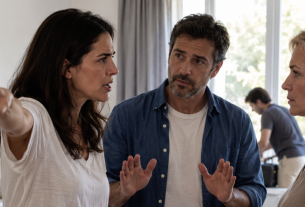
“Where, then? At home? Where you still won’t tell me anything, because at home you just nod and walk into another room. Right here, Igor. Here and now, because I’m standing here with primer in my hands, and we can’t even pay for glue for the wallpaper we’ve been saving up for two years.”
He sighed, pushed the cart to the side so he wouldn’t block the line, and spoke quietly—almost whispering, hoping she wouldn’t hear.
“I sent it to Dad. For a transmission. The Niva’s transmission broke—he’s got no car, and he needs it to get to his medical appointments.”
Anna stayed silent for five seconds, but those seconds felt longer than the whole conversation so far.
“How much?” she asked.
“Fifteen.”
“You gave fifteen thousand rubles for a car that’s older than our marriage, instead of buying glue for walls that have been bare concrete for three years.”
“Anya, he needed…”
“I needed it, too,” she interrupted, her voice trembling even though she was trying so hard to keep it steady. “I needed wallpaper. I need to stop living as if we’re in a dorm. I need my husband to at least warn me before he gives away the last of our money to his father.”
The cashier carefully set the receipt aside and told them she would wait while they figured things out, that they could take their time, no rush. But Anna had already put the primer back on the shelf by the register, quietly, without a sound, and said she’d wait outside.
Igor was left alone at the register, with a cart half full of building supplies he suddenly couldn’t pay for, and a feeling he knew all too well. It was a mix of guilt and irritation, because even he didn’t quite understand why he made that transfer right now, knowing money was tight, knowing his wife had been waiting for that wallpaper for two years.
About ten minutes later, he walked out empty-handed. Anna was sitting on the curb by the entrance, using her jacket to shield her knees from the wind, staring straight ahead at the parking lot.
«Let’s go,» he said.
«Let’s go,» she agreed, without looking at him.
Inside their old Logan, the car they bought even before they got married, both of them sat in silence. Igor drove more carefully than usual, a bit slower, as if wanting to draw out the drive, to delay the moment they’d have to talk again. Anna stared out the window at the gray buildings, the billboards, the people pushing strollers.
«Do you even realize,» she finally said, as they were almost home, «that we buy groceries on credit from Tamara at the corner shop? That my credit card is nearly maxed out? That the mortgage squeezes us every single month so much I count every penny before I buy myself a new pair of tights? And your dad is buying parts for a car that, sorry, should have been scrapped ages ago.»
«It works, it just needed a new gearbox,» Igor tried to explain.
«It worked a year and a half ago, when he bought it. Since then, it breaks down every single month—first the starter, then the alternator, now the gearbox. Have you even kept track of how much we’ve put into it?»
«I don’t keep track, Anya. He’s my father.»
«And I’m your wife,» she said quietly—and there was more pain in that quiet than in any shout. «I’m a person too, you know, with my own needs. But somehow, whenever it comes to your father, my needs end up not being that important.»
They went up to their apartment in silence. The same empty flat greeted them—bare concrete walls they once planned to cover with wallpaper by the end of the first year, a gray linoleum floor they’d laid themselves to save money, and a mattress on the bedroom floor since there still wasn’t money for a bed—all their savings had gone into the down payment, then the mortgage payments each month.
Anna walked to the kitchen, turned on the kettle, took an open pack of pasta from the cupboard, and a can of stew she’d been saving for an emergency. Today definitely counted as one of those days.
«I don’t want to fight with you,» Igor said, standing in the kitchen doorway.
«I don’t want this either,» she replied without turning around. «But I just don’t have the strength left to pretend everything is fine. Do you realize we’ve been saving for wallpaper for two years? Two whole years, Igor. We’re eating pasta with canned meat three times a week just to put aside an extra thousand. Meanwhile, your father keeps replacing parts in that old wreck of his, and for some reason you think that’s more important than how we’re living.»
«He’s alone. He has no one but me,» Igor said, his voice full of real exhaustion—not irritation, just the weary resignation of someone tired of explaining himself.
«He has a pension,» Anna reminded him. «And as far as I know, it’s not that small. He worked at the factory his whole life. He’s got decent seniority.»
«The pension isn’t enough for car repairs—you know how much parts cost nowadays.»
«Then let him sell that car and get something newer, something that won’t fall apart every month,» Anna shot back, her voice showing real anger for the first time in the entire conversation. «Or let him just take the bus like every other normal retiree. It’s not like he lives out in some remote village. We have city buses running every ten minutes.»
Igor didn’t reply. He sat down at the small kitchen table they’d bought on sale—wobbly on one leg, with promises to fix it that always got put off. He watched as Anna sliced canned meat into the pan. Her back was straight and tense, showing that their talk wasn’t over, just on pause for a moment.
«You know what hurts the most?» she said a minute later, still not turning around. «It’s not that you helped your dad. Helping a parent is normal, it’s the right thing to do. I’d actually praise you for it if we could afford it. What hurts is that you did it secretly. You didn’t ask me, didn’t warn me—you just did it. As if I’m not your wife but some obstacle you don’t need to tell things to.»
Igor stayed silent, because there really was nothing to argue with. He honestly hadn’t asked her; he really had made the transfer quietly, just hoping maybe it would go unnoticed, that his salary would come in before they needed money for construction supplies, that he wouldn’t have to explain himself.
«I’m sorry,» he said finally. «I really didn’t think it through.»
«You never think when it comes to your father,» Anna replied, and there was so much tired truth in her words that Igor felt something tighten inside him.
Dinner passed in almost complete silence. They ate pasta with canned meat at the wobbly table, both of them looking off to the side instead of at each other. Afterward, Anna went to wash the dishes, and Igor pulled out his phone to write a quick text to his dad: money’s sent, the part can be picked up at the shop. His father replied quickly with a short, «Thanks, son, you saved me,» and that was the end of their exchange.
Igor sat for a long time, staring at that short reply, trying to understand why he didn’t feel the usual warmth at helping his father—instead, there was just a vague anxiety, as if he’d done something wrong but couldn’t quite figure out what.
The next morning, he woke up early, even before his alarm. It was gray outside, just another ordinary weekday, but he had a reason to get up earlier than usual. His father had asked him to come to the garage and help finish installing a new gearbox they’d picked up from the shop yesterday—but had run out of time to put together by hand. It would take at least a couple more hours of work.
Anna was still asleep while he quietly got ready in the hallway. She woke up to the sound of the closet door closing. Even though her eyes were still sleepy, her gaze was already clear and aware.
«Where are you going?» she asked, propping herself up on her elbow.
«To the garage, to help my dad. I promised to help with the gearbox.»
Anna was silent for a moment, then spoke—calmer now, without yesterday’s anger, her voice laced more with a tired sense of acceptance.
«Alright. I’ll bring you lunch around noon, otherwise you’ll forget to eat there again, come home hungry and grumpy, and then we’ll end up arguing all over again.»
Igor was surprised by her offer. He had expected the conversation from yesterday to continue, more complaints, but instead he received care—and that made him feel even more uncomfortable.
«Thank you,» he said quietly. «Really, thank you.»
His father’s garage was on the outskirts of town, in an old co-op built back in Soviet times. The metal garages stretched out in long rows, all painted the same faded blue, the paint chipped and peeling for ages now. His father arrived earlier and was sitting on a low bench by the open garage doors.
«Hey, Dad,» Igor said as he got out of the car.
Viktor Petrovich stood up to greet him and gave him a firm handshake. He was short and lean, his face marked by lines more from sun and wind than from age, though he was already close to sixty-five. His hands were working hands, knuckles cracked, nails bitten almost to the base.
«Hey, son. Thanks for coming. I couldn’t have managed alone—my back’s been giving me real trouble.»
«No problem—we’ll get it done,» Igor replied, pulling his work jacket from the trunk. «Show me what’s up with the gearbox.»
They spent about an hour working on the old Niva. The car had seen better days—the doors were starting to rust at the bottom, the seats were worn down to the frame, and under the hood everything smelled of engine oil and that other scent you only find in machines that should’ve retired long ago but still somehow keep going.
Halfway through the job, his father suddenly straightened up, grabbed his lower back, and winced in pain.
«Oh, I can’t,» he said. «It’s completely locked up. You’ll have to finish this part, son—I need to go lie down for a bit, I really can’t straighten up right now.»
Igor looked at his father with sympathy, though somewhere at the edge of his mind he remembered that just yesterday, when his father called asking to borrow money, he’d sounded energetic and lively—no mention of back pain then.
«Go rest,» he said aloud. «I’ll finish up.»
His father went into the small annex next to the garage, where there was an old, saggy couch and an electric kettle, leaving Igor alone to keep working on the new gearbox.
Around noon, Anna arrived. She came into the garage with a large bag in her hand that smelled of something homemade and fresh, and a thermos tucked under her arm.
«Hi,» she said, glancing around the garage and taking in her husband, covered in grease and oil. «I brought you some cabbage pies, and tea in a thermos. Where’s Dad?»
«He’s resting, his back started hurting,» Igor replied, wiping his hands on a rag.
Anna pressed her lips together for a moment, but stayed silent. She set her bag down on the workbench, took out the pies wrapped in a clean towel, and poured the tea into a plastic mug.
«Eat while they’re hot,» she told him.
Igor sat down on the same low stool where his father had been in the morning and began to eat, while Anna took a seat beside him, her eyes drifting to the disassembled car.
«You know,» she said after a minute, «I didn’t mean to be harsh yesterday. I’m just tired. Tired of counting every penny, tired of us living like college students when we’re already in our thirties.»
«I get it,» Igor answered with his mouth full. «I really do. It’s just… Dad is all alone now, Mom passed away a while ago, he has no one else but me.»
«I know,» Anna said more gently. «I don’t mind you helping him. What bothers me is you doing it behind my back, as if I’m your enemy and not your wife.»
Igor nodded as he finished his pie, and for the first time in two days, something like peace settled between them—fragile, but real.
After lunch, Anna left for her second shift at the pharmacy, where she worked as a pharmacist. Igor stayed to finish working on the car. He tightened the last bolts, checked the oil level, and decided to also look at the car heater, since his father had complained it only blew cold air even with the heat on.
He climbed into the car, started fiddling with the heater damper control, and while working, he accidentally knocked the glove compartment lock with his hand. The old, loose lock clicked and opened by itself, even though Igor hadn’t been trying to open it.
Inside the glove compartment were the usual things: car documents in a worn folder, an old rag, a pack of paper napkins, a screwdriver. But among the clutter was a sheet of paper, neatly folded into quarters—obviously not just stuffed in, but deliberately concealed.
At first, Igor didn’t want to go through someone else’s papers, but there was something about how neatly it was folded, how out of place it looked among the old car documents, that made him unfold it.
It was a payment schedule. A shared construction contract. He read the first line again and again, not believing his eyes. A studio, twenty-eight square meters, in a residential complex whose name Igor immediately recognized—one of the city’s most expensive new projects, with a secured area, a concierge, underground parking.
The monthly payment was eighty-five thousand rubles. Igor kept scanning that number—it just didn’t fit in his mind. Eighty-five thousand every month. That was almost double his own total income.
He kept scrolling through the statement, his hands trembling just a little. At the bottom of the page, in the section for recent payments, there was a note about an early payment made. The date was yesterday. The amount: fifteen thousand rubles. And the signature, neat and unmistakable since childhood—the signature of Viktor Petrovich.
Igor stood inside the old Niva, holding that sheet of paper, and suddenly everything around him seemed so quiet. Even the usual sounds of the garage cooperative—the clanging of metal from a neighboring stall, distant voices—all faded far into the background.
He remembered the phone conversation with his father just yesterday: the anxious voice, the talk about the gearbox breaking down at the worst possible time, how being without the car was like being without hands, how he desperately needed help, that he wouldn’t even ask if it weren’t a real emergency.
He recalled lying next to Anna as she slept last night, feeling a weight of guilt, but convincing himself that helping his elderly, sick father wasn’t just a duty—it was the right thing to do, it was what a good son should do.
But now, it turned out his father wasn’t struggling at all. His father was buying a new apartment. An expensive one in a prestigious complex, where in the evenings pretty lights probably glow by the fountain, where a concierge greets the residents at the entrance, where the parking lot is warm—not like this old garage with a leaking roof.
Igor slowly folded the sheet again, carefully, exactly as it had been before, and set it down on the workbench instead of putting it back in the glovebox. His hands were oily, leaving dark fingerprints on the white paper, but that no longer mattered.
He got out of the car and sat down on the bench where Anna had recently been eating pastries, and began to wait. His father showed up about ten minutes later, still limping a bit—though now the limp seemed oddly unconvincing to Igor, almost rehearsed.
“So, son, did you manage?” his father asked cheerily, his voice nothing like the one of a man who an hour ago supposedly couldn’t straighten up from back pain.
Igor quietly nodded his head towards the workbench where the unfolded sheet lay.
Viktor Petrovich walked closer, spotted the paper, and for a moment his face changed—it grew tense—but he quickly regained his composure and tried to speak casually.
“Oh, that,” he said, picking up the sheet. “Yeah, I was looking at an apartment, a friend suggested it, a realtor I know was just showing some options.”
“Dad,” Igor said quietly, “that’s your signature. It’s a co-investment contract. And the payment was made yesterday—fifteen thousand, an early pay-off.”
Viktor Petrovich was silent for several seconds, and in that silence, you could tell he was weighing what to say, how to talk his way out of it—but there was no way out now. The numbers and dates spoke for themselves.
“Fine, I bought it,” he finally admitted, his voice lacking its earlier cheer, but not sounding ashamed—more with the tired resignation of someone who’s been caught but doesn’t see himself as guilty. “What’s the big deal? I need somewhere to spend my remaining years too, son. I can’t just rattle around in this old wreck forever.”
«And where did you get the money for the down payment?» Igor asked, feeling something flare up in his chest—something he couldn’t quite name yet, not quite anger, more like a bitter disappointment mixed with the sense of being used.
«Savings,» answered his father shortly. «I’ve been saving my whole life, son, you know I’m not a spender, not a squanderer.»
«And the fifteen thousand I sent you yesterday,» Igor looked his father straight in the eyes, «did that also go toward the car’s transmission, or did it go directly into paying for the apartment?»
His father averted his gaze, and that said more than any words could have.
«A bit of both,» he mumbled. «I bought the transmission, you saw it yourself, I have the receipt. But those fifteen thousand turned out to be extra, so I thought, why let good money go to waste? Better to make an early payment than let it just sit on the card.»
«So you asked me for money to fix your car, knowing that Anya and I are counting every penny, knowing we’ve been saving for wallpaper for two years,» Igor spoke slowly, trying not to raise his voice, «while you were paying eighty-five thousand a month for an apartment you never told us about.»
«Igor, you don’t understand,» his father began, but Igor cut him off, raising his voice for the first time in the whole conversation.
«I understand perfectly well, Dad. I understand that you lied to me. Not just once, but constantly, for months, while you asked for money for gas, for car parts, for medicine. Have you even counted how much I’ve sent you over the past year?»
Viktor Petrovich stayed silent, staring off somewhere—at the scattered tools, at the oil stains on the concrete floor.
At that moment, Anna’s car pulled up to the garage. She had managed to leave work early, hoping to surprise her husband, maybe help pack up the tools—but as soon as she stepped out, she immediately sensed that something serious had happened here.
«What happened?» she asked, glancing from her husband’s pale face to her bewildered father-in-law.
Igor silently handed her a piece of paper, unable to muster the strength to speak. Anna took it, quickly glanced over it, and Igor watched as her expression changed; the surprise disappeared, replaced by something like bitter understanding.
She didn’t yell. She was never the sort to raise her voice during moments like these—unlike many others, Anna could be quiet, and that made her all the more fearsome in her righteousness.
«Would you look at that,» she said, looking at her father-in-law with a sad, wry smile. «We’re poor people, counting every penny, buying groceries on credit, saving up for wallpaper for two years. And you, Viktor Petrovich, it turns out, have bought yourself a studio apartment. Twenty-eight square meters, in a prestigious complex. Guess you want to spend your golden years in a brand new place.»
Viktor Petrovich didn’t look at her; he stared at the floor, and it was obvious he had no answer. Any defense he could try would sound weak and unconvincing.
«Anya, you don’t understand the situation,» he tried to interject, but even he knew how hollow those words sounded.
«I understand, Viktor Petrovich,» she replied calmly—almost too calm considering what she was saying. «I understand perfectly. You’re asking your son for money, knowing we live in an apartment with concrete walls and just a mattress on the floor, while at the same time you’re making early payments on your own studio. What’s unclear about that?»
Igor stood nearby, silent, listening to the conversation as if it wasn’t happening to him, but to someone else far away—and he was just a bystander. Inside, everything was churning, but on the outside he remained still, almost as if he’d turned to stone.
«I wanted to tell you, later—when everything settled down,» his father said quietly, still unable to lift his eyes.
«When?» Igor shot back. «When you pay it off completely, then you’d tell us? In ten years?»
His father didn’t reply, and that silence was as good as an admission.
Without a word, Igor walked over to the workbench and put the paper back, carefully, as if he wanted everything to appear untouched. Then he grabbed a rag and wiped his hands clean of oil—though they were already nearly spotless—and started taking off his old work overalls he kept just for moments like these in the garage.
«Let’s go home,» he said to Anna, though his eyes stayed on his father. «Let him clean up himself.»
His father lifted his head and in his eyes there was a flicker of something like fear.
«Igor, what do you mean? How am I supposed to do it myself? I won’t get it done—there are still hoses to connect, and I don’t know the first thing about that.»
«You’ll figure it out,» Anna answered for her husband, taking his arm. «You’re not poor, after all. You can hire a professional. I’m sure you can afford it now.»
She said it with no anger, using a calm, almost casual tone—yet there was more bitterness in that quiet sentence than in any scream.
They got into Anna’s car, leaving Igor’s Logan parked right by the garage, deciding that Igor would come back for it later, alone. His father stayed standing by the garage gates, looking lost and suddenly so much older, watching them drive away.
They didn’t speak for the whole drive home. Anna drove carefully, glancing over at her husband now and then. He sat staring out the window, clearly deep in thought, wrestling with something inside himself—and it was clear now was not the time to disturb him.
«How are you holding up?» she asked gently as they pulled up to their home.
«I don’t know,» Igor replied honestly. «I really don’t know what to think right now. For so many years I believed I was helping him because he was alone, because life was hard for him. But it turns out he was just using me. All those transfers, all those loans for car parts, for medicine.»
«Maybe not all of it was a lie,» Anna said softly, though it was clear she didn’t quite believe it herself. «Maybe the car really did break down.»
«Maybe,» Igor agreed. «But he didn’t keep the studio a secret for no reason. He knew if I found out, I’d stop helping.»
Anna said nothing to that, because there was nothing left to say. The truth was just too obvious, too bitter, and there was nothing left to add.
They sat in the kitchen for a long time without turning on the lights, even though it was already getting dark outside. Neither of them felt like eating or talking; they just sat together in silence. But this wasn’t the heavy silence after an argument—it felt different. It was the quiet of people who had gone through something important together and now needed time to process it in peace.
«You know what hurts the most?» Igor finally said, staring into the darkness outside. «It’s not about the money. We could get over the money—fifteen thousand isn’t a huge sum for us, really. What hurts is that he lied. All these years.»
«Are you going to call him?» Anna asked.
«I don’t know,» Igor answered honestly. «Right now, I just don’t know.»
Over the next few days, his father called several times, but Igor didn’t answer. He kept putting off the conversation, not ready to face it yet and unsure what to say. Anna didn’t pressure him or ask why he ignored the calls—she was just there, making dinner, going to work, and slowly a new, delicate balance settled into their home.
A week after the incident in the garage, they decided it was finally time to start putting up the wallpaper—the cheap, simply patterned rolls that almost went unpaid that dreadful day. They managed to get the money for it; Anna took a bit off her credit card, even though she hated doing that, but she felt they couldn’t put it off any longer. The bare concrete walls had become a symbol of something they were eager to leave behind.
They did the work themselves, with no professionals, in the evenings after work. Igor mixed the glue in an old basin while Anna rolled out the wallpaper on the corridor floor where there was enough space. Working together, they struggled to hold up the long strips and press them to the walls, doing their best to avoid bubbles and creases.
«It’s crooked,» Anna observed, stepping back to look at the first strip they pasted.
«It’ll straighten as it dries,» Igor tried to reassure her, though he wasn’t so sure himself.
They continued to work in silence, but this silence was nothing like the heavy quiet of recent weeks. This was the silence of people focused on a shared task, and in this concentration, there was a gentle closeness that they had been missing lately.
«Remember,» Anna said, dipping the roller in glue, «when we first moved in three years ago, and you promised the walls would be papered in six months?»
«I remember,» Igor grinned. «I was an optimist back then.»
«Now you’re a realist,» she replied, and there was no reproach in her voice—just a kind, warm understanding.
By the end of the evening, they had only managed to finish one wall in the living room, but even that felt like a huge accomplishment after so many years of bare concrete. They stood side by side, both covered in glue and tired, looking at the first patterned wall—simple, inexpensive, but theirs.
«It’s beautiful,» Anna said softly.
«It is beautiful,» Igor agreed.
At that moment, Igor’s phone rang. His father’s name appeared on the screen. Igor looked at the phone, then at Anna. She gave him a silent nod, as if to say the choice was his—she wouldn’t push him one way or the other.
He didn’t pick up the phone. He just let it ring until it stopped.
“I’m not ready yet,” he said softly, almost apologetically.
“That’s alright,” Anna replied. “When you’re ready, you’ll talk. He’s not going anywhere.”
About a month passed. In that time, they managed to put up wallpaper in almost the entire apartment, except the kitchen. They decided to leave that for later because it also needed new tiles for the backsplash, and right now they only had enough money for wallpaper in the living rooms. But even this small transformation was noticeable — the apartment started looking less like a temporary place and more like an actual home.
During that time, his father called a few more times, but Igor rarely answered. Their conversations were short, formal, lacking the warmth they used to have. Viktor Petrovich tried to explain himself, mentioning something about wanting to surprise Igor, saying he hadn’t expected his son to react like this, and that the apartment wasn’t even for himself, but so there’d be something to leave for his grandchildren someday.
Igor listened to these explanations with suspicion, because the numbers just didn’t match up. Eighty-five thousand a month was a huge amount for someone who supposedly was saving up for future grandkids, but he didn’t want to get into the details or have more confrontations. He just needed time.
One evening, while Igor and Anna were sitting in the kitchen, drinking tea after dinner, the phone rang again — it was his father. Igor looked at the screen, sighed, and this time he picked up.
«Yes, dad, I’m listening.»
Viktor Petrovich’s voice on the other end sounded anxious, almost hurt.
«Igor, son, why aren’t you answering? I’ve been calling for three days now, but you keep hanging up. Your aunt Valentina called me, asking what’s going on, and I told her that you left me alone with a half-taken-apart car. Can you imagine, it’s still sitting there like that, I just can’t fix it alone, and you aren’t coming by or calling.»
Igor felt a wave of irritation mixed with exhaustion rise in his chest. The fact that his father had already complained to the relatives, making it seem like Igor was the one who had done wrong, that he’d left his dad in trouble — it was the last straw.
«Dad,» he said in an even voice, trying not to shout even though he wanted to, «I’m not going to discuss the car right now. Anna and I have plenty to deal with ourselves. We still have a mortgage to pay on the apartment.»
«Igor, but the car—» his father began, but Igor cut him off, unable to restrain himself anymore.
«We’re young, but we’re not well-off, dad. Every penny counts for us. I’m sorry, but I just can’t help right now.»
He pressed the hang up button and put the phone on the table, screen down, so he wouldn’t have to see if his father called again.
Anna looked at him across the table, her gaze filled with both sympathy and something that looked like pride.
«Was it hard?» she asked quietly.
«It was hard,» Igor admitted. «But there’s just no other way anymore.»
They sat in silence for a while, finishing their now lukewarm tea as darkness settled outside and lights flickered on in the neighboring houses. It was just another evening for an ordinary family, spending their nights putting up cheap wallpaper and counting every penny until payday. But tonight, it felt like they were finally starting to see where the line lies between caring and what that care can become if left unnoticed for too long.
The phone on the table buzzed again, just once—a message had arrived. Igor didn’t check to see who it was from; he just sat there, staring at the dark screen. Anna got up, walked over to the sink, and started washing the dishes. The sound of running water filled the kitchen, that familiar, homely noise that could hide them from tough questions for just a little longer.