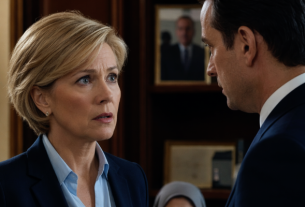
“Anya, I’ll put together the menu, and you’ll cook,” Valentina Petrovna said, holding out a three-page list. “I’d do it myself, but my hands hurt. This arthritis has been tormenting me.”
Anna took the list. Cold appetizers, hot dishes, salads, three kinds of desserts. For her and Dmitry’s anniversary, her mother-in-law had invited eight people. Without asking.
“Valentina Petrovna, wouldn’t it be easier to order something?” Anna raised her head.
“Order?!” her mother-in-law threw up her hands—hands that showed not the slightest hint of arthritis. “What will my friends think? That we don’t know how to host guests? No, Anya dear, show us what you’re capable of.”
Anna folded the list into quarters. Then again. And again. A tiny square of paper lay on the table.
“All right. I’ll show you.”
Seven months earlier, right after the registry office, Dmitry had said they would live with his mother for a while. For a while turned out to mean forever. Valentina Petrovna, whose husband had passed away seven years ago, lived alone in a three-room apartment and suffered terribly. Not from loneliness. From having to cook and clean.
On the second day after the wedding, her mother-in-law got a migraine.
“Anya dear, sweetheart, my head is splitting. I can’t even get up. Make something yourself, all right?”
Anna cooked. Then cleaned. Then did the laundry. By evening, Valentina Petrovna had recovered and gone to the salon to get her hair styled. She returned refreshed, with shiny hair that smelled of expensive shampoo.
The migraines came back every time cooking had to be done. Dizziness appeared before cleaning. Arthritis showed up when the dishes needed washing and disappeared when her mother-in-law flipped through magazines or went shopping.
Dmitry didn’t notice. Or didn’t want to notice.
“So what? Mom can’t do it. Her health is bad. You’re young. You’ll manage.”
Anna managed. She got up at five in the morning, made breakfast for three, went to teach first-graders, came back at six, and until eleven at night she washed clothes, cleaned, and cooked for the next day. Dmitry came home, ate dinner, and lay down to watch television. Sometimes he asked why she was “always in a bad mood.”
She was losing weight. Shadows settled under her eyes. Her hands became dry, her nails started peeling. In the mirror, Anna saw a stranger: tired, aged, empty.
Then, three weeks ago, Valentina Petrovna announced the anniversary celebration.
On the morning of the celebration, Anna woke up at five, but she didn’t go to the kitchen. She put on jeans and a light blouse and did her makeup. From the closet, she took out a box with an envelope inside: a full-day spa certificate. She had spent the last of her savings on it. The very money she had been saving for a coat.
Valentina Petrovna came out for breakfast in a silk robe, saw her daughter-in-law dressed up, and pursed her lips.
“Why are you all dolled up? You’ll be stuck at the stove all day. Go change.”
“I have things to do,” Anna said, handing her the envelope. “This is for you. An anniversary gift.”
Her mother-in-law opened the envelope. Her eyes widened.
“A spa? Anya dear, how sweet! But I can’t today. I have to supervise the table. The guests…”
“Valentina Petrovna,” Anna sat across from her and looked her straight in the eye. “Don’t you want Lyudmila to see you glowing? Just imagine how jealous she’ll be. Everyone will ask where you got transformed like that. And I’ll take care of the table myself. Don’t worry.”
A pause. Valentina Petrovna thought it over. Her fingers stroked the envelope. Vanity won.
“Well… perhaps. Lyudka is always bragging about her cosmetologist. Dimochka will drive me?”
“Of course,” Anna said, calling her husband.
Dmitry came out sleepy and displeased. He listened, muttered his agreement, and half an hour later they left. The apartment was empty.
Anna went into the bedroom. From the closet she took out a black dress she had bought the day before at a secondhand shop and a pair of heels. She called Kira’s acquaintance, who worked part-time as a makeup artist. By five in the evening, everything was ready: hair, makeup, dress. Anna looked at herself in the mirror. She didn’t recognize herself.
Alive.
She never went into the kitchen.
The guests began arriving at half past six. Svetlana Markovna, a heavyset woman with a loud voice, was the first to enter the living room and froze.
The table was set perfectly. A white tablecloth without a single crease. Candles. Crystal glasses. Cutlery for eight. Everything in its place.
There was no food.
“Anya dear, where are the… appetizers?” Svetlana Markovna turned around.
“A surprise,” Anna smiled. “We’re waiting for the guests of honor.”
The others arrived: Valentina Petrovna’s friends, Dmitry’s colleagues. Everyone brought flowers and gifts, everyone was dressed up. They sat down, exchanged glances, and stared at the empty table. Someone joked about a fashionable diet. They laughed awkwardly.
Anna poured mineral water. Smiled. Waited.
At seven, Dmitry and his mother arrived. Valentina Petrovna swept into the hallway glowing: her skin shining after a peel, her hair falling in waves, her manicure flawless. She took off her coat and entered the living room.
Then stopped.
An empty table. Eight guests sitting there with bewildered faces. Anna in a black dress, holding a glass of water.
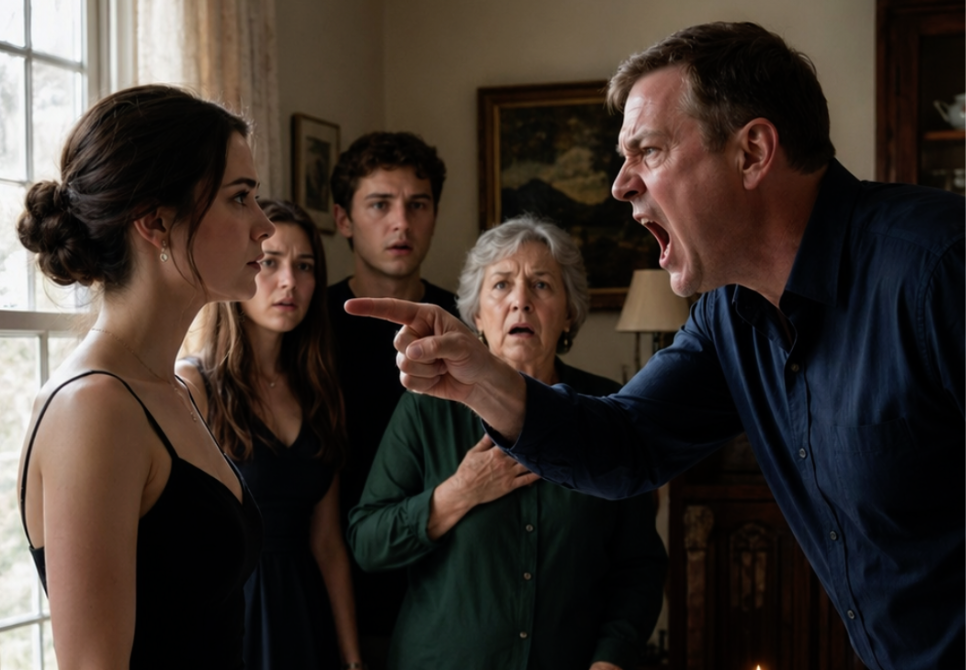
“What… what is this?!” Valentina Petrovna’s voice rose to a shriek. “Anna! Where is the food?! I gave you the list!”
Dmitry came in after her. He saw the table. His face flushed red.
“Anna, have you completely lost your fear? The guests came for our anniversary, and the table is empty!”
He shouted through the entire house. The guests stared at their plates, their phones, the windows—anywhere but at the scene.
“What are you doing?! Are you out of your mind?!”
Anna waited. She placed her glass on the table.
Quietly.
“This is my surprise.”
Silence fell like a curtain.
“In honor of our anniversary, I’m announcing our divorce,” Anna said, taking off her wedding ring. She placed it on the white tablecloth. It clinked. “I’m leaving. Today. Right now.”
Dmitry opened his mouth. Closed it. Opened it again.
“You’re doing this… in front of people?! You staged this circus in front of the guests?!”
“I staged the truth,” Anna said, picking up the bag she had packed in advance. “For seven months, I was your maid. I cooked, washed, cleaned. From five in the morning until midnight. And you never once asked how I was. Never once helped. You just used me. Both of you found me convenient. That’s all.”
Lyudmila, one of her mother-in-law’s friends, snorted into her fist. Svetlana Markovna nodded—barely noticeably.
“Anya dear, sweetheart, wait. We’ll discuss everything,” Valentina Petrovna stepped toward her, stretching out hands with a perfect manicure. “You’re just tired, I understand. We’ll hire a helper, really. Right, Dimochka?”
“Too late,” Anna said, heading for the door.
Dmitry lunged and grabbed her by the elbow.
“Stop! You can’t just take off and leave!”
“I can,” Anna freed herself. “Watch me.”
She opened the door. Behind her, she heard Dmitry’s panicked voice on the phone.
“Hello, restaurant? I urgently need delivery for eight people! Right now! I’ll pay whatever it costs, just hurry!”
Anna closed the door. She stepped onto the landing. Took out her phone and wrote to Kira: “Can I come to you?”
The reply came instantly: “Come over, you fool. It was long overdue.”
Anna stayed with Kira for a week. She slept on a folding cot, went to work, came back, and simply stared out the window. Kira didn’t pester her with questions.
Dmitry called for three days. At first, he shouted, demanded she return, called her ungrateful. Then his tone changed—he begged, promised things would be different. Anna listened in silence and hung up. On the fourth day, a message arrived: “Mom is bedridden. She’s really sick. Are you happy now?”
Anna blocked the number.
But Svetlana Markovna, that very same guest, wrote to her: “Anya dear, forgive me for bothering you. You did the right thing. I lived with the same kind of mother-in-law for thirty years. I didn’t have the courage to leave. You’re a hero.”
Then Lyudmila wrote. Then someone else. They all said the same thing: she had been right.
A week later, Kira came back from the store and said she had seen Dmitry. He had been standing with a cart full of frozen dumplings and ready-made meals. He looked rumpled, his eyes red.
“I asked how things were. He muttered that his mother really was sick now, couldn’t do anything. So now he has to cook and clean and work. They hired someone for a couple of hours, but it’s expensive. He’s already sold the car. Gave up fishing. Has no time for anything.”
Anna listened. She felt nothing. No gloating, no pity. Just relief.
“He asked where you were. Asked me to tell you that if you come back, everything will change.”
“It won’t,” Anna shook her head. “Now he just knows the price of what I was doing.”
Another week later, Anna rented a room in a shared apartment near the school. Ten square meters, a communal kitchen. A window overlooking the courtyard where pigeons cooed. Nothing special.
But it was hers.
She sat on the bed, looking at the walls. On the floor stood a suitcase with her belongings. Everything she had taken.
Her phone vibrated. An unknown number: “Anna, this is Valentina. Forgive me. I didn’t understand what I was doing. Come back. I’ll change.”
Anna read it. Deleted it. Put the phone on the windowsill.
Outside, an old woman was scattering crumbs. Pigeons flocked together, jostling, cooing. Noisy. Alive. It smelled of autumn, wet asphalt, and other people’s dinners from the communal kitchen. It did not smell of her mother-in-law’s perfume and her endless migraines. It did not smell of Dmitry, who had never learned to truly see.
Anna opened the window wider. The cold air struck her face. She breathed in—deeply, fully, all the way to the bottom of her lungs.
For the first time in seven months, she went to bed at eight in the evening simply because she wanted to. Not because she had collapsed from exhaustion, but because she could afford to. No one would wake her up demanding that shirts be ironed. No one would tell her she wasn’t trying hard enough. No one would use her compliance as weakness.
In the morning, she woke up to sunlight. Saturday. She didn’t have to get up. She could sleep some more, go for a walk, or simply lie there. Any choice was hers.
In the kitchen, her neighbor Tamara, a woman over fifty, was boiling the kettle.
“Tea?”
“Thank you.”
They sat in silence. Outside were pigeons, cars, someone arguing in the courtyard. An ordinary morning. Someone else’s.
But hers.
Anna finished her tea and rinsed the mug. She looked at her reflection in the window glass. Pale, without makeup, hair tousled. Ordinary.
Free.
Alive.
She smiled.