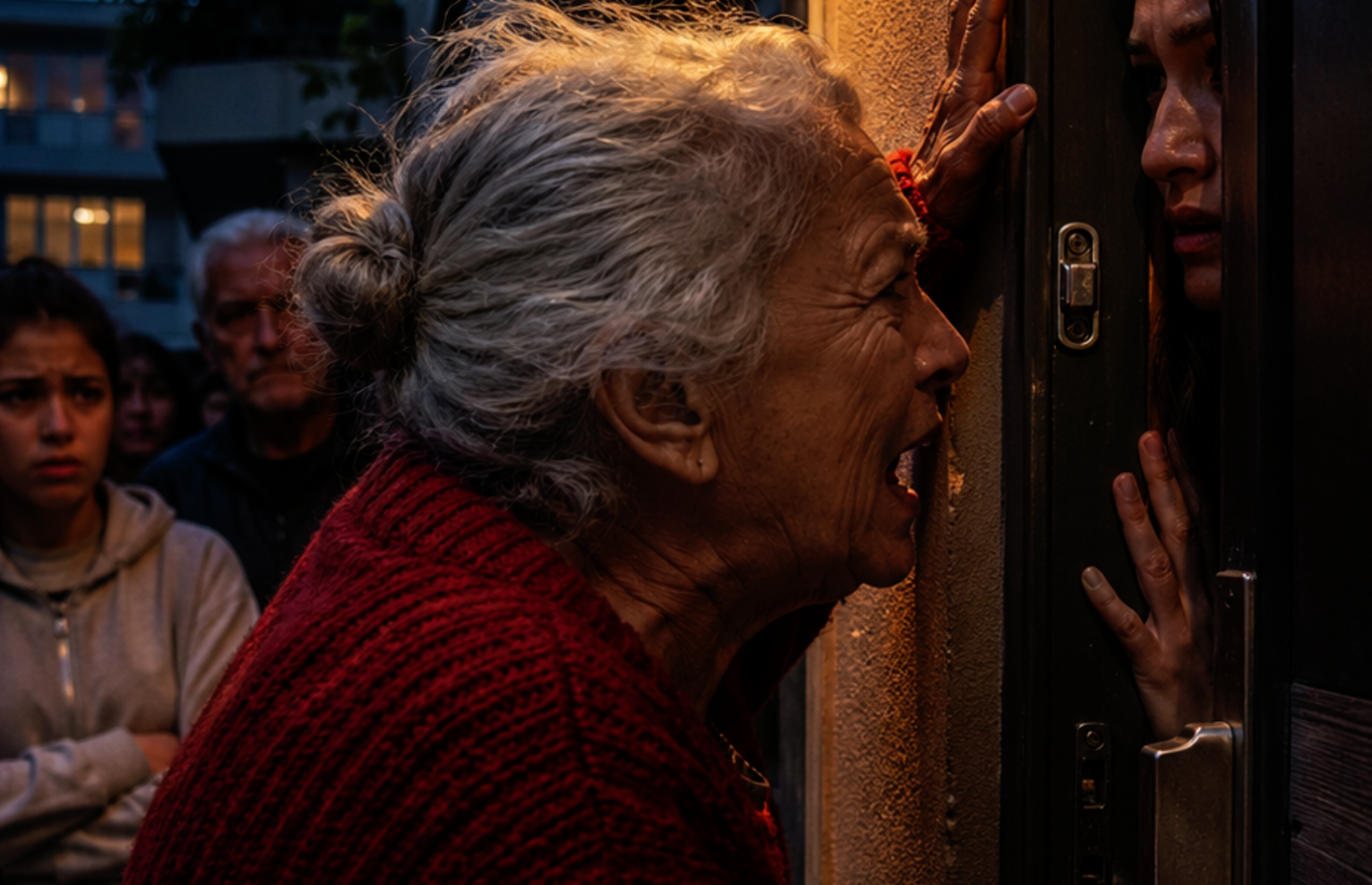
The sound was so loud that even the pigeons in the attic woke up. Zinaida Petrovna was standing on the landing, screaming as if someone had taken the last thing she had left in the world.
But all that had been taken from her was someone else’s key to someone else’s apartment.
“Anna! Open this door right now! This is outrageous!”
I stood barefoot behind the door on the cold parquet floor, thinking only one thing: why hadn’t I done this sooner? Why had I endured it for five years? Why had I allowed this woman to turn my apartment into a public passageway?
She yanked the handle and rustled around in the keyhole with her old key. Then she started pounding on the door with her fist. She screamed for about fifteen minutes. The neighbors began peeking out, but I didn’t open. Half an hour later, Sergey arrived.
He knocked more quietly, but more persistently.
“Anya, enough. Open up. Let’s talk like normal people.”
Like normal people. I smirked and went to put the kettle on. I had tried talking to them like normal people for four years and eleven months. During the final month, I had been collecting documents.
It all started with the key. Sergey asked me to give his mother the spare key—just in case, in case something happened. Zinaida Petrovna had just been discharged from the hospital then, pale, with trembling hands. I felt sorry for her. I gave it to her.
A week later, I came home from work and found a note on the table.
“Anyechka, I dusted and washed the floors. I moved the figurine from the dresser to the shelf—that’s where it belongs.”
The figurine—an antique porcelain ballerina my mother had given me—had been shoved onto the top shelf behind the books.
I told Sergey. Gently, carefully. He nodded and promised to talk to her. After that, Zinaida Petrovna started calling five minutes before arriving. She considered that a warning.
Then she got into the habit of visiting my bakery on weekends. She would walk between the tables, frown at the display case. One day, she picked up my work notebook, flipped through it, and said in front of the salesgirls:
“Anyechka, in the word beze, the stress is on the last syllable. Illiteracy in business is not serious.”
The girls looked down at the floor. I smiled. Inside, something hardened.
Sergey said his mother was old-school, that she meant well, that she was lonely by herself. That I should understand her situation. I understood it for five years. And she kept expanding the boundaries of my territory until there wasn’t a single corner left where I felt like the mistress of my own home.
My daughter Marina arrived on Friday evening. Eighteen years old, a first-year university student. Thin, pale, with dark circles under her eyes from exams. I hugged her in the doorway and led her toward the kitchen. I didn’t even have time to get there. The doorbell rang.
Zinaida Petrovna entered the apartment carrying a bag of literature textbooks.
“Marishenka, I heard you came home! You must have taken literature exams. I taught for forty years. Come on, I’ll check what you know.”
Marina looked at me in confusion. Zinaida Petrovna was already laying out the textbooks and putting on her glasses. She was planning to give her an exam. On Saturday evening. To my daughter, who had just returned from her exam session.
“Zinaida Petrovna, maybe not now? Marina is tired.”
“She can rest later. Education is more important. Marina, name the main themes of Crime and Punishment.”
Marina began answering. Quietly, hesitantly. Zinaida Petrovna interrupted her, shook her head, clicked her tongue.
“A girl should sit at home with her textbooks, not roam around rented corners. Anna, you should have left her here, under my supervision. You work, and I would have made sure she studied.”
Marina turned pale. I stepped forward, but at that moment Sergey came home from work. He heard the end of the sentence and looked at his daughter, at his mother, then at me.
“Don’t contradict your elders, Marina. Grandma is right. You need to show respect.”
Marina stood up from the table. Silently, she gathered her things. She looked at me in such a way that something inside me snapped. And then she went to spend the night at a friend’s place. She did not stay in her own home.
I lay down, turned toward the wall, and thought until morning. By morning, I understood: if I didn’t leave now, I never would. And my daughter would never forgive me.
The money disappeared on Wednesday. I had been saving for a new mixer for the bakery—I had been putting money aside for six months. The envelope was in the dresser. On Monday, it was there. On Wednesday, it was gone.
Sergey came home from work in his wrinkled blue postal worker’s uniform. I asked about the money. He looked away.
“I took it. Mom needed it urgently. For her stamp collection. She found some rare ones.”
“For stamps? You took my money without asking?”
“It’s for Mom. It matters to her. She’s been collecting her whole life.”
“And the bakery doesn’t matter to me? I saved for half a year.”
He sat down on the sofa and pulled off his boots.
“You earn money. You’ll save up again. Mom is a pensioner. Have you really become that greedy? Getting upset over a piece of metal when your husband’s mother is in need.”
Greedy. A piece of metal. His mother—not mine. His.
I understood everything at that moment. That to him, I would always come second. That he had not married me—he had taken in a servant who also brought in money.
I silently got up and called a lawyer.
The moment had come.
In the morning, I went to handle the paperwork. They confirmed it: the apartment was mine. Sergey was not registered as an owner and had no rights to it. I came back while he was away. I called a locksmith and changed the lock. I packed his things into two suitcases. Neatly, without anger. And then I waited.
But most importantly, I took out all the old text messages. All the correspondence from the past five years. Every request to “borrow until tomorrow.” Every “Mom asked for help.” Every “I’ll return it next week.” I sat down at the computer and made a spreadsheet.
Three columns: date, incident, amount.
Forty pages.
From the missing box of expensive tea to the broken vase. From the money “borrowed” for Zinaida Petrovna’s birthday to the money stolen for stamps. Everything. With evidence.
I printed out that spreadsheet and placed it in a thick folder. Along with the apartment documents and the divorce petition.
It was my defense.
And my weapon.
Sergey came home at eight. His key didn’t work. He rang the doorbell. I opened it and handed him the suitcases.
“Take them.”
“Anya, what are you doing?”
“I’m filing for divorce. Leave.”
He didn’t believe me. He tried to enter. I closed the door. He kept calling. I didn’t answer. Then Zinaida Petrovna called, screaming about ingratitude. I silently listened for a minute, then hung up. I blocked both numbers.
I knew there would be more in the morning. I knew Zinaida Petrovna would come with her key.
And that was exactly what happened.
At six in the morning, she was standing outside my door. First, she rustled her key in the lock. Then she realized.
And then my mother-in-law’s scream rang through the entire courtyard—so loud that all the neighbors woke up, and pigeons flapped their wings on the ledges.
“Anna! What do you think you’re doing?! Open this door right now! This is my apartment! My son lives here!”
I stood behind the door and waited. I knew this wasn’t over yet. Twenty minutes later, Sergey arrived. He pounded on the door, demanded I open it, threatened to call the police.
I stayed silent.
The neighbors were already leaning out, listening, whispering among themselves.
Good.
I needed witnesses.
Then I stepped out. With the folder in my hands.
Zinaida Petrovna fell silent. Sergey stepped forward.
“Stop this circus. Let’s talk normally.”
“We’ll talk.”
I handed him the folder.
“Here is the purchase agreement. In my name. The divorce petition. And this.”
I took out the spreadsheet. Forty pages.
“This is everything you have taken from me over five years. Every borrowed ruble. Every missing item. The broken vase. The money for stamps. I wrote everything down. And I saved every text message. Every promise from you to return it tomorrow. Every conversation. Everything.”
Sergey took the pages. His face turned white. Zinaida Petrovna snatched them from him and ran her eyes over them. Her face twisted.
“You… you were watching us?! Counting?!”
“I was protecting what was mine. What you called greed was self-respect.”
I paused. I looked at the neighbors standing in their doorways.
“If you try to break in one more time, I’ll call the district police officer. There are witnesses. There are documents. And now leave. Forever.”
I turned around, went back into the apartment, and closed the door. I leaned against it with my back and listened as they went downstairs.
Slowly.
Heavily.
Then silence came.
For the first time in five years—real silence.
The divorce was processed quickly. Sergey didn’t resist—the apartment wasn’t his, so there was nothing for him to lose. Zinaida Petrovna called acquaintances, complained, painted me as a monster. But people weren’t fools. They had seen how they had lived at my expense.
A month later, I bought the new mixer. I launched a new line of croissants. Business improved. Strange as it may sound, when the constant background noise left my life, I suddenly had strength again.
Marina started coming on weekends. Not right away. She was afraid I would fall apart, that I would cry. But when she came and saw that I was calm, alive, she relaxed. She sat in the kitchen, ate three croissants, and said:
“Mom, I’m glad you kicked them out. I was afraid to say it, but he was weak. And his mother was just…”
We burst out laughing. For a long time, until we cried. And I realized I had regained not only my apartment, but my daughter too.
Sergey called a year later. From an unknown number. I answered.
“Anna, it’s me. Don’t hang up. I need to talk.”
I said nothing.
“I wanted to say… all of that happened for nothing. We had a good life. Mom says you were just overstressed back then. Maybe we could meet?”
He thought he could come back. That I was waiting, missing him. That he still mattered.
“Sergey, everything that needed to be said, I said a year ago. In that folder. Did you read it? Or did your mother take it away so she wouldn’t upset herself?”
Silence.
“Well, there. We’ve talked. Don’t call me.”
“Why have you become so bitter? We lived together for so many years.”
“For those years, I spent four of them trying to become convenient. So your mother would like me. So you wouldn’t get upset. But I wasn’t happy. And I got tired of being convenient.”
I hung up. I blocked the number. My hand didn’t shake. Inside, I was calm.
Sunlight poured through the window. On the table lay a new contract—a large coffee shop had ordered baked goods for the month ahead. Marina was supposed to come in the evening with a friend; they wanted to help at the bakery.
Life went on.
My life.
In my apartment.
With my rules.
And most importantly—with my locks on the doors.
Sometimes I remember that morning. Zinaida Petrovna’s scream ringing through the whole courtyard at six in the morning when she realized her key didn’t work. Her face when she saw that spreadsheet—forty pages of her own greed, printed out and documented. Her helpless rage when she realized that, for the first time in five years, she could no longer simply walk in and take what was mine.
People say you have to forgive, compromise, preserve the family.
But now I know something else.
You have to preserve yourself.
Because if you don’t protect your territory, it will be occupied. Softly, gradually, with words about love and care. And then one day it turns out there is no place for you in your own home.
I don’t regret changing the locks. I only regret not doing it sooner—on that very first day, when Zinaida Petrovna moved my mother’s figurine and called it care.
The door to my apartment now opens only for those I choose to let in. By my own will. In my own time.
And no stranger’s key will ever fit my lock again.
Source