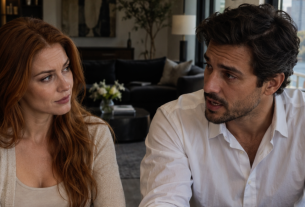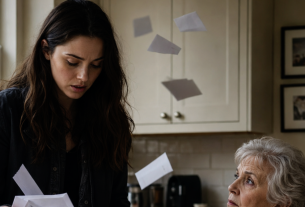
“You no longer have access to my money,” his wife said coldly. “The apartment is mine. The car is mine too. Run to your mother and let her…”
The apartment was flawless, like a showroom display. Glossy surfaces, the cold shine of chrome details, a sofa with perfectly straight cushions—not a speck of dust, not a crumb. The air was still and sterile, as if no one lived there, as if the place merely waited for someone’s visit.
Alexey stood by the panoramic window, looking out at the evening city flooded with neon. The headlights of the cars below seemed like strange, unfamiliar stars to him. He heard the click of a key in the lock. The rustle of a coat being taken off in the hallway, brisk footsteps across the parquet.
Anna entered the living room without looking at him. Her gaze slid over the screen of her smartphone, her fingers moving quickly across the glass.
“Your freshmen have exams tomorrow?” he asked, turning away from the window. He tried to make his voice sound even, domestic.
“Mmm,” she murmured, already burying herself in the laptop screen on the long dark-wood table. “Quarterly performance report. Not now.”
Alexey stepped closer. He wanted to share something, to pour out the warmth that had built up inside him during the day.
“Can you imagine, we had a small miracle today. My student, Timofey, that quiet one who always sits in the back row… He performed brilliantly at the national Olympiad. First place. I always believed in him, but for him to do that…”
He smiled, looking at her bowed back in the strict blazer. He waited for her to turn around, for at least a spark of interest to flash in her eyes. Even polite interest would have been enough.
Anna slowly raised her head. Her gaze was empty, faded with exhaustion.
“Alexey, that’s wonderful. Congratulate him on my behalf.” Her voice was flat, without intonation, like a newsreader reading the weather report. “But for God’s sake, can we do without all this excitement? My head is splitting. The world does not revolve around your child-prodigy students.”
He felt his own joy—so alive and fragile—hit that wall, quietly shatter, and fall apart like a crystal trinket. A lump rose in his throat.
“I just wanted to share it,” he said quietly. “It matters.”
“To you, yes,” she said, staring at the screen again, her fingers tapping the keys with a mechanical, abrupt clatter. “What matters to me is making these numbers balance by morning. Everyone has their own priorities.”
He stepped back toward the window. Back to his strange stars.
In that flawless, expensive box with its perfect view, his joy was needed by no one. It was out of place, like a book left on a stone-composite countertop, disturbing with its carelessness an order calculated down to the millimeter. He inhaled deeply, trying to pull at least one drop of living air into his lungs, but all he breathed in was the smell of cleaning products and the expensive perfume Anna sprayed into her hair every morning.
The expensive apartment, his nominal home, smelled of melancholy and loneliness. He felt like an accidental guest who had come on the wrong day, at the wrong time, interfering with the hostess’s truly important affairs.
The weekend came.
Saturday morning found Alexey brewing coffee in the huge kitchen, which looked more like a laboratory. Anna was already sitting at the table, looking through something on her tablet. Even now, her posture was collected and businesslike.
“Mom called,” Alexey began, carefully placing a cup in front of her. “She asked for help at the dacha. The fence is completely leaning; a new post needs to be dug in. Shall we go today? I promised.”
He saw her shoulders tense. She did not look up.
“I have a conference call at noon. Then I need to finalize the presentation for Monday. No dachas.”
“Anya, we can leave after your call. You can help her sort out the raspberry bushes, and I’ll take care of the fence. A couple of hours, and we’ll be back. You used to like visiting her.”
“I used to,” she corrected coldly. “That was a long time ago. Now I have different priorities. And you, by the way, should have them too.”
He took a deep breath, trying to remain calm.
“This isn’t about priorities. This is about my mother. It’s hard for her alone. She’s waiting.”
Anna sharply pushed the tablet aside. The sound rolled loudly across the tabletop.
“So what? She’s waiting, and I’m supposed to drop everything and go dig around in garden beds? I have my own life, Alexey! My own concerns! Or have you forgotten whose money we live on? Whose money allows you to be an ‘idealistic lecturer’ while I ‘finalize’ these endless presentations just to pay for even that cup of coffee of yours!”
It was as if he had been doused with ice water.
“What does money have to do with this? I’m talking about helping my elderly mother!”
“And I’m talking about the fact that it’s time for you to finally grow up!” Her voice rang out, rising higher and becoming sharper. “You’re forty years old, and you still run to Mommy to hammer nails! Look at yourself! Your classmates have long since become executives, business owners, and you… you still rejoice like a schoolboy over some student!”
She stood up, her eyes burning with cold anger.
“I’m tired of dragging you along behind me. Tired of this endless struggle with your helplessness. Tired of everything being on me. The house, the car, the loans, the plans! And you live in your little world of lectures and Olympiads, as if tomorrow will take care of itself!”
“Anna, enough,” he tried to stop her, but she no longer heard him.
“No, not enough! I understand now. You want to go to your mother? Excellent. Go. For good.”
She walked away from the table, went to her expensive leather briefcase, and sharply pulled out a set of keys. Throwing them onto the table in front of him, she said the words that hung in the air, sharp and heavy as shards of glass.
“You no longer have access to my money. The apartment is mine. The car is mine too. Run to your mother. Let her feed and water you.”
Alexey froze.
He looked at the set of keys lying on the cold glossy wood, then at her angry face, twisted with contempt. Those words were not just an insult, not just an angry exaggeration. They were an act of total annihilation. They crossed out all ten years of their marriage, all their shared past, turning him into a pathetic beggar living off his successful wife.
He could not find an answer. He could not say anything. He simply turned and left the kitchen, leaving her alone in that flawless, sterile silence.
He felt the ground slipping from under his feet.
This was not a quarrel.
This was a divorce.
The economy-class hotel room was cramped and impersonal. It smelled of old carpet and disinfectant. Alexey sat on the edge of the hard bed, staring at the wall. Anna’s words still rang in his ears like an alarm bell.
“Run to your mother. Let her feed and water you.”
It felt as if his face was burning with the flush of shame from those words. Mechanically, he touched the rough surface of the cheap blanket with his fingers. This soulless room was the complete opposite of their sterile, sparkling apartment. And in this uncomfortable reality, his thoughts became clearer, sharper.
Another image rose before his eyes. Not the cold Anna in a blazer, but a smiling girl with burning eyes. A third-year student who bombarded him with questions after lectures on economic history. She had spoken with passion:
“I want to understand how real financial systems are built, not these dry diagrams in textbooks!”
He, a young lecturer back then, flattered by her attention and intelligence, had caught her enthusiasm. They could talk for hours. He had seen in her not only beauty, but a kindred spirit thirsting for knowledge.
Where had that girl gone?
He ran a hand over his face, trying to wipe away the exhaustion. His thoughts involuntarily jumped to the apartment. To the very apartment Anna had so furiously called “mine.”
Yes, the down payment had mostly come from her funds. But where had those funds come from? Not only from her rapid career rise. He remembered her father, Boris. He remembered his domineering voice, his habit of looking down on everyone, his incomprehensible but clearly profitable “business projects.” Part of the money had been inherited from him.
Boris’s death several years earlier had brought Anna not only grief, but also substantial capital.
Alexey had always felt dislike toward his late father-in-law, though he carefully concealed it. That man was deeply alien to him. His cynicism, his certainty that everything in the world could be bought and sold, his dismissive comments about “penniless teachers”—all of it stirred in Alexey a quiet but steady aversion.
And then, as if fate itself were handing him an answer, his phone rang. The screen lit up with a name: his sister, Olga.
He answered, trying to keep his voice from trembling.
“Lyosh, hi!” came her cheerful voice. “How are you two? You haven’t forgotten we’re going to Mom’s on Sunday, have you? You’ll help with that fence?”
Alexey’s heart clenched. He did not tell his sister that he had already suggested this to Anna, and what had come of it.
“Yes, of course I haven’t forgotten,” he forced out. “I’ll come.”
“Great!” Olga paused, as if thinking something over. “By the way, there’s something strange. Our old supplier, Petrovich, called me today. Remember him? He says he saw a car in town exactly like the one that man… Boris, your father-in-law, used to have. Different plates, of course. But the make, the color, even the scratch on the bumper were the same. Strange, right? He decided to tell me, just in case.”
Alexey froze.
Boris’s car.
The very one he had driven around in during the years of his “prime.” The very one whose purchase had coincided with the ruin of their father’s small family workshop.
“Lyosh, can you hear me?”
“I hear you,” Alexey answered quietly. His voice sounded unfamiliar. “Thank you, Olya. You know… that reminded me of an old story.”
“About Dad and his ‘friend’ Boris?” his sister’s voice immediately darkened, all cheerfulness disappearing. “Yes, don’t remind me. I still dream about that wheeler-dealer. How he undermined Dad, lured away clients, and then bought up his debts for pennies… Dad said not to get involved with him. We didn’t listen… That whole story ruined Dad’s health, you know that.”
Alexey knew.
He remembered perfectly how his father, always so strong and full of life, seemed to break after that collapse. He remembered his extinguished gaze, the quiet conversations with his mother about debts. And he remembered how Boris, already rich and successful, once came to their home, said something to his father like, “Business is business. You shouldn’t have gotten into things that weren’t yours,” and placed an envelope of money on the table.
“So your children don’t go hungry.”
His father had silently stood up and thrown the envelope into the stairwell.
And now Alexey lived in an apartment bought with that man’s money. His wife, Boris’s daughter, shouted at him about his failure.
The circle had closed.
The bitter irony of fate pressed down on his chest, not letting him breathe. He said goodbye to his sister and lowered the phone.
In the silence of the hotel room, a frightening clarity came over him.
Their marriage, their quarrel, her contempt—it was not just a clash of personalities. It was a war that had begun long ago. And he, without even realizing it, had been living all these years on enemy territory.
His success, his well-being had been built on the ruins of his own family.
The money that had given Anna such power over him smelled of old betrayal, a betrayal that had never faded at all…
To be continued just below in the first comment.
The apartment was flawless, like a showroom display. Glossy surfaces, the cold gleam of chrome details, a sofa with perfectly straight cushions — not a speck of dust, not a single crumb. The air was still and sterile, as if no one actually lived there, as if the place were merely waiting for someone’s visit. Alexey stood by the panoramic window, looking out at the evening city flooded with neon. The lights of the cars below seemed to him like strange, unfamiliar stars.
He heard the click of a key in the lock. The rustle of a coat being taken off in the hallway, sharp footsteps across the parquet floor. Anna entered the living room without looking at him. Her gaze slid over the screen of her smartphone, her fingers quickly running across the glass.
“Your first-year students have their exam session tomorrow?” he asked, turning away from the window. He tried to make his voice sound even, casual, domestic.
“Mmm,” she murmured, already lowering her eyes to the laptop screen on the long dark-wood table. “Quarterly performance report. Not now.”
Alexey came closer. He wanted to share something, to pour out the warmth that had built up in him throughout the day.
“Can you imagine, something like a small miracle happened today. My student, Timofey — that quiet one who always sits in the back row — he performed brilliantly at the national Olympiad. First place. I always believed in him, but this…”
He smiled, looking at her bent back in the strict jacket. He waited for her to turn around, for at least a spark of interest to flicker in her eyes. Even polite interest would have been enough.
Anna slowly lifted her head. Her gaze was empty, faded with exhaustion.
“Alexey, that’s wonderful. Congratulate him on my behalf.” Her voice was flat, without intonation, like a news anchor reading the weather report. “But, for God’s sake, can we do without all this excitement? My head is splitting. The world doesn’t revolve around your gifted students.”
He felt his own joy — so alive and fragile — strike that wall, quietly shatter, and fall apart like a crystal trinket. A lump rose in his throat.
“I just wanted to share it,” he said quietly. “It matters.”
“To you, yes.” She looked back at the screen, her fingers tapping the keys with a mechanical, abrupt rhythm. “What matters to me is that these numbers balance by morning. Everyone has their own priorities.”
He stepped back toward the window. Back to his strange stars. In this flawless, expensive box with its perfect view, his joy was needed by no one. It was out of place, like a book tossed onto a stone countertop, disturbing with its carelessness the order calibrated down to the millimeter. He took a deep breath, trying to draw even a drop of living air into his lungs, but inhaled only the smell of cleaning products and the expensive perfume Anna had sprayed into her hair that morning. The expensive apartment, his nominal home, smelled of melancholy and loneliness. He felt like an accidental guest who had arrived on the wrong day, at the wrong time, getting in the hostess’s way while she dealt with truly important matters.
The weekend arrived. Saturday morning found Alexey making coffee in the huge kitchen, which looked more like a laboratory. Anna was already sitting at the table, looking through something on her tablet, her posture collected and businesslike even now.
“Mom called,” Alexey began, carefully placing a cup in front of her. “She asked for help at the dacha. The fence is completely leaning over. A new post needs to be dug in. Shall we go today? I promised.”
He saw her shoulders tense. She did not look up.
“I have a conference call at noon. Then I need to finalize the presentation for Monday. No dachas.”
“Anya, we can leave after your call. You can help her sort through the raspberries, and I’ll take care of the fence. A couple of hours and we’ll be back. You used to like visiting her.”
“I used to,” she corrected coldly. “That was a long time ago. Now I have different priorities. And frankly, so should you.”
He took a deep breath, trying to stay calm.
“This isn’t about priorities. It’s about my mother. It’s hard for her alone. She’s waiting.”
Anna sharply pushed the tablet aside. The sound rolled loudly across the tabletop.
“So what? She’s waiting, and I’m supposed to drop everything and go dig around in garden beds? I have my own life, Alexey! My own concerns! Or have you forgotten whose money we live on? Whose money allows you to afford being an ‘idealistic teacher’ while I ‘finalize’ these endless presentations just to pay for even that cup of coffee of yours?”
It was as if he had been doused with ice water.
“What does money have to do with this? I’m talking about helping my elderly mother!”
“And I’m talking about the fact that it’s time you finally grew up!” Her voice rang out, rising higher and sharper. “You’re forty years old, and you still run to Mommy to hammer nails! Look at yourself! Your classmates are executives, business owners, and you… you still rejoice like a schoolboy over some student!”
She stood up, her eyes burning with cold anger.
“I’m tired of dragging you along behind me. Tired of this endless struggle with your helplessness. Tired of everything being on me. The home, the car, the loans, the plans! And you live in your world of lectures and Olympiads, as if tomorrow will take care of itself!”
“Anna, enough,” he tried to stop her, but she no longer heard him.
“No, not enough! I understand now. You want to go to your mother? Fine. Go. For good.”
She stepped away from the table, walked over to her expensive leather briefcase, and sharply pulled out the keys. Throwing the bunch onto the table in front of him, she said words that hung in the air, sharp and heavy as shards of glass.
“From now on, you have no access to my money. The apartment is mine. The car is mine too. Run to your mother. Let her feed and water you.”
Alexey froze. He looked at the bunch of keys lying on the cold, glossy wood, then at her furious face, twisted with contempt. These words were not merely an insult, not merely an angry exaggeration. They were an act of total destruction. They crossed out all ten years of their marriage, all their shared past, turning him into a pathetic beggar living off his successful wife. He could not find an answer. He could not say anything at all. He simply turned and left the kitchen, leaving her alone in that flawless, sterile silence. He felt the ground disappear from beneath his feet. This was not a quarrel. This was a divorce.
The economy-class hotel room was cramped and impersonal. It smelled of old carpet and disinfectant. Alexey sat on the edge of the hard bed, staring at the wall. Anna’s words still rang in his ears like an alarm bell. “Run to your mother. Let her feed and water you.” It felt as though those words had burned the color of shame onto his face. Mechanically, he touched the rough surface of the cheap blanket with his fingers. This soulless room was the complete opposite of their sterile, shining apartment. And in this uncomfortable reality, his thoughts grew clearer, sharper.
Another image rose before his eyes. Not cold Anna in a jacket, but a smiling girl with burning eyes. A third-year student who bombarded him with questions after lectures on economic history. She spoke passionately: “I want to understand how real financial systems are built, not these dry schemes in textbooks!” He, then still a young lecturer, flattered by her attention and intelligence, had become infected by her enthusiasm. They could talk for hours. He had seen in her not only beauty, but a kindred soul hungry for knowledge.
Where had that girl gone?
He ran a hand over his face, trying to wipe away the exhaustion. His thoughts involuntarily jumped to the apartment. The very one Anna had so furiously called “mine.” Yes, the down payment had been made mostly from her funds. But where had they come from? Not only from her rapid career. He remembered her father, Boris. He remembered his authoritarian voice, his habit of looking down on everyone, his unclear but evidently profitable “business projects.” Part of the money had been inherited from him. Boris’s death several years earlier had brought Anna not only grief, but also substantial capital.
Alexey had always felt dislike for his late father-in-law, though he had carefully hidden it. That man had been deeply alien to him. His cynicism, his certainty that everything in the world could be bought and sold, his contemptuous comments about “penniless teachers” — all of it had stirred in Alexey a quiet but stubborn rejection.
And then, as if fate itself had offered an answer, his phone rang. The name lit up on the screen: his sister, Olga.
He answered, trying to keep his voice from trembling.
“Lyosha, hi!” came her cheerful voice. “How are you two? You haven’t forgotten that we’re going to Mom’s on Sunday, have you? You’ll help with the fence?”
Alexey’s heart clenched. He did not tell his sister that he had already suggested it to Anna, or how that had ended.
“Yes, of course I haven’t forgotten,” he forced out. “I’ll come.”
“Great!” Olga fell silent for a moment, as if thinking something over. “By the way, something strange happened. Our old supplier, Petrovich — remember him? — called me today. He said he saw a car in town exactly like the one that belonged to that… to Boris, your father-in-law. The plates were different, of course. But the make, the color, even the scratch on the bumper were the same. Strange, right? He decided to tell you, just in case.”
Alexey froze. Boris’s car. The very one he had driven around in during his “prime.” The same one whose purchase had coincided with the ruin of their father’s small family workshop.
“Lyosha, can you hear me?”
“I hear you,” Alexey replied quietly. His voice sounded foreign. “Thank you, Olya. You know… that reminded me of an old story.”
“About Dad and his ‘friend’ Boris?” His sister’s voice darkened at once; all cheerfulness vanished. “Yes, don’t remind me. That wheeler-dealer still haunts my dreams. The way he undermined Dad, stole his clients, and then bought up his debts for pennies… Dad told us not to get involved with him. We didn’t listen… That whole story ruined Dad’s health, you know that.”
Alexey knew. He remembered perfectly how his father, always so strong and full of life, seemed to break after that collapse. He remembered his extinguished gaze, the quiet conversations with his mother about debts. And he remembered how Boris, already rich and successful, had once come to their home, said something to his father like, “Business is business. You shouldn’t have stuck your nose where it didn’t belong,” and placed an envelope of money on the table. “So your children don’t go hungry.”
His father had silently stood up and thrown the envelope out into the stairwell.
And now Alexey was living in an apartment bought with that man’s money. His wife, Boris’s daughter, had shouted at him about his inadequacy. The circle had closed. The bitter irony of fate pressed against his chest, making it hard to breathe. He said goodbye to his sister and lowered the phone.
In the silence of the hotel room, a frightening clarity came over him. Their marriage, their quarrel, her contempt — it was not merely a clash of personalities. It was a war that had begun long ago. And he, without knowing it, had been living all these years on enemy territory. His success, his comfort, had been built on the ruins of his own family. The money that had given Anna such power over him smelled of old betrayal that had never truly faded.
Alexey left the hotel, unable to remain within those four walls any longer. The city air, saturated with exhaust and the smell of asphalt, seemed sweeter than the suffocating atmosphere of the room. He wandered the streets without aim, and with every step the rage inside him boiled more fiercely. Fragments of Olga’s words, memories of his father, his mother’s humiliated shoulders — all of it merged into one deafening roar of resentment.
His wife. The daughter of the very man who had broken his father. She had shouted at him about his inadequacy, jabbed at him with that very money, money that smelled of someone else’s tears. Her cold “run to your mother” now sounded not merely like an insult, but like mockery turning into cruelty. She, the heiress of a fortune built on the bones of his family, dared to say such things?
The truth he had just discovered for himself burned from within like red-hot metal. He could not simply leave it like this. He could not walk away and swallow everything. He needed to say it to someone connected to that world, to that family. Someone who had seen it all from the outside.
He took out his phone, scrolled through his contacts with trembling fingers, and found the number. “Maria Ivanovna.” Anna’s mother. A quiet, always slightly frightened woman who, in all the years of their marriage, had never once raised her voice. He had always sensed in her some deep, hidden sorrow.
She answered almost immediately, as if she had been waiting for the call.
“Hello? Lyoshenka?” Her voice was just as soft and slightly tired as he remembered.
And then he broke. Words poured out in clots of pain and anger — incoherent, sharp. He did not shout, but his voice was low and ringing with tension.
“Maria Ivanovna… I don’t know what Anna told you. But we had a fight. A final one. And I want you to know why. I can’t keep silent anymore. I’ve just understood everything… about the money. About the apartment. About what we’ve been living on.”
He spoke about his father, about Boris, about how his “business” had left their family with nothing. He spoke breathlessly about how bitter and ashamed he felt now, realizing that all these years he had owed his well-being to the man who had destroyed his own family.
“She shouts at me about my failure!” His voice finally broke, and tears of anger and helplessness could be heard in it. “But what was her success built on? On my father’s misfortune! Do you understand? Did you all know this? And kept silent?”
Silence fell on the other end of the line. Heavy and long. Alexey was already prepared to hear excuses, or more likely a quiet reproach. But Maria Ivanovna said something entirely different from what he expected. Her voice sounded incredibly calm and sad.
“Lyoshenka, calm down. I… I understand everything. I understand your pain. But you do not know everything. You see only the tip, like that iceberg they show in films.”
She paused again, as if gathering her thoughts.
“Anya… she is not guilty of her father’s sins. She grew up in his shadow. And it was not the shadow of success, Lyosha. It was a very different shadow.”
Alexey gripped the phone so tightly his knuckles turned white. What was she talking about? What shadow? He was ready to shout that this was nonsense, an attempt to justify the unjustifiable.
“Come here, Lyoshenka,” Maria Ivanovna said quietly, almost in a whisper. “Please come to me. I need to show you something. Something you don’t know. Something that changed our whole life. And perhaps it will help you understand my daughter.”
His rage collided with this unexpected, quiet sorrow. He had expected a quarrel, resistance, but instead he received an invitation and a hint of some mystery. Curiosity, sharp and bitter, overpowered his anger for a moment.
“All right,” he agreed hoarsely. “I’ll come. Today.”
“I’ll be waiting,” she said simply, and hung up.
Alexey lowered his hand with the phone. He stood on a busy sidewalk, and people flowed around him like water. The noise of the city returned to him, but now it sounded muffled, as though through thick glass. The quiet voice on the phone promised not excuses, but new secrets. Secrets that, he vaguely felt, could turn everything upside down.
Maria Ivanovna lived in an old building with thick walls and high ceilings. The apartment preserved the smells of the past — lavender, old paper, and tea that had been slightly burned over many years. Time flowed differently here, not as it did in Anya’s sterile new-build apartment. Maria Ivanovna herself seemed even more fragile to Alexey than usual. Her face was pale, but her eyes, usually dim, burned today with a strange, determined light. She silently led him into the living room, where a samovar and two simple cups already stood on the table.
“Thank you for coming, Lyoshenka,” she said quietly, gesturing for him to sit in an armchair. “I knew this conversation would happen sooner or later. I just thought I wouldn’t live to see it.”
She did not ask him about the quarrel. She did not justify her daughter. Instead, she took a worn notebook with a calico cover from the old writing desk. The paper had yellowed; the corners were frayed.
“This is my sister Vera’s diary,” Maria said, stroking the cover. “Your aunt’s. Verochka was younger than me. A very lively, very bright person.”
She handed the notebook to Alexey. He took it with an awkward feeling, as if he were touching someone else’s private secret.
“You wanted to know the truth about Boris. About our money. It is here. Start reading from the bookmark.”
Alexey opened the notebook. Small, elegant handwriting — familiar to him from childhood — the handwriting of his beloved Aunt Vera, who had died of heart disease when he was a teenager. He had always thought ordinary melancholy had destroyed her. Now he began to understand that he had been wrong.
The pages marked twenty-five years earlier whispered of love. Vera enthusiastically described meeting a brilliant, energetic man named Boris. He was older than she was, confident, and seemed like a rock to her. They met in secret; he promised to marry her as soon as he “sorted things out.” Alexey turned page after page. Delight gave way to anxiety. Then came an entry that made his fingers turn cold.
“Today B. said I must have an abortion. We are going to have a child. Our child! And he says that now is ‘not the time,’ that a child would ‘tie his hands.’ He shouted at me. Said I had let him down. I do not recognize him. My strong, confident man is frightened. Frightened of responsibility.”
The next entries were full of despair. Boris disappeared. He stopped answering calls. And then Vera learned that he was getting married. Marrying her own older sister, Maria.
“Masha came today. Her eyes were swollen. She says she has no choice. That our parents are persuading her, that Boris is a ‘good match.’ She cried and said she was asking my forgiveness. But what can I say to her? She does not know about the child. Only B. and I do. I have been left alone. With his child under my heart and a broken heart in my chest.”
Alexey raised his eyes to Maria Ivanovna. She sat staring out the window, and a tear slowly ran down her cheek.
“He married me because my parents were ‘useful’ people,” she said quietly, without intonation. “And Vera… Vera he simply threw away like a used thing. I didn’t know about the child. I learned everything only afterward… after Vera was gone. She gave birth to a boy. He lived only two days. The doctors said his heart was weak. But I think she simply did not want to let him go alone. She died of grief, Lyosha. Of betrayal.”
Alexey could not utter a word. A drama he had never suspected was unfolding before him. His kind, quiet Aunt Vera. And Boris, who turned out to be not merely a ruthless businessman, but a true monster.
“And Anya?” he forced out with difficulty.
“Anya grew up in that house,” Maria’s voice trembled. “Her father loved neither her nor me. He humiliated us at every opportunity. I was a failed investment to him, and Anya was a burden he was forced to tolerate. He constantly told her: ‘Be strong! Trust no one! The world is cruel, and those who walk over others survive.’ From childhood she saw him insult me, and she made a vow to herself never to become like me. Never to be weak, dependent, humiliated. Her careerism, her coldness… it isn’t greed, Lyoshenka. It is a shield. A shield against old childhood trauma. She is afraid of repeating my fate. Afraid of being abandoned and helpless.”
Alexey leaned back in the armchair. All his ideas about the world had overturned in an instant. His anger at Anna, so fierce and righteous an hour earlier, crumbled into dust. Behind the mask of a successful, tough woman, he saw a frightened girl who had heard since childhood that trust was impossible, that love was weakness, and that the world was a battlefield where only the strongest survived.
He looked at the yellowed pages, at the tears on her mother’s face, and understood: they had all been victims of one man. His father had been the victim of Boris the businessman. His Aunt Vera, the victim of Boris the betrayer. Maria, the victim of Boris the tyrannical husband. And Anna… Anna was perhaps the greatest victim of all — from childhood, she had been held hostage by her father’s poisonous worldview.
He had come here full of righteous anger, expecting to find an ally in his condemnation. Instead, he found a truth far more terrible and complex. A truth that did not excuse Anna’s actions, but made them understandable. Cruel, but… human.
He no longer saw Anna as a monster. He saw a wounded, lonely person who, like him, was merely trying to survive in the shadow of the past.
Alexey stood before the door of his — or was it no longer his? — apartment. He did not ring. He took out the key Anna had so contemptuously thrown onto the table. The metal was cold. He turned it in the lock, and the click sounded deafeningly loud in the quiet stairwell.
He entered. The light was on in the living room. Anna sat on that same sofa, dressed in her flawless home attire — expensive trousers, a strict blouse. She looked at him without looking away; her posture was a challenge. She had been waiting. Waiting for a scandal, counter-accusations, a humiliated request to come back or, on the contrary, a theatrical slamming of the door.
She was ready for everything except what happened.
Alexey did not take off his coat. He slowly walked into the living room and sat in the armchair opposite her. His face was calm, but not stony, as she had seen it lately. It was tired and very serious.
“I went to see your mother,” he said quietly.
Anna flinched almost imperceptibly, then immediately pulled herself together.
“And what? Did you come to tell me that the two of you are now in the same camp against me? That I’m a monster and you two are pure and innocent?”
“No.” He shook his head. “I came to tell you that I understand everything.”
He paused, looking straight into her eyes. His gaze was not accusing, but… understanding. And that unsettled her more than any fury could have.
“I read your Aunt Vera’s diary. Now I understand everything.”
Those words hung in the air. They were not like a blow. Rather, they were like a key inserted into a hidden lock. Anna froze. Every muscle in her body tensed. She had not expected this. Never.
“What… what do you understand?” Her voice trembled, betraying her confusion.
“I understand why you are so afraid. Why you built this fortress around yourself. You haven’t been fighting me all these years. You’ve been fighting the ghost of your father.”
He spoke slowly, choosing his words, not like an accuser, but like a man trying to get to the essence.
“You saw how he humiliated your mother. You heard his ‘lessons’ about the cruelty of the world. You swore to yourself that you would never end up in her place. Never be weak. Never allow anyone to have power over you. Money, career, this apartment… they are not the goal. They are your walls. Your shield. And your coldness… it is a weapon you pointed at the whole world so it could not wound you. The way it wounded your aunt. The way it wounded your mother.”
Anna sat motionless. Her wide-open eyes were full not of anger, but of growing, animal fear. Her armor — that strong, unshakable shell of confidence and control — cracked. He was not attacking her weaknesses. He was pointing to the source of her strength. And that strength suddenly seemed ugly and pathetic to her.
“Be quiet!” burst from her, but her voice no longer had its former power. There was panic in it. “You know nothing!”
“I do,” he insisted quietly. “I know you were frightened as a child. I know you promised yourself to survive at any cost. And I… I became part of that world for you, the world that had to be controlled. Another risk to be minimized. I don’t want to be your risk, Anna. And I don’t want to be another tyrant in your life.”
He did not raise his voice. He simply spoke. He spoke her own truth, the one she had hidden from herself for years.
And then her bluff collapsed. Not with a crash, but with a quiet, bitter moan. She bent over, covering her face with her hands, and her shoulders began to shake. These were not theatrical tears. They were sobs torn from the very depths of her soul — quiet, choking, full of many years of pain. The sobs of that same little girl who had been afraid and had sworn never to be afraid again.
“Go away…” she whispered through her fingers. “Please, go away.”
Alexey silently stood up. He went to the door, but turned back at the threshold. She still sat bent over, small and defenseless in the center of her huge, cold fortress.
“I’m leaving not because you want me to,” he said. “But because you need to be alone. With your pain. With the truth you have carried inside for so long. I am not your enemy, Anna. I only wanted to be your husband.”
He left, quietly closing the door behind him. He left her alone with the ruins of her defenses and with the bitter, frightening, yet liberating knowledge that someone had finally seen her. Not the successful businesswoman. But the frightened child who was still afraid of the darkness in her father’s house.
Several days passed. Alexey rented a small room in an old district not far from the university. Life entered a new, temporary rhythm. He did not call Anna. He gave her space, understanding that no words would help now. Time was needed.
He had just returned from a lecture when there was a knock at the door. Quiet, almost uncertain. Alexey opened it.
Anna stood on the threshold. She wore no makeup, just simple jeans and a windbreaker he had not seen on her in years. In her hands she clutched the keys to their — to that — apartment. Her eyes were swollen, but her gaze was clear, without its usual steel.
“May I?” she asked quietly.
He silently stepped aside, letting her in. She entered and looked around his modest dwelling — the bed covered with an army blanket, books stacked in piles on the floor, his old laptop on a stool. Nothing unnecessary.
“I’m selling the apartment,” she said directly, without preamble.
Alexey remained silent, letting her speak.
“Dad left us the wrong kind of money,” her voice trembled, but she continued. “He left us his greed. And my fear. I thought those walls would protect me. But they became my prison. I was suffocating there all these years without even realizing it.”
She looked at him, and in her eyes he finally saw not a boss, not a fighter, but simply a woman. Tired and lost.
“I’ve reconsidered everything. Everything you said. And the diary… Mom gave it to me to read.” She swallowed. “I understood who I had been fighting against my whole life. And that in that fight, I nearly lost the only person who saw beyond my shield… simply me.”
She held out the bunch of keys to him. The gesture was not domineering, not commanding. It was… pleading.
“That apartment…” She paused, searching for the words. “It was never really mine. It was a monument to his money and my fear. And I don’t want it to remind me of that. I want…” She took a breath. “I want us to have a home. Ours. If… if you still want to try.”
She was not giving him keys. She was giving him part of her fortress. A symbol of her fall and, perhaps, the beginning of her redemption.
Alexey looked at the keys lying in her open palm. He looked at her face, from which the mask had finally fallen. He saw that same girl from the lecture hall — vulnerable, sincere, hungry not for victories, but for understanding.
He slowly raised his hand and… closed her palm around the keys. He did not take them.
“First, let’s build trust,” he said quietly. “The walls can come later.”
She looked at him, and tears flowed down her face. But these were not tears of despair or anger. They were tears of relief.
They stood in the middle of the shabby room, on the ashes of their old life, looking at each other and seeing not enemies, not rivals, but two very tired, very wounded people who had finally found the strength to end a war they had not started.
And in that silence, smelling of an old house and dust, a fragile but real hope was born. The hope that a true inheritance is not found in a bank account, but in the ability to forgive, understand, and begin again. Not from a clean slate, but with a clean heart.