Anna returned to Moscow a day early. That was just how it happened: the contractors in Nizhny had signed the documents in the morning, and instead of the evening train, she bought a ticket for the daytime Lastochka. In her bag lay a velvet case with a watch inside—Swiss mechanical craftsmanship, the kind Sergei had been talking about for the past six months. She imagined his face: those raised eyebrows, that satisfied smile that appeared only when he received expensive gifts. Anna did not like that smile. There was something boyishly greedy about it, but she pushed the thought away. A husband was a husband.
The key turned in the lock with its usual resistance—the cylinder had needed replacing for ages, but Sergei never got around to it. The hallway light was on. Strange: he was supposed to be at work. He had mentioned an important meeting with investors. Anna stepped into the corridor and froze.
By the mirror, leaning crookedly against the wall, stood a pair of unfamiliar ankle boots. Suede, beige, with thin stiletto heels. Size thirty-seven at most. Anna wore a thirty-nine and had always been self-conscious about it. Beside them lay a silk scarf printed with leopard spots—an item as tasteless as it was flashy. In the air hung the heavy, cloying scent of Baccarat Rouge, a fragrance that had triggered Anna’s migraines since childhood. She had once bought a sample of it out of foolish curiosity and thrown it away that same evening. Alla, her former friend, had laughed then: “You simply haven’t grown into complex fragrances yet.”
In the living room, the television was on—some music channel playing eighties videos. Anna walked down the corridor without taking off her coat and stopped in the doorway.
Sergei was sitting on the sofa they had chosen together at IKEA three years earlier. Next to him, with her legs tucked beneath her in thin nylon tights, sat Alla. The same Alla whom Anna had once brought into their home, introduced to her husband, and later arranged a job for as an accountant in his company. Her childhood friend, the only person who had stayed by her side when her father died. Now Alla was smiling that same smile Anna had seen in photographs from corporate parties but had preferred not to notice.
On the coffee table stood an open bottle of prosecco and two glasses. A cigarette butt floated in one of them.
Sergei noticed his wife first. He did not get frightened, did not blush, did not start making excuses. He looked at Anna the way one looks at a fly that has suddenly appeared over a plate of food—with disgusted irritation.
“Oh, you’ve shown up,” he said without even changing position. “We were just talking about you.”
Alla giggled and reached for the cigarettes.
“Seriozha, what are you…” Anna took a step forward, still holding the bag with the watch. “What do you think you’re doing? This is Alla! My friend!”
“Former friend,” Sergei corrected, rising from the sofa. He was wearing a house T-shirt, but his trousers were expensive office trousers. Apparently, he really had been going to a meeting but had changed his mind. “And do you know the difference between you and Alla, Anechka? Alla doesn’t drag her mother into my house. Alla doesn’t meddle in my business. Alla knows how to listen and doesn’t pretend to be a saint.”
Anna felt a lump rise in her throat, but it was not tears—it was rage. Cold, sticky, disgusting rage.
“You… you’ve lost your mind. I travel on business trips for you, I manage your accounting with my mother’s help, I—”
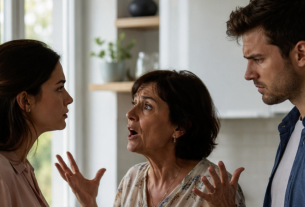
“Exactly!” he interrupted, taking a step toward her. “With your mother’s help! Everywhere there’s this Valentina Petrovna, her nose, her advice, her evening phone calls! I’m tired of it! I didn’t marry your mother! I married you, but you, Anya, have been gone for a long time. There is only her shadow.”
He grabbed her coat from the hanger—the one hanging near the entrance—and threw it onto the floor. Then he opened the bedroom door and dragged two huge suitcases into the corridor. Old leather ones, with scuffed sides. A wedding gift from Valentina Petrovna. Back then Sergei had joked, “Good suitcases. You can tell they come from the Soviet past. Reliable as a tank.”
“Take your junk and crawl back to your mommy,” he said, throwing the front door wide open. “The apartment is mine. The business is mine. I transferred everything into my name while you were running around with your reports and tears. That’s it, Anechka. Your subscription has expired.”
Alla, standing in the living room doorway, watched what was happening with lazy curiosity. She did not even try to hide her smile.
Anna did not cry. She bent down, picked up the suitcases—one after the other—and stepped out onto the stair landing. The door slammed shut behind her with the very sound she had been hearing in her dreams for the past six months: dull, doomed, like the lid of a coffin.
She sat down on the cold concrete floor of the stairwell, leaning her back against the radiator. Her coat had remained inside, but she did not even notice the cold. Her phone was in her hand. She dialed the only number she knew by heart.
“Mom…” Her voice broke. “He threw me out. Alla is there. He said everything belongs to him. The apartment, the business… Everything.”
There was a pause on the line. Anna could hear the old kitchen clock ticking softly in her mother’s apartment—a gift from her father on their silver wedding anniversary. Then Valentina Petrovna’s calm, slightly dry voice sounded:
“Anechka, listen to me carefully. Are you sitting in the stairwell right now?”
“Yes.”
“Good. Lift the left suitcase. The one with the scuffed handle. Unzip the side pocket. There should be a lining with a zipper. Open it.”
With trembling fingers, Anna felt for the zipper and pulled it. Inside lay a thick yellow envelope with a blue notary seal.
“Did you find it?” her mother asked.
“Yes… What is this?”
“This, daughter, is our peace of mind. Now take a taxi and come to me. And smile. I calculated everything.”
Anna sat in the back seat of the old Volkswagen her mother had ordered through a taxi service. The driver, an elderly man in a checkered cap, asked no unnecessary questions. The car smelled of vanilla and gasoline, and for some reason that strange mixture calmed her.
She opened the envelope. Inside were several documents. The first was a deed of gift for the apartment. The very apartment from which she had just been thrown out. According to the paper, the apartment had not been transferred to her, Anna, and certainly not to Sergei. The owner was listed as the minor Dmitry Alekseyevich Kravtsov—the son of her late brother, her six-year-old nephew. It came with an encumbrance granting Anna Dmitrievna lifelong residence as his guardian. The date of the agreement was yesterday.
The second document was a bank statement. The joint account belonging to Sergei and Anna, which just a week earlier had held about twelve million rubles, now showed zero. The money had been transferred to the account of Konsalt-M LLC, marked as “payment for consulting services.” Anna knew that company: its founder was Valentina Petrovna.
The third document was a copy of a notarized surety agreement signed by Sergei Vitalievich two weeks earlier. In it, he personally guaranteed repayment of a certain loan with all property belonging to him, including shares in the enterprise they had built together with Anna’s father.
Anna reread everything three times. Her hands were shaking, but no longer from fear—from the realization of the scale of her mother’s foresight.
Forty minutes later, she was sitting in the kitchen of her parents’ apartment. Nothing here had changed for years: the same linen curtains with embroidery, the same round table under an oilcloth cover, the same smell of dried apples and old paper. Valentina Petrovna—a short, lean woman with smoothly combed gray hair—sat opposite her, calmly stirring sugar into her cup.
Beside her, on a high-backed chair, sat Semyon Arkadyevich—an old family friend, a notary with the sorrowful face of Pierrot and an impeccable reputation. Without a word, he pushed another folder toward Anna.
“Anna Dmitrievna,” he began in a quiet, enveloping voice, “your mother came to me a month ago. She asked me to prepare a number of documents. A deed of gift in favor of her grandson, an agreement on the assignment of debt obligations, and this as well.”
He placed on the table a copy of a statement to law enforcement regarding fraudulent actions by the plant’s management. Sergei, as it turned out, had been siphoning assets through shell companies for six months, hoping to leave Anna with nothing. But he had failed to consider one thing: Valentina Petrovna knew about every step he took.
“How?” Anna managed to breathe. “Mom, how did you do all this… when?”
Valentina Petrovna set her cup aside and looked at her daughter over her glasses.
“Do you remember when you came to me a month ago, complaining that Sergei had become nervous and rude? That he increasingly said ‘mine’ instead of ‘ours’? I told you then: ‘Anya, men like your husband do not marry women. They marry guarantees.’ And I gave him those guarantees. Precisely so that he would lower his guard.”
She rose, went to the old cupboard, and took out another folder—worn, tied with strings.
“When your father was dying, he made me promise him something. Not to save the plant. Not the apartment. You. Your soul, your future. And I kept that promise. Seryozha thought he was playing chess with pawns, but I play with the queen. He captured one piece and thinks he has won, but he doesn’t notice that he is in check.”
Semyon Arkadyevich coughed into his fist.
“From a legal standpoint, the situation is as follows. Mr. Kravtsov personally guaranteed the company’s obligations to Konsalt-M LLC. The amount of the surety exceeds the value of his share in the business. The apartment he considered his own, as of today, actually belongs to your nephew. As guardian, you have the right to live there for life. Sergei has no connection to that apartment whatsoever. Moreover, we have grounds to believe he concealed income and diverted funds. Tomorrow morning, the documents will be sent to the appropriate authorities.”
Anna was silent. She could not wrap her mind around it: her mother, whom Sergei had called “an old battle-axe” and “an annoying mother-in-law,” had turned out to be ten steps ahead of him.
At that same time, in the apartment on the other side of Moscow, Sergei Kravtsov was celebrating his freedom. Alla, now wearing his shirt, was sitting on the kitchen island, swinging her bare feet. A second bottle of prosecco stood on the table.
“Seryozh, let’s change the wallpaper,” she chirped. “These gray walls are depressing. I saw this gorgeous Italian silk in a magazine, cream with gold.”
“We’ll change it,” Sergei nodded generously, pouring the remnants into the glasses. “We’ll change everything. This apartment will finally truly become mine. Without her mother, without her stupid family portraits, without…”
The phone rang. The screen showed: “Shepelev A.V.” — head of the plant’s security service. Sergei grimaced but answered.
“I’m listening, Shepelev.”
“Sergei Vitalievich,” the voice on the line was tense and somewhat strangled. “We have… visitors here. From the tax service, and the law firm Gordeev and Partners. They presented documents stating that as of this morning, the controlling stake in the plant belongs to the minor heir of the deceased founder. And also… they say that you personally acted as guarantor to some firm called Konsalt-M for an amount exceeding your share. Is that true?”
Sergei went pale. He remembered. Two weeks ago, his mother-in-law, Valentina Petrovna, had come into his office with a stack of papers. “Seryozhenka, dear, sign here. These are standard documents for re-registering the electricity meters. Anya is on a business trip, and they won’t accept them without a signature.” He had been busy, irritated, and wanted to get rid of her presence as quickly as possible. He had signed without looking.
“Shepelev, what nonsense are you talking about? What tax service? What lawyers?” he shouted into the phone.
“I’m sending copies to your email, Sergei Vitalievich. But the situation is serious. Very serious.”
Alla stopped swinging her legs.
“What happened?” she asked, sensing the festive mood evaporating.
“Nothing,” Sergei hissed, grabbing his jacket. “I’ll handle it myself.”
But when he opened his email on his phone and saw the scanned documents, his face turned as gray as the very wallpaper he had planned to replace.
In the morning, Anna woke up in her old girlhood room. Everything here remained as it had been in childhood: bookshelves with worn volumes of Bulgakov and Tsvetaeva, faded photo wallpaper with a birch grove, a plush bear on the windowsill. It smelled of chamomile and fresh pancakes.
She went into the kitchen. Valentina Petrovna, wearing an apron and holding a ladle, stood at the stove. Thin, almost transparent pancakes hissed in the pan—the kind Anna’s father had loved. With crisp edges and soft centers.
“Sit down, Anechka. Eat,” her mother said without turning around.
Anna sat at the table and suddenly felt tears welling in her eyes. Not from hurt—from a strange, aching feeling of coming home. The very feeling she had not experienced for many years in the apartment with gray wallpaper and expensive Italian furniture.
“Mom, I believed him. I loved him. And he threw me out in the clothes I was wearing.”
Valentina Petrovna turned off the stove, sat opposite her, and took her daughter’s hand.
“You know, daughter, when your father was building this home, he used to say: ‘Valya, the walls are not what matter. What matters is that love lives inside them.’ Your Seryozha is a draft. A draft comes in, slams doors, frightens people, but it always leaves. And the house remains standing. Because a house has a foundation. And that foundation is you and me.”
Anna wiped away her tears with her palm.
“What will happen now?”
“Now,” Valentina Petrovna adjusted her glasses, “we are going to your home. We’ll take Semyon Arkadyevich and two young men from a security agency. Not to cause a scandal. To politely ask Mr. Kravtsov to vacate the living space that no longer belongs to him.”
The elevator smelled of paint—the neighbors on the fifth floor were renovating. Anna stood there, pressing both suitcases to herself. Now they no longer seemed like symbols of exile, but like peculiar trophies. Semyon Arkadyevich was quietly explaining something to the security guards—strong young men in plain clothes, with cameras on their chests. Valentina Petrovna rang the doorbell.
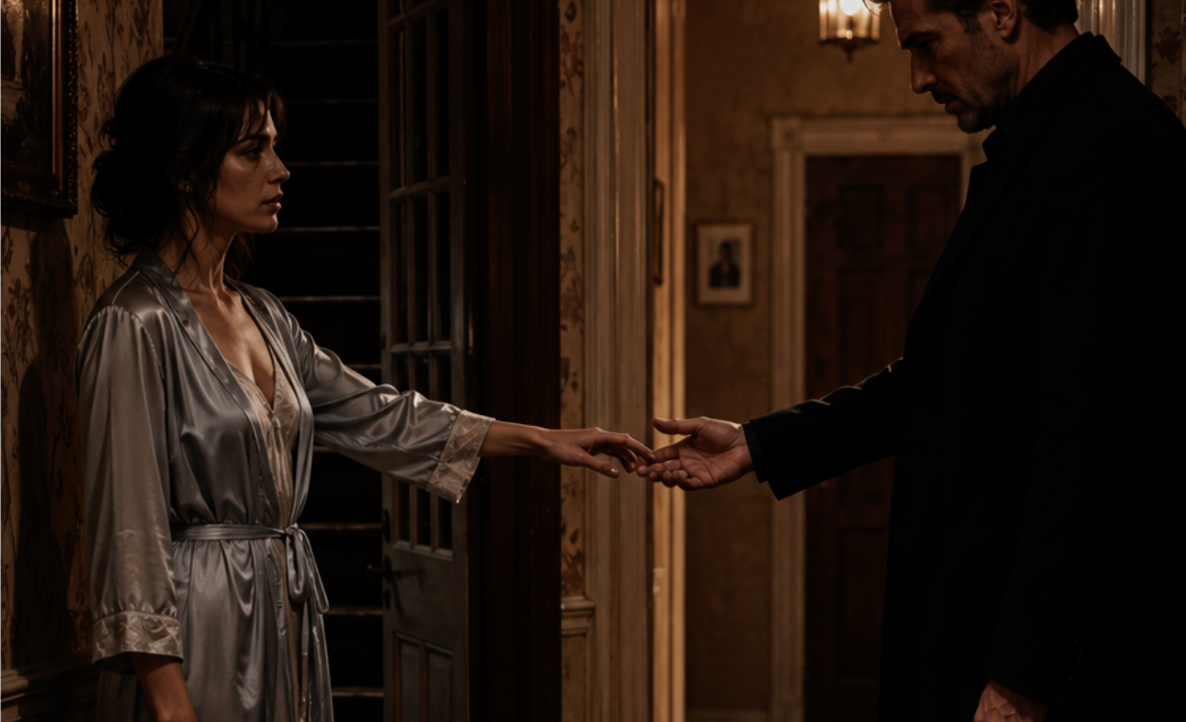
Alla opened the door. She was wearing a silk robe, her hair wet from the shower. Seeing the delegation, she tried to slam the door, but one of the guards gently and politely held it open.
“Excuse us, property dispute,” he said without the slightest aggression. “We are simply recording what is happening on video.”
Sergei came out into the corridor. He was pale, with shadows under his eyes. Evidently, he had not slept that night. In his hands he held a bundle of papers—apparently trying to find at least some loophole.
“What is this circus?” he shouted, though his voice broke into a falsetto. “I’ll call the police! This is my home!”
Valentina Petrovna calmly took a transparent document folder from her handbag.
“Seryozha, dear,” she said almost affectionately, “it seems you did not read what you signed very carefully. Here is the power of attorney for managing the property of the minor Dima Kravtsov. Here is the fresh court ruling on interim measures—I received it during the night. Here is the surety agreement with your signature. By law, you must vacate the premises within twenty-four hours. Otherwise, we will charge you rent at market value for every day of delay. And considering your current financial situation… you understand.”
Sergei snatched the papers and scanned them with his eyes. His face shifted from fury to confusion, from confusion to horror.
“This… this is forgery!” he screamed. “I didn’t sign this!”
“You did, Seryozha,” Semyon Arkadyevich sighed. “Here, on page five, is your signature. And on page seven. And on page nine. An expert examination will confirm it.”
Anna, who had stood silently the entire time, suddenly stepped forward. She looked at Alla—at her wet hair, her bare legs, her small feet, which only yesterday had seemed so elegant and now looked pathetic.
“Alla,” Anna said in an even voice, “your shoes are size thirty-seven. I remembered. The floors here are heated, but they’ll be shut off for nonpayment tomorrow. I advise you to put on socks.”
Alla said nothing. She simply stood there, biting her lip.
Sergei tried to say something, but the words stuck in his throat. He looked at Valentina Petrovna—at that short elderly woman in an old-fashioned coat with a neat little handbag—and saw not his mother-in-law, but the embodiment of everything he had despised and underestimated.
“You… you set all this up,” he whispered.
“No, Seryozha,” Valentina Petrovna shook her head. “You did everything yourself. I merely placed the chairs in the right order. You sat on them of your own free will.”
That evening, Anna sat in her mother’s living room, sorting through the contents of the suitcases. The first one really did contain some belongings: old sweaters, books, a couple of dresses she had not worn for three years. All of it could be thrown away.
But her mother asked her to open the second suitcase. The very one with the scuffed handle, in whose side pocket the envelope had been hidden.
“Look at the bottom, under the lining,” Valentina Petrovna said, standing in the doorway.
Anna lifted the thick fabric. Beneath it lay an old leather diary with a dark brown cover, held closed by an elastic band. She recognized it immediately—her father’s diary.
Beside the diary was a stack of black-and-white photographs. The plant in the nineties: tall workshops, soot-darkened windows, tired workers’ faces. And in every photograph—her father. Young, thin, with burning eyes. Explaining something, pointing, laughing.
Anna opened the diary. The first entry was dated 1993.
“Today we signed the lease agreement. Valya cried—she’s afraid we won’t manage. And I told her: we will. We’re Kravtsovs. If not by blood, then by spirit. The main thing is not to be afraid.”
She turned the pages, and an entire life passed before her. How her father took out loans, how he sat over drawings at night, how he worried over every kopeck, how he rejoiced at the first major order. And everywhere—mentions of her, of Anna, of “Nyusha,” as he called her.
On the last page, dated a month before his death, her father had written:
“The most important thing, daughter, is not the apartment, not the plant, not the money. The most important thing is to remember who you are and where you come from. Let go without regret of those who do not see you as a person. They leave on their own, because they have no place in our home. And a home is not walls. A home is memory.”
Anna closed the diary and sat for a long time, looking at the old photographs. Then she got up, went to her mother, and embraced her.
“You put this in the suitcase on purpose,” she whispered. “You knew he would throw out these exact suitcases.”
“I knew,” Valentina Petrovna answered simply. “Because he hated everything connected to your father. Which means he was certain to throw them out. But I wanted you to find this precisely when you were ready.”
A year passed.
Soft music played in the restored mansion in central Moscow. Anna stood by the window and watched the first snowflakes settle on the cobblestones of the old courtyard. Here, in the former apartment house of the Eliseev merchants, she had opened the family cultural center Heritage. The idea had come from her father’s diary: among his notes, she had found a mention of an old family friend, a well-known restoration expert. They met, talked, and six months later, the project became reality.
Today was the first anniversary of its opening. The halls were crowded with guests, journalists, and partners. Her nephew Dima, now a serious seven-year-old boy in glasses, was showing other children old photographs of the plant and telling them how “Grandpa built everything from scratch.”
Valentina Petrovna sat in an armchair by the fireplace, having an unhurried conversation with Semyon Arkadyevich. As always, he was sad and laconic, but quiet pride shone in his eyes.
There was a knock at the door. Anna’s assistant came in, a young woman with a frightened face.
“Anna Dmitrievna, a courier brought a petition. From Sergei Vitalievich. He asks that the seizure be lifted from the remains of his property.”
Anna took the envelope and turned it over in her hands. Inside, many words were written: repentance, pleas, promises. But she did not read to the end. She went over to her mother.
“Should we forgive him?” Valentina Petrovna asked, lifting her eyes.
Anna shook her head.
“No, Mom. We won’t forgive him. But we won’t finish him off either.” She carefully placed the letter into a folder labeled “Archive.” “Dad wrote in his diary: ‘Suitcases are needed only so that unnecessary things can be packed into them. Happy people travel light.’”
She looked out the window. Somewhere far below, in the evening traffic, Sergei Kravtsov’s old car was stuck in a jam. He was searching for a parking spot near the microloan office where he now worked as a manager. Alla had left him a week after the eviction—she had found a richer sponsor.
And in the mansion, lights glowed, children laughed, and the old suitcases with which this story had begun stood in the corner of the office. Now they held neither resentment nor discarded things. Inside them lay diaries, photographs, and letters—everything that formed the foundation of a home no draft could ever destroy.
Valentina Petrovna took a handkerchief from her handbag, adjusted her glasses, and smiled.
“You see, daughter. I told you. I calculated everything.”