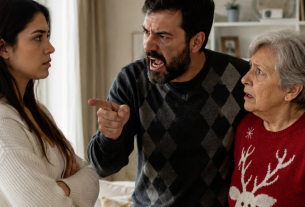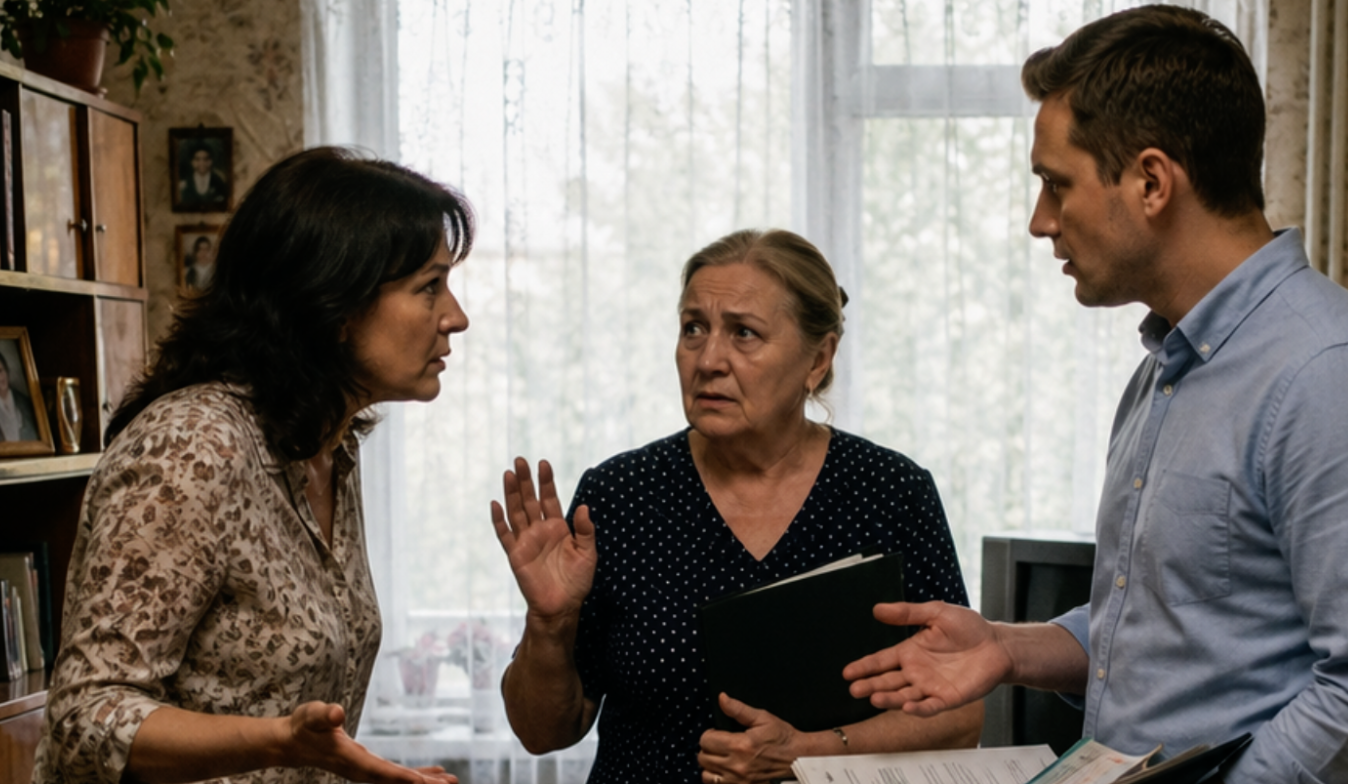
Monday began for Valentina Petrovna as usual—with the clatter of a pot and the tapping of a spoon against the rim of a plate. She did it deliberately louder than necessary, to wake everything in the house that was still asleep. In their old Khrushchev-era apartment building, the sound carried so well that the downstairs neighbors knew her morning repertoire by heart, but today she did not care about the neighbors.
Alina entered the kitchen, which smelled of burnt oatmeal. She was thin, straight-backed, wearing a strict gray suit that hugged her shoulders as if she were going to a reception with a minister, not to her own office. Her manicure was fresh—beige with a thin silver stripe—and that manicure irritated Valentina Petrovna most of all. It cost as much as her monthly pension. She knew that for certain.
“Going to leave hungry again?” Valentina Petrovna asked without turning around.
“I’ll have coffee, thank you,” Alina said, clicking the kettle button and reaching for the cezve.
“Your coffee will burn out your stomach. You won’t be able to have children eating like that. When is Dimka coming back?”
Alina said nothing, looking out the window at the gray courtyard. Her phone vibrated on the countertop, lighting up with the name “Dima.” Valentina Petrovna instantly grabbed the phone before her daughter-in-law could.
“Sonny! How are you there, on your business trip? Are they at least feeding you?”
“Mom, everything’s fine,” Dmitry’s voice sounded muffled and tired. “Listen, Alina’s having a difficult period at work right now, some kind of assessment, they might cut her bonus. So you… be gentler with her, all right? Don’t nag.”
“Me? Why, I treat her like my own daughter!” Valentina Petrovna glanced sideways at her daughter-in-law. “Take care of yourself, son. You must be thin by now.”
“Everything’s fine, Mom. I’ll be back in a month. Bye.”
Valentina Petrovna put the phone down and looked at Alina with a long, assessing gaze.
“An assessment, is it? Of course. I know what these assessments are. She probably spends all the money on clothes, while Dimka works himself to death abroad. And the apartment is mine, my own blood and sweat, registered in my name. You think I’m a stupid old woman and don’t understand anything? I understand everything.”
Meanwhile, Alina opened her folder to take out her planner, and one awkward movement knocked the folder over. Papers scattered across the floor like a fan. Valentina Petrovna bent down faster than one would expect from a woman with a bad back. In her hands was an estimate.
“Buyout of business share. Urgent. Amount: 7,000,000 rubles. Lider Real Estate Agency.”
Alina snatched the paper away, her face turning white as chalk.
“This is none of your business, Valentina Petrovna. I’ll handle it. Myself. And don’t drag your son into it.”
Her voice sounded hard, almost rude. Alina shoved the folder into her bag and left the kitchen, leaving her mother-in-law standing there with her mouth open and her heart pounding furiously.
In Valentina Petrovna’s head, an invisible calculator began clicking.
“Seven million. Lord. She’ll ruin us. She’ll squeeze the apartment out of us, abandon my son, and I’ll be left on the street. I have to save what is mine. Before it’s too late.”
The decision formed instantly. Valentina Petrovna dialed Zinaida Ilyinichna, a friend from her factory days who now worked as a dispatcher at the housing office and knew everyone and everything.
“Zina, help me out. Where can I get money urgently? A lot. Just without extra eyes.”
“Valyusha, I know some people. Our own people. Come tomorrow to Solnyshko, I’ll take you there.”
In their neighborhood, “Solnyshko” was what people called the semi-basement premises of a former savings bank, now occupied by an office with a bright sign reading Fast Money. It smelled of dampness and stale booze. The manager, Gleb, a young man with empty eyes and an expensive watch, greeted Valentina Petrovna as if she were family.
“Valentina Petrovna, for you—special terms. The amount is five million. The interest rate… well, you understand, risks. But we believe you’ll pay it back quickly.”
He pushed the contract toward her. The print was tiny, the lines swimming before her eyes, but Valentina Petrovna, a former chief accountant, could have figured it out if not for panic and blind certainty in her own righteousness. She saw only the number “5,000,000” and the word “collateral.” In the section listing the pledged property was her two-room apartment on Stroiteley Street.
“It’s just a formality,” Gleb smiled, sliding a pen toward her. “You’ll pay it back little by little from your pension, and we’ll forget all about it.”
The pen would not write. Gleb gave her his own—thick, with a gold nib. Valentina Petrovna signed. Her hand was trembling, but she forced herself to write her surname clearly, as she had once done in accounting ledgers.
At that moment, she thought she was saving the family from a predator. In reality, she had just dug a wolf pit beneath her own doorstep.
The money—five heavy bundles—she brought home in a shopping bag and hid in the sideboard behind the Madonna dinner set, which was taken out only for Easter. Now she waited for the right moment to throw it in her daughter-in-law’s face and say, “Here! Stop disgracing yourself! Pay those people back and pray for me!”
The moment came two weeks later. Alina returned from work late, exhausted, with red eyes. Valentina Petrovna could not hold back. She dragged the money out of the sideboard and threw the envelope onto the table.
“So? Had enough? Thought I was blind? Thought you’d ruin my son and sell our apartment to your friends from Lider? Here! Take it! And don’t you dare make a sound now!”
Alina froze. Then she slowly picked up the envelope, looked at the money as if it were a nest of snakes, and turned her gaze to her mother-in-law.
“Where did this come from?”
“None of your business! My son is more important to me than your ambitions!”
“Sit down, Valentina Petrovna.”
Alina sat down herself. Her hands were trembling, but her voice turned icy. She took the same folder from her bag, opened it, and laid out documents in front of her mother-in-law.
Not an estimate for a business deal. Medical statements from a German clinic. Bills for surgery. A diagnosis on official letterhead with an eagle and the words “Heidelberg University Hospital.” A rare heart disease. The only chance was surgery in Germany. Cost: seven million rubles.
“Dima is not on a business trip,” Alina said quietly. “He is undergoing examinations. The surgery is in two weeks. I sold my apartment in the region, the one I inherited from my grandmother. I borrowed from friends. I took out a bank loan. Seven million is the price of your son’s life. And you thought I was buying fur coats.”
Valentina Petrovna clutched her chest. The air in the kitchen grew thick and hot.
“My son… But how… And this money?” She pointed at the envelope.
“Where did you get it?”
“I… I borrowed it. Against the apartment. I thought you were ruining us. I wanted to get ahead of it, to shame you…”
“You borrowed five million against the apartment,” Alina repeated slowly, and every word fell like a stone. “To give it to me, so I could pay off some imaginary debt? Valentina Petrovna, did you even read what you signed?”
Her mother-in-law was silent. Alina stood up, went to the window, and looked for a long time at the darkening courtyard.
“All right. That comes later. Right now, the main thing is Dima. I will not take this money. It’s dirty, and from the look of it, the interest is extortionate. For now, keep quiet. Not a word to anyone. I’ll deal with the surgery, and then we’ll figure out how to pull you out.”
She did not shout. She did not cry. That made Valentina Petrovna even more frightened.
Three months passed. Dmitry underwent surgery. He returned home weak, pale, but alive. Alina had lost weight, shadows had settled under her eyes, but she held herself together. Valentina Petrovna moved through the apartment like a shadow, flinching at every ring of the doorbell. She kept silent about her debt, hoping for a miracle.
No miracle came.
On Thursday morning, the doorbell rang. Valentina Petrovna opened the door. On the threshold stood Gleb, the same manager with empty eyes, and two men in leather jackets who looked more like wardrobes than people.
“Valentina Petrovna, your payment is ninety-two days overdue. Taking into account the capitalization of interest, your debt now amounts to nine million four hundred thousand rubles. We are forced to initiate the seizure of the pledged property.”
“What property?” Alina came out from the depths of the corridor.
Gleb smiled. His smile was like a shark’s—many teeth and no warmth.
“The apartment, Alina Sergeyevna. Your mother-in-law pledged it for five million three months ago. Unfortunately, no payments have been received. Tomorrow at ten in the morning, the bailiffs will come. I advise you to pack your things.”
Valentina Petrovna sank onto a chair in the hallway. Alina stood there, gripping the doorframe.
“Show me the contract.”
Gleb handed her a copy. Alina ran her eyes over the lines and gave a soft whistle.
“Three hundred and sixty-five percent annually with weekly capitalization. This isn’t even robbery. This is a Criminal Code article.”
“That is not for you to judge,” Gleb snapped. Then, already turning away, he added under his breath, but loudly enough for Alina to hear, “By the way, give my regards to your boss. You brought us a good client. Straight by the book.”
Alina froze.
Her boss? What boss? She worked as a lawyer in a construction company; her superior had nothing to do with microfinance organizations. And then it dawned on her. She turned sharply to her mother-in-law.
“Zinaida Ilyinichna. She took you to them?”
“Zina? Yes, she said they were reliable people… Why?”
“Because Gleb is your Zinaida’s son. And her housing office is a feeder system for spotters. They specialize in lonely pensioners with apartments. Valentina Petrovna, you have no idea what kind of pit you fell into. Or who pushed you into it.”
That same evening, Alina sat in her former room, now turned into an office, staring at the apartment plan. A Stalin-era building, high ceilings, thick walls. Numbers spun in her head: nine million four hundred thousand in debt, the apartment sold through a front person, most likely to a reseller, eviction inevitable.
And suddenly her gaze caught on a dotted line in the corner of the plan. A back entrance. A cold storage room, added back in the nineties by the first-floor residents, but mistakenly never entered into the technical passport by the Bureau of Technical Inventory. Legally, the space did not exist. Physically, it did.
And that changed everything.
The next day, Alina did not go to the bailiffs. She went to the office of the reseller, a certain Arkady Semyonovich, a plump man with oily little eyes who had bought the apartment from the microfinance organization for three million rubles in order to resell it for six.
“Arkady Semyonovich,” Alina began, sitting down without invitation, “I know that the apartment on Stroiteley Street is now yours. But I also know that it contains an illegal extension. If I go to the housing inspection now, the transaction will be declared void. You will lose both your money and your reputation.”
The reseller turned crimson.
“What do you want?”
“I want to buy this apartment from you. For double what you paid. Six million. But you will register it in my name. I will settle the issue with the extension myself, and no one will ever learn about your mistake. Or I call the prosecutor’s office. Choose.”
Arkady Semyonovich wheezed for about ten minutes, then waved his hand.
“To hell with you, businesswoman. Tomorrow at the notary. Money up front.”
Alina nodded. She had six million. The very money she had taken out as a loan for Dima’s surgery, but after selling her regional apartment and receiving help from friends, she had managed to preserve part of the amount. Plus, she had arranged a restructuring with the bank. It was her last money, but it was worth it.
A week later, Alina entered the apartment on Stroiteley Street as its full legal owner. Her mother-in-law sat in the kitchen, staring at one point. In front of her stood a half-finished mug with Valocordin.
“That’s it, Valentina Petrovna. The apartment is mine now. But you will live here until the end of your days. And we will have breakfast and dinner at the same table. And you will call me daughter. Not ‘that one,’ not ‘her,’ but daughter. Because I paid for this kitchen with my blood and with my fear of losing my husband. Twice.”
Valentina Petrovna raised her eyes. There were tears in them, but along with the tears there was a strange relief.
“Forgive me, daughter. Forgive an old fool.”
Alina sat down beside her and covered the wrinkled hand with her palm.
“I’ll forgive you. But from now on, I make the tea. With mint.”
Six months passed. Zinaida Ilyinichna stood by the entrance and smoked, nervously glancing up at the second-floor windows. Her son Gleb had recently been arrested—Alina had, after all, sent complaints to the Central Bank and the prosecutor’s office, and the microfinance scheme had collapsed, dragging an entire chain of fraud along with it.
Zinaida saw the warm light glowing in the window of Valentina Petrovna’s former apartment. She saw Alina setting the table, Dmitry laughing with his head thrown back, and Valentina Petrovna herself pouring tea.
The old woman stepped out onto the balcony for some air and noticed her traitorous friend.
“Valka!” Zinaida shouted from below. “Well? Did your daughter-in-law eat you alive? Did she drive you out of the apartment?”
Valentina Petrovna looked at her for a long moment, then glanced back at the room where she was no longer the owner, but where she was loved and awaited.
“She did eat me, Zina,” she answered loudly, for the whole courtyard to hear. “And thank God she did. At least one smart person finally appeared in this house. And your cooking has given me heartburn my whole life. Go on, keep trading in other people’s misfortunes.”
She turned around and went back inside the apartment, firmly closing the balcony door behind her. Alina poured her mint tea and pushed a small dish of cookies toward her.
Sometimes, to preserve a family, you have to lose everything you thought was yours. Because walls are just bricks. A home is when someone pours you tea, even knowing that you almost destroyed that very home.