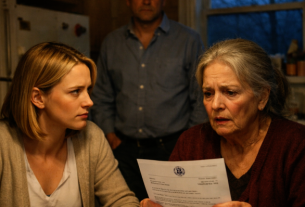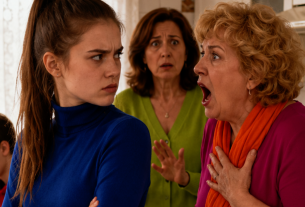
The doorbell didn’t sound like a timid visitor asking for help. It sounded like a debt collector demanding payment for a debt you didn’t even know you had. I glanced at the clock: Friday evening, the sacred time for rest and a TV series. But behind the door, judging by the heavy breathing and the rustling of padded coats, stood the “Holy Trinity”: my mother-in-law Valentina Stepanovna, my sister-in-law Elvira, and her husband Gena.
“Dasha, open up! We have a million-dollar matter for you, but only exactly one minute!” my mother-in-law proclaimed through the door in the same voice people usually use to announce an evacuation.
I opened it. Valentina Stepanovna floated into the hallway. Elvira came after her, her eyes darting around so fast it looked as though she was trying to catch sight of her own ears, and Gena brought up the rear with the expression of a man whose sandwich had been stolen, but who was too shy to ask by whom.
“Hi there, relatives,” Ilya said, coming out of the kitchen and wiping his hands on a towel. “What’s on fire?”
“Not a fire, a business strategy!” Valentina Stepanovna tossed off her coat without even checking whether I would catch it or not. I didn’t. The coat landed heavily on the ottoman like a tired seal. “Put the kettle on. This is a serious conversation.”
“But you said ‘just one minute,’” I reminded her.
“Oh, Dasha,” Elvira waved me off, plopping onto the sofa. “Mom, tell them.”
We sat down. Or rather, they occupied the kitchen, while Ilya and I took up defensive positions by the windowsill.
“Here’s the thing,” my mother-in-law began, smiling sweetly like a fox outside a henhouse. “This year the harvest at the dacha is unprecedented. Twenty sacks of choice, fluffy potatoes! It would be a sin to let such good produce go to waste. So we decided to take it to the market while the price is still good. A penny saved is a penny earned, as you know.”
“Congratulations,” Ilya nodded. “What does that have to do with us?”
“Well, it has to be transported!” Elvira threw up her hands. “Gena’s trunk is too small, and besides… it’s a shame.”
At that point Gena entered the conversation. He cleared his throat, adjusted his glasses, and said importantly:
“My little beauty is still under warranty. The upholstery is velour, champagne-colored. You put a sack in there, the dust will get embedded, and the dry cleaning will cost more than the potatoes. And the suspension, too… it’s sporty, stiff. Not meant for hauling cargo.”
I looked at Ilya. We both knew that Gena’s “sports car” was actually a budget sedan bought on credit, which the whole family was paying off while pinching pennies even on matches.
“And so,” my mother-in-law concluded triumphantly, “we decided to take your car. Dasha has that… what do you call it… crossover. Spacious, high up. And the interior is leather—wipe it down with a cloth and that’s it. Besides, Dasha dear, your car isn’t new anymore. It’s already three years old, used to hard work.”
“So,” I said slowly, “you want to take my car, pack it to the roof with dirt and root vegetables, wreck the suspension on a country road, stink up the interior with dampness, while your ‘champagne’ sits in the garage in sterile cleanliness?”
“Oh, why are you being so rude?” Valentina Stepanovna said, offended. “Not ‘wreck it,’ just use it for its intended purpose. A car is supposed to work! You only drive it to the office and the store. It’s standing idle with you. Metal rusts when it isn’t used!”
“Valentina Stepanovna,” I said with a smile, pouring myself some water, “by your logic, if something is sitting unused, it should urgently be put into circulation?”
“Of course! That’s how a good хозяйка thinks.”
“Excellent. You have that family Czech dinner set in your china cabinet. It’s been gathering dust for twenty years. Why don’t I take it to a barbecue next weekend? There’ll be a lot of people, dishes get broken, and your set is just sitting there unused anyway. Porcelain gets dull without food!”
“Don’t compare the two!” my mother-in-law shrieked. “That set is a memory! It’s sacred!”
“And my car is worth three million rubles and my peace of mind. That’s sacred too—like relics, only on wheels,” I shot back.
Gena shifted unhappily in his seat.
“Dasha, why are you starting this? We’re not asking for it for free. We’ll give you… a sack of potatoes.”
“Gena, a full tank of gas costs three thousand. A deluxe car wash after your village-style tuning is another fifteen hundred. Suspension wear is priceless. Your sack of potatoes comes out costing as much as truffles. Great business, I must say.”
“Oh, you always measure everything in money!” Elvira snorted. “Relatives are supposed to help each other! We’re family! When you needed to take your cat to the vet, Mom lent you that carrier, didn’t she?”
“Elya, I bought you that carrier two years ago,” Ilya reminded her calmly.
Elvira immediately went on the attack.
“That’s not the point! The point is the attitude! We came to you with our hearts open, and you… what, are you stingy? Just say you’re too stingy to help your own mother and sister!”
“We are stingy,” Ilya said firmly. “Dasha pays for that car’s maintenance herself, and she pays for the insurance herself. I don’t interfere, and I don’t advise you to either.”
Valentina Stepanovna realized that the direct attack had failed, so she switched tactics. She put a hand to her chest and made the mournful face of a martyr being led to execution for stealing a bread roll.
“My son, I never thought I’d live to see this. Your father and I did everything for you… and this is what we get—‘stingy.’ We’re not asking just because. We may be in a difficult financial situation. We still have to pay off the loan for Gena’s car, and this is such a good chance to make some money.”
“Mom,” Ilya frowned, “you said you paid off the loan with Gena’s bonus.”
“Well… almost paid it off!” Elvira jumped in quickly, her eyes darting even faster. “The interest piled up… hidden fees… bankers are bloodsuckers!”
“Strange,” I said thoughtfully, turning my phone in my hands. “Because yesterday on Instagram you posted a story: ‘The new iPhone is the best gift from my husband.’ The seventeenth Pro Max, unless I’m mistaken? And here you are saying debt is strangling you?”
“That… that’s a replica!” Elvira blurted out, blushing right down to the roots of her peroxide hair. “A Chinese knockoff! We got it for three thousand!”
“Really?” I smirked. “And the geotag from the Parus restaurant? They say the Caesar salad there costs about the same as one of your sacks of potatoes.”
“We were treated!” my sister-in-law screeched, getting completely tangled in her own story like a fly in sticky tape. “Stop counting our money!”
“Well, you came here for our resources,” Ilya pointed out reasonably. “That means we’re entitled to an audit.”
My mother-in-law realized that the poverty story was falling apart. She straightened up, squared her shoulders, and decided to go all in.
“All right then. I am your mother, and I demand respect. If you’re so sorry about a piece of metal, just say so. But mark my words, Ilya: we won’t be going to Aunt Sveta’s юбилей next weekend. And we’ll explain that we had no way to get there because a son refused to help his own mother. Let people know what kind of person you are.”
That was an ultimatum. Public shaming was Valentina Stepanovna’s favorite weapon. She could already see herself as the victor.
I looked at Ilya. He was uncomfortable, but he didn’t want to get into a marketplace shouting match with his mother. It was my time. I smiled—broadly and warmly.
“Valentina Stepanovna, why make such sacrifices? You can’t miss the юбилей. And the potatoes need to be sold. I’ve come up with the perfect solution.”
The relatives grew alert. Gena stopped chewing on his lip. Elvira froze.
“If you want to make money, then the volume must be large. My car would fit maybe five sacks at most if we folded the seats down. But you have twenty. That’s four trips. Gas, time… not cost-effective. I’ll call you a cargo taxi right now. A Gazelle van. Everything will fit in one go! And there are movers too, so Gena won’t have to break his back.”
I demonstratively opened an app on my phone.
“Here, look. Pickup in fifteen minutes. Only two thousand rubles to the market. If you have twenty sacks, you’ll make that back with the profit from one sack, and the other nineteen will be pure profit! Brilliant, right? My car stays clean, and Gena’s ‘champagne’ stays safe.”
My relatives’ faces fell.
“What taxi?” Gena croaked. “Two thousand? For five kilometers? Are you crazy?”
“Gena, you’re the economist,” I said in surprise. “Do the math. Depreciation, gas, your time. A taxi is profitable!”
“We’re not paying some stranger!” my mother-in-law barked. “The whole point of having your own household is that everything is free! You do it with your own resources!”
“But you don’t have your own resources,” I said calmly, without looking up from the screen. “What you have is potatoes and a desire to ride on someone else’s back. That’s not household management, Valentina Stepanovna. That’s parasitism. Like aphids on a rose.”
“You… insolent girl!” my mother-in-law choked out, getting to her feet. “Ilya, did you hear that? She called me an insect!”
“She called the process parasitism, Mom,” Ilya corrected tiredly. “And the taxi suggestion made sense. If you’re sorry to spend two thousand for the sake of business, then it’s not much of a business after all. It’s just an excuse to push us around.”
They stormed out of the apartment with noise and clatter like a herd of bison. Valentina Stepanovna forgot her scarf on the ottoman, but she didn’t come back for it—her pride was worth more than mohair.
When the door slammed shut, a blissful silence settled over the apartment.
“You weren’t really going to call them a taxi, were you?” Ilya asked, putting an arm around my shoulders.
“Of course not,” I snorted. “But I knew the word ‘pay’ works on them the way holy water works on vampires.”
Ilya laughed and kissed me.
“You’re a cruel woman, Darya.”
“Not cruel—fair. For it is written in the scripture of housewives: ‘Give not thy keys to those who do not value thy threshold, and thou shalt preserve thy nervous system forever and ever.’”
And they never did sell the potatoes. Half of them rotted in the garage because they were too cheap to pay for delivery, and they wouldn’t fit into the ‘champagne.’ But now, whenever they come to visit—and they do, what can you do—they behave at the door quieter than water, lower than grass.