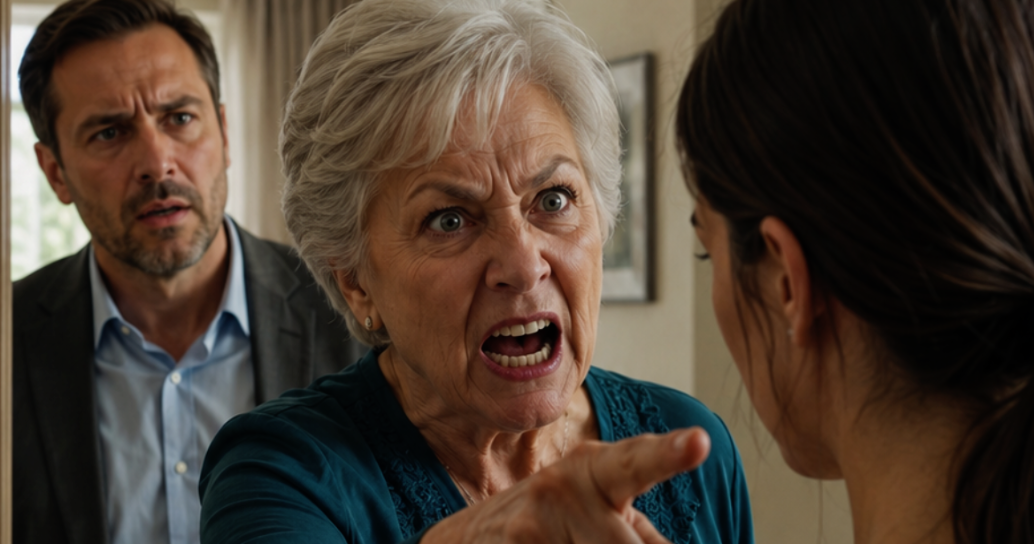
“Don’t you dare!” Valentina Petrovna turned around so sharply that her rhinestone earrings swung, throwing glints of light onto the wall. “I don’t want to see you while the Nesterovs are here! Sit in your little kennel and keep quiet!”
Dina froze by the half-open kitchen door, clutching a towel in her hands. Through the crack, she could see her mother-in-law adjusting the vase of artificial roses on the coffee table, smoothing the napkins, checking whether the crystal shot glasses stood evenly on the tray.
“Mom, calm down…” Artem began, but Valentina Petrovna waved her son off as if he were an annoying fly.
“The last thing I need is disgrace in front of decent people! The Nesterovs will come, they’ll see this…” She faltered, searching for the right word. “They’ll see her, and what will they think? That my son married just anyone?”
Dina quietly closed the door. Her hands were shaking, but she forced herself to breathe evenly.
Three years.
For three years she had lived in this apartment on Pokrovka, in the very center of Moscow, and every time guests came to the house, she was hidden away like a shameful secret. Like damaged goods too embarrassing to put on display.
The doorbell rang ten minutes later. Dina heard her mother-in-law chirping greetings, heard voices ringing out, heard Artem laugh — that special, polished, social laugh he never used with her.
She stood by the window in her room — her “kennel,” as Valentina Petrovna called it — and looked out at the evening city.
The October twilight was thickening quickly. Windows in the houses across the street lit up one after another, and Dina suddenly wondered how many women there were behind those windows just like her — women hiding from other people’s eyes. Women who had become invisible in their own homes.
She had grown up in Ryazan, in an ordinary family. Her father worked at a factory, her mother in a library. After technical college, Dina moved to Moscow, rented a room in Medvedkovo, and worked as an administrator in a dental clinic.
That was where she met Artem.
He had come in to have a tooth treated. He smiled, joked, invited her to a café. Back then, he had been different.
Or had she simply wanted to believe that?
“Dinka, bring us some more ice,” Artem’s voice came from the living room, carrying the careless tone people use when speaking to staff.
She took a container of ice from the freezer and went out.
The living room smelled of expensive perfume and cognac. The Nesterovs were sitting at the table — an elderly couple in elegant clothes — while Valentina Petrovna sat beside them, glowing like a Christmas tree.
“Ah, here’s our helper,” her mother-in-law said without even looking at Dina. “Put it on the table and go.”
Mrs. Nesterova — a woman of about sixty with a cold gaze — looked Dina over appraisingly.
“Who is this? The new housekeeper?”
The air in the room seemed to freeze.
Dina placed the container on the table and raised her eyes.
Artem had buried himself in his phone. Valentina Petrovna smiled stiffly.
“Oh no, Lyudmila Semyonovna! She is… she is a distant relative. She helps around the house sometimes.”
A relative.
Her son’s wife — a distant relative.
Something clicked inside Dina.
Quietly, almost inaudibly.
But Dina felt that click ripple through her entire body.
She slowly wiped her hands on her apron and took it off. Folded it neatly and placed it over the back of a chair.
“I am his wife,” she said softly but clearly. “Artem’s wife. I have been his wife for three years.”
Valentina Petrovna jumped up from her chair so abruptly that a cup of coffee tipped over onto the tablecloth.
“You… how dare you?! Out! Get out of the living room immediately!”
“No,” Dina shook her head. “I’m not leaving. I am tired of hiding in my own home.”
Artem finally lifted his head from his phone. His face showed confusion, irritation, and something else — fear of his mother.
“Dina, don’t make a scene. Go to your room. We’ll talk later.”
“Later?” she gave a bitter smile. “We’ve been living on ‘later’ for three years. When Mom won’t hear, when there are no guests, when she falls asleep… I’m not waiting for ‘later’ anymore.”
The Nesterovs sat with their faces stretched in shock, clearly not expecting such a turn.
Valentina Petrovna turned crimson.
“You… you insolent girl! I took you into this house out of pity! Fed you, clothed you, and you…”
“Out of pity?” Dina’s voice grew firmer. “You took me into this house because your son married me. And from the very first day, you did everything you could to make me feel like a servant instead of a member of the family.”
She grabbed the bag hanging in the hallway and threw on her coat. Her hands were shaking again — but now from adrenaline, from anger, from liberation.
“Where are you going?!” Artem finally stood up. “Have you lost your mind completely?”
Dina turned back at the threshold. She looked at her husband — at the man who had once given her flowers and read her poetry. The man who had promised to protect and love her. The man who had first called her “the helper” two weeks after the wedding, when his mother asked him to.
“I am no longer your servant. And I am no longer your secret. Live however you want.”
The door closed behind her with a quiet click.
The stairwell smelled of cats and fresh paint. Dina leaned against the wall and closed her eyes. Her heart was pounding so hard it felt as if it might burst out of her chest.
She took out her phone and dialed Katya, the only friend she had not lost contact with over those three years.
“Katya… can I come to your place? Just for a little while… yes… yes, something happened…”
Kurskaya metro station was packed with people. Dina pushed her way through the crowd, feeling shoulders brush against her, someone step on her foot, smelling wet clothes and cheap coffee from a vending machine.
She inhaled that smell deeply — the smell of ordinary life, where people hurried about their own business, where no one hid or pretended.
The train carriage was stuffy. Dina stood by the door, holding the rail, and looked at her reflection in the dark glass.
Thirty-one years old.
Hair tied back in a ponytail, face pale, dark circles under her eyes.
When was the last time she had looked in the mirror for any reason other than to check whether she looked invisible enough?
Her phone vibrated.
Artem.
Five missed calls.
She rejected the call and switched off the sound.
Katya lived in Tekstilshchiki, in a nine-story panel apartment building. She met Dina at the door in sweatpants and a stretched-out T-shirt, hugged her tightly, and asked nothing at first.
“Tea? Or straight to cognac?”
“Tea,” Dina took off her coat and sank onto the worn sofa. “I’m not ready to get drunk yet.”
Katya brought two mugs of steaming tea, sat beside her, and tucked her legs under herself.
“Tell me.”
And Dina told her.
Not everything at once. First about that evening, about the Nesterovs and her mother-in-law’s words. Then the words began pouring out on their own, like water through a broken dam.
How Valentina Petrovna had disliked her from the first day — “not our circle,” “no connections,” “from the provinces.” How Artem had defended her at first, but then began agreeing with his mother more and more often. How, gradually, Dina had turned into a servant — cooking, cleaning, doing laundry, yet never being invited to sit at the table when guests came.
How one day Valentina Petrovna had said, “Don’t disgrace us, sit in your room.”
And Artem had stayed silent.
“My God, Dinka,” Katya grabbed her hand. “Why were you silent? Why didn’t you tell me earlier?”
“I was ashamed,” Dina took a sip of tea and burned herself. “Everyone kept saying, ‘How lucky you are, what a husband you found, an apartment in the center, such an intelligent mother-in-law…’ And what was I supposed to say? That I was like a pet in their house? That my husband protects his mother, not his wife?”
Katya was silent, stroking her hand.
Outside the window, evening Moscow murmured — somewhere a dog barked, children shouted in the yard, an entrance door slammed.
“Stay with me,” Katya finally said. “For as long as you need. We’ll figure it out.”
That night Dina did not sleep.
She lay on the folding bed, staring at the ceiling and thinking.
About how, three years ago, she had believed love could overcome anything. That Artem would change, that her mother-in-law would get used to her. But people do not change if they do not want to change.
And Artem did not want to.
Morning began with twenty calls from her husband.
Then Valentina Petrovna wrote: “Stop this hysteria and come back. Don’t disgrace the family.”
Dina turned off her phone.
Katya left for work at eight, leaving her keys and a note: “The fridge is yours. Rest.”
Dina got up, took a shower, and for the first time in a long while, did not hurry. She made coffee and sat by the window.
Down below in the courtyard, old women were walking dogs, mothers were taking children to kindergarten. Ordinary life, without pretense and fear.
She took her laptop and opened her email.
Her résumé had not been updated in three years.
Valentina Petrovna had forbidden her to work — “Why do you need money? We’ll provide for you.”
Only that “providing” had turned out worse than prison.
By lunchtime, Dina had sent her résumé to six clinics.
By evening, two replies came in — invitations for interviews.
She turned her phone back on only the next day.
Thirty-eight missed calls from Artem, twelve from her mother-in-law.
One message from her husband’s mother:
“Artem’s heart is acting up. Are you satisfied?”
Dina smirked.
A classic move — manipulation through illness.
She had seen Valentina Petrovna use that scheme constantly: headache, blood pressure, heart pain. And Artem came running every time, canceling all plans.
But now it was no longer Dina’s problem.
She typed a reply:
“Call an ambulance. I am not coming back.”
The first interview was at a clinic on Prospekt Mira.
Dina put on the only decent dress she had, applied makeup, and straightened her shoulders. The head doctor — a woman of about fifty with intelligent eyes — looked through her résumé and asked several questions about her previous experience.
“Why haven’t you worked for three years?”
Dina hesitated.
What was she supposed to say?
That her husband and his mother had forbidden her? That she had sat at home like a locked princess in a tower?
“Family circumstances. But now I’m ready to work full-time.”
The head doctor nodded.
“We need a receptionist administrator. The schedule is flexible, the salary is modest at first, but there are prospects for growth. Can you start in a week?”
“I can,” Dina smiled.
And for the first time in a long while, the smile was real.
That evening, she sat with Katya in the kitchen, drinking cheap boxed wine and laughing — loudly, sincerely.
“I got the job! Katya, I’m going to work again!”
“You beauty,” Katya clinked her mug against hers. “And Artem is still calling?”
“He is. Calling. Writing. But I don’t answer.”
“And you’re right not to. Let him understand what it feels like to lose someone.”
Only Artem did not understand.
Three days later, he found her.
That evening, when Dina was returning to Katya’s place with groceries, he was waiting by the entrance. He looked older, gaunt, in a wrinkled shirt.
“Dina, let’s talk.”
“There’s nothing to talk about,” she tried to walk past, but he grabbed her by the arm.
“Mom is sick. Seriously sick. Her blood pressure keeps jumping, she’s swallowing pills by the handful. The doctors say it’s stress. Because of you.”
Dina pulled her arm free.
“Because of me? Artem, your mother abused me for three years. Humiliated me, hid me, treated me like a servant. And you stayed silent. You always chose her, not me.”
“You know what she’s like… You should have endured it, adapted…”
“Adapted?” Dina’s voice broke into a shout. “I adapted for three years! I washed, cooked, cleaned! I kept quiet when she called me a servant! And what changed? Nothing!”
“Dina, come back. I’ll talk to Mom. She’ll understand…”
“No,” Dina shook her head. “I won’t come back. I want to live, Artem. To live, not exist in fear. I found a job. I’m starting a new life. Without you.”
She turned and walked toward the entrance.
Artem called after her, but she did not look back.
Katya’s apartment was warm and smelled of borscht. Dina took off her jacket, went into the kitchen, and sank onto a chair.
“He came?”
“Yes.”
“And what did you tell him?”
“That I’m not coming back.”
Katya poured her a bowl of borscht and pushed the bread toward her.
“Well done. Hold on. The hardest part is behind you.”
But Dina knew the hardest part was only beginning.
Work at the clinic became her salvation.
Dina came in at eight in the morning, smiled at patients, scheduled appointments, handled paperwork. Zhanna Sergeevna, the head doctor, turned out to be strict but fair. She did not pry into Dina’s personal life, did not ask unnecessary questions — she simply allowed her to work.
A month later, Dina rented a room in Perovo — tiny, with furniture from the nineties, but it was hers. She bought new bedsheets, hung curtains on the window, and placed a violet in a pot on the windowsill.
It was her space, where no one could tell her how to breathe.
Artem called less often.
Valentina Petrovna sent one last message:
“You will regret this. God sees everything. He will punish you for destroying the family.”
Dina deleted the number and blocked the contact.
Six months passed.
Spring came late to Moscow, but decisively. In one week, the snow melted, the trees turned green, and people took off their heavy jackets.
Dina was walking home from work through the park when she saw Artem.
He was sitting alone on a bench, hunched over, looking ten years older. Crutches stood beside him.
She wanted to pass by, but he raised his head and met her eyes.
“Dina…”
His voice was hoarse and tired.
She stopped a few steps away.
“What happened?”
“A stroke,” he gave a crooked smile. “Two months ago. My left side still doesn’t work properly. The doctors say stress, overwork. But I know it’s payback.”
Dina said nothing.
Inside, there was no pity, no gloating. Just emptiness.
“Mom…” Artem stumbled over the word. “Mom is sick too. Stomach cancer. Stage four. They say she has three months left, maybe less.”
“I’m sorry,” Dina said.
And it was true — she was sorry, but not the way she would have been before. Not with that kind of pity that made her endure and stay silent.
“She asked me to tell you…” Artem swallowed. “She asked for forgiveness. Said she was wrong. Said she poisoned my life, destroyed our marriage.”
“It’s too late for apologies.”
“I know. I understood too late too. When you left, I thought, ‘It’s nothing, she’ll come back.’ And then Mom started getting sick. First her stomach, then bad test results, then the diagnosis. And I… I was left alone with her. I take care of her, feed her, give her pills. And I realized what it was like for you for three years.”
Dina sat down on the edge of the bench.
“What do you want from me, Artem?”
“Nothing,” he shook his head. “I just wanted you to know. We got what we deserved. Mom is dying in agony, and I… I’m disabled at thirty-four. I lost the business, my friends turned away. I’m alone in an empty apartment with a sick mother who now asks forgiveness from everyone she hurt. Only it’s too late. Everything is too late.”
He stood up, leaning on his crutches, and slowly walked away.
Dina watched him go and thought about how strangely life worked.
For three years, she had endured humiliation, hoping everything would change. For three years, she had been their servant — someone they could hide and be ashamed of.
And now they were both sick, broken, punished.
But she felt no triumph.
Only relief.
She had left in time.
She had saved herself in time.
That evening, Dina met Zhanna Sergeevna in a café. The head doctor offered her a new position — senior administrator, with a salary one and a half times higher.
“You work well,” Zhanna Sergeevna said. “You’re responsible, punctual. I can see how much you’ve changed over these months. As if you’ve come back to life.”
“That’s exactly what happened,” Dina smiled. “I came back to life.”
A week later, a message came from an unknown number.
“Valentina Petrovna died yesterday. The funeral is the day after tomorrow. Artem.”
Dina read it, exhaled, and deleted the message.
She would not go to the funeral.
Not out of anger or revenge. Simply because that chapter of her life was over.
Her mother-in-law had died without truly repenting, because words spoken on a deathbed changed nothing. Artem had been left disabled and alone, because all his life he had chosen his mother over his wife, convenience over justice.
And Dina…
Dina simply kept living.
She rented a one-room apartment in a new building in Novokosino. She did the repairs herself — painted the walls light beige, put up wallpaper, hung shelves. She met her neighbor, Taisiya, a woman of about sixty who treated her to pies and told stories from her youth.
At the clinic, they offered Dina training courses in medical management.
She agreed without hesitation.
One Saturday morning, she stood on the balcony of her apartment with a cup of coffee. Down below, the courtyard was alive with noise — children played ball, teenagers rode scooters, old women sat on benches. The sun shone brightly, and white clouds drifted across the sky.
Her phone vibrated.
A message from Katya:
“How are you, my friend? We haven’t seen each other in ages. Maybe a movie today?”
Dina smiled and typed back:
“Let’s do it. Pick the film.”
She finished her coffee, put the cup on the small table, and stretched her whole body.
The air smelled of spring, freedom, and new possibilities.
Artem and his mother had gotten what they deserved — not because Dina had wished it, but because life had put everything in its place. Those who cause pain to others sooner or later end up alone with that pain. Valentina Petrovna had died in fear and loneliness, never having learned how to love. Artem had been left disabled, without a family, without a business, without a future.
And Dina began to live again.
Not out of revenge.
Not out of a desire to prove anything.
Simply because she had the right to.
She went back into the room, changed into jeans and a light blouse, and picked up her bag. In the mirror, she saw a woman with clear eyes and a calm face.
Not the beaten-down, frightened Dina who had hidden for three years in a “kennel.”
A new Dina.
Free, confident, alive.
She left the apartment, went down the stairs, and stepped out into the street, toward the spring day.
Behind her remained the old life with its humiliations and fear.
Ahead lay the future — unknown, but entirely her own.
And that was enough.