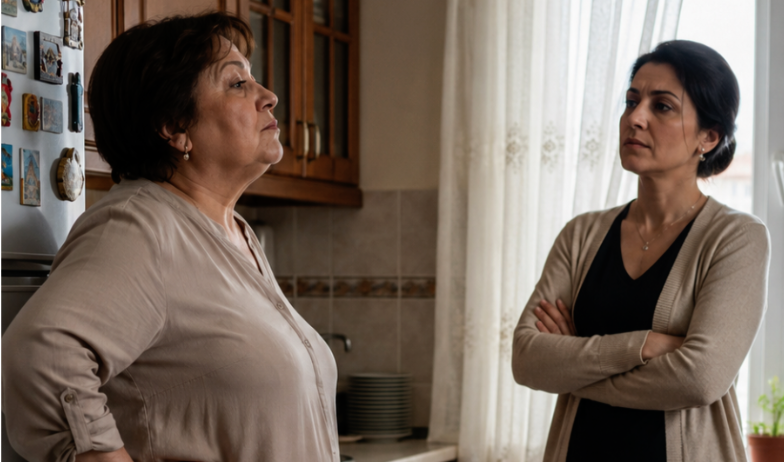
“Why are you all sitting here like everything has already been decided? We’re going to divide the money!”
Tamara threw her bag onto a stool and sat down at the head of the kitchen table herself. As if it were her kitchen, her table, and her—Tamara’s—stools. Olga had only just turned off the tap; she had been washing the last cup before the “guests” arrived.
Behind Tamara, their mother, Nina Sergeevna, squeezed through the doorway in her padded raincoat, even though it was a July evening outside and thirty degrees in the shade. In her hands was a plastic bag from a chain store, with a packet of dry cookies sticking out of it. They had brought something for tea. Thank you, at least they hadn’t come empty-handed to take things away.
“Eight hundred rubles for a taxi from the station,” Tamara announced, as if Olga were supposed to reimburse her. “I’m running around, turning myself inside out, and meanwhile things like this are happening behind my back.”
Mikhail, Olga’s husband, was sitting in the corner with a tablet. On the screen was some forum about reels and spinning rods—Olga noticed it out of the corner of her eye. He muttered, “Hello,” and buried himself in the screen again. His “I’m not here” status had clearly been switched on in advance.
“What things, Toma?” Olga dried her hands with a towel. She hung it neatly on the hook, corner to corner.
“These things!” Tamara slapped her palm on the table. The large hoop earrings in her ears swayed—gypsy-style, clearly from the market, clearly worn “for the occasion.” “Mom transferred almost two million to you! And I got nothing! What kind of division is that?”
There it was. Tamara had crossed the threshold twenty minutes ago, and those twenty minutes had been spent on “How was the trip?” and “Sit down.” And now—straight to business.
Olga remained silent. Numbers clicked in her head, the way they always did—twenty years in factory accounting don’t pass without leaving a trace. In March, her mother had sold her one-room apartment on the left bank. Three million two hundred thousand. Of that, she had kept eight hundred thousand for herself in a savings account. One million eight hundred thousand she had transferred to Olga—for a specific purpose: hip replacement surgery and dental work. Olga had been saving for it herself for a year. Her mother had seen how her daughter limped by the end of every shift and decided: I’ll sell the apartment, move to my niece’s place in the village, and give Olga the money so she can get back on her feet.
Literally.
“Mom,” Olga turned to her mother. “Did you tell Tamara what the money was for?”
Nina Sergeevna began fussing and taking off her raincoat.
“Well, I… I wrote in the chat so Tamara would know that everything was all right with you now… I didn’t think…”
“What didn’t you think? That my sister would rush over to divide my teeth in half?”
“Don’t twist things!” Tamara practically jumped up. “She’s our mother! The money from selling the apartment belongs to both of us! Why does it all go to you?”
“Because it’s for my operation,” Olga said evenly. “Not for a vacation.”
Tamara snorted and looked around the kitchen. Her gaze caught on the new dishwasher.
“Oh, look at that. You installed a dishwasher. With my money, basically.”
“With Mikhail’s salary. In May.”
“Yeah, sure.”
Olga sat down opposite her. She folded her hands on the table. In the corner, Mikhail scrolled through something on his tablet and nodded to himself, as if reading something important. The master of the house was performing a complex act: being present in body and absent in every other way.
“Toma, how long did you come for?”
“I’m not going anywhere until we divide the money!” Tamara took her phone out of her bag and placed it on the table demonstratively. “I have a screenshot from the chat right here. In black and white: ‘I transferred one million eight hundred to Olya.’ Mom is a witness. We’ll do it fairly: nine hundred for you, nine hundred for me.”
“Nine hundred for what?”
“That’s none of your business! I have two kids! Lyoshka needs money for his driving license, Kristinka needs crowns! I have children, Olya, children! And who do you have? Just you and your Misha, two of a kind. What do you need to divide? You sit there together like two owls—no grandchildren, no worries!”
Olga did not answer immediately. She placed her palm on the table and stayed silent for exactly long enough that the refrigerator became audible in the kitchen.
“Owls,” she repeated. “I see.”
“Well, am I wrong?!” Tamara was already worked up, her voice rising. “At your age, I could have handled three children, and God didn’t even give you one! So at least help your sister, since you’re empty yourself!”
Nina Sergeevna gasped.
“Toma, what are you saying…”
“What am I saying?! I’m telling the truth! Olya, you’re not poor—you’re a factory accountant, your husband is an engineer. You’ll manage somehow. I need it MORE. As a sister, you should understand!”
Mikhail stood up quietly. He said into the air:
“I’ll go smoke,” and went out onto the balcony.
The door clicked shut behind him. A rustling sound came from the balcony, then the strike of a lighter. Mikhail had mastered the technique: where things get heated, don’t get involved—you can only smoke a cigarette there.
“See?” Tamara smirked after him. “Even yours won’t stand up for you. Because there’s nothing to stand up for. The money has to be divided.”
Olga stood up and went into the room. Tamara and their mother exchanged glances—Nina Sergeevna nervously twisted a button on her cardigan.
Olga returned with a thin folder. Not an accounting folder, a household one—an ordinary cardboard folder with an elastic band. She sat down and removed the elastic.
“Toma. Since you came here for fairness, let’s do this fairly.”
“Let’s!”
Olga took out the first sheet.
“My bank statement. Do you see the purpose of the payment? Read it out loud, since you like things in black and white.”
Tamara glanced sideways at it but took it. She read, already without her earlier enthusiasm:
“Targeted transfer… to daughter… for medical treatment: hip joint replacement and dental treatment.”
“Mom wrote that at the bank. In front of the teller. Of her own free will. Next.”
The second sheet.
“Contract with the clinic. Preliminary. Joint replacement, imported prosthesis, hospital room, rehabilitation. The amount is one million one hundred forty thousand. Do you see the date? The operation is scheduled. I’ve been in line since February.”
Tamara was silent. Her finger twitched against the tabletop.
“Third. Invoice from the dentist. Implants, four of them, plus prosthetics. Four hundred twenty thousand. I haven’t been able to fix my teeth for three years; I kept putting it off. Add it up: one million one hundred forty plus four hundred twenty. More than one and a half million. Out of one million eight hundred.”
“Well… there’s still some left!” Tamara seized on it. “More than two hundred is left! At least divide that!”
“Rehabilitation, a sanatorium, medication, taxis to the clinic for six months. I limp, Toma. I can’t even climb onto a minibus.”
Olga took out her phone. She opened the messenger and turned the screen toward her sister and mother.
“And this is my correspondence with Mom. Mom, do you recognize it? April third. You wrote: ‘Olenka, this is strictly for your legs and your teeth, so that my girl will be healthy. I’ll help Tamara separately when I can.’ Your hand. Your words.”
Nina Sergeevna froze. She recognized it. Her lips moved silently—she wanted to say something and didn’t.
“Mom, did you write that?”
“I did, Olenka…” she said quietly. “I did.”
“That means nothing!” Tamara raised her voice, but now there was a crack in it. “Messages aren’t documents! Mom can change her mind! Mom, you said we were family, that it should be split equally!”
“I said I would help you separately,” Nina Sergeevna forced out, without looking at her older daughter.
Olga did not argue. In fact, she stopped arguing altogether. She opened her banking app.
“Toma. Look here. Since you like it when things are in black and white.”
A few taps. A transfer using the details from the contract—prepayment to the clinic, an advance payment for the prosthesis and her place in the queue. A large six-figure sum. She turned the phone toward the table.
“I’m confirming it.”
Her finger hovered over the button.
The balcony went quiet. Even Mikhail, apparently, was listening through the glass.
The number on the account balance trembled and decreased. Right before their eyes. Tamara’s mouth opened—and closed again, soundlessly.
“The money has gone to the clinic,” Olga said matter-of-factly, as if she were reading out a receipt from Pyaterochka. “There’s nothing left to divide. That money is no longer in the account. It’s in the prosthesis and in the queue.”
Silence. The refrigerator hummed loudly through the kitchen.
“You… you did that on purpose!” Tamara choked out. “In front of us! Out of spite!”
“For a purpose,” Olga corrected her. “So the matter would be closed today. Since you said you were staying overnight.”
She turned to her mother. Her voice softened by half a tone.
“Mom. If you want to help Tamara, help her. You have eight hundred thousand left in your savings from the apartment. Give her as much as you think is right. That is your right, and I won’t say a word. But not from my medical money. That medical money is my legs.”
Nina Sergeevna sat with her hands lowered onto her knees. She was silent.
“Mom!” Tamara turned to her. “Do you hear her? Give me at least half of yours!”
And then something happened that, perhaps, made the whole visit worthwhile. Nina Sergeevna looked at her older daughter—the very one she had just been fighting for—and said quietly but clearly:
“Toma, I have eight hundred thousand for my funeral and for old age. I’m moving to Lyusya’s place in the village. I need to have the stove rebuilt there. I’ll give you fifty thousand for Kristina’s crowns. But no more.”
“Fifty?!” Tamara half-rose from her seat. “I paid eight hundred just for the taxi!”
“Well, who forced you to come?” Nina Sergeevna muttered to the floor.
The balcony door opened slightly. Mikhail stuck his head in.
“Will you have tea?” And without waiting for an answer, he disappeared back outside. Offering tea—that he could do. Money—that was for the women.
Tamara swept her phone off the table. The screenshot from the chat, on which she had pinned all her hopes, now looked like the wrapper from an already-eaten candy.
“Well, choke on it then,” she said, standing up. “Some sister you are. I came to you from across the whole region, and you shove bank statements in my face! Accountant.”
“Accountant,” Olga agreed. “Twenty years. I like numbers when they add up.”
Tamara slammed the door so hard that the shot glasses rattled in the sideboard. Nina Sergeevna started gathering herself to follow, but Olga stopped her.
“Mom, where are you going at this hour? Stay. Tamara can take a taxi to the station, and you stay with me. You need the stove rebuilt—let’s calculate how much it will cost. From your eight hundred thousand.”
Her mother stayed. Tamara left alone.
A week later, the clinic called Olga—the operation was confirmed, the date was set for the end of July, the prosthesis had been ordered, and the advance payment had gone through. Olga wrote the date on the wall calendar and circled it twice with a pen.
Two weeks passed. The joint was replaced, everything went smoothly, and Olga was sent to a sanatorium near Voronezh to finish rehabilitating her leg. During all that time, Tamara did not write even once. Not “How are you?” Not “Forgive me.” She stayed silent, as if she were the one who had been offended.
But Olga’s roommate at the sanatorium turned out to be an interesting woman—a former client of Tamara’s, who had gone to her for haircuts for about ten years until Tamara changed salons. From her, between procedures, Olga learned that things in Tamara’s family were complicated: her husband had been without steady work for the second year, Lyoshka still hadn’t saved up for his driving license, and the salon where Tamara had rented a chair had closed down, so now she was running from house to house, cutting hair for cash. That was where the passionate “I need it more” had come from.
Her mother called Olga herself a month later, when Olga had already returned home and was slowly walking around the apartment with a cane. Her voice was guilty and quiet.
“Olenka… forgive me, old fool that I am. I didn’t write in the chat out of malice. I just wanted to boast that things were finally getting better for my daughter. And look how it turned out.”
“It happens, Mom,” Olga said. “Did you get the stove rebuilt?”
“They’re rebuilding it. How are you? Are you walking?”
“I’m walking. Little by little.”
Olga hung up. She went over to the refrigerator, where a sheet of paper was held to the door with a magnet—the rehabilitation schedule from the sanatorium. She took the sheet down, reread tomorrow’s point, and put it into that same cardboard folder, together with the bank statement and the contract.
Then she snapped the elastic band shut.