Marina carefully wrapped the porcelain figurine in newspaper—the very one her grandmother had once brought back from Kislovodsk. The boxes stood in a neat row in the hallway, labeled in marker: “kitchen,” “books,” “memories.” She had circled the last word twice.
The doorbell rang sharply and impatiently. Marina wiped her hands on her apron and went to answer it, expecting no one. Viktor Sergeyevich stood on the threshold. He looked older, with dark circles beneath his eyes and a rumpled jacket.
“Hello, sweetheart.”
“Dad?” Marina stepped aside to let him in. “Two years. Not a single call or message for two years. Come in.”
“I see you’re going somewhere?” His eyes swept over the boxes, and something flickered in them. It was not concern. It looked more like interest.
“Yes. I’m moving to a village near Voronezh. I was offered a position there, and I accepted.”
“A village?” Viktor Sergeyevich froze. “Are you serious? You have an apartment in the city, and you’re moving to the countryside?”
“I couldn’t be more serious.” Marina smiled, trying not to reveal her tension. “Would you like some tea? I haven’t packed the kettle yet.”
She put the water on and took out two cups. Her hands moved calmly and automatically, but inside, something had tightened like a drawn string. Her father never visited without a reason. Galina Petrovna was always behind it somehow.
“I’m glad you opened the door,” Viktor Sergeyevich said, sitting on a stool. “I thought you might not want to see me.”
“You’re my father.” Marina placed a cup in front of him. “I never closed my door to you. You were the one who said you wanted nothing more to do with me. Remember?”
“Well, I lost my temper,” he said, looking away. “It was a difficult time. Kristina lost her place at the university, and everyone’s nerves were on edge…”
“Kristina lost her tuition-free place because she didn’t attend her classes. That wasn’t my fault, Dad. It was her choice.”
Viktor Sergeyevich remained silent, stirring sugar into his tea. Marina waited. She knew the real reason for his visit was still coming.
“Listen, sweetheart,” her father finally began, his voice suddenly ingratiating and unfamiliar. “Since you’re moving to the countryside, you won’t need this apartment anymore.”
“What are you getting at?” Marina set her cup on the table.
“Kristina has nowhere to live. Galina Petrovna said it would only be fair…”
“Fair?” Marina interrupted, her voice growing quieter. “Fair is my grandmother—my mother’s mother—leaving this apartment to me. To me. Not to Kristina. Not to Galina Petrovna.”
“You’ve been given a house in the village, so go and live there and transfer the apartment to your sister!” Viktor Sergeyevich suddenly raised his voice, as though someone had pressed a button. “That would be the right thing to do.”
“It isn’t my house, Dad. It’s employer-provided accommodation. And Kristina is not my sister. We have different mothers, different grandmothers, and apparently different fathers as well.”
“Is that any way to speak to your father?” He rose halfway from the stool.
“And is that any way to speak to your daughter?” Marina did not back down. “You didn’t come here to see me. You came for the apartment. Galina sent you, didn’t she?”
Viktor Sergeyevich turned red. He began fumbling anxiously in his pocket and pulled out a sheet of paper folded into quarters.
“Here. Everything is written down. It’s a deed of gift. All you have to do is sign it.”
“You brought a completed document?” Marina took the paper, unfolded it, and read it. “You prepared everything already. Without my knowledge. Without my consent. You simply showed up with a piece of paper.”
“Kristina is twenty-three years old, and she has nowhere to live!”
“I was fourteen when I left home because my stepmother fed me scraps and locked me in the pantry because of the bad grades Kristina received! Where was your concern then, Dad?”
Viktor Sergeyevich said nothing. Slowly and carefully, Marina tore the paper in half. Then she tore it again, and once more. She placed the pieces on the table in front of him.
“Tell Galina Petrovna that this apartment came from my grandmother. It was mine, it is mine, and it will remain mine. End of discussion.”
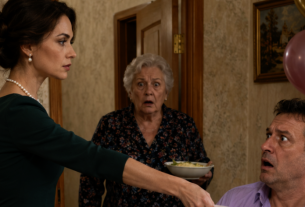
The doorbell rang again. Marina opened the door and found Galina Petrovna herself standing on the threshold, with Kristina hiding behind her. Her stepmother entered without being invited, shoving Marina aside with her shoulder.
“Well, did you talk to your father?” Galina Petrovna surveyed the apartment as though she already owned it. “I knew that spineless weakling wouldn’t be able to handle it. I had to come myself.”
“Get out of my apartment,” Marina said calmly, enunciating every word.
“Your apartment?” Her stepmother smirked. “Look at yourself. You’ve packed your boxes and you’re running off to the countryside, but you want to leave the apartment empty. You have no conscience.”
“My conscience is perfectly fine. But you, Galina Petrovna, have a calculator where your conscience should be.”
“Mom,” Kristina said, tugging at her mother’s sleeve. “Maybe we shouldn’t do this.”
“Be quiet!” Galina snapped. “I put up with this ungrateful girl for twelve years! I fed her and clothed her for twelve years!”
“Fed me?” Marina stepped toward her. “You let me eat whatever Kristina left behind. You took away the pocket money Grandma gave me. You ripped books out of my hands and said I was ruining my eyesight just to show off. Is that what you call feeding and clothing me?”
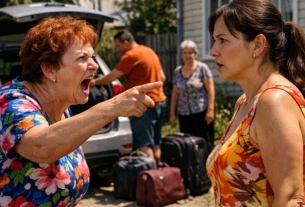
“You insolent little brat.” Galina Petrovna jabbed a finger into Marina’s chest. “That old woman filled your head with nonsense! The old hag…”
Marina caught her hand. She gripped it so firmly that Galina Petrovna gasped in surprise. Then Marina slapped her—once, sharply and precisely.
“Do not ever speak about my grandmother that way,” Marina said, pronouncing each word separately. “Never.”
Her stepmother stumbled backward, clutching her cheek. Her eyes grew as round as saucers. In all the years she had known her stepdaughter, nothing like this had ever happened. Kristina pressed herself against the doorframe.
“You… you hit me? Viktor! Viktor, did you see that?”
“I saw it.” Viktor Sergeyevich stood in the hallway, staring at the floor. “I saw it, Galina.”
“Why are you just standing there? Say something to her!”
“What am I supposed to say?” He raised his eyes, and for the first time in many years, Marina saw not weakness in them, but shame. “She’s right, Galya. You started it.”
“Take your deed of gift.” Marina pointed to the scraps of paper on the table. “And leave. All three of you. Now.”
Galina Petrovna backed toward the door, still holding her cheek. Kristina rushed out first. Viktor Sergeyevich paused on the threshold.
“Marina…”
“Go, Father. You made your choice a long time ago. Today I made mine. You really are spineless.”
A week later, Marina handed the apartment keys to her friend Olesya. They were sitting in a café across the street from the building, and Olesya turned the key ring over in her hands, examining the keychain—a small wooden owl Marina had carved at school.
“Are you sure you don’t want to sell it?” Olesya raised an eyebrow. “It’s a good neighborhood, and property values have risen.”
“No. Rent it out. Put the money into a separate account. This apartment is all I have left from Grandma. I’m not selling it.”
“What happens if they try something again?”
“Let them try. You’re officially registered as my representative, the apartment belongs to me, and all the documents are in order.”
“Marina.” Olesya leaned closer. “I’ve known you for fifteen years. You’ve never been this tough. What happened?”
“I slapped my stepmother,” Marina said so casually that Olesya began coughing. “And I realized I should have done it about ten years ago.”
“Wow. You really did that?”
“She insulted Grandma. In front of me. Inside Grandma’s apartment. That was the last time I allowed her to open her mouth in my presence.”
Olesya silently embraced her friend. Then she pulled away, put the keys in her bag, and said:
“I’ll find good tenants. A married couple, no pets and no surprises. I’ll send you a report every month. You can leave without worrying.”
Marina departed the following morning. The bus jolted over the potholes, fields stretched beyond the village, and the air became different—thick and real. The school principal met her when she arrived, showed her the house, and gave her the keys. Her life was beginning with a clean slate.
She met Dmitry three months later. He delivered supplies to the school cafeteria. One day, he stopped near her gate after seeing Marina planting wild rose bushes along the fence.
“You’re digging crookedly,” he said.
“Thank you for the criticism,” she replied without turning around.
“I’m not criticizing you. I’m offering to help.”
She turned toward him. He was tall and tanned, with hands that clearly knew what to do with a shovel. He was smiling—not arrogantly or condescendingly, but simply and openly.
“All right, then. Help me,” Marina said.
A year and a half later, they were married. The wedding was quiet—twenty guests, a long table in the yard, and strings of lights hanging between the apple trees. Olesya came and brought the porcelain figurine from Kislovodsk that Marina had forgotten during the move.
“Your grandmother would have approved,” Olesya said, looking at Dmitry.
“I know.” Marina smiled. “She would have said, ‘Finally, my dear granddaughter. Finally, you have a decent person beside you.’”
Another year passed. Marina and Dmitry were sitting on the veranda one evening when the telephone rang. The number was unfamiliar.
“Hello?”
“Marina… it’s Kristina.” Her voice was quiet and trembling. “Please don’t hang up.”
“Speak.”
“Mom… Mom left Viktor Sergeyevich. She took all the money from their accounts and transferred the car to her… to another man. They left together. Dad is alone. Completely alone. He has nothing left, Marina. Nothing at all.”
Marina remained silent. Dmitry raised his head, noticing something in her expression.
“And you?” Marina asked.
“Me? Mom said she would take me with her. But she didn’t. She sent me a message saying I was twenty-five and old enough to take care of myself. Then she changed her number.”
“A familiar tactic,” Marina said without malice. “I heard the same thing when I was fourteen. From her.”
“Marina, I understand I have no right to ask you…”
“No. You don’t have that right. But go ahead.”
“Dad… he isn’t eating. He sits alone in an empty apartment. Galina took all the furniture. Everything. While he was in the hospital having tests done, she hired movers and removed everything, right down to the last stool. She even took the curtains.”
Marina closed her eyes.
“Kristina, listen carefully. I am not obligated to help him. He brought this on himself. He chose Galina. Every day, every year, he chose her instead of me.”
“I know…”
“But he is my father. And I am not Galina Petrovna. Give me his address. I’ll come the day after tomorrow.”
Dmitry placed his hand over hers. He said nothing. He was simply there beside her.
Marina ended the call and sat silently for a long time. Then she turned to her husband.
“She cleaned him out. Completely. After everything she did to me, am I supposed to carry him now too?”
“That’s for you to decide.” Dmitry squeezed her fingers. “But I’m with you, whatever you choose.”
“I’ve decided. I’ll bring him here. Temporarily. Let him see how people live when they aren’t being led around on a leash.”
Two days later, they arrived in the city. Viktor Sergeyevich’s apartment really was empty. The walls were bare, and wires from the missing light fixtures protruded from the ceiling. Her father was sitting on the floor in the hallway, leaning against the wall. A plastic bottle of water and a piece of bread lay beside him.
“Dad.” Marina crouched in front of him. “Get up. We’re leaving.”
“Where?” He did not raise his eyes.
“To my place. In the village. Temporarily.”
“But you said I had made my choice…”
“You did. And that choice brought you here, sitting on the floor. But I am your daughter, and now I’m making my choice. Get up.”
Dmitry helped him to his feet. Viktor Sergeyevich remained silent throughout the entire drive. Only when they entered the village and Marina pointed out the house with the wild rose bushes along the fence did he finally speak.
“Your mother loved planting wild roses too. We had some growing beneath our window. Do you remember?”
“I remember, Dad. I remember.”
He lowered his head.
“Forgive me. I know those words aren’t enough, but I have nothing else.”
“They aren’t enough,” Marina agreed. “But at least they’re a beginning.”
A month later, a letter arrived from Olesya. Apparently, before leaving, Galina Petrovna had attempted to rent out Marina’s apartment through another agency by pretending to be the owner. Olesya discovered the scheme, stopped it, and filed a complaint with Rosreestr, the state property-registration authority. Galina was facing a substantial fine.
But the most surprising news came at the end of the letter. The man Galina Petrovna had left with turned out to be just as much of a swindler as she was. Three weeks after their departure, he disappeared—with the money, the car, and everything Galina Petrovna had so carefully taken from Viktor Sergeyevich. She was left penniless in an unfamiliar city, without a home and without a single person she could call.
Marina read the letter, folded it, and put it inside her desk drawer. Dmitry entered carrying an armful of firewood.
“What did they write?”
“Justice.” Marina looked at her husband. “Sometimes it arrives on its own, without anyone’s help.”
“And your stepmother?”
“She is no longer my stepmother. She is a stranger who received exactly what she deserved: emptiness.”
On the veranda, Viktor Sergeyevich was peeling potatoes. He was doing it awkwardly and slowly and had already cut his finger, but he was doing it. For the first time in twenty years, he was doing something for himself. Marina went outside, bandaged his finger, and sat beside him.
“Dad, you’re holding the knife like a pen. Let me show you.”
“All right.” He smiled—timidly and guiltily, but he smiled.
The wild roses along the fence had blossomed—pink, thick, and stubborn.
Grandma would have approved.