Maksymko was drawing a house. Not the one they lived in, but one that did not exist yet: with a chimney, a tree by the porch, and a dog almost half the size of the roof.
“Mom, this will be my room,” he said, pointing his pencil at the upstairs window. “The one where I can be loud.”
Hanna wiped her hands on a towel and said nothing.
In their one-room apartment, being loud was never allowed. Not when Maksymko built a fortress out of pillows, not when he laughed, not when he cried. The walls were thin, the downstairs neighbors were nervous, and the child’s bed stood so close to the sofa that at night Hanna could hear her son breathing right beside her ear.
She worked in the kitchen. Remote accounting, other people’s invoices, other people’s reports. Her laptop stood on the same table where porridge was cooked in the morning and cabbage was chopped in the evening. At ten, Maksymko would fall asleep, and Hanna would return to the table to work.
Three years passed like that.
Oleh came home that evening excited, carrying two shopping bags and wearing the expression of a man who had just won something important.
“Hanna, just listen. The forest is right behind the fence. It has its own well, the water is clear as a tear. Two floors, brick walls, proper heating—you can live there all year round, not just in summer. Taras, Lida, and I looked over everything.”
Hanna was taking plates out of the drying rack.
“And?”
“And for Mom and Dad’s thirty-fifth wedding anniversary, we’re giving them a house! From all three children. Huh? Come on, tell me I’m a genius!”
She placed the plate on the table. Very carefully, so it would not make a sound.
“It’s a nice gift, Oleh. But whose money is paying for it?”
“Oh, don’t start.” He was already pulling bread from one of the bags. “Lida doesn’t have any money right now. Taras doesn’t either. You know what they’re like.”
Hanna knew.
Lida visited their parents twice a year, and both times it was because she needed something. Two years earlier, her mother-in-law had given Lida all the money she had saved for a new sofa because “Lidochka needs it.” Taras had forgotten his mother’s birthday three years in a row.
And now, suddenly, they “didn’t have any money.”
“We’ve been saving,” Oleh said. “What we have isn’t enough, I calculated it. But you still have the money your father left you. It’s exactly the amount we need.”
The kitchen became so quiet that Hanna could hear the neighbors’ television murmuring through the wall.
“So,” she said slowly, “I’m buying a country house for your parents. With my money. And all three children will present it as a gift.”
“What’s the big deal? Mom lets us live in her apartment for free, by the way. Lida and Taras will pay back their shares later. Gradually.”
“When?”
Oleh did not answer.
Hanna sat down.
She remembered her father sitting on a stool in Nizhyn, wearing nothing but an undershirt, a pencil in his hand as he counted numbers in a squared notebook. He had sold her mother’s old house, moved into a two-room apartment, and recorded every single hryvnia left over from his pension on a separate line.
At the top of the page, in block letters, he had written:
“FOR HANNA’S HOME.”
He had died in March.
She found the notebook afterward while sorting through his drawers.
Eight years of entries.
Eight years of saving two hundred here, five hundred there.
It was not enough for an apartment in Kyiv.
But it was more than enough for a house outside the city.
“No,” she said. “That is my father’s money. It will be used for a home for Maksym.”
Oleh’s face changed in an instant. His smile disappeared as though someone had wiped it away.
“You used to be normal. What happened to you?”
“Nothing happened to me. Your parents can be helped by Lida and Taras. They have hands too.”
“This would be for Maksym too! He could run around in the fresh air there!”
“He’ll run around in his own yard,” Hanna said. “Not in his grandmother’s.”
Oleh slapped his palm against the table. The plate jumped.
“Fine! Then we split what we’ve saved! My half goes toward the country house, and you can do whatever you want with your inheritance!”
“Fine,” she replied so calmly that he looked confused. “An inheritance isn’t divided in a divorce. I already spoke to a lawyer. And I can buy that house myself.”
“Oh!” He immediately brightened. “Now we’re talking.”
“But the documents will be in my name. Neither you nor your parents will be listed as owners. I’ll simply allow them to live there.”
He stared at her as though she had suddenly started speaking a foreign language.
“Are you insane? It’s supposed to be a gift! Mom would never accept that!”
“And I’m supposed to stay silent in someone else’s apartment while my money gets handed out to other people?”
The words “other people” hung in the kitchen and did not disappear until morning.
For two days, Oleh barely spoke to her.
He threw short phrases at her like cigarette butts.
“Take the bag.”
“The child’s crying.”
On the third day, Lida called.
“Hannochka, you’re a smart woman,” she sang into the phone. “Mom is so excited about this house. She’s already told the neighbor about it.”
“Lida, how much are you contributing?”
Silence.
“Well, you inherited money from your father. It’s easier for you than for us.”
“My father died in March,” Hanna said. “Do you really think that makes things easier for me?”
Lida hung up.
Maksymko got sick on Thursday.
His nose became stuffy, his mood worsened, and his temperature climbed close to thirty-eight degrees. Hanna postponed her reports, booked an appointment with the pediatrician for Saturday, and stayed home.
She was sitting with her son in the room when the lock clicked.
Oleh had come home in the middle of the day.
And he was not alone.
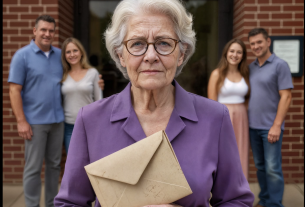
His mother, Nina Vasylivna, came with him.
Hanna had already stood up to go out and greet them when she heard her own name.
She remained standing where she was.
“So, what does your wife say?” her mother-in-law hissed from the hallway.
“She’s dug her heels in. Says if she buys it, it’ll only be in her name.”
“Clever little thing, isn’t she? Listen to me. Pressure her. Tell her you’ll throw her things out onto the stairs.”
Hanna stopped breathing.
“I never liked her,” Nina Vasylivna added casually, as though talking about the weather.
“Mom.”
“What do you mean, ‘Mom’?”
“I’ll try to push her tonight. The deal is the day after tomorrow. The seller is waiting.”
Hanna pressed both palms over her mouth.
She went to the window.
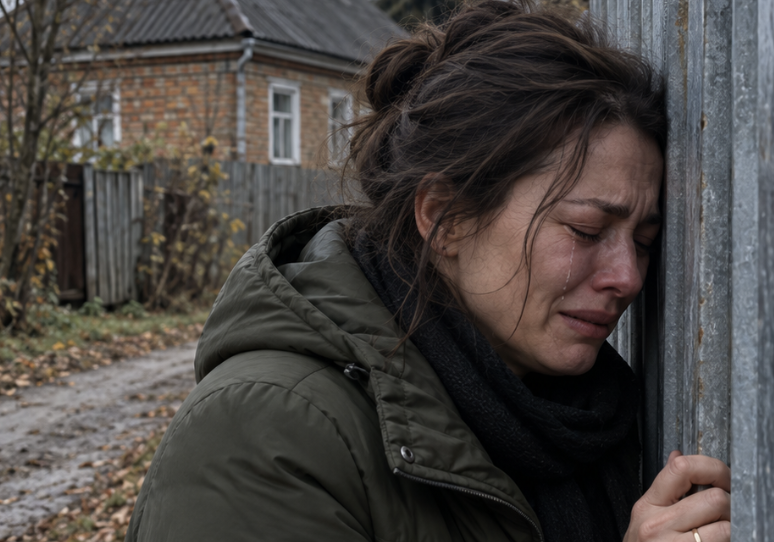
The tears did not come.
Instead, something inside her became flat and cold, like ice over a puddle.
She kept listening.
Memorizing.
The date of the sale.
The seller’s name.
The village.
After her mother-in-law left, Hanna went into the kitchen and put the kettle on.
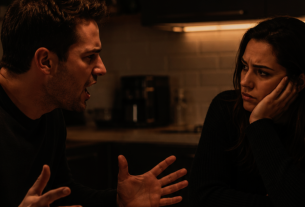
“So here’s how it’s going to be,” Oleh began from the doorway. “If you don’t withdraw the money tomorrow, pack your things and go to your mother’s. I’m not keeping you here. Understand?”
Hanna lowered her eyes.
“I understand. There’s no need to argue. I’ll do everything.”
He actually let out a sigh of relief.
“That’s more like it.”
That night, she sat in the kitchen with her laptop turned off, staring into the dark window.
At four in the morning, she sent one sentence to a realtor she knew:
“I need a house outside the city. I’m ready to start viewing tomorrow.”
In the morning, as soon as the door closed behind Oleh, Hanna opened the wardrobe.
It turned out they did not have many belongings.
Two suitcases.
Three bags.
One box of toys.
One box containing her father’s papers.
Eight years of life fit into the trunk of a moving taxi.
Maksymko sat on the floor in his jacket, holding his drawing.
“Are we going to Grandma’s?”
“To Grandma’s.”
“And then are we coming back?”
Hanna crouched in front of him and fastened the top button of his coat.
“And after that, we’re going to our home.”
Her mother met them on the porch in a village near Fastiv, wearing a headscarf, flour still dusting her hands.
“My girl… did he hurt you?”
“Worse than that, Mom,” Hanna said quietly. “But we won’t be here long.”
She found the house on the third day.
Beautiful.
Brick.
Pine trees behind the fence.
Its own well.
A new heating system.
The renovation had been finished the previous year.
It was an urgent sale: the owner had died, his children lived abroad, and they wanted to settle the property matter as quickly as possible.
Hanna recognized the photographs before she even read the address.
She said nothing.
She went there, walked around the yard, stood beside the well.
A lawyer checked the documents.
The notary set a date.
The inheritance was her personal property, and only one surname appeared on the ownership papers.
Hers.
For the first time in her life.
When she signed, her hand did not tremble.
A dog lived by the gate.
An old shepherd dog the late owner’s children had not taken with them. The neighbors fed him, and every morning he returned to the same place and waited.
“Brovko,” the neighbor said. “He’s been here since he was a puppy.”
Maksymko clutched his mother’s hand.
“Mom. He’s mine. From my drawing.”
Hanna looked at the dog.
The dog looked back at Hanna.
“He’s yours,” she said.
Oleh called.
He wrote messages.
He raged that she had “stolen their joint savings,” then begged, then went silent.
Two months later, she received a message:
“I want to see my son.”
Hanna sent him the address.
He arrived in November, in a cold drizzle.
He stepped out of the car, raised his collar—and froze.
In front of him stood the same house.
The same gate.
The same forest rising behind the roof.
Hanna came out to the gate.
She wore rubber boots, her mother’s old jacket, and her wet hair clung to her face.
Brovko sat beside her leg.
“Are you mocking me?” Oleh said hoarsely. “This is the one. I found this house.”
“You did,” Hanna agreed. “And the seller said the previous buyers never brought the money.”
“You bought it with our money!”
“With my father’s. He saved it in that notebook for eight years.”
Oleh stepped forward and stopped when the dog stood up.
“You planned all this.”
“No.” She adjusted her scarf. “I just overheard you talking to your mother.”
He turned pale.
Opened his mouth.
And found nothing to say.
“Maksym is asleep,” Hanna said. “He had a fever on Monday. The doctor said he needs bed rest. But you didn’t come here for him, did you? You came to look at the house that was supposed to become your mother’s country home. You’ve seen it now.”
The rain kept falling—fine, persistent, dreary autumn rain.
“Hanna…”
“Go home, Oleh.”
She closed the gate.
The lock clicked, short and dry.
She did not look back.
She walked along the path toward the porch, Brovko beside her, while somewhere upstairs, in the room with the little upper window, her son was sleeping.
That evening, Hanna went into his room.
Maksymko’s drawing hung above the bed, attached with tape: a house with a chimney, a tree by the porch, and a dog half the size of the roof.
She took the squared notebook out of the box.
She opened it to the first page, where her father had written in large block letters:
“FOR HANNA’S HOME.”
She ran her finger across his handwriting.
“There, Dad,” she whispered. “We did it.”
Down below the window, Brovko made a sleepy grumbling sound.
And for the first time in many months, Hanna drew a full breath—calmly, freely, with no one else’s lies inside her home.