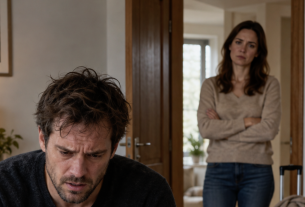
«Did you take my charger?» she called out from the hallway, but Ilya didn’t even look up from his laptop.
«Check the shelf,» he said.
«It’s not there.»
«Then I didn’t take it.»
This is how things went. There were no slamming doors, no broken plates. Just a question, an answer, and emptiness. And then silence again—a silence that thickened with each passing month, like jelly left untouched.
Anna found her charger by herself. It was under the coffee table, the place where Ilya tossed everything: old receipts, advertising flyers, the TV remote that no one had used in ages. She picked it up quietly, went into the room, and closed the door.
Ilya didn’t notice any of this.
They had lived together for seven years. They met at the architecture studio where they both started out—she drew facades, he made models. Back then, it felt right: same tastes, same books on the shelves, the same annoyance at open floor plans in new apartments. Then the studio shut down, and Ilya moved to a construction company—good money, boring work, hated deadlines. Anna stayed in architecture, scraping by on commissions, sometimes earning a third of what he made. They never talked about it. At some point, it just became a fact.
The apartment was his—or rather, his parents’, who had moved to Krasnodar and left their three-bedroom place on Petrogradskaya. Anna lived there without being registered, without a lease, without her name on the mailbox. It seemed like a small thing. But small things are like cracks in plaster: you don’t notice them at first, and then one day you see the whole wall is covered.
«Mom called,» Ilya said one evening without looking up from his phone. «They want to come for two weeks in June.»
«Okay.»
«I told them the room is free.»
Anna looked up from her sketchbook.
«Which room?»
«Well, yours. The office. There’s a sofa in there.»
«Ilya, all my drawings are in there. My tablets, my printer…»
«Just put them somewhere else.»
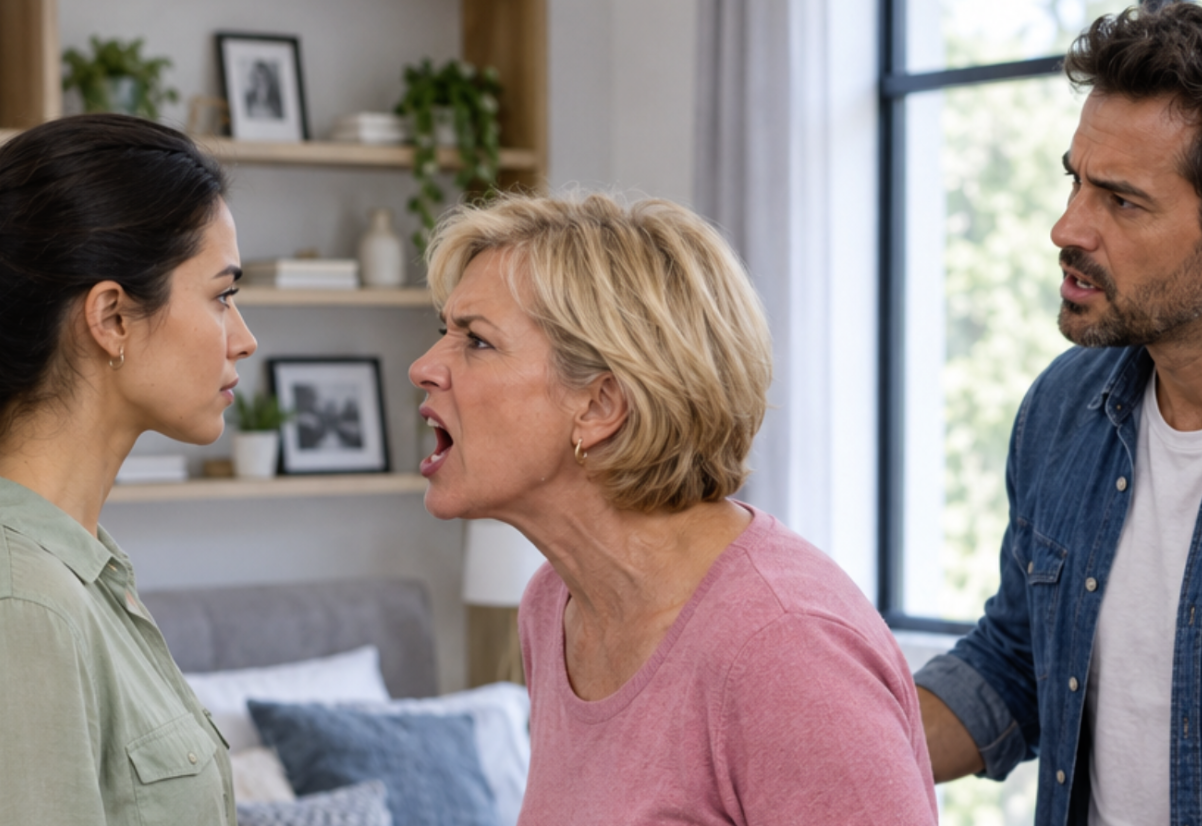
So she did. Packed everything into big bags, shoved them under the bed and into the closet. Ilya’s parents arrived and ended up staying for twenty days, not two weeks. His mother, Valentina Sergeyevna—a woman with a wasp waist and the look of a tax inspector—immediately made it clear who the temporary guest in the house was.
«Anya, how long have you two been together?» Valentina Sergeyevna asked on the third day, looking Anna over as if she were deciding whether to buy or shop for something cheaper.
«Seven years,» Anna replied.
«Seven years?» Valentina Sergeyevna repeated with a smile that held no warmth. «And still nothing?»
At that moment, Ilya was washing the dishes and pretended not to hear.
When his parents left, Anna pulled the bags out from under the bed. One of her tablets was scratched—someone had put a suitcase on it. She didn’t say anything. She just took a photo of the scratch and put her phone down.
Maybe that’s when something quietly switched inside her. It didn’t break—nothing snapped. It just shifted. Like a relay switching with no sound, no spark. Suddenly, the wiring changed.
No one noticed. Least of all Ilya.
He hadn’t noticed a lot lately. He didn’t see that she’d stopped suggesting watching something together in the evenings. He didn’t notice she was staying late at the workshop—a small rented space in Kolomna shared with a few young architects. He didn’t see that she was eating at home less and less.
Then Roman appeared in her life.
Not in a romantic way—at least, not at first. Just someone who sat down next to her at the workshop one day, looked at her sketches, and said:
“These are impressive. Why aren’t you entering the competition?”
“What competition?”
“The city one. The riverfront renovation. Deadline’s in a month.”
Anna had never even heard of the competition. That’s because Ilya, having received an email to the old shared inbox they almost never used, just deleted the message. Not out of spite. He just didn’t think twice. It wasn’t his field, not his interest.
Roman showed her the link. She opened it, read the terms—and for the first time in months, she felt something inside wake up. Not euphoria, just interest. Real, alive, with no sense of obligation.
They worked evenings, sometimes until one in the morning. Roman was blunt, sometimes unbearable, argued loudly and didn’t give in just to be polite. But he listened. It felt strange—being truly listened to.
Ilya, when she came home late, would ask:
“That workshop again?”
“Yeah.”
“Do you even eat there?”
“I eat.”
And that was it. The conversation would close, like a folder on a desktop.
She didn’t win the competition. She got third place—no cash prize, but her work was published in a professional journal and she received an offer from a small firm on Vasilievsky. Not huge money. But it was hers. Something of her own.
She told Ilya about it over dinner.
“Third place,” he repeated. “Well, not bad.”
Not bad. She looked at him and thought: he won’t even ask what the project was about. He won’t ask what the firm is called. Won’t ask how she feels.
And he didn’t ask.
She organized the move herself, all in one day—rented a small van, called two friends, and by evening there was nothing left in his apartment except faint traces on the shelves—light squares where her books once stood.
No note. No phone call. Just—her things were gone.
Ilya came home at half past eight. He took off his shoes in the hallway, walked to the kitchen, put on the kettle. Opened the fridge. Took out a container of food. Everything was as usual.
Then he went into the room—and stopped.
The shelves were empty.
He stood for a moment, looked around, as if expecting to find some explanation on the wall. Then he took out his phone and texted her: “Where are you?”
Three dots blinked—and disappeared. There was no reply.
The kettle boiled in the kitchen. Ilya didn’t go to turn it off. He sat on the bed, staring at the white rectangles on the shelves—marks left by books that were no longer there—and for the first time in many months he felt something like confusion.
Not grief yet. Just—emptiness. The very emptiness he’d failed to notice for so long, until it became impossible to ignore.
For three days he waited for her to call.
It wasn’t because he missed her—no, he hadn’t even realized yet exactly what he had lost. He was just used to things working themselves out somehow. They’d argue, then make up. They’d break up, then get back together. Life always found a way to return to normal, and Ilya believed that with the calm confidence of someone who had never truly been left before.
On the fourth day, he messaged her again: “We need to talk.”
She replied two hours later, a short response: “Not now.”
Not now. He reread it twice. What does that mean—not now? Then when? He started typing a reply, erased it, typed again—and put the phone aside. He decided he would wait. She’d calm down, come back, and they’d talk about everything properly.
He knew how to wait. It was a talent he felt proud of, even though, in truth, it was just convenient—waiting was so much easier than taking action.
His mother called on the fifth day. Valentina Sergeyevna had an uncanny sense for someone else’s trouble.
“Ilyush, how are you both doing?”
“We’re fine.”
“And Anya?”
There was a pause, just a second too long.
“She left,” he finally said.
“Left? Where did she go?”
“For good.”
Silence. Then—Ilya could almost hear how his mother was holding back a satisfied tone:
“Well… maybe it’s for the best, Ilyush. Seven years and nothing has changed. That’s not normal.”
“Mom, please stop.”
“I’m just saying. The apartment’s nice, you’re a good man, you have a job. You’ll find someone serious. Verochka, Lyudmila Pavlovna’s daughter, she’s available…”
He said goodbye and hung up the phone.
Verochka. Dear God.
At work, Ilya had a colleague—Denis, a burly man in his mid-forties, twice married and therefore saw himself as an expert in all things personal life. When Ilya, not even knowing why, mentioned over lunch that there were “some problems at home,” Denis immediately perked up.
“She left?”
“Yeah.”
“On her own?”
“On her own.”
Denis nodded like a doctor who’d made his diagnosis even before the examination.
“So there’s someone else. They never leave without a reason, Ilya. There’s always someone else.”
“No, there wasn’t anyone else.”
“Well, if you say so,” Denis replied and grabbed his fork, as if closing the topic.
Ilya headed back to his office and sat down at his desk. Denis was talking nonsense, of course. Anna was… she was a serious person. She wouldn’t do something like that…
Roman. The name popped into his head by itself. She had mentioned him a few times—a colleague from her studio, helped her with a competition. Ilya hadn’t paid attention then. Now, he realized he knew nothing about this man. Nothing at all.
He opened her profile—they followed each other, though both rarely posted anything. Her last post was three weeks ago—a photo of a sketch, no caption. He scrolled down. Tags, reposts, other people’s projects…
And then—a photo. The studio, a few people around tables, laughing. Anna’s in the right corner, head tilted back a little, laughing too. Next to her—a tall guy with dark hair, his hand on the back of her chair.
Ilya closed the app.
Then he opened it again. Looked once more. Closed it.
He had no plans to go anywhere. Honestly. Yet on Saturday morning, he somehow found himself on Vasilievsky Island—supposedly running errands, just passing by—and his feet led him to that bureau, the name of which he actually remembered, even though he pretended not to be paying attention back then.
A small mansion tucked in a side street, a wooden sign, and large windows. He stopped across the street and stood there for about three minutes, unsure what he was even planning. Go inside? Say what? ‘Hi, I’m Ilya, the ex. Just came to see what you’ve found here’?
«Are you looking for someone?»
He turned. On the porch stood a man—the same one from the photograph. Tall, wearing an unzipped jacket, holding a coffee cup. He looked at Ilya without hostility, just curiously observing.
«No,» Ilya said. «I’m just…»
«Are you Ilya?»
A pause.
«She told me about you?»
Roman squinted a little.
«A bit. Enough.»
They stared at each other for several seconds. Then Roman took a sip of coffee and said calmly, without any challenge, which somehow felt worse than if it had been a challenge:
«She’s not here right now. And if you want to talk to her, text her. That’s her call, not mine.»
Ilya nodded. He turned and headed back to the metro.
Inside, something was slowly and unpleasantly turning over. Not even jealousy—something else. It felt like he’d come to where his house once stood, only to see someone else’s tree growing there now. And the tree had done nothing wrong. It had just—grown.
That evening, he finally called her. She picked up—he hadn’t expected that, so he stayed silent for a few seconds.
«Hello,» he said at last.
«I’m listening,» she replied. Her voice was calm. Not angry, not cold. Just even, like someone who’d already made up their mind.
«I was at your bureau today.»
A pause.
«Why?»
«I don’t know.» That was honest, and even he was surprised by his honesty. «I really don’t know. Anna, at least explain to me…»
«Explain what, Ilya?»
«Why it was like this. No conversation. Just your things—and that’s it.»
She was quiet for a moment. Then she said, softly, with no strain in her voice:
«I did talk. I talked for seven years. You just didn’t hear me.»
Dial tone.
He sat there with the phone in his hand, staring out the window. Outside, the sky was growing dark, somewhere below the city was making its usual, indifferent noise, busy with its own life. And suddenly Ilya realized: he didn’t even know where she lives now. Didn’t know who she’s with. Didn’t know if she’s happy.
And the strangest thing—he hadn’t known these things before, either. Back then her things filled his shelves, and it had seemed like that was enough.
Two weeks went by
Ilya lived alone in the apartment—and for the first time really felt what that word meant. Not bachelor freedom, not long-awaited space. Just—a void that wouldn’t go away, no matter how much he turned on the TV.
He started noticing odd things. Like it was always her who bought the coffee he liked, the one with a caramel taste. She was the one who called the repairman when the faucet broke. She remembered when to change the filter in the kitchen hood—and would just do it without saying a word. All of this had been part of his life, as natural as air—unnoticed, assumed—until it was gone.
At work, Denis looked at me with sympathy and kept suggesting we should go out somewhere. Ilya always refused—not because things were good, but because the last thing he wanted was to sit in a bar and listen to someone else’s theories about why women leave.
His mom called again on Friday night. This time, she had some news.
«Ilyush, here’s the thing… Do you remember Uncle Grisha?»
Uncle Grisha was a whole story in the family. Grigory Semyonovich, my father’s brother—a loud man with three marriages behind him and an unshakeable belief that everyone owes him something. He lived in St. Petersburg and we only saw each other rarely—which Ilya was honestly fine with.
«I remember. What about him?»
«He wants to stay with you for a while. Just temporarily. Something’s going on with his apartment…»
«Mom.»
«Ilyush, he’s still family. Two weeks. That’s all.»
Ilya closed his eyes.
Uncle Grisha arrived the next day, hauling two huge suitcases and his third wife, Lyuda—a quiet woman in her mid-thirties with keen eyes and a habit of touching other people’s things without asking. She headed straight to the kitchen, opened every cabinet and asked,
«Why do you have so little food?»
«Because I live alone.»
«You should eat properly,» she said in a tone that brooked no argument.
Meanwhile, Uncle Grisha had already settled into an armchair and turned on the TV.
«Nice place,» he declared. «I’ve always said Petrogradskaya is the spot. So, did Anya move out? Good, it was dragging on anyway…»
«Uncle Grisha,» Ilya asked, «do you want something to eat after your trip?»
Two weeks stretched into three. Uncle Grisha was the kind of man who always found reasons not to rush. Papers weren’t ready, or «we need to wait until Tuesday», or «the realtor moved the meeting». Every time Ilya came home, the television could be heard from the hallway.
One evening, he walked into the kitchen and found Lyuda had emptied the bottom drawer of the table—the same spot where Anna kept receipts, old postcards, little trinkets. Now everything was neatly stacked on the table.
«What are you doing?» he asked, a tense note creeping into his voice.
«Tidying up. There was so much junk here…»
«It’s not junk.»
«See for yourself,» she said, nodding at the stacks. «Receipts from two years ago, some random scraps of paper…»
Among the papers was a postcard. Small, simple—a little house among trees. Anna had brought it back three years ago from some town she’d visited alone for the weekend. He couldn’t go; he’d had urgent work. She came back with that postcard and said, «It was so nice there. We need to go together.»
They never did.
He picked up the postcard, gripped it tight, and walked out of the kitchen.
The next day, he wrote to her. Not a «we need to talk,» just: «How are you?»
She didn’t reply right away. Three hours later: «I’m fine. Settling in.»
«Where are you living?»
«Rented a studio at Petrogradskaya. Ironic, huh.»
He chuckled—didn’t expect that himself. Wrote back: «Uncle Grisha’s living with me.»
Pause. Then: «My condolences.»
It was almost like old times. Almost.
He stared at the screen, thinking: there she is, just two blocks away, settling into her new rented studio. She’s starting her new life. And he wasn’t afraid for her—not at all. It was obvious she’d be fine. What scared him was something else: that she’d thrive without him. That one day, a year from now, he’d stumble across her article in some journal, her name right at the top of the list—and there’d be no mention of him. No context, just her.
Just her name. On its own. Standing apart.
Uncle Grisha left in the middle of November—just as unexpectedly as he appeared, saying that ‘everything worked out.’ Lyuda packed her bags in forty minutes, so deftly that Ilya started to suspect she’d actually been ready to leave for a while, just waiting for the signal.
The apartment was empty again.
Ilya walked through the rooms. He straightened a chair. Picked up a stray bag Uncle Grisha had left on the floor. He stepped into the workspace—the one where her tablets and printer used to be. Now, it was just empty. White walls, a windowsill, dust in the corner.
He took out the postcard with the little house. Set it on the windowsill, leaning against the glass.
He stood there for a moment, just looking.
Then he picked up the phone and dialed her number. Not a message—he actually called. She answered on the third ring.
‘Hello.’
‘Anna. There’s something I want to say. Not so you’ll come back—I know that’s not going to happen. Just… you talked for seven years, and I never heard you. That’s true. I’m not making excuses.’
She was silent. He went on:
‘I found the postcard with the house. The one you brought from Luga. We never did make it out there together.’
‘No,’ she said softly. ‘We never did.’
‘I’m sorry.’
The pause dragged on. Outside, the city buzzed; somewhere, a front door slammed.
‘I hear you,’ she finally said. ‘Thank you for calling.’
And she hung up.
Not harshly. Not angrily. Just—done.
He stayed by the window, phone still in his hand. Outside, the sky over the Petrograd Side was getting dark—some window glowed two blocks away. Maybe it was hers. Maybe not.
Ilya put the postcard back on the windowsill.
Tomorrow he needs to buy coffee. The kind he actually likes—something he still hasn’t figured out. For seven years, she just knew, and he never asked. Now he’ll have to find out for himself.
It seemed like such a small thing, almost nothing at all. But, somehow, that’s what hurt the most.
January arrived suddenly—cold, without warning.
Ilya walked down Bolshoy Prospekt, turned up his collar, stuffed his hands in his pockets. He just walked—no purpose, just to avoid sitting at home in a silence that, by now, didn’t feel foreign, but his own. He was starting to get used to it—slowly, in spite of himself, but getting used to it.
He stopped at the window of a small coffee shop. Walked in.
He took a cup, stepped over to the window, and looked out at the street. People hurried by—moving fast, caught up in their own lives, not caring about anyone else.
And suddenly—he saw her.
Anna was walking on the other side of the street. In a familiar coat, a big bag slung over her shoulder—probably full of tablets. She was alone. Walking with her head down, lost in her thoughts, her expression focused and calm—the face of someone who knows exactly where she’s going.
Ilya didn’t go out. Didn’t tap on the glass. Just watched.
She walked past, never lifting her eyes. Disappeared around the corner.
He finished his coffee—and finally realized exactly what kind he liked. No caramel. Just strong, plain coffee.
Who would’ve thought? It took seven years to figure that out.
He smirked quietly to himself and stepped outside. The frost hit his face, sharp and honest. Ilya paused for a moment, taking a deep breath of the cold air.
Then he buttoned up his coat and kept walking.